

Current job listings show dozens of open positions across the country, illustrating the wide range of culinary career opportunities in UAE. Roles include commis chef, chef de partie, sous chef and head chef, with paths in both kitchen and front-of-house teams. A culinary career can start with practical support work or entry-level food preparation and develop into a specialist or leadership role.
Choosing a direction takes more than an interest in cooking. Understand what each role involves, how responsibilities grow, and which practical skills can support your next step. This guide maps key culinary career opportunities in UAE, explains how kitchen roles differ from guest-facing work, and shows how focused training can build a practical foundation. Whether you’re entering the industry or aiming to advance, use it to match your interests and skills with a suitable path.
Key Takeaways
- Compare kitchen roles, from entry-level preparation to specialist and leadership positions, to identify a realistic starting point.
- Consider whether your strengths suit kitchen work or guest-facing roles, since each path calls for different skills.
- Build practical culinary skills that support progression and help you contribute confidently in a professional kitchen.
- Use focused culinary training to strengthen your foundation before pursuing roles that match your interests and experience.
Culinary career opportunities in UAE
Culinary careers in the UAE span food preparation, specialist cooking, kitchen supervision, and restaurant management. Compare roles by their daily duties, required skills, and potential next steps. Job listings offer a snapshot of current openings, but your direction should also reflect whether you prefer hands-on cooking, team coordination, or guest service.
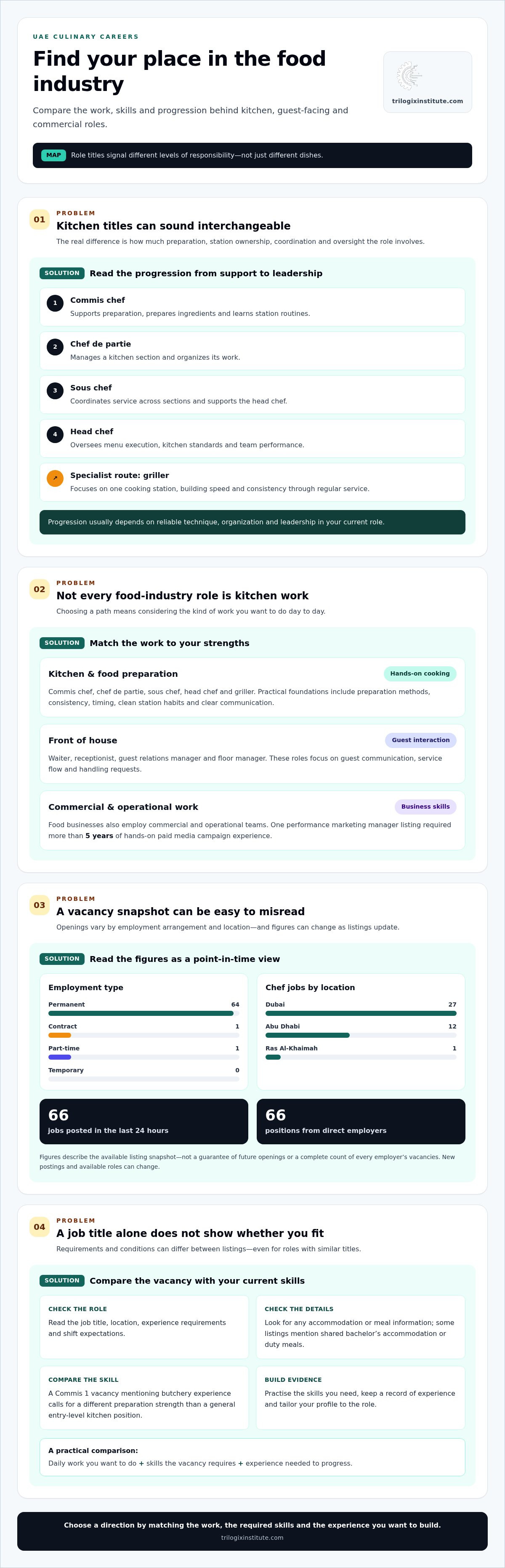
Kitchen teams often follow a defined progression. A commis chef supports preparation and learns station routines; a chef de partie manages a kitchen section; and a sous chef coordinates service while supporting the head chef. A head chef oversees menu execution, kitchen standards, and team performance. A griller may focus on one cooking station, building speed and consistency through regular service.
These titles signal different levels of responsibility, not just different dishes. A commis chef might prepare ingredients and follow a station plan, while a chef de partie organizes the work for that section. A sous chef communicates across sections during service. Progression usually depends on showing reliable technique, organization, and leadership in your current role.
Job listings also reveal varied employment arrangements. UAE chef listings include 64 permanent positions, alongside 1 contract position and 1 part-time position. They show 0 temporary positions. These figures describe the listings available in the provided snapshot, not a guarantee of future openings or a complete count of every employer’s vacancies.
Location can shape a search. The listing snapshot shows 27 chef jobs in Dubai, 12 in Abu Dhabi, and 1 in Ras Al-Khaimah. It also shows 66 jobs posted in the last 24 hours and 66 positions from direct employers. Treat those figures as a point-in-time view; new postings and available roles can change.
Pay varies by position and listing. Some listings describe shared bachelor’s accommodation, and some include duty meals. Treat these as examples, not a standard pay scale for every UAE kitchen.
Before comparing a salary, read the entire vacancy. Check the job title, location, experience requirements, shift expectations, and any accommodation or meal details. A Commis 1 role mentioning butchery experience, for instance, calls for a different preparation strength than a general entry-level kitchen position. Compare responsibilities with your current skills, then identify what you need to practise.
Not every food-sector career takes place behind a stove. FoodFund International identifies waiter, receptionist, guest relations manager, and floor manager as front-of-house roles. These jobs focus on guest communication, service flow, and handling requests. If you enjoy interaction and coordination, a dining-room role may suit you better than station-based kitchen work.
Restaurant businesses also need commercial and operational teams. A performance marketing manager role requires more than 5 years of hands-on paid media campaign experience. These examples show how food businesses can employ people beyond culinary production.
For a kitchen-focused path, build practical evidence of your skills. Learn core preparation methods, then practise consistency, timing, clean station habits, and clear communication. Keep a record of your skills and experience so you can describe what you can prepare and where you have worked. Tailor each application to the role rather than sending the same general profile everywhere.
Changes across the wider industry may also create different kinds of work. The Food and Agriculture Organization of the United Nations (FAO) links innovation and circular-economy approaches in agrifood systems with new job opportunities. The International Organization for Migration (IOM) identifies tourism and services as Gulf sectors with potential for future employment. These perspectives point beyond restaurant kitchens to food systems and hospitality services.
To choose a direction, compare three factors: the work you want to do each day, the skills vacancies require, and the experience needed to progress. If you are drawn to cooking, consider commis roles and practise station skills. If guest interaction is a strength, explore front-of-house positions. Commercial roles may suit candidates with relevant sales or marketing skills.
Trilogix Institute: TTI Dubai Foundation Electrical Engineering
Trilogix Institute offers TTI Dubai Professional Culinary Arts for learners developing practical skills for kitchen roles. If you want to prepare for commis work or strengthen your culinary foundation, instructor-led training with hands-on practice can give your learning structure. Use the roles above to identify techniques and areas of practice that align with your goals.
Choose the course that fits the career path you want to pursue. TTI Dubai Foundation Electrical Engineering, TTI Dubai Advanced AutoCad 2D & 3D, and TITP Beginner Essential Industrial Motor Control serve different technical interests, while Professional Culinary Arts is the relevant option for culinary training. Training can support skill development, but it does not replace the experience and performance employers assess in hiring.
Contact Trilogix Institute to discuss TTI Dubai Professional Culinary Arts and your learning goals.
Turn Your Culinary Ambition Into a Clear Next Step
A strong career direction starts with a deliberate choice: decide what kind of work you want to be known for, then build your skills around it. Culinary career opportunities in UAE span varied working environments and responsibilities, so focus on a path that suits your strengths and the experience you want to gain. Set a practical learning goal, identify the skills to develop, and use that plan to guide your next move.
Training can give structure to that process by helping you practise techniques and strengthen your foundation before pursuing a role. Trilogix Institute offers TTI Dubai Professional Culinary Arts, alongside technical courses for learners pursuing other fields. Explore the available training and consider how it aligns with your career direction. Contact Trilogix Institute to take the next step in planning your learning. A focused decision today can help you move toward a career path with purpose and confidence.


