
An electrical systems troubleshooting course can suit facility technicians and other staff who need to identify electrical faults and support safe maintenance in industrial or commercial facilities. A five-day electrical maintenance and troubleshooting course is designed to help non-electrical personnel diagnose industrial faults and carry out repairs or replacements safely.
Keeping equipment running takes more than reacting when something stops. Teams need a clear method to test components, trace likely causes and decide when a fault needs escalation. Effective training connects these practical tasks with safe, repeatable work habits.
This guide explains who should attend and what to expect, from fuse testing and motor troubleshooting to structured maintenance workflows. It also covers how training applies to facility power systems, what can shape a course’s format and cost, and how to choose a suitable option for your team’s experience and responsibilities in the UAE.
Key Takeaways
- Identify how switchgear, motor control centres and protective devices work together to support facility power distribution.
- Learn what crisscross voltmeter testing can reveal about a suspected fault in three-phase fuses.
- Build a systematic approach to motor troubleshooting by considering symptoms, operating conditions and possible fault sources.
- Use clear safety and maintenance workflows to guide inspections, fault diagnosis and decisions about escalation.
- Assess whether this training suits your role, from hands-on facility technicians to non-electrical personnel who encounter industrial equipment faults.
Switchgear, motor control centres and protective devices
Switchgear controls, isolates and protects electrical equipment, while a motor control centre groups equipment used to operate motors. A facility technician might trace a pump supply from a switchboard feeder to an MCC bucket, then identify the contactor, overload relay and outgoing circuit. Understanding how these components connect helps narrow a fault to the supply, control path or motor. A tripped protective device is a symptom to investigate, not a reason to keep resetting the circuit without finding the cause.
Single-line diagrams show the main power path using simplified symbols. Control-system drawings show how devices such as push buttons, auxiliary contacts and coils interact. Start at the affected load and trace upstream through its feeder and protective devices. Compare the drawing with equipment labels and observed conditions: an outdated drawing or mismatched label can lead faultfinding in the wrong direction. For example, if an MCC motor won’t start, the diagram can show whether its control circuit depends on a local stop button or an interlock from another machine.
Useful clues include a tripped breaker, blown fuse, contactor that doesn’t pull in, or control relay that changes state unexpectedly. Treat each as evidence to investigate. Record the affected device, what the operator observed, and whether the fault occurs during starting, running or stopping. These details help distinguish a power-side issue from a control-circuit fault without assuming one failed component explains every symptom.
A logical control-circuit investigation follows the drawing and tests one point at a time. First, define the symptom, such as a conveyor that won’t start from its station. Then identify the control supply, stop and start devices, interlocks, overload contact and contactor coil shown on the drawing. Check each component in sequence using methods appropriate to the equipment and the worker’s training. If the start command reaches the coil but the contactor doesn’t operate, the evidence points to the coil or its connection. If it doesn’t, trace backward through the control path.
AC and DC motors require different fault considerations. For an AC motor in an MCC, symptoms such as humming, failure to start or repeated overload trips can direct attention to the supply, load, connections or control components. A DC motor has its own control and connection arrangement, so use its specific drawings rather than assuming AC procedures apply. A practical training course should connect switchgear, protective devices, diagrams and motor controls through worked fault scenarios. This builds a repeatable method: identify the affected circuit, follow its documented path, assess the evidence and determine the appropriate next action.
Practical examination 1 contributes 20% of the overall mark, practical examination 2 contributes 30%, and practical examination 3 contributes 40%; the skills demonstration contributes 10%.
Crisscross voltmeter testing of three-phase fuses
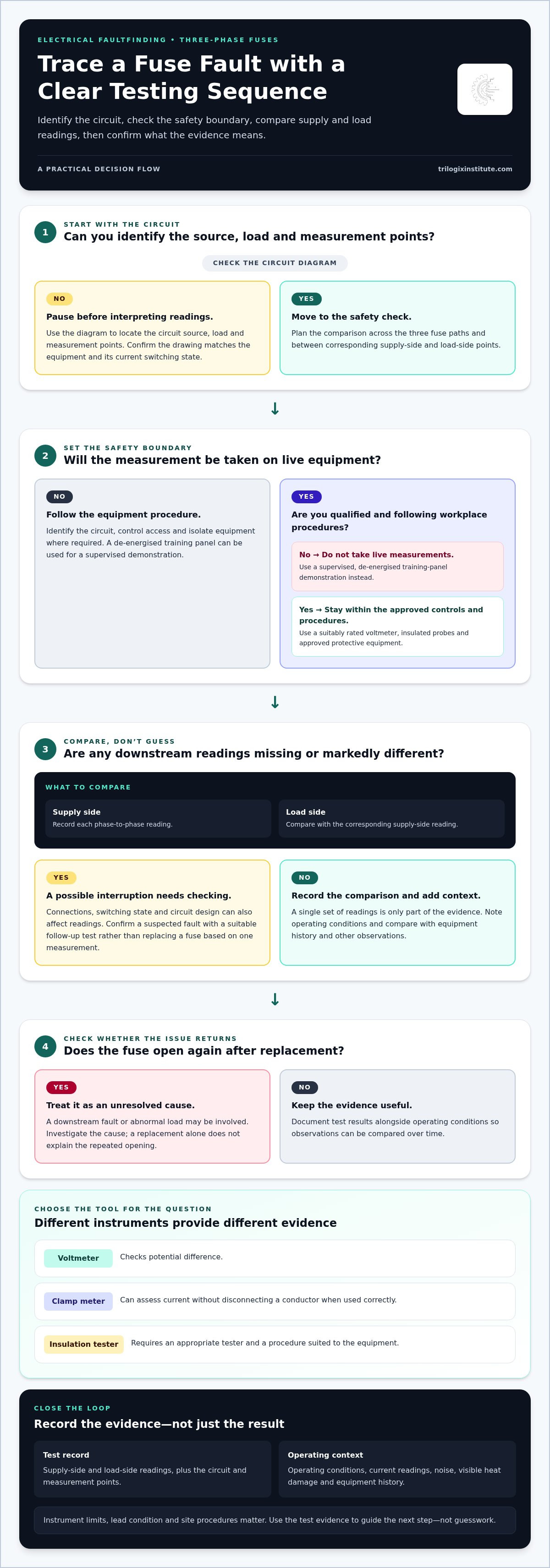
Electrical testing tools can include a suitably rated voltmeter, insulated probes and approved protective equipment. Safe procedures start with identifying the circuit, controlling access and isolating equipment where required. Live measurements are for qualified personnel following workplace procedures. Training should explain instrument selection and safe testing boundaries before participants take measurements.
Crisscross voltmeter testing compares readings across the three fuse paths and between corresponding supply and load points. The aim is to identify an imbalance or open fuse, not rely on a single reading. In a supervised exercise, an instructor can use a de-energised training panel to demonstrate probe placement and explain how readings change when one fuse path is open. Testing live equipment requires appropriate competence, controls and site procedures.
Before interpreting readings, identify the source, load and measurement points on the circuit diagram. Record each phase-to-phase reading on the supply side and compare it with the corresponding load-side reading, using the meter as directed by the equipment procedure. A missing or markedly different downstream reading may indicate an interruption, but connections, switching state and circuit design also affect results. Confirm a suspected fault with a suitable follow-up test rather than replacing a fuse based on one measurement.
Condition monitoring adds context to electrical testing. A technician may compare current readings, operating noise, visible heat damage and equipment history to identify a developing problem. For example, a fuse that opens again after replacement points to an unresolved cause, such as a downstream fault or abnormal load. Record operating conditions alongside test results: isolated readings are less useful than comparable observations over time.
Electrical testing also depends on choosing the right tool for the question. A voltmeter checks potential difference, while a clamp meter can assess current without disconnecting a conductor when used correctly. Insulation testing requires an appropriate tester and a procedure suited to the equipment. Participants should learn instrument limits, how to check lead condition and how to document results. These practices make testing evidence-based rather than guesswork.
Ask what practical exercises, assessment methods and certificate arrangements a training course includes. A useful programme links demonstrations with supervised practice and explains how results guide next steps. For learners building electrical fundamentals, structured electrical engineering coursework can provide a route into core concepts before more specialised measurement tasks.
Electric motor maintenance and troubleshooting
Motor troubleshooting starts by connecting the reported symptom to the machine’s operating conditions. For an AC machine that hums but fails to turn, consider the supply, mechanical load, connections and starter circuit. A motor that starts and then trips its overload presents a different pattern. Record when the fault occurs and what changes before testing. This structured approach helps distinguish electrical causes from problems in the driven equipment.
How do courses compare by curriculum, hands-on training and accreditation? Compare coverage of motor principles, testing, wiring and fault diagnosis, then consider how much practice involves equipment or case exercises. Accreditation and awards are separate considerations, so check the named awarding body and the exact qualification attached to a programme.
For a three-phase induction motor, learning should connect its nameplate and wiring diagram to the actual installation. Participants can practise tracing the supply through a starter, inspecting terminal connections and identifying the motor’s winding arrangement from its documentation. The right test depends on the motor design and test method. Interpret measurements alongside the observed symptom rather than treating them as an isolated pass-or-fail answer.
A three-phase motor starter typically combines a contactor, overload protection and control devices. Use its diagram to trace the start command, stop path and coil circuit. If the contactor doesn’t engage, identify where the command stops before considering component replacement. Maintenance checks can also cover ventilation openings, signs of overheating, loose connections and unusual vibration. Keep findings specific to the motor and its operating history.
- Motors: Compare starting, running and stopping symptoms with the supply and load conditions.
- Heaters: Trace the control command and protective response when heating fails or stops unexpectedly.
- Actuators: Check whether the command reaches the device and whether its movement matches the process signal.
- Alarm devices: Establish whether the alarm indicates a process condition, a control fault or a failed signal path.
Are UAE troubleshooting courses available online, in person or in a hybrid format? Course enquiries list onsite, online and classroom modes. Hybrid delivery combines remote learning with in-person activities, so distinguish it from those listed formats when comparing course structure.
Do UAE courses provide certificates or recognized qualifications? A listed course award is QQI award 6N22488 in Electrical Troubleshooting of Machine Systems. An award identifier names a qualification, but doesn’t by itself establish its acceptance for every employer or purpose in the UAE.
An electrical systems troubleshooting course is most useful when its learning activities match the machines participants encounter. Compare motor-wiring exercises, fault scenarios and assessment methods, then consider how the curriculum covers related equipment such as heaters, actuators and alarms. This helps distinguish general theory from practice relevant to facility work.
Electrical safety and maintenance workflows
A safe maintenance workflow starts before anyone approaches a panel or machine. Define the task, identify the equipment and review its drawings. Then determine whether the work requires isolation or testing, and assign responsibilities to trained personnel. For example, a technician investigating a stopped pump should identify its supply, starter and connected process equipment before opening an enclosure. Clear planning helps prevent an uncertain fault from turning into uncontrolled work.
Machine safety depends on controlling every relevant energy source, not just switching off the main control. A conveyor may have an electrical supply, stored mechanical movement and an automatic start command from a control system. The isolation plan should identify these sources, communicate the equipment’s status and prevent accidental re-energisation under site procedures. Before maintenance begins, personnel need to establish that the equipment is in the required safe condition using the workplace’s approved process.
Protective systems such as fuses, circuit breakers and overload relays help limit damage when abnormal conditions occur. A tripped breaker is a finding to investigate, not a reason for repeated resets. Record the device, operating conditions and fault symptoms, then examine the circuit and equipment history. For example, a motor starter that trips during startup may point to a motor, load or supply issue. The protective device interrupts a fault; it doesn’t identify the cause.
Electrical troubleshooting should follow a logical sequence. Confirm the reported symptom, compare it with the control drawing, and choose checks appropriate to the task and the worker’s competence. A voltage measurement, for instance, can help locate an interruption in the supply path, but testing methods must match the equipment and site procedures. Stop and escalate if the circuit, expected condition or safe test method is unclear. Document the finding, action taken and remaining issue before returning equipment to service.
A practical maintenance record makes the next investigation more efficient. Note the asset identifier, observed condition, protective-device status, test results and work completed. If a fan repeatedly stops, compare operating conditions and inspection findings across reports instead of treating each visit as a new fault. Review those records during handover so the next technician understands what changed and what remains unresolved.
How long does an electrical systems troubleshooting course take? The electrical maintenance and troubleshooting course lasts five days. That allows a structured introduction to fault diagnosis and maintenance concepts, while the depth of practice depends on the programme’s exercises and delivery format.
For facility teams, the useful outcome is a repeatable workflow: plan the task, control machine energy, assess the fault, record evidence and communicate the next action. A training course should connect each step to equipment examples, such as a pump starter or distribution panel, so participants can apply the method to real maintenance responsibilities.
Electrical power systems in industrial and commercial facilities
In a facility, a fault at one load can affect more than the machine that stops. Electrical power follows an interconnected path from the incoming supply to distribution equipment, control panels and end-use loads. A technician investigating a dark office area, for example, needs to distinguish a local lighting-circuit fault from an upstream distribution issue. Mapping that path gives troubleshooting a clear starting point.
Industrial sites often connect electrical supply to production equipment, pumps, ventilation and automation controls. Commercial buildings may distribute power to lighting, lifts, cooling systems and tenant spaces. The symptoms differ, but the method is similar: identify the affected equipment, compare it with neighbouring loads, and interpret the relevant drawings and operating records. If several systems stop together, investigate shared supply components before assuming multiple independent failures.
Accurate electrical troubleshooting and repair support efficient operation and productivity in industrial environments. Practical techniques help teams connect a fault to its likely location. Trace the affected load back through its panel and feeder, note which protective devices have operated, then compare the evidence with the facility’s single-line diagram. For instance, a stopped production line and an unaffected nearby line may point to a branch circuit or local control issue rather than a site-wide interruption.
Good faultfinding combines electrical measurements with operating context. A reading is useful only when the technician knows where it was taken, what the equipment was doing and what the diagram predicts. A facility team can keep a consistent record of the asset identifier, symptom, operating state, device status and test result. Comparing that record with earlier maintenance findings can reveal recurring patterns, such as a fault linked to startup or a particular operating condition.
Industrial and commercial teams also need to understand how automation connects to electrical distribution. A control signal may stop a motor even when the power supply remains available; a protective device may interrupt a circuit after detecting an abnormal condition. Distinguishing these possibilities prevents a control fault from being mistaken for a supply failure. Training should connect diagrams, measurement techniques and realistic facility scenarios, then teach participants to explain how each finding supports their conclusion.
The practical takeaway is to troubleshoot from the system boundary inward: establish the scope, trace the documented power path, compare affected and unaffected loads, and interpret measurements in context. For structured learning that connects electrical fundamentals with workplace applications, explore practical electrical training.
Trilogix Institute: TTI Dubai Foundation Electrical Engineering
Trilogix Institute offers TTI Dubai Foundation Electrical Engineering for learners building a foundation in electrical engineering. It’s a relevant next step if you want structured technical learning before taking on more specialised electrical maintenance responsibilities. For a focused introduction to motor control, TITP Beginner Essential Industrial Motor Control is more directly related to industrial motor topics.
Choose according to your starting point and learning goal: foundation-level electrical engineering or beginner motor control. These offerings support the development of practical technical knowledge, rather than a university degree or a job placement guarantee.
Contact Trilogix Institute to explore which course best fits your learning goals.
Build the Next Step Into Your Team’s Development
Turn troubleshooting knowledge into a focused development plan. Identify the electrical tasks your team handles, the decisions they’re expected to make, and where stronger technical foundations could support their work. This gives you a practical way to judge whether an electrical systems troubleshooting course fits individual learners or a wider facility team.
Training is most useful when its focus matches the work ahead. A learner building core electrical understanding may need a different starting point from a technician developing motor-control skills. Trilogix Institute’s TTI Dubai Foundation Electrical Engineering offers a foundation-focused route for learners seeking to strengthen their electrical knowledge.
Use your goals to guide the next conversation: describe the skills you want to develop and the equipment or responsibilities that shape your learning needs. Contact Trilogix Institute about the course to discuss a suitable learning direction. A clear next step can help turn technical interest into purposeful progress.
Frequently Asked Questions
Who should Attend?
Facility maintenance technicians, plant operators and other staff who work around industrial electrical equipment can benefit. Training may also suit non-electrical personnel who need to recognise faults and understand when maintenance tasks require specialist attention. For example, a facilities supervisor coordinating a response to a stopped pump can use technical knowledge to describe symptoms clearly and support effective fault reporting.
What topics are covered in an electrical systems troubleshooting course?
An electrical systems troubleshooting course may cover investigating equipment faults, interpreting diagrams and connecting symptoms with possible causes. Topics can include motor behaviour, protective devices, testing methods and maintenance workflows. In practice, learners might study how a failed pump affects connected operations, then practise documenting the fault and communicating relevant findings. Review the curriculum for the specific equipment and exercises it covers.
Who is eligible to enroll in an electrical troubleshooting course in the UAE?
These courses can suit professionals, technicians, recent graduates and organizations seeking practical technical learning. The best fit depends on a learner’s current responsibilities and goals: a new entrant may want electrical foundations, while a maintenance worker may focus on understanding industrial motor control. Match the course level and subject matter to your experience, and consider whether the learning supports tasks within your role.
Which UAE providers offer electrical systems troubleshooting courses?
Trilogix Institute offers relevant technical training, including TITP Beginner Essential Industrial Motor Control. This suits learners seeking a foundation in motor-control concepts connected to industrial equipment. Since the offering focuses on motor control, compare its subject matter with your specific troubleshooting goals. Trilogix Institute also offers TTI Dubai Foundation Electrical Engineering for learners seeking broader electrical foundations.
What career paths and job opportunities can an electrical troubleshooting course lead to in the UAE?
The course can support facility technicians and other staff who identify electrical faults and assist with safe maintenance in industrial or commercial facilities. It is also designed to help non-electrical personnel diagnose industrial faults and carry out repairs or replacements safely.


