

A skills gap doesn’t automatically mean a capable technical team needs replacing. Upskilling my technical team means building on employees’ existing abilities and developing relevant skills to meet current and future work demands. Start by comparing the skills each role requires with the capabilities your team already has.
It’s understandable to want training to deliver practical value, not simply add another item to the calendar. A focused approach connects learning to real responsibilities, supports employees’ growth and gives them opportunities to apply new skills at work. This can strengthen productivity and engagement while supporting talent development and retention.
This guide explains what upskilling involves, how to identify skills gaps and how to shape training around your team’s needs and business priorities in the UAE. You’ll also learn how to track progress and where practical technical training can fit into a development plan.
Key Takeaways
- Define the capabilities your technical roles need, then compare them with employees’ current skills to pinpoint meaningful gaps.
- Prioritise learning that supports business goals and day-to-day responsibilities, and assess its value through changes in work quality and performance.
- Use employee input to shape development plans that build technical capability while supporting motivation and career growth.
- Choose upskilling when employees need to strengthen skills for their current or evolving roles; consider reskilling when the target role requires a different skill set.
- Connect training with practical application so employees can use new capabilities in their work and continue developing technical talent.
1. How do you upskill your team or employees more efficiently?
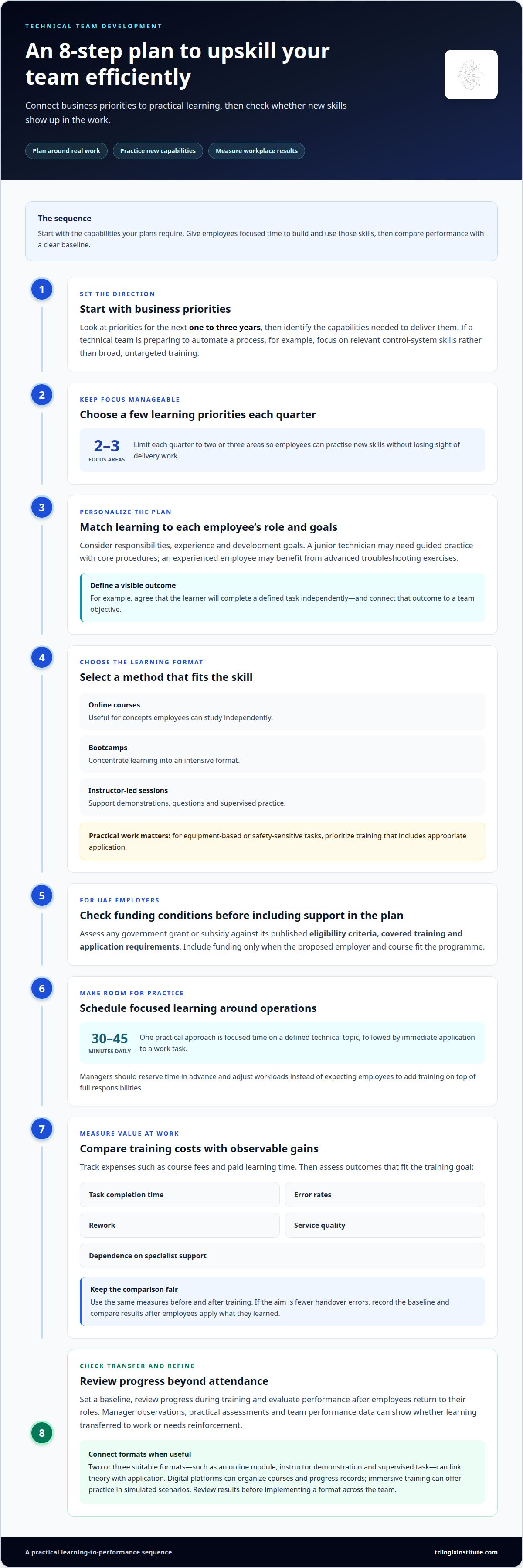
Begin with business priorities for the next one to three years, then identify the capabilities needed to meet them. A technical team preparing to automate a process, for example, may need stronger control-system skills rather than broad, untargeted training. Limit each quarter to two or three focus areas so team members can practise new skills without losing sight of delivery work.
Personalize learning by comparing each employee’s responsibilities, experience and development goals. A junior technician may need guided practice with core procedures, while an experienced employee may benefit from advanced troubleshooting exercises. Agree on a specific outcome for each learner, such as completing a defined task independently, and connect it to a team objective.
Choose between online courses, bootcamps and instructor-led training based on the skill and how it needs to be practised. Online learning suits concepts employees can study independently; bootcamps concentrate learning into an intensive format, while instructor-led sessions support demonstrations, questions and supervised practice. For equipment-based or safety-sensitive tasks, prioritize training that includes appropriate practical application.
For UAE employers, assess any government grant or subsidy against its published eligibility criteria, covered training and application requirements. These conditions determine whether support applies to a particular employer and course, so include funding in your plan only when the proposed training fits the programme.
Protect productivity by scheduling focused learning around operational demands. One practical approach is 30-45 minutes daily on a defined technical topic, followed by immediate application to a work task. Managers should reserve time in advance and adjust workloads, rather than expecting employees to add training on top of full responsibilities.
Measure return on investment by comparing training costs with observable workplace gains. Track expenses such as course fees and paid learning time, then assess relevant outcomes: task completion time, error rates, rework, service quality or dependence on specialist support. For example, if training aims to reduce handover errors, record the baseline and compare results after employees apply what they’ve learned. Use the same measures before and after training.
Track more than attendance. Set a baseline, review progress during training and evaluate performance after employees return to their roles. A manager’s observations, practical assessments and team performance data can reveal whether learning transferred to work or needs reinforcement.
Digital platforms can organize courses and progress records, while immersive training can provide practice in simulated scenarios. Delivering learning through two or three suitable formats, such as an online module, instructor demonstration and supervised task, helps connect theory with application. Select each format for its usefulness, then review results before implementing it across the team.
2. Assessing workforce skills gaps
Start with the work each role must deliver, not a catalogue of available courses. For a maintenance team, required capabilities might include diagnosing faults, interpreting technical drawings and documenting repairs. Compare those requirements with each employee’s demonstrated performance, then record where capability is strong, developing or missing. This creates a practical baseline for upskilling my technical team around actual job demands.
Use several sources of evidence to distinguish a skills gap from a temporary performance issue. Review work samples, quality reports, customer feedback, project outcomes and manager observations. If software users report recurring bugs or missing features, examine whether the cause involves technical knowledge, unclear requirements, outdated tools or another process problem before assigning training.
Assess technical skills alongside the behaviours that help teams deliver work. A practical skills map can cover technical competence, communication, leadership and collaboration. For example, an engineer may troubleshoot equipment independently but need practice explaining risks to colleagues. A team leader may understand technical procedures yet need stronger coaching skills to support junior staff.
There isn’t one technical skill ranking that applies to every UAE employer. Priorities depend on the sector, roles and systems in use. For a team operating automated equipment, assess control systems and fault diagnosis. For a software team, examine coding practices, security and the development tools used in current projects. These role-specific needs make upskilling my technical team more relevant than selecting training based on trends alone.
Emerging technologies can create future skills gaps before they affect daily output. Review planned projects, new systems and changing customer requirements, then identify the tasks employees will need to perform. If a business plans to introduce automation, assess whether technicians can operate, maintain and troubleshoot the relevant systems. Separate skills needed immediately from those needed for upcoming work.
Include employees in the assessment. Ask team members which tasks slow them down, where they need support and what responsibilities they want to develop. Pair their input with observed performance. Confidence alone doesn’t demonstrate competence, and a manager’s impression may overlook an employee’s strengths. Combining perspectives gives leaders a fuller view of current skills and potential.
Turn findings into a role-based gap analysis. For each capability, note the required standard, current evidence and the difference between them. Prioritize gaps by their effect on safety, quality, customer outcomes or upcoming business needs. A missing capability that blocks a critical task deserves attention before a secondary skill with little effect on current work.
Finally, match each gap to a suitable development response. A knowledge gap may call for structured learning, while limited practical experience may require supervised work or coaching. Revisit the assessment after employees apply what they’ve learned, using the same task standards or performance measures to determine whether capability has improved.
3. Employee satisfaction, productivity, and retention benefits
Training can deliver value beyond new technical capability when employees see how learning connects to their work and future. According to the Workplace Learning Report 2024, eight in 10 people feel learning adds purpose to their work. That sense of purpose can matter when employees face demanding projects, changing tools or limited opportunities to grow in their current roles.
Productivity is strongest when training addresses a real work challenge. A LinkedIn study found effective employee development can boost performance by up to 25%. Separately, 91% of companies and 81% of employees said upskilling and reskilling training boosted productivity at work. Treat these findings as context, then assess your own team through relevant measures such as work quality, task completion and fewer repeated errors.
Retention is linked to more than training access. Employees need to see a path from learning to meaningful responsibilities. Forty-five percent of employees said they’re more likely to stay in their role if they receive more training. Internal mobility matters too: companies that excel at it retain employees for an average of 5.4 years, compared with 2.9 years at companies that struggle with it.
Make development visible by recognizing effort and its application. A manager can acknowledge an employee who completes a technical course, then give that person a suitable task to demonstrate the new skill. Recognition can take the form of specific feedback, peer knowledge-sharing or added responsibility. Tie praise to evidence, such as improved troubleshooting or clearer handovers, rather than course attendance alone.
Employees also need realistic conditions to learn. When training is added to a full workload, it can feel like another demand instead of a development opportunity. Managers should agree on protected learning time, adjust priorities where needed and schedule opportunities to practise. For example, after a technician learns a new diagnostic process, assign a relevant job with appropriate support and review what worked.
Track satisfaction, productivity and retention as related but distinct outcomes. Ask employees whether learning supports their career goals, and compare responses over time. Review operational indicators alongside feedback, because improved output alone won’t show whether employees feel supported. If course completion rises but skills aren’t used, connect learning to real assignments; if turnover remains high, examine whether employees can grow into new responsibilities.
Recognition works best when it is fair, timely and connected to contribution. Leaders can highlight individual progress in team discussions while also acknowledging colleagues who coach others. This reinforces shared success, helps employees see how their effort supports team outcomes and makes development part of the working environment rather than a one-off event.
4. Tech upskilling and its role in developing technical talent
Technology changes can leave capable employees without the skills required for new tools, systems or development practices. Targeted learning helps technical talent adapt while preserving valuable knowledge of existing workflows. For example, a developer familiar with a company’s software can build capability in a new framework and apply it to an active project.
Decide between development and external hiring by comparing the required capability with what the team can realistically build. Upskill employees when the gap is trainable and their existing knowledge remains valuable. Recruitment may make more sense when a role requires expertise the team lacks and upcoming work cannot wait for a learning pathway.
Use a capability review to make that decision specific. Identify the task, required proficiency and deadline, then assess employees’ current performance and learning goals. If a team needs stronger cloud security, for example, distinguish foundational knowledge from advanced architecture skills. That distinction helps leaders determine whether training, recruitment or a combination can meet the need.
Turn development into a career path, not a course with no next step. Set a goal for the next 12-24 months, such as progressing from routine maintenance to independent fault diagnosis. Link each learning milestone to workplace responsibilities, coaching and practical assignments. Employees who gain a skill should have a chance to use it.
Growth opportunities matter to retention. A LinkedIn study cited in the research found that 94% of staff would stay longer if their company invested in career growth. Treat that finding as a reason to discuss progression directly: ask employees which technical responsibilities they want to develop, and agree on relevant opportunities with their managers.
Turnover can also reveal whether development pathways are working. Companies that struggle with internal mobility retain employees for an average of 2.9 years. Review whether skilled employees can move into more advanced assignments, specialist roles or leadership responsibilities. If capable staff repeatedly leave for growth, examine whether internal opportunities match their ambitions.
Career recommendations should reflect individual goals rather than a single team-wide curriculum. Seventy-eight percent of learners say they need course recommendations based on their career goals. Use regular development discussions to connect a learner’s interests with business capability needs, then assign relevant training and an opportunity to demonstrate progress.
Make the path visible. Define the skill, the evidence that demonstrates it and the next responsibility it can unlock. For instance, a technician developing automation skills could progress from supervised equipment tasks to diagnosing system faults. This gives development a practical destination and helps leaders build adaptable talent from within.
5. Upskilling compared with reskilling
Upskilling strengthens capabilities employees already use, helping them handle more complex work or new tools. Reskilling develops a different skill set for a changed role or career direction. For example, a technician learning advanced diagnostics is upskilling; a technician training to move into software testing is reskilling. Both support continuous development, but they address different workforce needs.
Choose the route by comparing an employee’s current responsibilities with the work your organization expects next. If the role remains broadly the same but its technology changes, upskilling can enhance existing expertise. If automation removes a task or a department needs people in different roles, reskilling may prepare employees for those opportunities. Identify the target work before selecting a course.
A practical decision starts with three points: the business need, the employee’s existing strengths and the capability required. For example, a maintenance team adopting automated equipment may need current technicians to learn control-system operation. That is upskilling if their role expands. If one technician moves into data analysis, training in data tools and reporting may represent reskilling.
Set a clear destination for either pathway. Define the tasks an employee should perform, the standard expected and the evidence that demonstrates readiness. A learner moving into a new role might complete relevant projects, practise key procedures and receive feedback from an experienced colleague. For upskilling, the evidence could be performing a more advanced task independently.
Career discussions help employees understand why a pathway fits. Ask which responsibilities they want to develop, then connect their interests with changing business requirements. A team member interested in technical leadership, for instance, may need deeper subject knowledge and opportunities to coach colleagues. Someone seeking a different function may need a structured transition plan and foundational training.
Don’t treat reskilling as a shortcut around role design. Before training begins, clarify future responsibilities, identify transferable skills and determine what additional learning is required. If an experienced technician knows equipment processes, that knowledge may transfer to a new operations role, while digital reporting skills need separate development. This makes the transition more focused and useful.
Review outcomes after employees apply their learning. Compare their performance against the agreed task standard, discuss challenges and adjust the development plan where needed. A pathway should lead to real responsibilities, not just course completion. For structured technical learning that can support skill development, explore technical course options.
Trilogix Institute
Trilogix Institute helps learners build practical technical skills through focused vocational training. When a skills review points to gaps in electrical engineering, technical drawing or industrial control, relevant options include TTI Dubai Foundation Electrical Engineering, TTI Dubai Advanced AutoCad 2D & 3D, TITP Beginner Essential Industrial Motor Control and Industrial Automation Specialization.
These courses can support employees in developing capabilities they can apply to technical tasks and evolving responsibilities. Choose training that matches the role’s actual requirements, then connect learning with workplace practice so new skills have a clear purpose. For teams or individuals planning their next technical development step, contact Trilogix Institute to discuss your training needs.
Build learning into the way your team works
The next step is to make development part of how work evolves, not a separate activity that ends when training does. Choose a capability that will matter in upcoming projects, give employees a chance to practise it and make room for feedback from managers and colleagues. This creates a clearer connection between learning, everyday responsibilities and future roles.
If you’re planning how to approach upskilling my technical team, focus first on the capability your people need to apply next. Trilogix Institute’s vocational training includes technical learning in areas such as electrical engineering and AutoCAD. Consider whether structured technical education fits your employees’ development needs and intended work.
Contact Trilogix Institute to discuss your training needs and explore a practical next step. With a clear development goal and opportunities to apply new skills, your team can keep moving forward.
Frequently Asked Questions
What is upskilling?
Upskilling develops a person’s existing capabilities so they can perform current or evolving work more effectively. For example, an electrical technician who learns to interpret more complex schematics builds on an existing technical foundation. The goal is deeper or broader competence within a related role, rather than primarily preparing for a different occupation. Training works best when employees can apply new knowledge to actual responsibilities.
How do you upskill your team or employees more efficiently?
Start with one work problem that training could address, such as repeated handover errors or delays diagnosing equipment faults. Select a learning activity that directly practises the relevant task, then agree on how employees will demonstrate the capability afterward. A short pilot with a relevant team can reveal whether the format suits the work before managers extend the approach to other roles.
Should every company have a tech upskilling plan?
Every company that depends on technology should consider how employees will maintain the skills their roles require, but the plan’s scale should match the organization’s needs. A small business might track a few role-critical capabilities, while a larger operation may need plans for several specialist teams. Review the plan when systems, responsibilities or business priorities change, rather than treating it as a fixed annual document.
What’s team training?
Team training develops capability among colleagues who need to coordinate their work, rather than focusing only on individual learning. For example, an engineering group could practise a maintenance handover together, clarifying how technicians record faults and communicate unresolved issues. This approach can reveal differences in procedure and establish shared expectations. Individual coaching may still be needed when team members have different experience levels.
Why is there a need for upskilling your technical talent today?
Technical roles change as organizations adopt new equipment, software and working methods. Without relevant development, employees may struggle to use updated tools or take on emerging responsibilities. Upskilling can help preserve valuable knowledge of existing systems while building capability for new tasks. It also gives technical employees a way to develop their careers instead of relying only on external recruitment to meet future needs.
How can I assess my technical team's current skills and training needs?
Choose a representative work task and define competent performance, including the expected process and quality of the result. Compare that standard with recent work, practical demonstrations and feedback from employees who perform the task. For example, a manager can observe how a technician diagnoses a fault, then identify whether the learning need concerns equipment knowledge, procedure or documentation.
What upskilling programs and certifications are available for tech teams in the UAE?
Options depend on the capability your team needs and the practical work employees must perform. Trilogix Institute offers TTI Dubai Foundation Electrical Engineering, TTI Dubai Advanced AutoCad 2D & 3D, TITP Beginner Essential Industrial Motor Control and Industrial Automation Specialization. These are vocational training options for developing relevant technical skills; select a program according to employees’ roles and the abilities they need to build.
How do I create an effective technical team upskilling plan?
Document the business capability needed, the employees who need it and the work that will demonstrate learning. Assign a manager to coordinate training, schedule practice around operational demands and agree on a review point after employees apply their skills. Keep the plan easy to update: if a project’s technical requirements change, revise the learning priorities and practical assignments to match the new work.


