

Automation engineering jobs in the United States are projected to grow by 10% from 2023 to 2033. That gives the automation engineer career outlook a clear positive direction, though opportunities depend on the skills employers need and the industries hiring.
Automation engineers design, operate, and improve systems that control industrial equipment and processes. The work combines electrical principles, control systems, and practical troubleshooting, so the role calls for more than an interest in technology. If you’re considering this career, you’ll want to understand the day-to-day duties, potential earnings in the United States, and the education and hands-on training that can prepare you. This article covers those essentials and explains what projected job growth may mean as you plan your route into the field.
Key Takeaways
- Understand how automation engineers design, maintain and troubleshoot control systems across industries, and explore the job titles that use these skills.
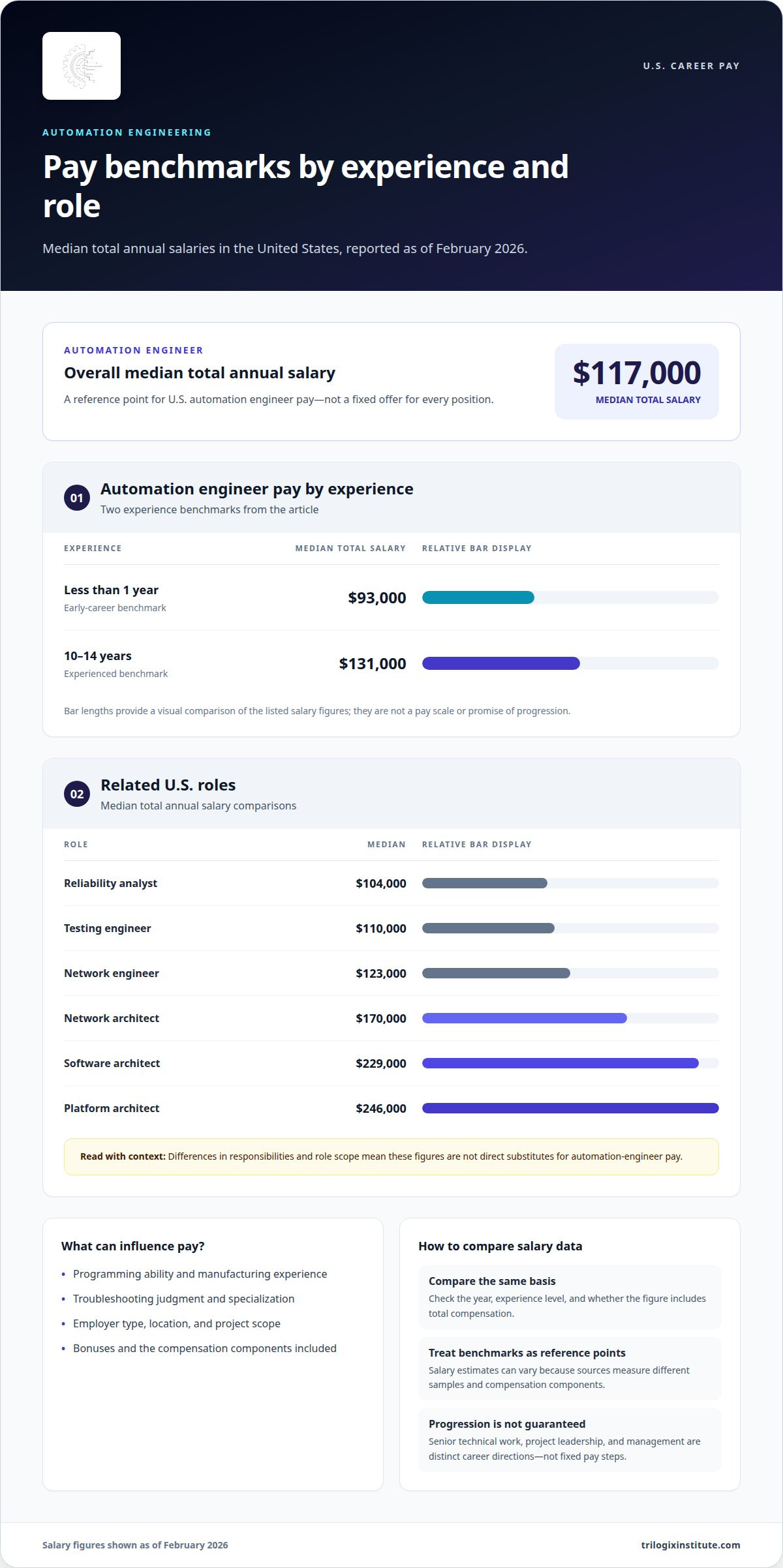
- Compare U.S. pay by experience level, including a median total annual salary of $117,000 as of February 2026.
- Identify how practical skills in industrial controls can complement formal education when preparing for automation work.
- See how education pathways vary, with some U.S. job postings requiring a bachelor’s degree and others specifying a master’s degree.
1. What does an automation engineer do?
An automation engineer designs, tests, and maintains industrial equipment controlled by hardware and software. For example, a production line may use sensors to detect a product, a programmable logic controller (PLC) to process signals, and actuators to move or sort it. The engineer brings these components together in automated systems that perform repeatable tasks and support continuous operations.
Responsibilities span the project lifecycle. Engineers gather process requirements, specify control components, configure PLC logic, and connect operator interfaces such as human-machine interfaces (HMIs). During commissioning, they test inputs and outputs, trace faults, and adjust sequences so machines respond as intended. They may also review operating data, document system changes, and coordinate with maintenance teams when a fault interrupts production.
Industrial automation is used in manufacturing, food processing, energy, water treatment, logistics, and automotive production. A factory might automate packaging and inspection, while a water facility might use controls to manage pumps and monitor process conditions. Robotics, machine vision, and artificial intelligence can also support inspection, sorting, or predictive maintenance. The application depends on the process and equipment involved.
Industrial communication networks allow controllers, sensors, drives, and supervisory systems to exchange data. Engineers may configure connections using technologies such as Ethernet-based industrial communication, Modbus, or PROFINET. Their work can include assigning devices, diagnosing communication faults, and confirming that controllers receive accurate signals. For example, a failed connection between a PLC and a variable-frequency drive can disrupt a machine even when both devices work individually.
Job titles vary by employer and project. Related roles include automation engineer, controls engineer, PLC programmer, robotics engineer, instrumentation and controls engineer, and manufacturing systems engineer. These professionals may work for manufacturers, system integrators, engineering consultancies, or companies operating industrial facilities. A controls engineer might focus on machine logic, while a robotics engineer develops automated movement and coordinates robot cells with production equipment.
Engineers also face practical challenges. Legacy equipment can be difficult to connect with newer controls, and outages require careful fault-finding under production pressure. Outsourcing may shift some design or programming work to external teams, while automation can reduce demand for certain repetitive tasks. However, systems still require people to integrate equipment, troubleshoot failures, and improve processes. The role therefore increasingly combines technical configuration with problem-solving.
Industrial automation work brings together electrical systems, software, machines, and communication networks. Engineers move from understanding a process to designing controls, testing equipment, and solving faults. The balance of these tasks depends on the industry and job title.
2. Automation engineer salaries in the United States
As of February 2026, the median total annual salary for automation engineers in the United States was $117,000. Experience shifts that benchmark: professionals with less than one year of experience had a $93,000 median total salary, while those with 10 to 14 years had a $131,000 median. These figures provide reference points, not fixed offers for every position.
Salary estimates vary because sources may measure different samples and components of compensation. Compare figures by year, experience level, and whether they include total compensation.
Pay also depends on the work involved. Programming ability, manufacturing experience, troubleshooting judgment, and specialization can influence an employer’s assessment. An engineer responsible for complex control projects may have a different compensation profile from someone in a narrowly defined support role. Employer type, location, project scope, and bonuses also affect total pay.
Career progression can lead from entry-level assignments to senior technical work, project leadership, or management. These are separate benchmarks, not guaranteed steps on a fixed pay scale.
For context, related U.S. roles also show a wide range of median total salaries. As of February 2026, network engineers had a median of $123,000, reliability analysts $104,000, and testing engineers $110,000. Network architects had a $170,000 median, software architects $229,000, and platform architects $246,000. Differences in responsibility and role scope mean these figures aren’t direct substitutes for automation-engineer pay.
Use salary data as one part of career planning. Compare roles by experience requirements, technical responsibilities, and compensation structure, then identify the skills relevant to your target position. For learners building a technical foundation, industrial automation training can connect study with practical industry skills.
Location can affect total pay, alongside employer type, project scope, and bonuses.
3. Certifications and hands-on training
Certifications can document focused knowledge, while practical training shows how that knowledge applies to equipment. The Certified Control Systems Technician certification from the International Society of Automation has three levels, offering technicians a way to demonstrate capabilities at different stages. A credential can strengthen a résumé, but it does not replace the ability to configure controls, interpret signals, and troubleshoot a real system.
Build your skills around tasks involved in automation work. Start with PLC fundamentals, ladder logic, and input/output wiring. Then practise tracing how a sensor signal reaches a controller and triggers an output. Use a computer and simulator to test control logic before connecting it to equipment. This approach turns abstract programming concepts into a clear sequence of actions and results.
The next learning stage can combine vendor-based PLC courses with SCADA and HMI projects. A 60-day learning-plan milestone recommends adding those projects and simulation labs after the initial fundamentals. For example, create a simulated process screen, connect it to controller logic, and test how alarms respond to changing inputs. This develops familiarity with industrial technologies without relying on theory alone.
Software tools matter because automation engineers often configure, test, and document systems digitally. Practise PLC programming software, HMI configuration, and SCADA monitoring in a connected project. Keep a troubleshooting record that explains the fault, the signal or logic involved, and the correction. These work samples help employers understand how you approach a control problem, not just which courses or certifications you completed.
In the UAE, practical ability is especially relevant to job applications: employers value hands-on training over purely online certificates. A useful portfolio can show a wiring exercise, a tested PLC sequence, and a simulated HMI or SCADA display. Explain the purpose of each component and how you diagnosed a fault. Keep descriptions precise, so hiring teams can connect your training to industrial tasks.
In 2025, over 70% of automation roles required proficiency in at least one scripting language. That figure supports adding scripting to your development plan alongside control-system skills. Use a small exercise, such as parsing equipment data or automating a repetitive test, to demonstrate the skill. Around 60% of organizations embedded DevOps practices into automation workflows in 2025, making version control and clear change records useful concepts to learn.
Choose training by matching each course to a skill you can demonstrate, such as electrical fundamentals, motor control, PLC logic, or supervisory interfaces. A credential can signal structured learning, while a completed and tested project shows how you apply it. Together, they provide stronger evidence of readiness for automation work.
4. Automation engineer education requirements
A four-year degree is one route to the science, technology, engineering, and mathematics foundation used in automation. In the United States, 63.36% of automation engineer job postings explicitly required a bachelor’s degree. Another 14.92% demanded a master’s degree. These posting figures describe stated employer requirements, not a universal rule for every automation position.
Degree programs can build the theory behind industrial control work. Electrical engineering covers circuits and equipment; mechanical engineering supports understanding of machines and production processes; and computer engineering develops knowledge of hardware and programming. Mechatronics combines elements of these areas, making it relevant to robotics and system integration. The best fit depends on whether a role focuses on controls, equipment design, software, or complete automated systems.
A degree also provides structured practice in technical problem-solving. Coursework may involve analyzing circuit behavior, interpreting system diagrams, and developing control logic. For example, a student might model how a sensor input affects a motor response, then explain the result using engineering principles. These exercises connect mathematics and computing concepts to the systems automation engineers encounter in manufacturing.
Education doesn’t end at graduation. Industrial technologies evolve, so continuing education can help engineers deepen a specialization or adapt to new responsibilities. Robotics, industrial communication, machine vision, and system integration are distinct areas for further study. An engineer working with automated production cells, for example, could focus on how robots coordinate with controllers and surrounding equipment.
Choose further learning by identifying the gap between your current knowledge and the requirements of target positions. If a role emphasizes control design, strengthen your control theory and programming skills. If it centers on integration, learn how equipment and software exchange information. Short courses, employer training, technical projects, and professional development can each address a specific need. Match the learning activity to a task you want to perform, then keep evidence of your work.
For applicants without a bachelor’s degree, job postings offer useful context: some positions require a degree, while others may emphasize different qualifications. Read descriptions closely and compare the stated education, technical duties, and experience criteria. A focused plan can combine formal education with targeted specialization, helping you prepare for the requirements of the automation positions you pursue.
5. Automation engineer job outlook
The automation engineer career outlook in the United States is positive, though competition remains part of the market. Automation engineering jobs are projected to grow by 10% from 2023 to 2033. The job market has about 44,000 openings, with nine candidates vying for each position. Demand for automation engineering professionals has grown by over 12% in recent years, so applicants need relevant skills to stand out.
Industrial automation and software test automation serve different needs, and the available figures don’t support a direct comparison of demand. Industrial automation engineers develop control systems for equipment and production processes. Software test automation engineers create tools and tests to check software behavior. Your career choice depends on whether you want to work with physical systems, software quality, or projects connecting both.
Demand for industrial automation engineers is tied to where employers operate production facilities and invest in equipment. Manufacturing, energy, water treatment, and logistics all use automated processes. National outlook figures don’t rank specific cities or regions, so review openings by industry, job title, and the technologies employers use.
Artificial intelligence and robotics are changing engineers’ tasks, not eliminating the need for engineering judgment. AI can help analyze operating data, while robotics can perform repeatable physical tasks. Engineers still need to integrate systems, test results, and respond to unexpected production conditions. Michigan Technological University links software engineering opportunities to new technologies in factory control and robotics.
The automation engineer career outlook also reflects a growing industrial automation market, expected to surpass $295 billion by 2028. Investment can bring projects involving connected equipment, upgraded production lines, and integrated control systems. Industry 4.0 increases the value of combining practical control-system knowledge with digital tools. This creates opportunities for engineers who can work across equipment, data, and system integration.
Turn the outlook into a focused development plan. Choose an area such as PLC controls, robotics, or industrial data, then build practical experience related to it. Document how you tested a system, solved a problem, or contributed to integration work. The automation engineer career outlook is strongest for candidates who can show employers how their skills apply to real production needs, rather than relying on broad claims alone.
Explore practical training options to build skills relevant to industrial automation work.
Trilogix Institute: TTI Dubai Foundation Electrical Engineering
Trilogix Institute offers TTI Dubai Foundation Electrical Engineering for learners building core electrical knowledge relevant to technical careers. For a more focused route into industrial automation, the Industrial Automation Specialization develops skills aligned with the field’s emphasis on control systems and practical work.
These programs can suit career changers strengthening their technical foundation and learners preparing to study automation in greater depth. They provide vocational training rather than a university degree or job placement guarantee, so consider how each course fits your education and career plan.
To discuss a suitable learning path, contact Trilogix Institute.
Build Your Next Career Step
A positive automation engineer career outlook can help you choose a direction, but progress starts with a learning plan suited to your current skills. Decide whether you need stronger electrical fundamentals, a technical specialization, or additional design skills. Then focus on training that supports the work you want to pursue.
Trilogix Institute offers TTI Dubai Foundation Electrical Engineering and TTI Dubai Advanced AutoCad 2D & 3D, alongside TTI Dubai Professional Culinary Arts. For an automation-focused path, consider how electrical engineering foundations can support further technical development. Each course serves a different learning goal, so select the one that aligns with your interests and next step.
Start a conversation with Trilogix Institute about your training direction. A clear plan and purposeful learning can help you move toward your next technical goal with confidence.
Frequently Asked Questions
What does an automation engineer do?
An automation engineer develops and supports technology that enables equipment to carry out tasks with limited manual control. In a bottling plant, for example, a control system can coordinate filling, sealing, and inspection. The engineer helps define how the sequence should work, tests its behavior, and investigates faults when equipment stops or produces inconsistent results. The role combines engineering decisions with communication across production, maintenance, and technical teams.
What are the qualities and skills required?
Automation engineers need logical problem-solving, patience, and attention to detail. A small error in a control sequence can cause a machine to behave differently than intended, so thorough testing and clear records matter. Communication is also important: engineers explain technical issues to operators and colleagues with different backgrounds. Adaptability helps when equipment, software, or project requirements change, while a systematic approach helps isolate faults instead of relying on untested adjustments.
What is the job outlook for automation engineers over the next 5-10 years?
The outlook is supported by continued investment in factory control, connected equipment, and robotics. Over the next 5-10 years, engineers who can integrate updated technologies with existing production systems will be positioned for varied project work. Michigan Technological University links software engineering opportunities to new technologies in factory control and robotics. The practical takeaway is to develop skills that apply across system design, commissioning, operations, and improvement.
Which industries employ the most automation engineers?
Automation engineers work in industries that rely on controlled equipment and repeatable processes, including manufacturing, energy, water treatment, and logistics. Employers may be manufacturers operating their own facilities or engineering firms building systems for clients. There is no supported ranking of which industry employs the most engineers. To assess a role, look at the equipment it covers, the operating environment, and whether the position focuses on design, integration, or ongoing support.
What skills, programming languages, and tools are most in demand for automation engineers?
Employers value control-system knowledge, programming ability, and practical troubleshooting. Common tools include PLC programming environments, operator-interface software, and industrial monitoring systems. Scripting can help automate tests or process equipment data; the language depends on the employer’s systems and project needs. Strong candidates can explain how they tested a change, handled an unexpected result, and documented the final configuration, rather than simply listing software without examples.
What education, certifications, or experience are required to become an automation engineer?
Requirements vary by position. Employers may seek an engineering degree, technical education, relevant experience, or a combination of these. Training in electrical principles and control systems provides a useful foundation, while certification can document focused knowledge. Practical experience adds evidence: describe the project, the system or task involved, your contribution, and how you tested the result. For an entry-level candidate, a well-explained training project can make technical learning easier to assess.
What are the main career paths and advancement opportunities for automation engineers?
Career paths can deepen technical expertise or lead to project responsibility. An engineer may specialize in robotics, controls, instrumentation, or system integration, then take on complex design and commissioning work. Other paths include leading automation projects, coordinating teams, or managing engineering operations. Advancement often depends on combining technical judgment with planning and communication, such as explaining project risks, coordinating equipment changes, and documenting decisions for colleagues and clients.
What is the average automation engineer salary by experience level and location?
Location can affect pay, but no specific city or regional salary figures are provided.


