

A senior chef’s earning potential can differ considerably from that of a typical kitchen role. This specialist figure offers context for professional chef average income, but it is not a benchmark for every chef.
Pay depends on more than a job title. Responsibilities, workplace, experience, reputation and location all shape earnings, so a headline figure alone can be misleading. These factors explain why professional chef average income varies across positions and workplaces.
This guide explains how to interpret chef pay ranges and earnings percentiles, what distinguishes head-chef compensation from other kitchen roles, and how to assess job prospects in the UAE. It also looks at monthly income figures in India and factors that can influence career progression.
Key Takeaways
- Head-chef pay varies with seniority, venue type, location, experience and the scope of kitchen responsibilities.
- Median pay offers a useful benchmark, while earnings percentiles show how widely salaries can differ across the profession.
- Job outlook figures help frame career prospects, but opportunities depend on role and sector.
- India’s monthly income comparisons across chef roles can help clarify how earnings change as kitchen responsibilities grow.
- Professional culinary training can build practical skills for people preparing to pursue a career in the kitchen.
What’s the salary of a Head Chef?
Head-chef earnings in the UAE vary by experience, responsibilities, workplace, reputation and location.
Experience and Executive Chef Earnings
Experience is the practical knowledge and leadership developed through progressively responsible kitchen roles. An executive chef’s earnings reflect more than years on the job: menu direction, staff management, purchasing decisions and consistent service also shape the role’s value. The UAE’s Michelin chef range offers a senior-level benchmark, not a standard salary for every head chef.
Work experience can support progression from preparing dishes to coordinating a station, supervising a team and leading kitchen operations. Each step brings added responsibility, but a title alone does not determine pay. Employers may weigh the size and style of the workplace, menu complexity and the chef’s record of managing service. Education builds culinary foundations; related work experience shows how those skills hold up during service.
Specialist nutrition expertise can also distinguish a chef’s skill set. For example, planning menus around dietary requirements combines food knowledge with careful preparation and communication. That expertise may suit certain kitchens, but the available UAE figures do not establish a separate pay premium for it.
Pay by Kitchen Role and Experience
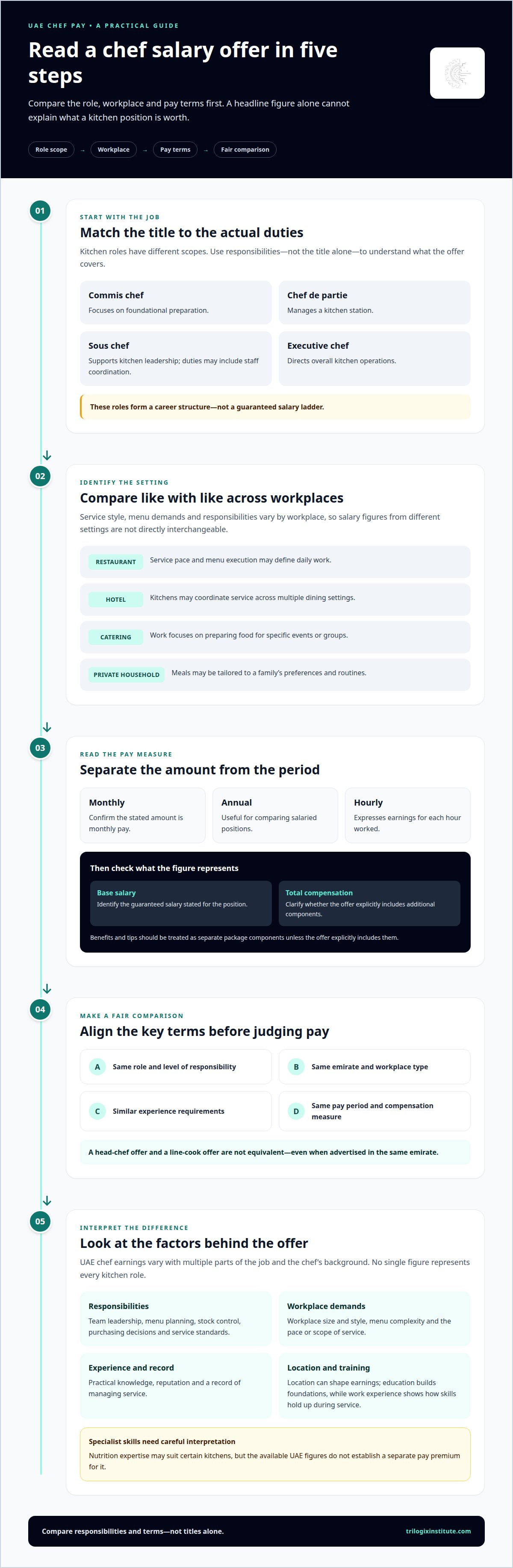
Kitchen-role pay is compensation associated with a position’s duties and level of responsibility. A commis chef focuses on foundational preparation, while a chef de partie manages a station; a sous chef supports kitchen leadership, and an executive chef directs overall operations. These roles form a career structure, not a guaranteed salary ladder.
As responsibilities grow, chefs may take on menu planning, stock control, staff supervision and service standards. Employers value those capabilities differently, so two chefs with similar experience may receive different offers. Education can build technique and food-safety awareness, while practical experience shows how a chef applies those skills during busy service.
To assess a role, compare its actual duties with your experience. A sous-chef position involving staff coordination differs from one focused on preparation. An executive-chef role may include broader operational decisions. These distinctions matter because a job title alone cannot explain the compensation for a specific kitchen position.
Pay Across Culinary Workplaces
Workplace-based pay is shaped partly by where a chef works. Restaurants, hotels, catering operations and private households differ in service style, menu demands and responsibilities, so their salary figures are not directly interchangeable.
These figures illustrate distinct high-end workplace contexts; they do not represent every restaurant, hotel, catering team or household role.
In a restaurant, service pace and menu execution may define the daily work. Hotel kitchens can coordinate service across multiple dining settings, while catering focuses on preparing food for specific events or groups. A private-household chef may tailor meals to a family’s preferences and routines. Responsibilities, experience and specialist skills help explain why salaries differ between workplaces.
Median annual and hourly pay for chefs and head cooks
A median is the midpoint of a pay distribution, while hourly pay expresses earnings for each hour worked. For UAE roles, compare figures only when they use the same period, job level and compensation measure.
Annual and Hourly Pay Measures
Annual and hourly measures describe pay over different periods. An annual salary is useful for comparing salaried positions, while an hourly rate helps assess roles paid by the hour. Neither measure alone explains the full compensation package.
For a UAE offer, first identify whether the stated amount is monthly, annual or hourly. Then clarify whether it refers to base salary or total compensation. A head chef’s responsibilities, workplace, experience, reputation and training can all affect the amount. These factors matter more than comparing unlike figures from different roles.
Treat benefits and tips as separate package components unless the offer explicitly includes them. Compare their terms alongside base pay instead of assuming they apply to every kitchen job. This also helps distinguish a predictable salary from additional or variable earnings.
Pay by State and City
Location-based pay comparisons examine how earnings differ between places. In the UAE, compare roles within the same emirate and workplace type instead of relying on a single national figure to represent every kitchen.
Restaurant, hotel, catering and private-household roles can involve different duties and expectations. A hotel position may involve coordinating service across several operations, while a restaurant role may focus on a particular menu and service pattern. Compare positions with similar responsibilities, experience requirements and pay periods.
Regional comparisons are more useful when the job title and compensation terms also match. A head-chef offer and a line-cook offer are not equivalent, even if both are advertised in the same emirate. Consider the role’s scope, leadership duties and workplace before interpreting a difference in pay.
Chef Earnings in the United Arab Emirates
UAE chef earnings vary with seniority, responsibilities, workplace, experience and reputation. A general salary figure cannot represent every chef across restaurants, hotels, catering and private households.
To assess an opportunity, compare the stated base salary with the position’s actual duties. Note whether the role includes team leadership, menu planning or wider kitchen operations. Review benefits or tips as separate terms so they do not obscure the guaranteed salary stated for the position.
This method keeps comparisons relevant to the UAE market. Match role, location, workplace and pay period before deciding whether an offer aligns with your experience and career goals.
Employment growth and projected job openings
Employment growth describes changes in hiring over time, while job openings arise when employers recruit or replace staff. In the UAE, chef opportunities depend on employer demand, workplace type and the skills required for each kitchen role. These factors help explain prospects without treating one job title as representative of the entire hospitality sector.
Restaurants recruit chefs to prepare menus, maintain service standards and manage kitchen stations. Hotels may need culinary teams for restaurants, events and other food operations. Catering businesses organise production around bookings and event requirements. Each setting has different staffing needs, so a restaurant-chef vacancy may call for different experience from a hotel-kitchen position.
Job growth and job openings are not the same signal. Growth means the number of positions is increasing; openings can also arise when employees leave or move into other roles. For example, a UAE hotel may recruit a replacement chef without expanding its kitchen team. A new restaurant, by contrast, may hire staff to establish its kitchen operations.
Role level also shapes hiring. A commis-chef vacancy focuses on foundational kitchen tasks, while a sous-chef position may require service coordination and team support. Executive-chef roles involve broader leadership and operational responsibilities. Candidates can use these differences to identify openings that match their current skills and those that call for more experience.
For a practical job search, start by defining your target role and workplace. Then compare job descriptions for cooking duties, team leadership, menu responsibilities and required experience. A hotel role involving event service may demand different strengths from a restaurant position focused on a particular cuisine. Matching your skills to actual duties makes career planning more precise.
In the UAE, location within the country and employer type can influence where opportunities arise. Dubai and Abu Dhabi have distinct hospitality employers, while other emirates also have restaurants, hotels and catering operations. Consider the specific employer and role rather than assuming demand is identical across every emirate or workplace.
Training and work experience can support readiness, but neither alone determines how many vacancies an employer will offer. Practical cooking ability, consistency, communication and leadership become relevant as responsibilities grow. For example, a chef aiming for kitchen supervision can build experience coordinating preparation and service before pursuing roles with broader team oversight.
Use employment outlook as a planning tool, not as a promise of a particular job. In the UAE, assess each opportunity by its employer, duties, workplace and expectations. This connects career development with the needs of restaurants, hotels and catering teams, while keeping decisions grounded in the role you are pursuing.
Pay distribution by earnings percentile
An earnings percentile ranks workers by pay, showing how a salary compares with others in the same dataset. For chefs, percentile figures help distinguish typical earnings from upper-end estimates, but the figures below describe the United States, not the UAE.
Top-percentile figures can indicate higher reported earnings, but they are not typical pay for every chef. In simple terms, this marks a point near the top of that dataset, rather than an average wage for every chef. It can signal the upper edge of reported earnings, but it shouldn’t be read as a standard offer or a likely starting salary.
A separate U.S. estimate places professional-chef annual pay between $188,641 and $352,130 for the 25th-to-75th percentile range. A higher percentile indicates pay above that of more workers in the dataset, rather than a typical wage for every chef. These figures show a wide spread within the central half of reported pay, and they differ from broader chef and head-cook wage measures.
Another U.S. dataset provides additional perspective on these earnings. Because these figures use different pay labels and tracking methods, it is important to compare like with like rather than combining them into one salary scale.
Percentile data can guide career planning when read alongside job duties. A higher-ranking figure may reflect seniority, leadership, a particular cuisine or a specialised workplace. The figures alone do not reveal which factor explains an individual salary. For example, a chef considering an executive role should compare its responsibilities and required skills with those of the roles behind the benchmark.
Demand also differs across settings, and U.S. figures cannot establish a UAE percentile. Use them to understand how widely reported professional-chef pay can vary, then assess UAE roles using local offers and job requirements. Compare annual salary with the same pay period, and separate base pay from additional compensation when both are stated.
For a practical comparison, identify the occupation, location, period and pay measure first. A professional-chef percentile is not interchangeable with a median for all chefs and head cooks. Nor does a U.S. top-percentile figure describe salaries in Dubai or Abu Dhabi. Matching these details helps readers use earnings data as context rather than treating one high figure as a typical career outcome.
Average monthly chef income in India
Monthly chef income is the reported pay for a kitchen role over one month. The India figures below show how earnings differ by position, and they use different reporting periods and measures.
For chefs overall, the reported average base pay is ₹20,277 a month in 2026. These figures offer a broad reference, not a single rate shared by every employer or state.
A commis chef is an entry-level kitchen role focused on foundational preparation. The average commis chef in India earns ₹17,507 a month in 2026. A chef de partie oversees a kitchen section, and the reported average is about ₹29,400 a month, updated July 2024. The different dates matter when comparing these roles.
A sous chef supports kitchen leadership and helps coordinate service. Sous-chef pay in India can vary by role and employer. PayScale India reports an average sous-chef salary of ₹483,033 a year in 2025. These are monthly and annual figures from different reporting periods, so they shouldn’t be treated as an exact like-for-like comparison.
Head-chef figures also vary by source and period. The gap between these estimates shows why readers should note the source and pay period before comparing salaries.
An executive chef leads broader kitchen operations, often combining menu direction with team and service oversight. The average executive chef earns ₹48,925 a month in India in 2026. PayScale India reports an average executive-chef salary of ₹737,844 a year in 2025, and its reported top 10% earn about ₹20 lakh a year in 2025. Top luxury-hotel executive chefs may earn ₹1.5-4 lakh a month in 2026.
Location examples add context, but they do not establish a state-wide rate. Differences in role, city, date and seniority all affect comparisons.
To plan a culinary career, compare the same role, location, pay period and reporting date. Formal education can build technique, while kitchen experience develops speed, consistency and confidence during service. Build practical culinary skills through structured training as you prepare for kitchen work.
Trilogix Institute: TTI Dubai Professional Culinary Arts
Trilogix Institute’s TTI Dubai Professional Culinary Arts is a practical next step for people building skills for professional kitchen work. Salary figures can help set expectations, but progression also depends on developing culinary technique, consistency and readiness for greater responsibility.
Turn to this training when you want structured culinary education to support your career preparation, whether you are starting out or strengthening your foundations. It provides a focused learning route; it does not replace experience gained through employment or guarantee a particular role or income.
Use your target kitchen role to guide what you want to develop next, such as preparation skills, menu knowledge or confidence in professional settings. For information about the program and how it fits your goals, contact Trilogix Institute.
Build Your Next Career Step
A professional chef’s average income can help set expectations, but it should not define your entire career plan. A stronger next step is to identify the kitchen responsibilities you want to handle, then build the technique and judgement those duties demand. That might mean refining preparation methods, improving consistency during service or strengthening your understanding of menu execution.
Choose a learning path that supports the role you are working toward. Practical culinary training can help establish core skills, while experience in a professional kitchen develops pace, teamwork and confidence over time. Treat each new capability as part of a longer progression, not a shortcut to a particular title or salary.
If you’re ready to explore training that supports your culinary goals, contact Trilogix Institute. Take the next step with a clear focus, a willingness to practise, and a professional standard you can keep building.
Frequently Asked Questions
Does a Culinary Diploma Raise Your Starting Salary?
A culinary diploma can strengthen your preparation, but it does not automatically mean a higher starting salary. Employers also consider practical ability, relevant kitchen experience, the role’s duties and the workplace. For example, a candidate who demonstrates reliable preparation and organised station work may be better positioned for an entry-level kitchen role. Treat formal learning as a way to build skills, then demonstrate them through consistent performance.
How Fast Can You Climb the Chef Pay Scale?
There is no fixed timeline for moving from an entry-level role into kitchen leadership. Progress depends on building dependable technique, handling more complex service demands and earning responsibility through performance. A practical approach is to master your current station, learn how the wider kitchen operates and seek duties that develop planning and team coordination. Promotions and pay changes depend on the position and employer, so focus on clear skill milestones.
How Much Does a Chef Make in India Per Month?
Monthly chef income in India varies by role, seniority, location and employer. A commis chef, chef de partie, sous chef, head chef and executive chef each have different responsibilities, so one monthly figure cannot represent them all. Compare estimates for the same job title and reporting period. Also distinguish monthly pay from annual salary figures, since mixing these measures can create a misleading comparison.
Is a Culinary Career Worth It Financially?
A culinary career can make financial sense when the expected role, workplace and progression align with your goals. Consider more than starting pay: assess the responsibilities you can grow into, the skills employers require and the work setting you prefer. For example, someone interested in leading a kitchen should plan to build both cooking ability and operational judgement. Compare realistic, role-specific earnings with your career priorities before committing.
What’s the Average Salary for Chefs?
There is no single average salary for every chef, because job title, location, experience and workplace change the comparison. A restaurant cook and an executive chef do different work, even if both work in professional kitchens. For a useful benchmark, compare the same role, region, pay period and salary measure. Median figures describe a midpoint; averages can shift when high or low salaries affect the dataset.
What is the average annual salary for a professional chef in the United States?
One listed estimate places the average annual professional-chef salary in the United States at $251,521. Treat this as a specific estimate, not a universal salary for every chef or head cook. The national median for the broader chef and head-cook occupation uses a different measure. Before applying a figure to a job decision, identify the dataset’s role definition and whether it reports average pay, median pay, or total compensation.
What is the average hourly wage for professional chefs?
A listed U.S. professional-chef estimate gives an average of $121 per hour. That figure is not interchangeable with the U.S. median hourly wage for chefs and head cooks, which covers a broader occupational group and a different measure. Check whether an hourly amount describes a salaried role converted into hourly terms, an actual hourly job, or additional compensation. The distinction matters when comparing offers or estimating annual earnings.
How much do executive chefs, sous chefs, and head chefs earn on average?
There is no single average covering executive chefs, sous chefs and head chefs across every country and workplace. Their earnings reflect different levels of responsibility, and titles can vary between employers. Executive chefs generally direct broader kitchen operations, while sous chefs support that leadership and head chefs lead kitchen teams. For a sound comparison, match the job title to its duties and compare salaries within the same country and pay period.


