

The strongest route to automation work combines electrical fundamentals, control systems, and practical troubleshooting. Building a career in automation can lead to hands-on technical roles, system integration, or project coordination, depending on the skills you develop.
If the field feels broad at first, that’s understandable. Building automation brings together HVAC and lighting controls, sensors, controllers, wiring, and control logic. The work also requires clear communication and structured problem-solving when systems need to be configured, monitored, or improved.
This guide explains how building automation systems work and outlines career opportunities in the UAE. You’ll learn about the technical foundations, skills employers may value, and practical ways to build experience as a beginner.
It also explores common career paths, from technician and system integrator roles to project management, along with the tools and programming languages used in automation. Use it to identify a clear starting point and choose which skills to develop next.
Key Takeaways
- Explore how building automation connects HVAC, lighting, sensors, controllers, and integration protocols to shape different technical and project-focused career paths.
- Assess certifications by how closely they align with the role you want and the practical capabilities employers need.
- Build experience through structured training and hands-on practice with electrical systems, motor control, and troubleshooting.
- Learn where programming languages and diagnostic tools fit into automation work, then focus on the tools that support your chosen path.
- Identify common career challenges, from solving system issues to coordinating projects, and see how Trilogix Institute’s Industrial Automation Specialization can support your technical learning.
Career opportunities
Building automation combines electrical systems, control logic, and building operations. For example, a technician investigating an unresponsive lighting zone might check its sensor, controller, wiring connection, and programmed sequence. Career paths differ according to which parts of the system you want to work with.
Entry-level and specialist roles focus on installing, testing, maintaining, or integrating building controls. A building automation technician may inspect sensors and actuators, read electrical drawings, and trace wiring faults. A system integrator connects equipment and protocols, such as BACnet or Modbus, so different systems can exchange information. Both roles apply electrical knowledge to practical system performance.
- Technician: tests controllers, checks sensor readings, and diagnoses faults in HVAC or lighting controls.
- System integrator: configures connections between building systems, including BACnet and Modbus devices.
- Energy management specialist: reviews system data to identify opportunities to improve energy efficiency.
- Project technician: supports installation and delivery by coordinating technical tasks with a project team.
- Technical project manager: plans work, coordinates resources, and tracks project timelines and deliverables.
These paths can overlap, but they emphasize different strengths. Technicians spend more time diagnosing equipment and control behavior. Integrators focus on how devices communicate across a system. Project managers combine technical awareness with planning and coordination. When building a career in automation, choose an initial role that matches both your current skills and the work you want to do each day.
Data skills can open opportunities beyond installation. Building automation professionals review performance records, identify unusual system behavior, and help optimize energy use. For instance, a controls specialist might compare HVAC schedules with building operating patterns. Those findings can inform system settings and predictive maintenance planning. Clear communication matters because recommendations must make sense to engineers, technicians, clients, and facility teams.
Project-focused careers suit people who can turn technical requirements into organized work. A building automation project may involve equipment, software configuration, testing, and coordination with other building trades. The project manager plans activities, assigns resources, and tracks deliverables through completion. Strong problem-solving helps teams resolve installation or integration issues while keeping the project’s objectives in view.
To compare roles, look for recurring tasks in job descriptions. Note whether a position emphasizes wiring, HVAC controls, programming, data analysis, or project coordination. Then identify which skills you need to strengthen. As technologies and energy-efficiency practices develop, ongoing professional development—such as the comprehensive educational programs provided by Trainetics Academy—helps individuals and organizations adapt to changing systems and industry standards.
Which automation certifications are most valuable to employers?
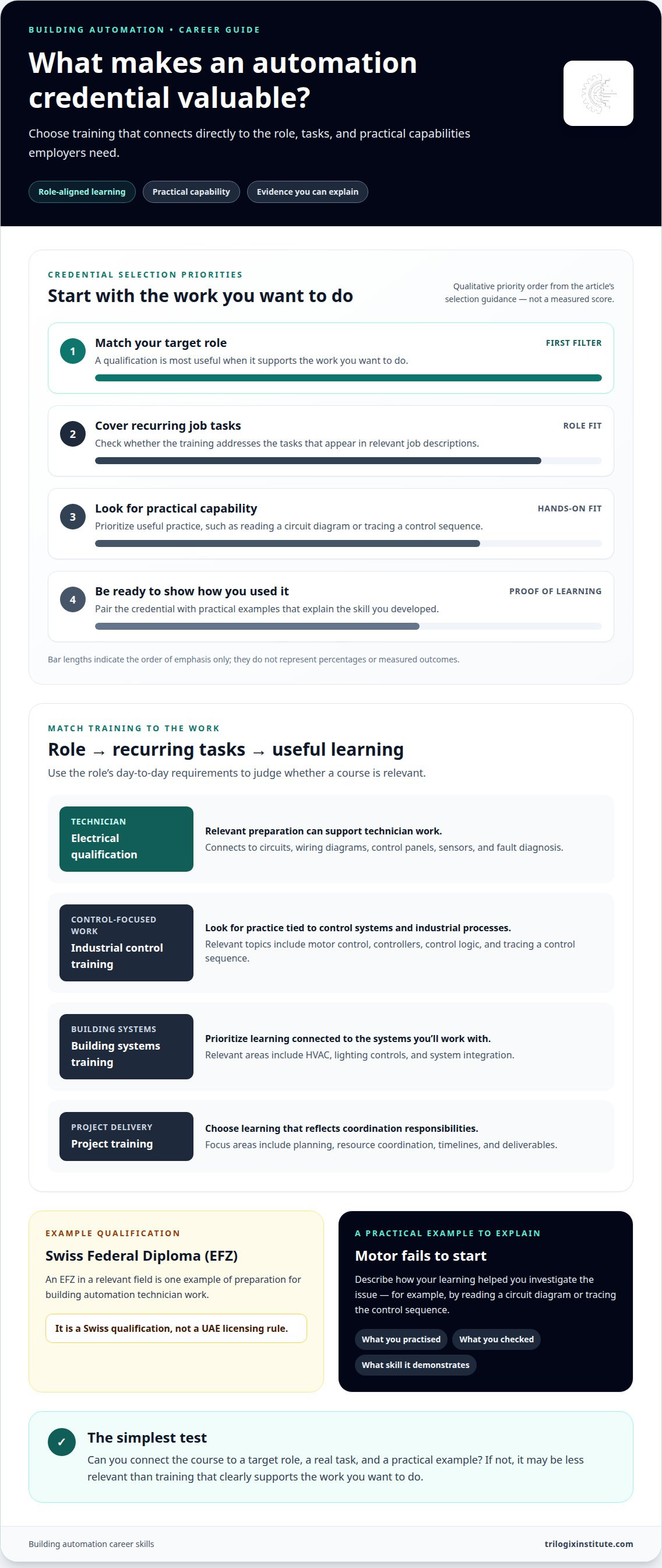
For building automation roles, a credential is most useful when it supports the work, such as electrical fundamentals, industrial control, system integration, or project delivery. Employers need people who can apply technical knowledge to equipment and tasks, not simply list course names. Match each qualification to the role you’re targeting.
Start with the job title and its recurring responsibilities. A technician vacancy may emphasize wiring diagrams, control panels, sensors, and fault diagnosis. An integration role may focus on configuring controllers and connecting systems through BACnet or Modbus. A project position may prioritize planning, coordination, and technical documentation. These differences make role-aligned training more useful than collecting unrelated certificates.
For an electrical foundation, a vocational qualification in a relevant field can support technician work. For students exploring accredited vocational education pathways, registered training providers like apeiro.edu.au demonstrate how structured training programs help learners build practical technical skills. The Swiss Federal Diploma of Vocational Education and Training (EFZ) in a relevant field is one example of preparation for building automation technician work. It is a Swiss qualification, not a UAE licensing rule.
Automation-focused training can demonstrate preparation in control systems and industrial processes. Its value is clearer when you can explain what you practised, such as reading a circuit diagram, tracing a control sequence, or identifying why a motor fails to start. Pair a credential with practical examples showing how you used the underlying skill.
- Electrical qualification: supports understanding of circuits, wiring, and electrical drawings.
- Industrial control training: relates to motor control, controllers, and control logic.
- Building systems training: connects learning to HVAC, lighting controls, and system integration.
- Project training: develops planning, resource coordination, timelines, and deliverables.
Use a simple selection process. First, identify your target role, such as technician or system integrator. Next, list its technical tasks. Then compare those tasks with each course’s learning outcomes and practical exercises. A course covering motor-control circuits, for example, is more relevant to control work than unrelated software training.
Keep your skills current by adding focused learning as your work changes. Building automation involves evolving technologies, energy-efficiency practices, and integration methods. Training should strengthen a specific capability, such as interpreting control logic or using system data to support maintenance. Trilogix Institute’s Industrial Automation Specialization offers structured automation-focused preparation alongside practical skill development.
How can beginners gain practical automation experience?
Start with small, observable tasks that connect electrical principles to control behavior. For example, sketch how a room sensor could signal a controller to adjust lighting. Label the input, decision, and output. This exercise builds the habit of tracing system logic before working with equipment and gives you a simple example to discuss in an interview.
Next, build your fundamentals through structured training with equipment and instructor guidance. Practise reading electrical drawings, identifying circuit components, and following a control sequence. In motor control, trace how a start command reaches a motor through its control circuit. Record each component’s function and the system’s expected response. Practical learning makes abstract terms easier to connect to workplace tasks.
Keep a project log for every exercise. Include the objective, a diagram, the steps you followed, the result, and any troubleshooting. For a simulated lighting-control task, note whether the sensor input produced the intended output. If it didn’t, document how you traced the logic. This record can demonstrate your reasoning without implying professional work experience.
- Practise safely: use supervised training equipment for electrical and motor-control exercises.
- Build a system map: show how sensors, controllers, and actuators interact in a sample setup.
- Explain the result: describe the fault, diagnostic steps, and correction in plain technical language.
- Connect systems: learn how protocols such as BACnet or Modbus support communication between devices.
Use practice projects to strengthen your communication as well as your technical ability. Explain a control sequence to someone unfamiliar with the equipment. For example, describe how a temperature sensor provides an input and how a controller uses it. Clear explanations help prepare you to collaborate with engineers, technicians, clients, and facility teams.
You can also learn beyond the training room. Attend industry conferences, follow building-automation publications, and participate in relevant forums. Use these channels to explore system approaches, energy-efficiency practices, and emerging technologies. Then choose an idea, such as monitoring performance data, and consider how it applies to a practical control task.
Finally, target beginner roles whose duties match your current skills. Compare technician job descriptions and note recurring tasks, such as reading drawings or diagnosing control issues. Use those tasks to guide your next practice project. A focused portfolio of diagrams, logs, and explanations gives employers concrete evidence of how you approach automation problems.
Look beyond individual job ads when planning your next steps. Stay informed about industry trends, technologies, regulations, energy-efficiency practices, sustainability, emerging standards, and best practices. Use that knowledge to identify topics for a training project, then describe how a topic could affect a control sequence or system decision. Keep notes and connect what you learn to a practical skill you can demonstrate.
Read experience requirements carefully and compare them with your current evidence, rather than assuming every role is an entry point. A duct fabricator job listing in Saudi Arabia specified 5 - 10 years of experience. If a posting asks for more experience than you have, use its listed duties to spot skills to develop and seek a role whose requirements fit your level. This makes applications more focused and gives you a clear learning target.
What programming languages and tools are commonly used in automation careers?
Automation professionals use programming languages and specialized software to configure, program, and diagnose systems. In building automation, those systems may coordinate HVAC, lighting, sensors, and controllers. The right tools depend on the role and equipment. A technician may focus on checking controller settings, while an automation programmer may write or adjust code.
C++, Python, and Java are used in some automation careers, but they are not requirements for every building-controls role. C++ may appear in work involving embedded control devices. Python can support scripts for processing system data. Java may be used in software environments that connect or manage automation functions. Focus on understanding the task each language supports.
For example, a professional reviewing temperature readings could use a script to organize data and identify patterns. A programmer might work with code that defines how a controller responds to sensor input. A technician may not write that code but still needs to understand its intended behavior when diagnosing an unexpected response. Match language learning to your target role.
Automation software supports configuration, programming, and diagnostics. Configuration tools set device parameters. Programming environments define control sequences. Diagnostic tools help inspect device status and identify communication or operating issues. In a building system using BACnet or Modbus, software and protocol knowledge help professionals understand how devices exchange information.
- Configuration software: sets controller or device parameters for a defined application.
- Programming environments: create or adjust sequences that govern system responses.
- Diagnostic tools: inspect status and help trace faults across connected equipment.
- Data tools: organize performance records to support energy analysis and maintenance planning.
Use a structured workflow when learning a tool. First, identify the device or process being configured. Next, record its expected input and output. Then examine the settings or sequence and compare system behavior with the expected result. If a sensor reading doesn’t trigger the intended response, for example, trace the input, control logic, and output in order.
Build transferable skills before taking on several programming languages. Practise reading control sequences, documenting settings, and explaining diagnostic steps. These habits apply across software environments. Keep notes on each exercise, including the system’s purpose, the tool used, changes made, and the observed result. That record shows your approach to technical work, even if a future employer uses different software.
For beginners, a useful next step is to learn automation fundamentals alongside guided practice. Focus on how electrical inputs, controller logic, and equipment outputs interact. Then add programming or data skills that fit your intended role. This progression connects software learning to real control tasks instead of treating code as a separate objective.
What are the risks and challenges of building a career in automation
Building automation can be technically demanding because connected systems don’t always fail in obvious ways. A room may feel uncomfortable even when its HVAC unit is running. The cause could involve a sensor reading, controller logic, actuator response, or communication between devices. Technicians need a methodical process, not guesswork or premature part replacement.
Integration work creates another challenge. BACnet and Modbus devices may need to exchange information across equipment from different systems. A settings mismatch or incorrect connection can disrupt expected behavior. Professionals need to understand the system architecture, document configuration choices, and trace signals between devices. Knowing one controller alone may not explain how the wider installation operates.
Technology changes too. New software, controllers, and energy-management approaches can alter the tools used in a role. Professionals who know only one interface may struggle when a project uses another. Ongoing learning helps address this gap. Industry publications, training programs, conferences, and forums can help workers follow new methods and emerging standards.
- Complex diagnosis: trace a fault through the sensor, controller, output, and connected equipment.
- Integration gaps: understand how protocols such as BACnet and Modbus connect devices.
- Changing tools: practise adapting to different configuration and diagnostic software.
- Communication demands: explain technical findings clearly to clients and project teams.
- Project coordination: manage dependencies between timelines, resources, and deliverables.
Data analysis brings its own risk: drawing the wrong conclusion from system records. An unusual temperature trend, for example, might reflect a sensor issue, a schedule change, or actual building conditions. Examine data alongside equipment behavior and operating context. This approach supports better energy decisions and avoids treating a single reading as a complete diagnosis.
Project roles can be demanding because technical work depends on coordination. A controls installation may involve configuration, testing, and input from engineers or facility teams. If one deliverable depends on another task, delays can affect the project sequence. Clear records, timely updates, and defined responsibilities help teams manage dependencies and resolve issues early.
Career preparation works best when it addresses a specific skill gap. If control logic is unfamiliar, practise tracing a sequence from input to output. If communication is difficult, rehearse explaining a fault without jargon. For structured learning in automation fundamentals, explore practical automation course options and focus on training that matches your intended role.
Trilogix Institute: Industrial Automation Specialization
Trilogix Institute offers the Industrial Automation Specialization for learners preparing to develop automation skills. It can be a relevant next step if you’ve identified industrial control as your preferred direction but want structured training before pursuing related roles. Beginners building electrical foundations can also consider TTI Dubai Foundation Electrical Engineering, while TITP Beginner Essential Industrial Motor Control focuses on a practical starting point in motor control. Choose according to the skills you need next: electrical fundamentals, motor-control knowledge, or broader automation learning. This progression can help connect technical concepts with the systems and tasks discussed throughout this guide. To discuss your learning direction, contact Trilogix Institute.
Choose Your Next Step with Purpose
Building a career in automation starts with a clear decision about which capability to strengthen next. Choose a learning path that supports your direction, whether you’re developing technical foundations, working with design software, or exploring a different vocational field. Trilogix Institute offers TTI Dubai Foundation Electrical Engineering, TTI Dubai Advanced AutoCad 2D & 3D, and TTI Dubai Professional Culinary Arts. Each offering serves a distinct learning interest, so focus on the one that fits your goals.
Before taking your next step, write down the role or skill you want to pursue and the practical knowledge you still need. That direction can help you choose training more deliberately and build momentum through purposeful learning.
Contact Trilogix Institute to explore your options and identify a suitable next step. With a defined goal and focused preparation, you can move forward with greater clarity.
Frequently Asked Questions
What types of careers are available in automation?
Automation careers range from equipment-focused roles to software, testing, and project work. A robotics technician, for example, maintains robotic equipment and investigates operational faults, while a controls engineer develops or adjusts control systems. Commissioning specialists verify that installed systems function as intended. In the UAE, the right path depends on whether you prefer hands-on equipment work, system design, software development, or coordinating technical delivery.
What are typical salaries for automation engineers and technicians in the UAE?
Pay in the UAE depends on the role’s technical scope, your experience, sector, and the systems you can operate or troubleshoot. An automation engineer’s responsibilities may differ substantially from a technician’s, even within the same employer. Compare compensation on the same basis, such as monthly or annual AED, and consider the full package alongside duties, working arrangements, and required technical capabilities.
What is the career outlook for automation and robotics in the UAE?
Career prospects depend on employers’ project needs and role requirements, rather than one uniform outlook. Automation and robotics work can involve equipment integration, system testing, maintenance, and technical support. To assess opportunities, review UAE vacancies for recurring requirements, such as control-system knowledge, electrical foundations, programming, or robotics experience. Use those patterns to target training and practical projects that match specific job duties.
How do industrial automation, test automation, and business process automation careers differ?
Industrial automation often involves working with physical equipment. Test automation uses software and scripts to check whether digital applications behave as expected. Business process automation streamlines repeatable administrative workflows, such as transferring information between systems. The daily work differs: an industrial specialist may diagnose equipment behavior, a test engineer designs software checks, and a process analyst maps tasks before automating them.


