

Strong electrical design starts with sound fundamentals, not just another software tool. If you’re comparing electrical design training UAE options, course titles can blur the line between general electrical knowledge and the calculations, drawings, and standards used in design work. To choose well, look for a clear connection between electrical principles and the decisions learners practise making.
This guide explains the core tasks involved in electrical design and the practical skills worth developing. It also shows how to compare course content with your experience and goals, and why project requirements and relevant standards matter in the UAE. Use the examples and checklists to assess what a course lets you practise, not just the topics it names.
For learners building technical knowledge, Trilogix Institute’s Foundation Electrical Engineering training offers an instructor-led vocational starting point. It focuses on a technical foundation, rather than a university degree or a job guarantee. Use it to strengthen your understanding before deciding which design skills you want to develop next.
Key Takeaways
- Electrical design involves interpreting requirements and developing coordinated documentation, a different focus from installation or maintenance.
- Build design capability in sequence: understand circuits, interpret requirements, calculate, document, and review.
- Load calculations and cable selection depend on project-specific inputs, so look for learning that explains the decisions behind them.
- When comparing electrical design training UAE options, assess what learners practise and produce, not just the topics listed.
- Use your experience, goals, foundation knowledge, and practice needs to choose a realistic next step, including whether Foundation Electrical Engineering at Trilogix Institute suits your starting point.
What Electrical Design Training in the UAE Helps You Learn
Electrical design training teaches you to turn project requirements into coordinated information that can guide an electrical system’s development. The work involves more than producing a drawing. A designer considers the building’s intended use, expected loads, safety, usability, and how electrical services interact with other building systems. For learners exploring electrical design training UAE, the key distinction is that design connects technical knowledge to documented decisions.
Electrical engineering is a broad field with multiple specialities and applications, as outlined in this Electrical Engineering Overview. Design is one area within it. Electrical foundations help learners understand principles and system behaviour. Installation focuses on putting equipment and wiring in place, while maintenance focuses on inspection, fault-finding, and repair. These areas can inform one another, but they involve different tasks and outputs.
What does an electrical design learner work towards?
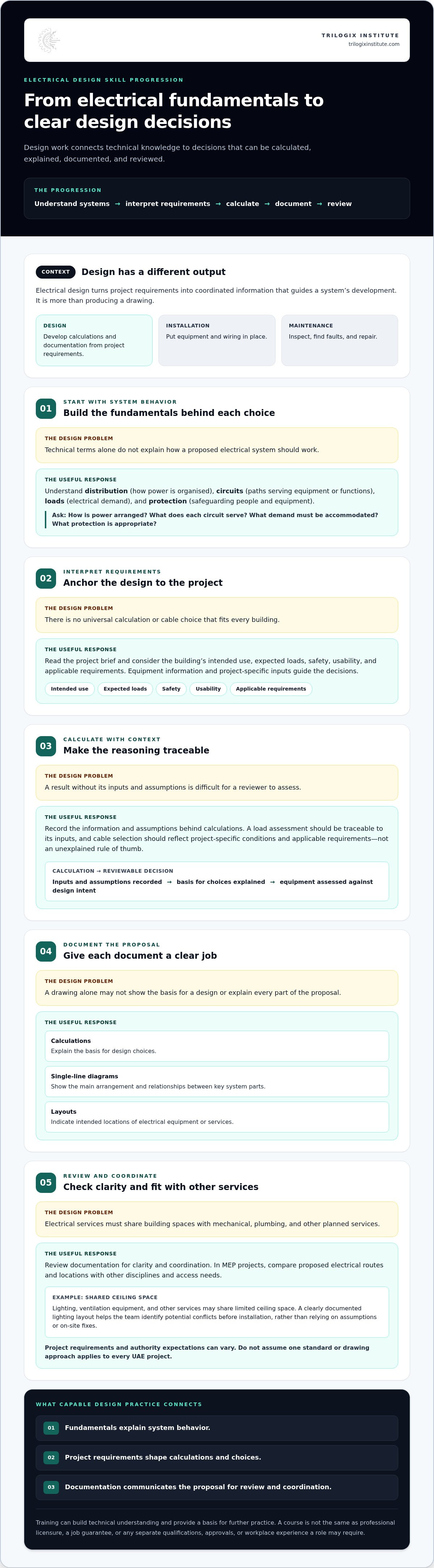
A typical design process moves from interpreting a project brief to identifying requirements, developing calculations, communicating the proposed arrangement through drawings, and reviewing the documentation for clarity and coordination. Calculations explain the basis for choices; drawings show where equipment and services are intended to go. Together, they help engineers, installers, and reviewers understand and assess the proposed system.
Training can build technical understanding and give you a basis for further practice. Completing a course is not the same as earning professional licensure or securing a job. Treat training as a way to develop knowledge and practise defined skills, not as a substitute for any separate qualifications, approvals, or workplace experience a role may require.
How electrical design connects to MEP projects
MEP stands for mechanical, electrical, and plumbing. In a building project, these disciplines need to fit within the same spaces and serve the building’s intended use. Electrical layouts therefore need to coordinate with mechanical equipment, plumbing routes, access requirements, and other planned services. Requirements and authority expectations can vary by project, so don’t assume one standard or drawing approach applies to every project in the UAE.
For example, lighting, ventilation equipment, and other services may share a limited ceiling space. A clearly documented lighting layout helps the project team see intended fixture positions and identify potential conflicts early. That gives stakeholders a basis for coordination before installation, rather than leaving details to assumptions or on-site fixes.
Good design decisions balance several considerations. Load informs the system capacity being planned; safety shapes the design and its documentation; usability affects how people will use the building; and coordination helps the electrical proposal work alongside other disciplines. Electrical design training UAE should help learners understand how these factors influence a design, while recognising that project-specific inputs and applicable requirements guide the final decisions.
Electrical Design Training Skills: From Fundamentals to Design Decisions
Electrical design skills develop in a sequence. First, understand how electrical systems behave. Then interpret project requirements, perform relevant calculations, document decisions, and review the work for clarity. Each stage supports the next: a polished drawing still won’t communicate a sound design if the assumptions behind it haven’t been considered.
Sound electrical design turns fundamental knowledge into decisions that can be calculated, explained, documented, and reviewed. That’s the progression to look for in electrical design training UAE: a clear link between principles and design tasks, rather than a collection of technical terms.
Which electrical fundamentals support design work?
Start with the concepts behind the decisions. Distribution concerns how electrical power is organised and delivered through a system. Circuits describe the paths serving equipment or building functions. Loads represent the electrical demand a system must account for. Protection concerns how equipment and people are safeguarded when faults or abnormal conditions occur.
Each concept prompts a design question: How is power arranged? What does each circuit serve? What demand should the design accommodate? What protection is appropriate? The answers depend on project requirements, equipment information, and applicable standards. There isn’t one universal calculation or cable choice for every building.
How do calculations become drawings and schedules?
Calculations become useful to a project team when their inputs and assumptions are recorded. For example, a load assessment should be traceable to the information used to make it. That context helps reviewers understand the proposed system and assess whether selected equipment suits the design intent. Cable selection also depends on project-specific conditions and applicable requirements, not a rule of thumb applied without context.
Different documents communicate different parts of the proposal:
- Single-line diagrams show the main arrangement and relationships between key parts of a system.
- Layouts indicate the intended locations of electrical equipment or services within the building.
- Schedules organise relevant information about circuits or equipment for reference and review.
Together, these documents make design choices easier to follow. Drafting software such as AutoCAD can help create or edit drawings, but using a tool isn’t the same as understanding the electrical decisions those drawings represent. Software supports communication; the designer still needs to reason through the assumptions, selected information, and project requirements behind each drawing.
When comparing learning options, look for a progression from fundamentals to documented work and review. Learners strengthening their technical base can start with Foundation Electrical Engineering training at Trilogix Institute, then build on that knowledge through continued learning and practice.
How to Compare Electrical Design Training in the UAE
Course titles can sound similar while the learning experience differs. To compare electrical design training UAE options, look beyond topic names and identify what learners actually practise, document, and review. A course that mentions calculations, for example, might explain a concept, demonstrate a worked example, or guide learners through applying it. Those are different levels of practice.
Foundations: Look for a clear connection between electrical principles and the decisions they support. Check whether the content suits your existing knowledge or assumes prior experience.
Design tasks: Look for activities such as interpreting requirements or developing calculations, rather than a list of topics without application.
Drawing practice: Identify whether drawing work is explained or actively practised. Useful evidence includes a learner-created or revised document that communicates design intent.
Feedback: Look for opportunities to review work and understand how to improve it. A demonstration shows a process; feedback helps you recognise and correct gaps in your own attempt.
Prerequisites: Compare stated entry knowledge with your experience. A beginner may need structured electrical foundations, while a technician may be ready to build on existing technical knowledge.
What course details reveal practical depth?
Practical depth is clearer when a course links a concept to an example, then to a documented task. A description of load assessment is more useful if it explains what information informs the work and how the result is recorded. For drawing practice, check whether learners produce, interpret, or revise design documentation.
Distinguish instructor-led practice from watching an instructor demonstrate a task. Both can support learning, but active practice gives learners the chance to apply ideas and receive guidance. Topic lists alone don’t show how much application or feedback a course includes. For broader context on course selection, the electrical engineering courses guide explores how training choices relate to learning goals and readiness.
How should UAE standards and software be assessed?
Separate general engineering principles from rules that apply to a particular project. Requirements can depend on the project and the relevant authority, so a standard reference isn’t automatically applicable everywhere. IEC and NEC are examples of standards references, not interchangeable or universal instructions. Their relevance must be assessed against the project’s location, scope, and applicable authority requirements.
Software familiarity can help you create or interpret drawings, but it doesn’t replace engineering judgement. Assess whether software use supports sound reasoning, clear documentation, and review, rather than treating tool names as proof of design competence. Certification or accreditation claims also shouldn’t be treated as universal requirements for every learning goal or role. Focus on the course’s stated outcomes and what you’ll be able to practise and produce.
Choose Electrical Design Training That Matches Your Starting Point
The right course depends on what you already know and what you want to practise next. Before comparing electrical design training UAE options, write down a specific learning goal, such as strengthening circuit fundamentals, understanding design calculations, or becoming more confident reading electrical drawings. A clear goal makes course descriptions easier to assess and helps you avoid choosing based on a title alone.
Use this five-step self-assessment to identify your starting point:
- Experience: Record any electrical study, technical work, or practical exposure you’ve had. Note what you can already explain or do.
- Goals: Define the capability you want to develop. “Learn electrical design” is broad; “understand how design assumptions are documented” is more focused.
- Foundations: Consider whether you can comfortably discuss circuits, distribution, loads, and protection. If these concepts feel unfamiliar, build that base first.
- Practice needs: Identify where you need guided application, such as working through calculations, interpreting drawings, or understanding documentation conventions.
- Next learning step: Choose a course level that addresses the gap you identified, rather than assuming you need advanced design content straight away.
A beginner may benefit from structured electrical foundations before moving into specialised design topics. A technician with relevant experience may already understand equipment and electrical systems but want to deepen their knowledge of calculations or design documentation. Starting at the right level makes learning more purposeful for both groups.
Is foundation electrical engineering a suitable starting point?
Foundation-level study can be a sensible choice if electrical principles are new to you or if you want to organise and strengthen existing knowledge before tackling design decisions. Trilogix Institute’s Foundation Electrical Engineering training is an instructor-led vocational option for learners building technical knowledge. It provides a starting point for learning the fundamentals, not a university degree or a guarantee of independent design competence or employment.
What should you be able to practise during training?
Look for a clear relationship between concepts and applied exercises. As you study, keep a short record of questions you can’t yet answer, calculations you find difficult to follow, and drawing conventions you want to understand better. This turns a general ambition into a useful learning plan and gives you a practical way to reflect on progress.
Use this checklist when assessing fit:
- Does the course level match your current knowledge?
- Can you identify what you’ll practise, not just what topics are named?
- Is there a connection between instruction and applied learning?
- Does the course support your next step without overstating the outcome?
One course can strengthen knowledge and provide a foundation for further development, but design capability grows through continued learning and practice. Choose the next step that addresses your current gap, then build from there.
Build Your Electrical Design Foundation with Trilogix Institute
Choosing a useful next step starts with an honest assessment: identify what you already understand, what you want to practise, and whether you need stronger electrical fundamentals before pursuing design-focused learning. Compare course information against those goals, focusing on the learning format and stated outcomes rather than assuming a course title guarantees a particular skill level or career result. This is a practical way to approach electrical design training UAE options.
Where does foundation training fit in your learning path?
Electrical fundamentals can provide a structured base for later design-focused learning. If circuit principles and other core concepts still feel unfamiliar, strengthening those foundations may be more useful than starting with advanced design topics. If you already have technical experience, consider whether you need to reinforce particular concepts or practise applying what you know in a design context. Progress depends on your experience and continued learning, not on an automatic course-to-course outcome.
Trilogix Institute offers Foundation Electrical Engineering as instructor-led vocational training for learners building technical knowledge. It isn’t a university degree or a guarantee of employment or professional authorisation. Use the course overview to explore the training and its published details. Choose based on your learning goals and the course information, rather than assuming specific modules, credentials, or results.
What is the next step toward electrical design skills?
Decide whether your immediate priority is understanding electrical principles or applying existing knowledge to design activities. For a beginner, a foundation-level course may be an appropriate first step. For a technician with relevant experience, the next learning goal may be more targeted practice, such as becoming more confident with calculations, drawing conventions, or interpreting technical documentation. Either way, be specific about the gap you want to address.
Before beginning, write down a few questions you want to resolve, the calculations you want to understand better, and the drawing conventions you need to interpret. Use that record to connect course learning with your own development. Instructor-led vocational training provides a structured learning format; practical value comes from engaging with the instruction and continuing to develop your knowledge. No single course should be mistaken for a guarantee of independent design competence.
Your next step doesn’t need to be complicated. Match your current knowledge to a suitable foundation, define what you want to learn, and use course details to decide whether the pathway fits. Explore electrical engineering training at Trilogix Institute to take a focused next step.
Take the Next Step with Purpose
Your next move doesn’t have to map out an entire career. Start by choosing one capability you want to strengthen, then use it to guide what you learn and practise next. A focused goal makes it easier to recognise progress and decide when you’re ready to take on more complex design work.
Before selecting electrical design training UAE, write down what you can already do, where you need support, and what you want to understand better. Keep that short learning plan as a reference when reviewing course information. It can help you make a considered choice instead of being swayed by broad promises or technical terms alone.
For learners building their technical base, Trilogix Institute’s Foundation Electrical Engineering training provides an instructor-led vocational starting point. Let your current knowledge guide the pace and direction of your development, and choose each learning step to address a specific goal.
Ready to explore the course pathway? Explore electrical engineering training and take a confident next step toward your learning goals.
Frequently Asked Questions
What is electrical design training?
Electrical design training develops the knowledge used to turn building or system needs into documented electrical proposals. For example, a learner might practise tracing how an equipment requirement affects the information shown on a drawing or schedule. Course scope varies, so compare the exercises, expected starting knowledge, and learning outcomes rather than assuming similarly named courses teach the same level of design work.
Can beginners take electrical design training in the UAE?
Yes. Beginners can explore electrical design training UAE, but the suitable starting level depends on their existing knowledge and each course’s prerequisites. If terms such as circuit, load, or distribution are unfamiliar, a foundation-level route can help establish context before specialised design topics. Trilogix Institute’s Foundation Electrical Engineering training is an option for learners building technical knowledge. Choose a level that matches what you can already explain.
How do I choose electrical design training that includes practical learning?
Look for specific examples of learner activity, such as completing a guided exercise, interpreting a sample drawing, or receiving feedback on an attempt. A course description that names “calculations” doesn’t show whether learners solve problems themselves or only watch a demonstration. Compare the time devoted to application, the type of work learners handle, and whether instruction helps them understand errors, not just follow a finished example.
What skills are needed for electrical design?
Electrical design draws on technical understanding, careful reasoning, and clear communication. A learner should be ready to interpret requirements, follow how electrical systems are organised, and explain the basis for a proposed choice. Attention to detail matters too: inconsistent labels or missing information can make technical documents harder to review. The skills needed for a particular role vary with its responsibilities, project scope, and applicable requirements.
Is electrical design training the same as an engineering degree?
No. Vocational training and a university degree are distinct education routes, so check the stated course level and credential before enrolling. Trilogix Institute’s Foundation Electrical Engineering training is vocational training, not a university degree. It can support the development of technical knowledge, but it isn’t a degree, professional licence, or guarantee of employment. Those outcomes involve separate requirements and depend on the relevant institution, role, or authority.
Do electrical design courses in the UAE teach DEWA or other authority requirements?
Course coverage differs, and no single authority’s requirements should be assumed to apply to every UAE project. The relevant authority depends on the project’s location and scope. If a course discusses DEWA or another authority, treat that as a learning reference, not approval to certify or authorise designs. For project work, use current requirements issued by the authority responsible for that specific project.


