

What if the skill that makes you valuable as an engineer isn’t the newest software, but your ability to apply it to real work? Employers look for sound technical foundations, practical capability and the judgement to adapt as tools and roles change. That’s why the most useful engineering skills for job market readiness are a balanced mix, not a single software badge or qualification.
If you’re unsure which capabilities employers expect, or how classroom knowledge translates into workplace tasks, start by looking at the responsibilities in roles that interest you. Technology continues to reshape engineering work, but strong fundamentals, clear communication and a commitment to learning remain useful across changing roles.
This guide explains the technical and transferable skills to consider, from CAD and automation to problem-solving, teamwork and project coordination. You’ll learn how to compare your abilities with realistic role requirements, identify the gaps that matter most, and choose a practical next step. Structured, equipment-based training can help connect theory with application, whether you’re strengthening electrical engineering foundations, building AutoCAD capability or developing industrial automation and motor control skills.
Key Takeaways
- Engineering skills for job market readiness combine durable fundamentals with tools and specialisations relevant to your target discipline.
- Match technical capability to role tasks: the right depth in CAD, systems, equipment and safe work practices depends on the position.
- Show workplace readiness through observable behaviours, such as explaining technical decisions clearly, collaborating effectively and adapting when requirements change.
- Compare several role descriptions, map their tasks against evidence of your skills, and prioritise gaps you can practise.
- Use structured, equipment-based learning to complement theory, choosing a pathway that aligns with the capability you want to strengthen.
What engineering skills does today’s job market actually value?
Employers value capabilities that help engineers complete the work a role requires and coordinate effectively with others. The right combination varies. An electrical engineering role focused on equipment may call for different technical depth from a design position using digital models. A single checklist cannot cover every discipline, sector or level of responsibility.
Job-market engineering skills are the technical knowledge, transferable behaviours and practical ability needed to perform role-specific tasks accurately, safely and collaboratively. This definition puts the emphasis on evidence: what you can understand, communicate and do, not simply what topics you’ve studied.
It also helps to separate lasting foundations from changing tools. Engineering principles, measurement, logical analysis and attention to safety can remain relevant across roles. Software platforms, automation methods and specialist knowledge may shift with the sector or project. A useful overview of the definition of an engineer and engineering branches shows why skills need to be considered in context: the work spans distinct fields with different practical demands.
Technical, transferable and applied skills: how they differ
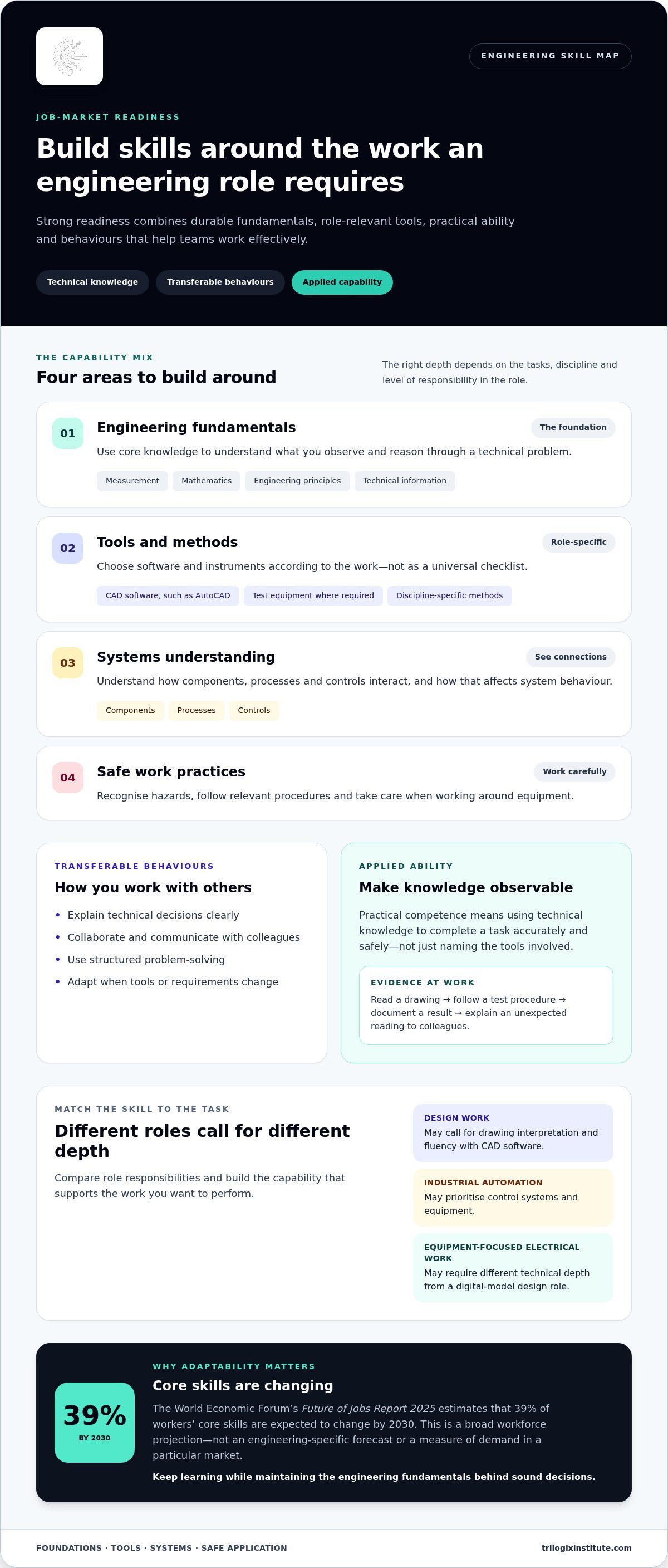
Technical skills are knowledge of engineering principles, systems, tools and methods. Transferable skills include communication, teamwork and structured problem-solving, which support work across disciplines. Applied skill is using both to complete a task accurately and safely, such as reading a drawing, following a test procedure, documenting a result and explaining an unexpected reading to colleagues.
These categories work together. Knowing how a system should operate is technical understanding; describing a fault clearly is communication; carrying out the relevant checks and recording findings correctly demonstrates application. Employers need to see how knowledge translates into dependable work, not just recognise a list of course topics.
Why engineering skill demand changes
Automation, artificial intelligence, digital design and sustainability priorities can change the tools engineers use and the problems they’re asked to solve. Digital systems may require closer collaboration between equipment, software and data; sustainability work can bring new design and efficiency considerations. These shifts make adaptability valuable, but they don’t remove the need to understand the engineering fundamentals behind a decision.
The World Economic Forum’s Future of Jobs Report 2025 estimates that 39% of workers’ core skills are expected to change by 2030. This is a broad workforce projection, not an engineering-specific forecast or a measure of demand in a particular market. It signals why continuous learning matters, rather than suggesting that established technical knowledge is becoming obsolete.
For practical skill-building, connect the trend to the task you want to perform. Someone strengthening electrical foundations might practise interpreting system behaviour, while a learner focused on automation may need familiarity with control concepts and equipment. Instructor-led, equipment-based learning can complement theory with structured practice. Trilogix Institute’s engineering and technical courses include pathways in electrical engineering, AutoCAD, industrial motor control and industrial automation. Each relates to different skill goals, rather than forming a universal checklist.
Which technical engineering skills build a strong foundation?
A dependable technical skill set has four parts: engineering fundamentals, tools, systems knowledge and safe work practices. The balance depends on the role. A design engineer may need to interpret drawings and work fluently with CAD software, while an industrial automation role may prioritise control systems and equipment. Engineering skills for job market readiness should be chosen against the tasks you want to perform, not collected as a universal checklist.
Build around these capability areas:
- Fundamentals: measurement, mathematics, engineering principles and interpretation of technical information.
- Tools: discipline-specific software and instruments, such as AutoCAD or test equipment where the work requires them.
- Systems: understanding how components, processes and controls interact.
- Safe work practices: recognising hazards, following relevant procedures and working carefully around equipment.
Practical competence means using technical knowledge to complete a task accurately and safely, not simply naming the tools involved.
Engineering fundamentals and technical problem-solving
Strong problem-solving begins with evidence. An engineer might compare a measured value with the expected result, review a drawing or specification, and check whether the equipment is operating under the stated conditions. Mathematics and core principles help make sense of those observations; methodical reasoning helps narrow down possible causes rather than relying on guesswork.
Good documentation is part of the process. Record what was checked, what was observed and what conclusion follows. This makes the reasoning easier to review and gives colleagues usable information. Memorising procedures can help with routine tasks, but understanding why each step matters makes it easier to respond when a result is unexpected.
Digital tools, automation and safe working practice
Tools are valuable when they support a real task. AutoCAD can help with technical drawings and design work, while programmable logic controllers (PLCs) are relevant to roles involving automated processes. Neither belongs on every engineer’s must-have list. The target discipline determines which tools deserve focused practice and how deeply to learn them.
Industrial automation knowledge helps learners understand how equipment, control logic and processes connect. For example, following how a control signal relates to a machine’s operation builds a systems view, rather than treating each component in isolation. Pair that knowledge with careful work habits: understand the task, use equipment as instructed, and communicate uncertainty before proceeding. Safe practice is a professional responsibility, not an optional add-on.
For learners developing these capabilities, instructor-led practice with real-world equipment can complement theory. Trilogix Institute’s technical engineering and automation courses include electrical engineering, AutoCAD, industrial motor control and industrial automation pathways. Choose learning that fits the gap you’ve identified, whether that’s strengthening fundamentals, developing design-tool experience or understanding connected equipment.
How do communication and adaptability strengthen engineering performance?
Technical knowledge matters, but it doesn’t show by itself how someone will contribute to a shared project. Engineers coordinate tasks, explain decisions and raise concerns so others can act on reliable information. Communication and adaptability make technical capability usable in team settings, supporting clear handovers and considered responses when plans change.
These behaviours are observable in everyday work. Look for evidence in how you describe a finding, document a change, respond to feedback or handle an unfamiliar task. They strengthen engineering skills for job market readiness, but no single transferable skill guarantees hiring. Employers assess capability in relation to the work and team.
Communication, teamwork and technical documentation
Engineers often need to explain technical information to colleagues with different responsibilities or levels of technical knowledge. A useful update is accurate and direct: state what was checked, what the result showed, and what action or decision is needed. Clear writing helps colleagues follow the reasoning rather than infer it.
| Transferable skill | Observable engineering-work behaviour |
|---|---|
| Clear communication | Explains a finding in plain language, then provides relevant technical detail. |
| Teamwork | Shares progress, listens to input and coordinates handovers with colleagues. |
| Structured problem-solving | Separates observed evidence from assumptions and describes the next step. |
| Adaptability | Adjusts to a changed requirement while checking its technical implications. |
For example, instead of writing “the equipment failed,” a useful handover might identify the test performed, the result observed and the condition that differed from expectations. Concise records preserve context between people and tasks. They support continuity and traceability, and reduce misunderstandings about what has already been checked or changed.
Adaptability, learning agility and professional judgement
Tools, processes and project requirements can change during an engineer’s work. Adaptability means understanding what has changed, identifying which knowledge still applies, and learning what’s needed to proceed responsibly. It isn’t chasing each new technology. A tool is worth learning when it connects to the tasks, systems or goals of the role.
Professional judgement also means recognising the limits of your knowledge. If a new process or unfamiliar result raises questions, define what you know, identify the uncertainty and seek reliable technical information or input from an appropriate colleague. Don’t present an assumption as a verified conclusion.
To develop these behaviours, practise giving short, evidence-based updates and keeping clear records of decisions and results. After a task changes, note what changed, what you needed to learn and how you confirmed your approach. These examples help you demonstrate collaboration and learning agility alongside technical ability, without overstating your experience.
How can you assess and develop your engineering skill gaps?
A useful skills audit starts with a specific role, not a broad goal such as “get better at engineering.” Identify which capabilities matter for the tasks you want to perform, what evidence you already have, and where focused practice could help. Treat job descriptions as clues, not fixed standards: requirements differ between employers, projects and levels of responsibility.
Turn target-role requirements into a skills map
Compare several descriptions for roles that interest you. Note the requirements that recur, then organise them into four groups: technical knowledge, tools, practical tasks and transferable behaviours. A single advertisement may include preferences that are specific to one team. Patterns across multiple roles can help reveal which capabilities are more central to the work.
Use a simple status for each skill: demonstrated, developing or not yet practised. Support “demonstrated” with evidence, such as a completed drawing, a troubleshooting exercise or a clear technical explanation. Prioritise gaps that recur across relevant roles and affect core tasks. Don’t treat every unfamiliar term as an urgent training need.
- Choose a target role that reflects the work you want to do.
- Analyse several descriptions and extract recurring tasks and requirements.
- Map your evidence against technical knowledge, tools, practical tasks and behaviours.
- Identify priority gaps based on relevance to the work and frequency across roles.
- Plan practice that produces evidence you can review and explain.
This process can also clarify how different learning formats fit your goals. A vocational training versus university degree guide can help you compare their different purposes as you decide how to address a gap.
Build evidence through deliberate practice
Turn each priority into a task with a defined output. If you’re building technical drawing ability, produce a drawing and check it against the task requirements. If you’re practising fault-finding, create a troubleshooting record that sets out the issue, the checks performed, the observations and the conclusion. A specific output makes progress easier to assess than an open-ended goal like “learn more about automation.”
Seek feedback, revise the work and record what changed between attempts. Keep examples of completed projects, practice records and technical explanations together, removing confidential or sensitive information before sharing any work. These examples help you describe your contribution accurately without overstating your experience.
If structured instruction would help you practise a technical gap, explore hands-on technical course options in areas such as electrical engineering, AutoCAD, industrial motor control and automation. Choose a pathway that matches your skills map, then use the practice to build evidence relevant to your target tasks. This focused approach makes engineering skills for job market preparation more manageable and measurable.
How can practical engineering training support job-market readiness?
Practical training can help turn theory into task experience. An instructor can guide learners through a technical process, while equipment-based practice gives them a structured setting to apply concepts, observe results and build familiarity with real-world tools and systems. This complements independent study and academic learning; it doesn’t replace them or guarantee a particular career outcome.
The right learning pathway depends on the gap you identified. If you need stronger foundations, a technical grounding may be more useful than a specialised tool. If you already understand the principles but lack practice with a particular system, focused instruction can help you build experience in that area. Choose learning for its relevance to your development plan, not simply because a topic sounds current.
Choose a learning format that fits the skill gap
Instructor guidance and access to equipment can be useful when a skill depends on handling tools, following a process or understanding how a system responds. Independent reading and digital resources can support preparation and review. Consider the learning activities and the evidence you want to produce, such as a completed drawing, a documented practical task or a clearer understanding of equipment operation.
For example, a learner strengthening technical design skills may focus on AutoCAD practice, while someone aiming to understand connected equipment may prioritise industrial automation. A person building electrical fundamentals may need a different learning pathway. In each case, connect the course content to the role tasks you’re targeting, then decide how you’ll apply and reinforce what you learn.
Connect practical training with a continuing development plan
Foundation Electrical Engineering is one relevant pathway for learners seeking to build electrical engineering knowledge. Advanced AutoCAD 2D & 3D and Industrial Automation Specialization are distinct options for different development goals. Industrial motor control offers another focused area of study. These examples aren’t interchangeable: select the subject that matches your current capability and the tasks you want to practise.
After training, continue developing through deliberate practice. Review your work, record questions that arise and identify the next capability to strengthen. If electrical engineering aligns with your plans, an electrical engineering career-readiness guide can provide a relevant point of reference.
Instructor-led vocational learning can support this process by combining guidance with equipment-based practical experience. Explore the hands-on engineering and technical courses and compare their subject areas with the gaps in your skills plan. A focused next step is more useful than trying to learn every tool at once. The aim is to build capability you can demonstrate, while continuing to adapt as your target tasks evolve.
Make your next engineering skill count
Career readiness develops through deliberate choices, not by trying to master every tool at once. Choose one capability that matters to the work you want to do, then decide how you’ll practise it and demonstrate your progress. That focused approach makes engineering skills for job market preparation more manageable, while leaving room to adapt as your goals evolve.
For a practical next step, consider whether guided, equipment-based learning would help you apply what you know. Trilogix Institute offers instructor-led technical training using real-world equipment, with course areas including electrical engineering, AutoCAD, industrial motor control and industrial automation. Each can support a different development goal, so connect your choice to the skill gap you want to address.
Explore Trilogix Institute’s practical technical training pathways and identify a learning option that fits your next step. Build one relevant capability, put it into practice and keep moving forward with purpose.
Frequently Asked Questions
What engineering skills are most in demand in the job market?
Problem-solving, sound technical knowledge, communication and digital capability recur across engineering work, but the specific tools and depth vary by role. The engineering skills for job market preparation should reflect the tasks you’re targeting: a design role may prioritise drawing and modelling, while equipment-focused work may call for system operation and fault diagnosis. Treat demand claims cautiously unless they name their source, publication date and geographic scope.
Are soft skills important for engineering jobs?
Yes. They help engineers make technical work understandable and coordinated. For instance, a concise handover can state which component was checked, what the test showed and what remains unresolved. A clear report lets teammates distinguish observed facts from assumptions. These behaviours support technical capability rather than replacing it, and they’re more useful to demonstrate than simply describing yourself as a “good communicator” or “adaptable.”
How can I improve my engineering skills without a degree?
Start by examining the tasks in roles that interest you, then choose a practical way to develop a relevant capability. Projects, guided practice, instructor-led vocational training and feedback can all help you build applied experience. The appropriate route depends on the work: some positions may require particular qualifications or credentials, so read role requirements carefully. Training can support skill development, but it doesn’t guarantee employment or replace credentials required for a role.
What practical skills should a beginner engineer learn first?
Begin with the basic working habits that support your chosen discipline: reading technical information carefully, recording results clearly, checking units and following safe work instructions. Practise explaining what a diagram or specification requires before acting on it. Then add a tool or equipment skill that matches your intended work. For example, someone interested in technical design may focus on interpreting drawings, while an automation learner may prioritise understanding control sequences.
How do I identify gaps in my engineering skills?
Compare several role descriptions and note recurring capabilities, then test yourself against a specific task rather than relying on confidence alone. For example, if a role mentions drawing revision, check whether you can make a requested change and explain what you altered. Keep a simple record of the task, your evidence, feedback and next practice step. This turns a broad concern into a development priority you can act on.
Will engineering skills training guarantee me a job?
No. Training can help you practise relevant technical capabilities, but no course can guarantee a job. Hiring decisions also depend on the position’s requirements, your experience and qualifications, the employer’s selection process and wider labour-market conditions. Treat training as one part of preparation: use it to strengthen skills, keep examples of your work, and assess each opportunity against your actual experience and credentials.
How can engineers keep their skills relevant as technology changes?
Keep core knowledge current, then assess new methods against the work you want to do. Follow credible sources relevant to your discipline, such as technical guidance or software release information, and check the date and scope before acting on a trend. Choose learning that solves a real capability gap instead of chasing every new tool. Reviewing your target roles periodically can help you decide what deserves attention next.


