

What if the best route to your next career step is the one that teaches you to do the work, not just study it? If you’re asking, “is vocational education a good choice?”, the answer depends on how well the training fits your goals and the tasks you want to perform. Practical learning can build useful, job-related skills, but a qualification alone can’t guarantee employment or suit every career path.
It’s reasonable to weigh the appeal of hands-on training against concerns about future options and whether a course reflects real workplace demands. Assess the learning, qualification and next steps together. This guide explains where vocational education can be valuable, where its limits matter, and how to judge whether a course aligns with your plans.
You’ll also see how instructor-led, equipment-based practice can connect technical concepts with workplace tasks, using foundation electrical engineering as an example. A practical course-assessment framework will help you compare what you’ll learn with the skills and progression you’re aiming for, so you can make a considered decision before committing.
Key Takeaways
- Learn how vocational education combines occupational knowledge with applied skills, and what meaningful practice should include.
- Use the question “is vocational education a good choice” to guide your decision, then weigh your career goal, course quality and relevant requirements.
- Apply a five-step framework to define a target role, identify skill gaps, review course outcomes, assess the learning approach and set realistic expectations.
- Separate qualifications a role requires from practical skills that can strengthen your readiness for work.
- See how Trilogix Institute’s technical training, including Foundation Electrical Engineering, connects vocational learning with technical practice.
What Is Vocational Education and How Does It Prepare You?
If you’re weighing practical training against a more academic route, start with what you want to learn and how you plan to use it. Vocational education focuses on occupational knowledge and applied skills, helping learners build capabilities connected to particular types of work. If you’re asking, “is vocational education a good choice?”, the course’s content and outcome matter more than its label.
Vocational education is learning designed to develop knowledge and practical skills for a defined occupation or field, rather than focusing mainly on broad academic study. That distinction is about emphasis, not value: vocational learning can include theory, while academic pathways can also develop practical abilities. The forms vocational education takes vary across countries and providers. What is vocational education? offers a broader overview of its different forms and settings.
There’s no single format. Programs differ in length, delivery, assessment and the qualification or other outcome they provide. Some emphasize supervised practice; others include more classroom instruction. Before enrolling, find out what the specific program teaches, how learning is assessed and what completion represents. These details matter more than the vocational label alone.
What does vocational education include?
Depending on the field and program, learning may combine technical instruction, supervised practice and occupation-specific objectives. Instruction introduces relevant concepts; practice gives learners a chance to apply them; assessment can show whether they meet the stated learning objectives. Practice is most useful when it has a clear purpose and guidance, rather than being activity without instruction or feedback.
Electrical engineering provides one example of a technical learning pathway. A learner may want to connect foundational concepts with the way electrical equipment is handled in practical settings. Trilogix Institute provides Foundation Electrical Engineering training as one example of vocational learning in this field, with instructor-led, equipment-based technical learning. This illustrates how a practical format can link study with applied work, without implying that every electrical program covers identical content. The vocational course options include examples across technical fields.
Course content and credentials depend on the program. Compare its stated learning objectives and assessment approach with the skills you want to develop. For example, look for an outcome that describes a task or concept you can demonstrate, rather than relying on a course title to tell you what you’ll be able to do when you finish.
Who considers vocational education?
Vocational learning can suit people at different points in their working lives. A school leaver may be exploring a field and building an initial base of occupational knowledge. A career changer may be focused on skills relevant to a new direction. A worker may want targeted development that builds on experience already gained.
Their priorities differ. One learner might need a structured introduction to a field; another may want to strengthen specific capabilities or connect existing knowledge with practical tasks. No starting point makes someone inherently better suited to vocational education. The useful question is whether the program’s focus, learning format and outcome align with your current needs and next step.
How Vocational Education Turns Learning into Practical Capability
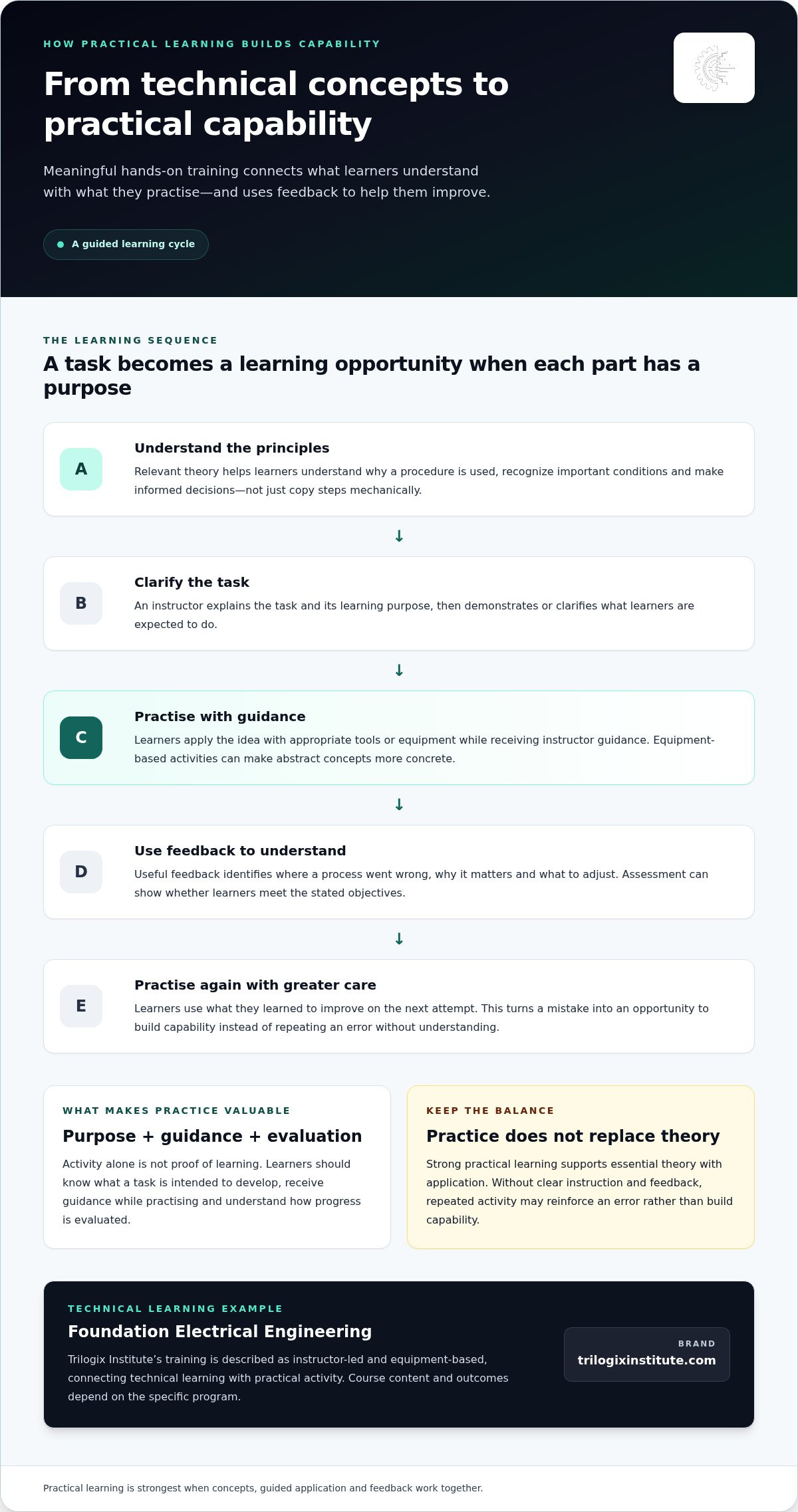
Practical training is most valuable when it moves beyond watching a demonstration. Learners need to understand the idea behind a task, try applying it, receive useful feedback and practise again with greater care. That cycle helps connect technical knowledge with the decisions and actions that may be needed in a work setting.
Equipment-based activities can make abstract concepts more concrete. Working with technical equipment under instruction, for example, can help a learner see how a concept relates to a task rather than encountering it only in written material. The activity depends on the subject and course. Trilogix Institute’s vocational programs include instructor-led, equipment-based technical training, bringing explanation and guided practice together.
That practical emphasis is one of the benefits of vocational education, but activity alone isn’t proof of learning. Learners should know what a task is intended to develop, receive guidance while practising and understand how progress is evaluated. Without those elements, repeated activity may reinforce an error instead of building capability.
What makes hands-on training valuable?
Useful hands-on training has a clear learning purpose. An instructor explains the relevant principles, demonstrates or clarifies the task, and guides learners as they practise with appropriate tools or equipment. Feedback can help identify where a process went wrong, why it matters and what to adjust on the next attempt. This turns a mistake into a chance to improve, rather than something a learner repeats without understanding.
Theory still matters. It helps learners understand why a procedure is used, recognize relevant conditions and make informed decisions instead of copying steps mechanically. Strong practical learning supports essential theory with application; it doesn’t treat practice as a substitute for understanding. That balance is particularly important in technical fields, where a task may depend on applying concepts accurately.
How do learners demonstrate progress?
Evidence of progress can take different forms depending on the course. It might include demonstrating a task, completing a practical exercise, explaining the reasoning behind a process or meeting stated criteria in an assessment. These are possible ways to show learning, not a claim that every program uses the same assessment method.
Repeated practice, assessed against clear learning outcomes, gives learners evidence of the skills they can demonstrate and where they still need to improve. As you review a course, connect each stated outcome to something observable: a task you can perform, a process you can explain or a result you can produce. If an outcome is too general to connect to a demonstrable skill, identify what capability it is intended to build.
That’s a practical way to judge whether training may transfer to workplace tasks, and to answer the question is vocational education a good choice for your goals. If you’re exploring technical learning pathways, compare the vocational course options with the capabilities you want to develop.
Is Vocational Education a Good Choice for Every Career Goal?
No. Practical training can help you build relevant skills, but completing a vocational course doesn’t guarantee employment. Outcomes can depend on your effort, the quality and relevance of the training, employer needs, and requirements for the role and jurisdiction where you plan to work. A course can develop capability, but it can’t control hiring decisions or replace every credential an occupation may require.
So, is vocational education a good choice? It may be a strong fit when your learning preferences, target tasks and qualification needs point in the same direction. Start with the role you’re targeting, then distinguish its required credentials from skills that could strengthen your practical readiness. This keeps the decision focused on your destination, rather than on broad claims that one route is best for everyone.
What are the potential advantages and limitations?
A focused program can concentrate learning on skills related to a particular occupation or field, while applied practice can help you connect concepts with tasks. This clarity can be useful if you have a defined goal. The trade-off is that a narrow specialization may not cover every capability you’ll need later, especially if your responsibilities or interests change. You may need further study or development as your path evolves.
Recognition also matters. The value of a qualification can vary by employer, occupation and jurisdiction. A credential that supports your learning may not meet a particular role’s formal requirements. Treat course completion and employment eligibility as separate questions, and identify the qualification needed for your intended work in the place you plan to pursue it.
When might another learning route fit better?
If your intended career requires a specific academic degree, or you want sustained study across broader theoretical subjects, a vocational course on its own may not meet that goal. Some careers also require formal credentials beyond practical training. Identify the qualification the role requires before enrolling, then compare routes based on whether they lead toward that requirement.
A quick fit check can clarify the choice:
- Learning preference: Do you want structured, occupation-focused learning with applied elements, or broader academic study?
- Target tasks: Do the course outcomes relate to work you actually want to do?
- Qualification need: Does the course provide the kind of learning or credential your intended role calls for?
- Next steps: If your goal changes, will you need additional study or credentials?
Answering these questions gives you a more realistic basis for weighing benefits against limitations. For a fuller comparison of routes, see this vocational training versus university degree guide. The aim isn’t to choose the most prestigious-sounding option; it’s to select a pathway aligned with the skills, qualification and future flexibility your goals demand.
How to Decide Whether a Vocational Course Fits Your Next Step
A course is a better use of your time when its outcomes connect to a real next step. Before enrolling, work through five checks: define a role, identify your skill gaps, compare course outcomes with those gaps, assess how learning is delivered, and set realistic expectations about what completion will achieve. This process helps answer “is vocational education a good choice” for your circumstances, rather than in the abstract.
Start with a role and skills-gap check
Begin with the work you want to do, not a course title that sounds appealing. List the tasks associated with your intended role, then note which skills you already have and which you need to develop. Separate essential entry requirements from additional capabilities that could strengthen your practical readiness. Where relevant, use occupational standards and review current role requirements for the UAE and the type of work you’re targeting.
Use a five-step course-fit framework
- Define a target role. Name a specific position or type of work. Consider its routine tasks, tools and responsibilities so you can assess training against something concrete.
- Identify skill gaps. Compare those tasks with your current abilities. Mark which gaps concern required credentials and which involve skills that may improve your readiness but aren’t formal entry requirements.
- Check course outcomes. Match each stated learning outcome to a skill or task you want to develop. Look for a clear connection, not just a similar-sounding course title.
- Assess the learning approach. Review the balance of instruction and practical work, the instructor guidance and how learning is assessed. Consider whether the examples and equipment relate to the skills being taught.
- Set expectations. Decide what course completion can reasonably contribute to your next step, and identify any further qualification, experience or development you may need.
Check the practical details
Course fit also depends on whether the learning structure works for you. Compare the schedule, delivery format and expected commitment with your work, family and other responsibilities. A relevant syllabus may still be difficult to complete if its format conflicts with your circumstances, so account for the time and participation it requires.
Before enrolling, use this checklist:
- Can I name the role or capability I’m pursuing?
- Do the outcomes connect to specific tasks I want to perform?
- Can I distinguish the course credential from any separate requirement for the role?
- Is the instruction, practical work and assessment approach clear?
- Does the schedule and learning format fit my commitments?
If the course aligns with your target tasks and learning needs, compare Trilogix Institute’s course options to find a relevant vocational pathway.
How Trilogix Institute Connects Vocational Learning with Technical Practice
Vocational education is most useful when the subject, teaching approach and learner’s next step align. Trilogix Institute provides instructor-led practical vocational training in technical fields, including foundation electrical engineering, industrial automation, motor control and AutoCAD. Its technical training includes equipment-based practice, connecting instruction with opportunities to apply learning. That approach can be relevant if you’re asking, “is vocational education a good choice?” and want a clearer sense of what practical learning may look like.
A course is still one part of a career plan, not a promise of a particular job or outcome. Consider what you want to learn, how you prefer to learn it and whether the course’s stated focus supports your next step. Then compare those priorities with the course information.
A technical example: foundation electrical engineering
Foundation Electrical Engineering is one vocational learning direction for someone interested in developing foundational knowledge in the field. Trilogix Institute provides training in this area, with an instructor-led, practical approach to technical learning. The example shows how a learner can explore a defined subject through guided instruction and equipment-based training, without assuming every program has the same curriculum or assessment.
If you’re considering this direction, start by identifying the kind of electrical work or further learning that interests you. Compare that goal with the course information, and separate the foundational skills you hope to develop from any formal qualification a future role may require. This keeps the course in perspective: it can support learning, while your career requirements and next steps may involve additional experience or credentials.
Choose a next step based on your learning goal
Use a simple fit test before deciding. Name a target role or field, identify the skills you want to build, consider whether instructor-led practical learning suits you, and establish what credentials your intended next step requires. Then compare those priorities with the course’s stated information. This makes it easier to distinguish a relevant learning opportunity from one that simply sounds interesting.
Trilogix Institute’s vocational course options include technical and other practical learning pathways. Review the information with your own goals in mind: look for the subject area that matches your interests and consider how its learning approach fits your preferences. Don’t treat a course title as a guarantee of workplace readiness; use it as a starting point for evaluating whether the training supports the capabilities you want to develop.
For an overview of the institute’s approach and training pathways, explore Trilogix Institute.
Make Your Next Learning Decision With Purpose
The useful question isn’t whether one education route is right for everyone. It’s whether a specific course helps you move toward a role and develop capabilities you intend to use. If you’re still asking “is vocational education a good choice,” make a focused comparison: match your goal to the learning approach, course outcomes and qualification needs, then decide whether the fit is strong enough to pursue.
For learners drawn to technical practice, Trilogix Institute’s instructor-led training includes options such as Foundation Electrical Engineering, Industrial Automation Specialization and Advanced AutoCAD 2D & 3D. Consider these as distinct learning directions, and weigh each against the skills you want to build rather than assuming any course guarantees a particular career outcome.
Explore course information with your priorities in mind. A clear goal makes it easier to choose relevant learning and identify what you may need beyond the course. Explore Trilogix Institute to take the next step toward a practical learning path that fits your ambitions.
Frequently Asked Questions
Is vocational education a good choice for career changers?
Yes, it can be a useful option if the training addresses skills needed in your target field. Career changers may bring transferable strengths such as communication, organisation, problem-solving or experience working to procedures. For example, a learner moving into a technical role might combine prior teamwork experience with new field-specific skills. Before enrolling, identify the role’s entry requirements and distinguish transferable strengths from credentials or capabilities you still need to develop.
Can vocational education lead to a successful career?
It can help prepare you for work by developing relevant knowledge and practical capability, but it can’t guarantee a successful career or a job offer. Outcomes also depend on how you apply your learning, the quality and relevance of the training, employer expectations and conditions in the job market. Consider success in stages: gaining a skill, demonstrating it, meeting role requirements and continuing to develop as the work changes.
Is vocational education only for people who do not want university?
No. People choose learning routes for different goals, interests and circumstances, and those choices don’t need to be ranked. Someone who wants broad academic study may pursue a university pathway, while someone focused on occupation-specific skills may prefer vocational learning. Others may combine different forms of education over time. The practical question is which route supports the knowledge, capabilities and credentials required for the next step you have in mind.
Do employers value vocational education?
Employer expectations vary by occupation and organisation. Some roles place particular importance on a specified qualification, while others may also consider demonstrated ability, relevant experience and how well a candidate can perform essential tasks. A vocational course can contribute to preparation, but its title alone doesn’t establish that you meet every employer’s requirements. Review job descriptions in your intended field and compare their stated expectations with your training and evidence of skills.
What should I check before enrolling in a vocational course?
Check that the learning outcomes describe capabilities relevant to your intended role, then look for how the course supports them through instruction and practical activity. Understand how learning is assessed and what evidence you may produce, such as a completed task or demonstration. Clarify the award or credential associated with completion, if any, and whether it matches role requirements. Also consider whether the learning format and schedule work with your commitments.
Can vocational education help me change industries?
It may help you build skills for a new field, especially when you identify a specific gap between your current abilities and the tasks involved in the work you’re targeting. A transition from a related field may require different preparation than a move into an unfamiliar one. Map existing strengths against role expectations, then consider targeted training alongside relevant experience. A course can support preparation, but it can’t promise a job or a successful transition.
Does vocational education provide a qualification?
It depends on the program. Some vocational courses lead to a certificate, diploma or other award, while others may focus on training or skill development with a different completion outcome. Don’t assume the course title tells you what credential you’ll receive. Read the program information to understand its stated outcome, then compare that with the qualification required for your intended role. Recognition can also differ across employers, occupations and jurisdictions.


