

Spending AED 134,922 per year on a theoretical university degree is no longer the fastest route into the UAE's technical workforce. While traditional academics have their place, the 2026 job market demands immediate, hands-on proficiency that textbooks simply cannot provide. You've likely realized that online certificates lack the tactile experience needed for safety, and four-year programs often feel like a massive financial gamble when you need to start your career now. It's frustrating to see job postings asking for experience you haven't had the chance to gain yet.
This article reveals how a targeted foundation electrical engineering course Dubai bridges the gap between ambition and employment through instructor-led, equipment-based training. You'll learn exactly how to master the practical skills that UAE employers prioritize, from basic circuit design to industrial motor control. We will explore the specific certifications that validate your expertise and show you how to gain the confidence to handle real-world electrical faults in a professional environment.
Key Takeaways
- Understand why UAE employers in 2026 prioritize hands-on proficiency and equipment-based training over traditional, theory-heavy academic degrees.
- Discover how a foundation electrical engineering course Dubai bridges the skills gap by focusing on industrial wiring, circuit design, and real-world fault diagnosis.
- Identify the core technical competencies required to transition from a newcomer to a professional capable of handling complex electrical installations.
- Explore the diverse career pathways available to certified technicians, ranging from maintenance roles to specialized industrial automation positions.
- Learn the value of instructor-led lab training in building the muscle memory and confidence necessary for a safe, successful technical career.
What is a Foundation Electrical Engineering Course and Why Does it Matter?
A foundation electrical engineering course Dubai is a concentrated vocational program designed to move beyond abstract concepts. It focuses on direct equipment interaction, ensuring that students don't just read about circuits but actually build and test them. This practical immersion is essential because, before diving into specialized fields, it's helpful to understand What is Electrical Engineering? in a broader, professional context. At its core, this foundational training provides the technical literacy required to operate safely and effectively in high-stakes industrial environments.
By 2026, the UAE's technical landscape has shifted toward extreme efficiency. Employers in Dubai's booming construction and infrastructure sectors no longer have the luxury of training new hires for months on the job. They prioritize 'ready-to-work' individuals who can handle a multimeter or wire a control panel on day one. This course serves high school graduates seeking a fast track to a career; career switchers looking for stability in a growing market; and existing technicians who need to formalize their experience with a recognized industry standard to secure higher-paying roles.
The Core Objectives of Foundational Training
Pragmatic education focuses on utility. Every module in the TTI Dubai Foundation Electrical Engineering program serves a specific professional purpose, moving students from basic theory to practical industrial applications. The training centers on three pillars:
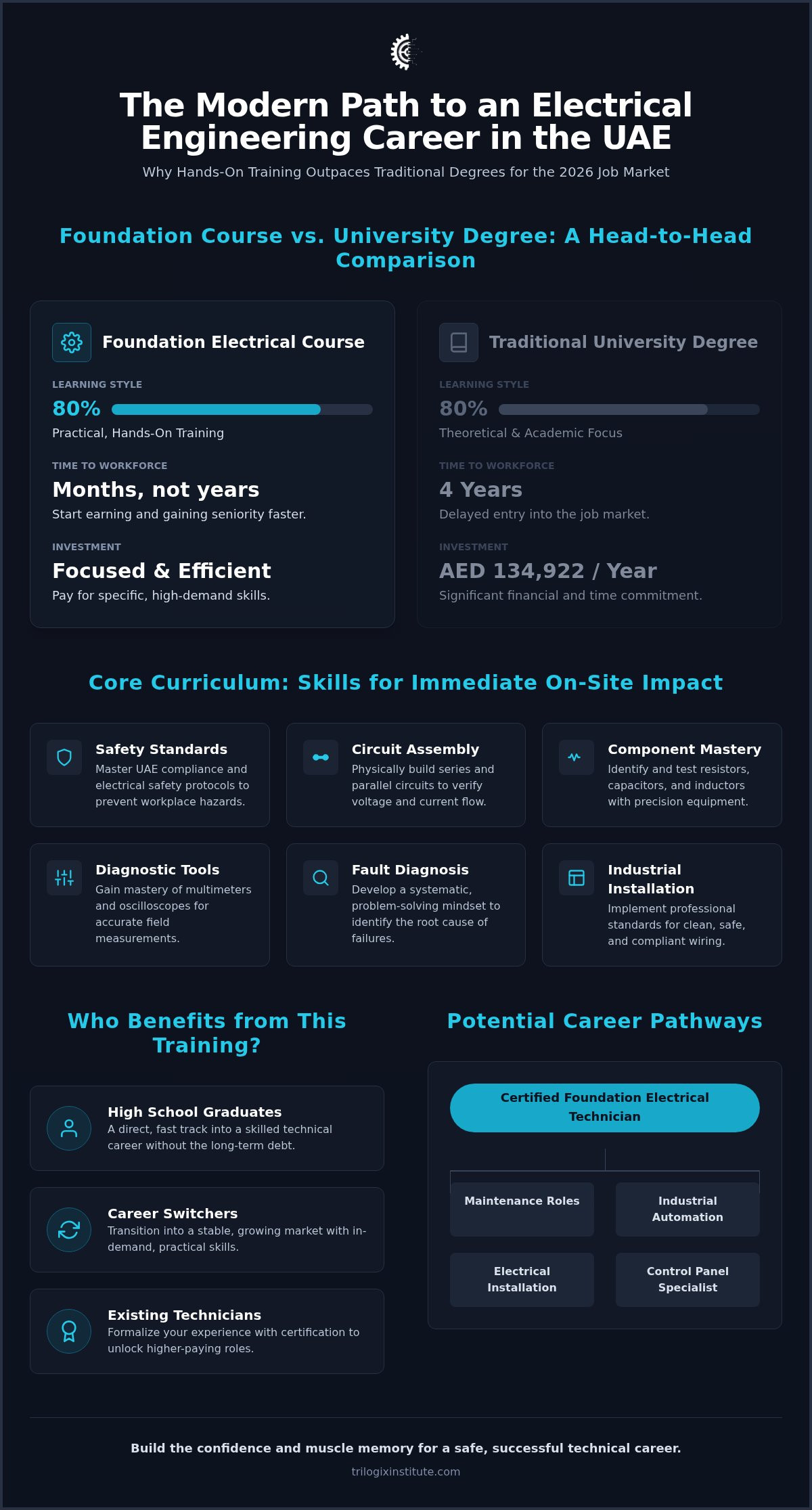
- Safety Standards: You'll master UAE compliance and electrical safety protocols to prevent workplace hazards and ensure regulatory alignment.
- Diagnostic Mastery: Learning to use professional measurement equipment like oscilloscopes and multimeters is critical for accuracy in the field.
- Fault Diagnosis: We cultivate a systematic problem-solving mindset. You'll learn to identify why a circuit failed, not just how to replace a fuse. This analytical approach is what separates a basic laborer from a skilled technician.
Foundation vs. Academic Degrees: A Quick Comparison
Choosing the right path depends on your career timeline and financial goals. Traditional university degrees often take four years and require a massive financial commitment. A foundation electrical engineering course Dubai offers a different, results-oriented value proposition:
- Speed to Market: You can enter the workforce in months, not years. This allows you to start earning and gaining seniority much earlier than university peers.
- Focused Investment: You pay for specific, high-demand skills rather than general electives that don't apply to your daily tasks on a job site.
- Practical Ratio: While degrees are often 80% theoretical, foundational training flips this. You'll spend roughly 80% of your time in real-world equipment labs, building the muscle memory that employers value.
Core Curriculum: What You Will Master in a Foundation Course
The TTI Dubai Foundation Electrical Engineering curriculum is built on the principle of immediate utility. Academic programs often dwell on high-level physics that doesn't apply to daily technical tasks. In contrast, this course focuses on the tangible systems you'll encounter on a job site. You start by mastering DC and AC circuit theory using real-world components rather than just software simulations. This hands-on approach ensures you understand how electricity behaves in physical wires and panels before you ever step onto a commercial project.
Essential Circuitry and Component Mastery
Mastering the fundamentals is the first step toward professional competence. In the foundation electrical engineering course Dubai, students transition quickly from theoretical calculations to the physical assembly of series and parallel circuits. This phase involves deep interaction with the hardware that forms the backbone of any electrical system. You will focus on:
- Physical Assembly: Building series and parallel circuits to verify voltage drops and current flow.
- Component Testing: Identifying and testing resistors, capacitors, and inductors using precision multimeters.
- Installation Standards: Implementing industrial electrical installation standards to ensure clean, safe, and compliant wiring.
Circuit troubleshooting requires a systematic verification of continuity and insulation resistance while strictly adhering to lockout-tagout safety protocols.
Introduction to Industrial Controls
Industrial environments rely on more than just basic power distribution; they require sophisticated control logic to manage heavy machinery. You'll gain a deep understanding of the components that drive modern infrastructure, such as relays, contactors, and timers. Understanding these parts allows you to interpret the basic logic inherent in electrical control systems. A key practical exercise involves building a simple motor starter circuit from scratch. This task builds the confidence needed to handle larger industrial systems and prepares you for the complexities of the modern workplace.
Precision in the field begins with accurate documentation and planning. The curriculum includes essential training in blueprint reading and basic AutoCAD 2D drafting for electrical layouts. These skills are vital for anyone looking to understand Career Pathways for Electrical Technicians, as the ability to interpret technical drawings is a universal requirement for advancement. Mastering these tools ensures your work meets the high standards of Dubai's engineering firms. If you're ready to start building these skills, you can explore the full technical course catalog to find the right fit for your professional goals.
Practical Lab Training vs. Theoretical Learning: Which Path Secures Employment?
Theoretical knowledge provides the "why," but only practical lab training provides the "how." In the competitive UAE job market, employers don't just look for certifications; they look for muscle memory. A professional foundation electrical engineering course Dubai prioritizes equipment interaction because handling real wires, panels, and diagnostic tools is irreplaceable. You can't learn the tension required for a secure terminal connection or the subtle smell of an overheating component through a screen. Physical dexterity is a prerequisite for safety and efficiency on any industrial site.
Instructor-led guidance adds a layer of value that self-paced modules cannot replicate. When you make a mistake in a lab, an expert is there to provide immediate feedback. This correction process is where true learning happens. It transforms a potential safety hazard into a controlled lesson, preparing you for the high-pressure reality of UAE industrial environments. By the time you reach a job site, your on-the-job training time is significantly reduced, making you a more attractive candidate for immediate hire.
The Limitations of Online Engineering Modules
Digital simulations often fail because they remove the physical consequences of technical errors. While some institutions promote flexible online options, these programs don't teach the hand-eye coordination needed to navigate a cramped electrical cabinet. Entering a live workshop with only theoretical knowledge poses significant safety risks to yourself and your team. Additionally, a physical classroom fosters peer-to-peer learning. It allows you to observe different troubleshooting approaches and collaborative problem-solving in real-time.
Inside the Equipment-Based Lab
True technical mastery requires working with industrial-grade hardware. Students at TTI Dubai engage directly with Programmable Logic Controllers (PLCs) and motor controllers. These are the same systems powering Dubai's infrastructure. Beyond the hardware, modern electrical design relies on precision software. Integrating TTI Dubai Advanced AutoCad 2D & 3D skills into your workflow allows you to move from a digital blueprint to a physical installation with total accuracy.
Safety remains the non-negotiable foundation of our laboratory environment. Every student must master Personal Protective Equipment (PPE) protocols and laboratory safety standards before touching live equipment. This disciplined approach ensures that your habits align with global industry standards. It makes you a reliable asset from your first day of employment.
Career Pathways for Electrical Technicians in the UAE
A foundation electrical engineering course Dubai is the first step toward a career where technical mastery dictates your earning potential. The UAE job market in 2026 rewards specialized skill sets over generalist backgrounds. For those entering the field, the starting point often involves roles such as Junior Electrician, Maintenance Technician, or Assistant Drafter. Research indicates that entry-level technicians with 0 to 1 years of experience typically earn an average monthly salary of AED 2,788. While this serves as a solid starting point, the real financial upside lies in mid-level advancement.
As you gain experience, you can transition into roles like Industrial Electrician or Control Systems Technician. These positions involve managing more complex infrastructure and troubleshooting critical failures in commercial or industrial settings. The city's booming construction and hotel sectors ensure a consistent demand for these skilled professionals. Completing a foundation electrical engineering course Dubai provides the technical literacy required to climb this ladder efficiently and securely.
From Foundation to Industrial Automation
Mastering basic motor control is the gateway to the high-demand field of industrial automation. Modern UAE manufacturing and logistics hubs rely heavily on automated systems to maintain production efficiency. By building on the skills learned in a foundation course, you can eventually specialize in Programmable Logic Controllers (PLCs) and SCADA systems. This specialization is where technicians often see the most significant jumps in salary and responsibility.
Lifelong learning is essential in a fast-moving technical landscape. Developing a portfolio of short-term technical courses allows you to adapt to new technologies as they emerge. For instance, moving from wiring fundamentals to a TITP Beginner Essential Industrial Motor Control course provides the specific logic skills required for automation. This progression ensures you remain an indispensable asset to your employer as the industry evolves.
Industry Standards and Certification Value
A UAE resume gains immediate credibility when it features KHDA-approved training. This accreditation signals to employers that your skills align with both local regulations and international standards, such as those set by the International Electrotechnical Commission (IEC). Compliance with Dubai Electricity & Water Authority (DEWA) standards is also a critical factor for career progression in the local market. It's often the difference between being overlooked and being shortlisted for a premium role.
Practical certification serves as the definitive proof of your industry readiness and technical competency in a high-stakes environment. It bridges the gap between being a student and becoming a professional. If you're ready to formalize your expertise and enter the technical workforce, you can contact our admissions team to secure your professional future today.
Start Your Professional Journey with TTI Dubai Foundation Electrical Engineering
Trilogix Institute (TTI Dubai) provides a clear path for students who value utility over abstract academia. Choosing the right institution is a critical decision that influences your professional trajectory for years. Our foundation electrical engineering course Dubai is designed to transform ambition into a measurable skill set. We focus on vocational excellence, ensuring every hour spent in our lab translates to a capability you can list on your resume. This pragmatic approach is why results-oriented students select our program to bridge the gap between their current status and a technical career.
Our instructors are not career academics. They are Meet our instructors: Industry insiders with real-world experience. who understand the daily challenges of the UAE technical sector. This mentorship ensures you learn the nuances of the trade that textbooks often omit. You will train in a KHDA-accredited environment using professional tools and systems. We invite you to take A look inside our state-of-the-art training facilities. to see the industrial equipment you will master during your enrollment. This equipment-based approach is the primary differentiator that prepares you for immediate employment.
A comprehensive skill set requires more than just wiring knowledge. By integrating AutoCAD drafting and motor control logic, TTI Dubai prepares you for complex project environments. You'll move beyond simple installations to understand the design and logic phases of electrical engineering. This modular approach allows you to stack certifications, eventually leading to an Industrial Automation Specialization. This progression makes you a versatile asset capable of handling both the physical and digital demands of modern infrastructure. Our curriculum ensures that your foundation electrical engineering course Dubai serves as a springboard for these advanced technical specializations.
Transitioning from a learner to a certified professional is a structured, logical process. There are no overly complex prerequisites; we look for individuals with a commitment to technical precision and safety. For your first lab session, you only need a focus on accuracy and a willingness to engage with live systems. From there, we guide you through the certification process and help you align your new skills with international standards. Your journey toward a stable, high-demand career starts with a single practical step in our training facility. Contact Trilogix Institute to begin your technical career and secure your place in the 2026 workforce.
Secure Your Technical Future with Practical Mastery
The UAE’s 2026 technical landscape demands precision and immediate readiness. As we’ve discussed, the most efficient route to professional success isn't through abstract theory, but through the tactile experience of a modern workshop. By selecting a foundation electrical engineering course Dubai, you’re investing in a curriculum that prioritizes equipment-based training and real-world fault diagnosis. This approach ensures you don't just understand the logic of a circuit; you possess the physical skill to build and maintain it safely.
Trilogix Institute provides a no-nonsense path to technical employment through instructor-led sessions and an industry-aligned vocational curriculum. You’ve seen the career pathways available, from maintenance roles to industrial automation specializations. Now is the time to transition from an observer to a practitioner in one of the region's most stable industries. Your career doesn't have to wait for a four-year degree when you can start building your expertise today.
Enroll in the TTI Dubai Foundation Electrical Engineering Course Today and take command of your professional journey. We’re ready to help you turn your technical ambition into a lasting career.
Frequently Asked Questions
Is a foundation electrical engineering course equivalent to a university degree?
No, this program is a vocational training course rather than an academic degree. While university programs focus heavily on theoretical physics and advanced mathematics over several years, the TTI Dubai Foundation Electrical Engineering program prioritizes immediate technical proficiency. It's designed to bridge the gap between ambition and employment by providing the hands-on skills required for the 2026 job market in a significantly shorter timeframe.
How long does it take to complete the TTI Dubai Foundation Electrical Engineering program?
The program is structured to be an intensive, accelerated path into the technical workforce. Unlike degree programs that take years, our foundation electrical engineering course Dubai focuses on high-impact learning that can be completed in a matter of months. This allows students to enter the workforce and begin earning a salary much sooner. You should contact our admissions team for the specific schedule of the next intake.
Can I work as an electrician in the UAE after completing this course?
Yes, completing this course prepares you for entry-level technical roles such as Junior Electrician or Maintenance Technician. The curriculum aligns with industry standards and safety protocols essential for working on UAE job sites. While specific licenses like DEWA certification require additional government-mandated testing, this foundational training provides the practical equipment-based knowledge necessary to pass those exams and handle real-world electrical faults confidently.
Do I need prior experience in physics or math to enroll in a foundation course?
No, prior advanced experience in physics or mathematics isn't required for enrollment. We've designed the curriculum to be accessible for high school graduates and career switchers who are starting from scratch. Our instructors guide you through the necessary core principles of DC and AC theory as part of the practical training. The focus remains on how these principles apply to physical equipment rather than abstract calculations.
What kind of equipment will I use during the hands-on lab sessions?
Students work directly with industrial-grade hardware in our state-of-the-art labs. You'll master the use of diagnostic tools such as digital multimeters and oscilloscopes to test resistors, capacitors, and inductors. The training also includes interaction with real-world electrical panels, relays, contactors, and timers. This equipment interaction is critical for building the muscle memory that UAE employers prioritize when hiring new technicians for high-pressure industrial environments.
Is the AutoCAD training included in the foundation electrical engineering course?
While basic blueprint reading is covered, the TTI Dubai Advanced AutoCad 2D & 3D is a distinct specialized program. Many students choose to combine these courses to build a more comprehensive skill set. Mastering AutoCAD allows you to move from digital drafting to physical installation with total accuracy. This combination is highly valued in the UAE construction and engineering sectors, where technical drawing literacy is a standard requirement.
Are the certifications from Trilogix Institute recognized by UAE employers?
Yes, our training is delivered in a KHDA-accredited environment, which carries significant weight on a UAE resume. This accreditation ensures that the training meets the quality standards set by the Knowledge and Human Development Authority. Employers across the country recognize these certifications as proof of industry-aligned vocational excellence. It signals that you've been trained on real equipment by industry insiders rather than just completing online modules.
Can I transition into industrial automation after this foundation course?
Absolutely, this course is the ideal prerequisite for our Industrial Automation Specialization. Once you've mastered the fundamentals of circuitry and basic motor control, you can progress to more complex systems like Programmable Logic Controllers (PLCs) and SCADA. This clear progression map allows you to start with the basics and systematically build toward a high-paying career in the UAE's growing manufacturing and logistics sectors.


