
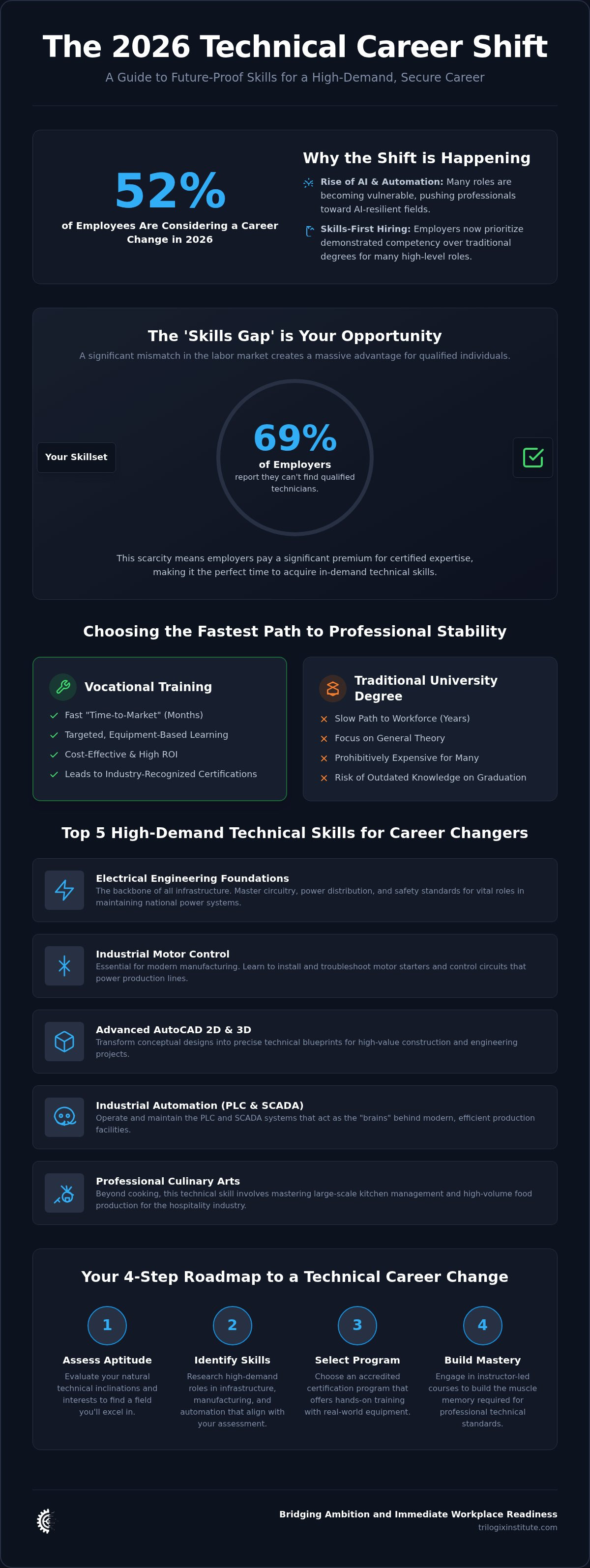
An estimated 52% of employees are considering a career change in 2026, yet many feel paralyzed by the rapid rise of AI and the prohibitive costs of traditional university degrees. It's natural to feel anxious about starting over in a field where you have no background, especially when you're worried about being replaced by automation. You likely want a stable, lucrative career path that offers immediate application rather than years of theoretical study. This guide identifies the most resilient technical skills for career change that lead to recognized industry certifications and high-demand roles in engineering and automation.
We believe that hands-on, equipment-based training is the most efficient bridge between your current ambition and a new professional reality. You'll discover why physical technical mastery often outweighs digital-only literacy in the current job market. This article explores the specific advantages of mastering tools through programs like TTI Dubai Advanced AutoCad 2D & 3D and Industrial Automation Specialization. We provide a clear roadmap to acquiring practical skills that are immediately applicable in the workplace, ensuring your next career move is both secure and rewarding.
Key Takeaways
- Understand the 2026 shift toward skills-first hiring and why physical technical mastery provides greater job security than digital literacy alone.
- Identify the high-demand technical skills for career change that lead to stable roles in infrastructure, manufacturing, and industrial automation.
- Learn why hands-on training with real-world equipment is the fastest way to build the muscle memory required for professional technical standards.
- Follow a methodical 4-step roadmap to assess your technical aptitude and select an accredited certification program that aligns with your career goals.
- Discover how instructor-led courses like the TTI Dubai Foundation Electrical Engineering bridge the gap between ambition and immediate workplace readiness.
Why Technical Skills are the New Career Currency in 2026
In 2026, the definition of professional value has undergone a fundamental shift. We define technical skills as the practical ability to perform specific, equipment-related tasks that sustain our physical world. While digital literacy remains relevant, the real economic power now lies in hardware, infrastructure, and automation. The national market has moved decisively toward a skills-first hiring model. This movement is validated by legislative shifts like the Federal Jobs for STARs Act, which prioritizes demonstrated competency over traditional four-year degrees for many high-level roles. For those identifying the right technical skills for career change, this represents a unique window of opportunity.
Vocational trades offer a unique defense against AI-driven automation. AI tools can process data or generate reports, but they cannot physically rewire a control panel or calibrate a complex industrial motor. This physical barrier makes technical trades highly resilient. As the World Economic Forum projects that 39% of workers' core skills will become obsolete by 2030, understanding the concept of retraining is no longer an optional pursuit; it's a vital survival strategy. 2026 is the year to move from vulnerable administrative roles to the stable, tangible world of engineering and automation.
The 'Skills Gap' and Your Opportunity
The current labor market is defined by a significant mismatch. Approximately 69% of employers report they can't find the qualified technicians they need to keep operations running. This scarcity creates a massive opportunity for you. Because the talent pool is shallow, employers are paying a significant premium for certified expertise. High-growth industries like industrial automation and electrical infrastructure are actively seeking individuals who can demonstrate immediate competence. When you acquire the right technical skills for career change, you aren't just looking for a job. You're filling a critical economic void that employers are desperate to bridge.
Vocational Training vs. University Degrees
The traditional path of a four-year degree is increasingly seen as a slow, expensive route to a job market that moves too fast. Vocational training focuses on 'time-to-market.' Instead of spending years on general theory, you spend months on targeted, equipment-based learning. This approach is far more cost-effective and allows you to enter the workforce with recognized certifications much sooner. If you're weighing your options, comparing Vocational Training vs. University Degree reveals that hands-on certification is the fastest path to professional stability.
Top 5 Technical Skills for a Successful Career Change
Identifying the most lucrative technical skills for career change requires looking beyond digital trends toward the physical systems that keep the world running. While many focus on software, the real demand lies in infrastructure, manufacturing, and technical design. According to the Harvard Division of Continuing Education, identifying emerging skills for professionals is crucial for staying competitive in an economy that increasingly values specialized, practical knowledge. We have identified five core areas where mastery leads to immediate professional value.
- Electrical Engineering Foundations: This is the backbone of all industrial and residential infrastructure. It involves understanding circuitry, power distribution, and safety standards.
- Industrial Motor Control: Mastering the systems that power modern manufacturing is essential. Technicians who can install and troubleshoot motor starters and control circuits are in high demand.
- Advanced AutoCAD 2D & 3D: This skill transforms conceptual designs into precise technical blueprints for construction and engineering projects.
- Industrial Automation: This field focuses on operating and maintaining PLC and SCADA systems, which are the brains behind modern production lines.
- Professional Culinary Arts: Beyond basic cooking, this involves the technical side of large scale hospitality, including kitchen management and high volume food production.
Foundation Electrical Engineering and Motor Control
The role of a technician in maintaining national power systems is vital for economic stability. Without these professionals, manufacturing plants and residential grids simply don't function. Starting with the TITP Beginner Essential Industrial Motor Control program provides a critical entry level skill set. It allows you to understand how heavy machinery is powered and protected. The career path is clear. You begin as a junior technician, move into specialized maintenance, and can eventually progress to a senior systems engineer role. This progression is built on the steady accumulation of equipment based experience. If you are ready to start this journey, you can explore our vocational programs to find your starting point.
Technical Design and Automation
Mastery of TTI Dubai Advanced AutoCad 2D & 3D is no longer just for architects. It's a foundational requirement for modern construction and manufacturing. Being able to visualize and draft technical components allows you to bridge the gap between engineering theory and physical production. This expertise intersects perfectly with the rise of smart factories. In these environments, design and automation work together. Technicians must understand how a 3D model translates into a physical automated system. For those looking to specialize further, the Industrial Automation Specialization Course offers the deep technical training required to manage complex robotic and PLC systems. This combination of design and control skills ensures your relevance in a rapidly evolving industrial market.
Theory vs. Practice: Why Hands-On Training Wins
Digital platforms offer convenience, but they often fail when teaching the high-stakes technical skills for career change required in engineering and automation. You can't develop the necessary muscle memory for industrial systems through a mouse click. Real-world troubleshooting requires physical interaction with live circuits and rotating machinery. Employers in 2026 have become increasingly skeptical of purely virtual certifications. They prioritize candidates who've logged significant hours in equipment-based labs. The myth that a career transition into the trades can be fully remote is simply inaccurate. Physical mastery requires a physical presence.
Learning through observation is fundamentally different from learning through action. When you're standing in front of an actual motor control center, the stakes are higher and the learning is deeper. Tactile feedback helps you understand the nuances of equipment behavior that a screen simulation simply can't replicate. This practical experience is what transforms a beginner into a competent technician. It's the difference between knowing the theory of electricity and being able to safely wire a complex industrial panel. For career switchers, this shop-floor readiness is the ultimate competitive advantage.
The Instructor-Led Advantage
Instructor-led training provides a critical safety net and an immediate feedback loop. When you're working with complex machinery, a correction from an expert mentor can prevent equipment damage and personal injury. These professionals bridge the gap between abstract theory and the messy reality of a workshop. They share the industry secrets and troubleshooting shortcuts that aren't found in manuals. Learning alongside peers in a lab setting also simulates the collaborative nature of the modern industrial workplace. It accelerates your progress by exposing you to a wider variety of troubleshooting scenarios than any solo simulation could provide.
Equipment-Based Learning Standards
We define equipment-based training as instruction using the exact hardware found on modern industrial floors. This includes Programmable Logic Controllers (PLCs), high-torque motors, and professional drafting software like TTI Dubai Advanced AutoCad 2D & 3D. This isn't just about familiarity; it's about meeting global industry standards. For those seeking specialized Electrical Engineering Courses in Dubai, the focus must remain on tactile competence. Mastering these tools ensures that your technical skills for career change are immediately transferable to the workplace. This direct application reduces the need for extensive on-the-job training and makes you a more attractive hire from day one.
The 4-Step Roadmap to Your Technical Career Change
Changing your professional trajectory requires more than just a resume update. It demands a methodical approach to identifying and mastering the right technical skills for career change. We recommend a four-stage process that moves from internal assessment to external validation. This sequence ensures you don't waste time on training that doesn't align with your strengths or market demand. By following this roadmap, you replace career anxiety with a structured plan for professional advancement.
- Step 1: Aptitude Assessment. Identify if your strengths lie in conceptual design or physical system maintenance.
- Step 2: Targeted Skill Acquisition. Enroll in an accredited, equipment-based program that offers instructor-led labs.
- Step 3: Portfolio Development. Document every circuit you wire and every 3D model you draft to prove your competence.
- Step 4: Industry Certification. Earn recognized credentials that confirm your readiness for professional employment.
Choosing Your Technical Path
Identifying your ideal niche is the foundation of a successful transition. You might find that you prefer the precision of digital drafting in TTI Dubai Advanced AutoCad 2D & 3D. Alternatively, you may thrive in the active, hands-on environment of the TTI Dubai Foundation Electrical Engineering lab. Short-term courses are an excellent way to test these waters without a years-long commitment. They provide a low-risk environment to determine if a specific field resonates with your problem-solving style. For those interested in the mechanical side of things, our Motor Control Certification Guide offers a deep dive into what this specialization requires.
Building a Technical Portfolio
Recruiters in the industrial sector look for proof of performance. Since you may lack years of prior industry experience, your portfolio must speak for you. This document should include high-resolution photos of your lab projects, detailed circuit designs, and CAD models. It's about showing, not just telling. When you can present a documented history of troubleshooting real-world equipment, you bypass many of the traditional barriers to entry. A strong portfolio, backed by an industry-recognized certification, allows you to compete with candidates who have years of general experience but lack your specific, specialized training. If you're ready to start building your professional proof, you can view our full course catalog to begin your transformation today.
How Trilogix Institute Facilitates Your Transformation
Trilogix Institute operates on a pragmatic philosophy: education must be a functional tool for professional advancement. We don't deal in abstract theories or purely academic pursuits. Instead, we provide the specific technical skills for career change that the 2026 industrial market demands. Whether you're training at our UAE or Philippines campuses, our instructor-led approach ensures you're prepared for global standards. The TTI Dubai Foundation Electrical Engineering program is specifically structured for those transitioning from non-technical backgrounds. It offers a clear, methodical path into the power and infrastructure sectors by focusing on the core competencies employers prioritize.
For individuals targeting the design and construction markets, the TTI Dubai Advanced AutoCad 2D & 3D course provides more than just software proficiency. It prepares you to produce industry-standard blueprints that are immediately applicable on a job site. This focus on utility is what sets our graduates apart. We understand that a career switcher needs more than a certificate; they need the readiness to perform on day one. By mastering these tools in a professional setting, you align your capabilities with the actual needs of the national workforce. This alignment is the key to securing a stable, lucrative role in a competitive economy.
Practical Labs and Expert Instructors
Our training centers feature specialized labs for PLC, Motor Control, and AutoCAD. You won't be watching pre-recorded videos or navigating virtual simulations. You'll be operating real-world industrial equipment under the guidance of experienced professionals. Our instructors act as career mentors, offering real-time feedback that bridges the gap between ambition and employment. We focus on an accredited vocational curriculum that employers actually recognize. This hands-on environment is designed to build the confidence necessary for a successful transition into technical engineering or automation roles. Our facilities include:
- Dedicated labs for Industrial Automation Specialization and PLC programming.
- Advanced motor control centers for TITP Beginner Essential Industrial Motor Control training.
- Modern drafting stations equipped with the latest AutoCAD software.
Next Steps for Aspiring Technicians
Your transformation begins with a clear-eyed assessment of your professional goals. We invite you to schedule a consultation at Trilogix to discuss which program aligns with your strengths. Preparing for your first day in a technical lab environment involves adopting a mindset of precision and safety. We are here to act as your partner in this journey, providing the no-nonsense path to success you've been looking for. If your interests lean toward the hospitality sector, you might also consider our Professional Culinary Arts Training. You can reach out to our team to book your initial career assessment and take the first step toward a stable future.
Take Command of Your Career Trajectory
The transition into a stable, technical role requires more than ambition; it requires a commitment to physical mastery. We've established that the most resilient technical skills for career change in 2026 are found in the fields of electrical engineering, industrial automation, and technical design. Moving through a structured roadmap from aptitude assessment to industry certification ensures that your professional pivot is grounded in market reality.
Trilogix Institute facilitates this journey through instructor-led training and specialized labs. You don't just learn theory; you operate the actual machinery used in modern industry. With the guidance of our expert faculty and the attainment of industry-recognized certifications, you'll enter the workplace with the confidence of an insider. Every lab session is designed to bridge the gap between your current experience and the demands of a high-growth technical field.
Explore our hands-on technical courses at Trilogix Institute to find the path that aligns with your strengths. Your professional transformation is within reach, and we're ready to help you build a more secure and lucrative future.
Frequently Asked Questions
What are the best technical skills for a career change with no experience?
Foundation Electrical Engineering and AutoCAD are excellent starting points for those without a technical background. These fields prioritize practical competency and equipment mastery over prior work history. Our TTI Dubai Foundation Electrical Engineering course is designed specifically for switchers to build a strong base in power systems. These skills are vital to national infrastructure, providing a clear entry point into industries where hands-on ability is the primary hiring criterion.
How long does it take to learn a new technical skill for a job?
While a university degree takes years, vocational certification focuses on intensive, accelerated learning. Most specialized technical skills for career change can be mastered in several months of dedicated, instructor-led training. The exact timeline depends on the complexity of the machinery involved. Mastering motor control or 3D drafting involves building muscle memory through repetitive lab work. This targeted approach allows you to enter the workforce much faster than traditional academic routes.
Can I learn electrical engineering or AutoCAD through online courses?
You can learn basic theory online, but professional proficiency requires physical interaction with real-world equipment. We don't offer purely online self-paced courses because they lack the tactile feedback needed for industrial safety and accuracy. Mastery of TTI Dubai Advanced AutoCad 2D & 3D or electrical systems demands specialized labs where you can troubleshoot actual hardware. Physical training ensures you meet the rigorous standards that national employers expect from certified technicians.
Are vocational certifications better than university degrees for career switchers?
Vocational certifications are often more pragmatic for switchers because they prioritize time-to-market and practical application. A degree involves extensive general theory that might not be immediately useful in a workshop. In contrast, our accredited vocational curriculum focuses on equipment mastery that's directly transferable to the workplace. This results-oriented approach is cost-effective and aligns with the 2026 industry shift toward skills-based hiring over traditional academic credentials.
What industries are hiring for technical roles in 2026?
Industrial automation, sustainable energy infrastructure, and advanced manufacturing are the primary drivers of technical employment in 2026. These sectors require technicians who can operate PLCs, manage motor controls, and execute complex CAD designs. As national infrastructure modernizes, the demand for certified electrical and automation specialists continues to outpace the available talent pool. This creates a stable environment for individuals who've invested in specialized, equipment-based training programs.
Do I need a background in math or science to start a technical career change?
A basic understanding is helpful, but you don't need an advanced academic background to begin. Our programs, such as the TITP Beginner Essential Industrial Motor Control, start with foundational concepts. We teach the specific mathematical and scientific principles required for the job within the context of practical lab work. This applied learning style makes technical subjects more accessible and ensures you understand the logic behind every physical task you perform.
How do I show technical skills on my resume if I'm changing careers?
Focus on your technical skills for career change by highlighting specific projects, certifications, and lab hours. Instead of listing general duties, describe the equipment you've mastered, such as specific PLC models or AutoCAD versions. Include a portfolio that documents your circuit designs or 3D models. This evidence-based approach proves to recruiters that you possess the hands-on competency required for the role, effectively bypassing a lack of prior industry work history.
Is it too late to start a technical career change at 40?
It's never too late to pivot, as the average age for a career change is currently 39. Many individuals at 40 bring valuable soft skills like problem-solving and reliability, which complement technical training. Industries in 2026 prioritize certified ability and equipment mastery over age. By acquiring specialized skills in fields like industrial automation, you can secure a lucrative and stable career path that remains resilient against AI-driven automation for decades.


