

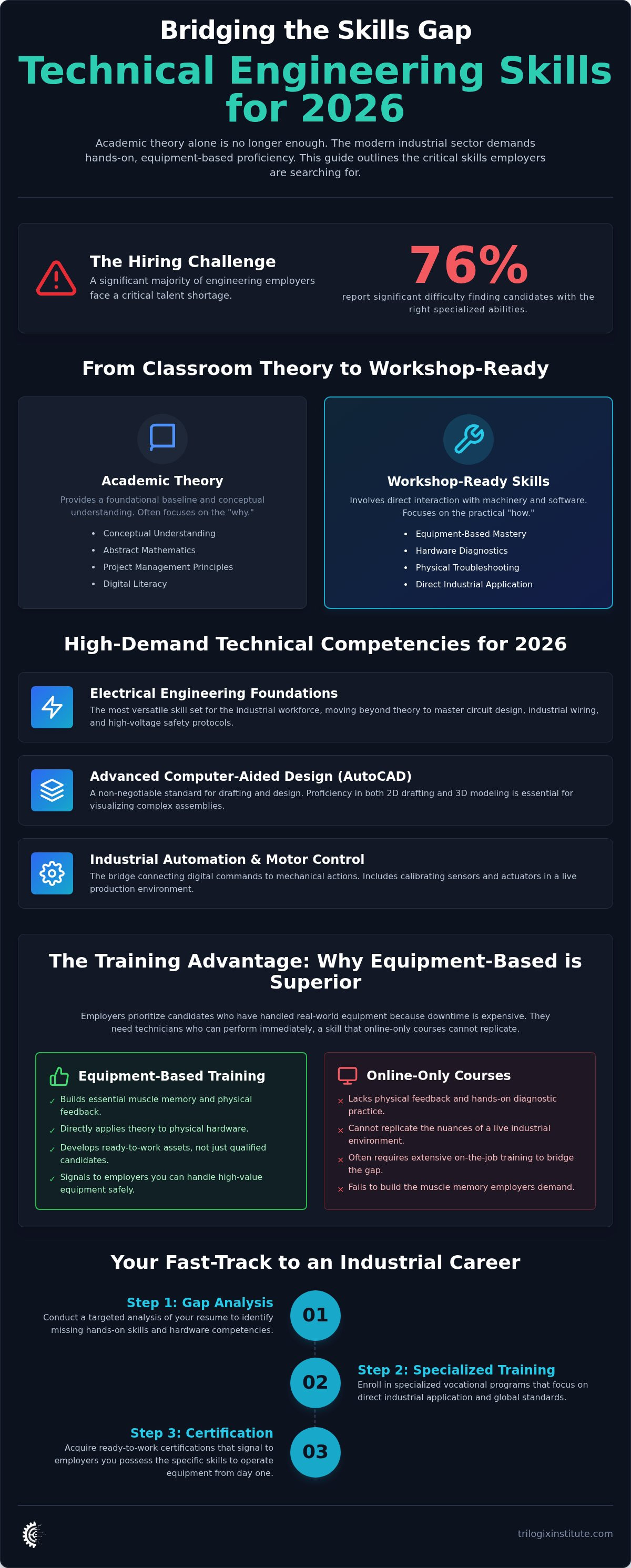
Did you know that 76% of engineering employers report significant difficulty finding candidates with the right specialized abilities? It's a frustrating reality for many graduates who hold a prestigious degree but realize their academic theory doesn't match the demands of a modern industrial workshop. You've likely felt that gap between what you studied and the actual technical engineering skills for employment that recruiters demand in 2026. It's natural to feel overwhelmed by the rapid shift toward automation or the constant updates to software standards.
We're here to bridge that gap by focusing on equipment-based mastery rather than just digital literacy. You'll learn exactly which high-demand competencies and hardware standards are essential for the current industrial landscape. This guide provides a clear list of employable skills, explains the difference between classroom theory and being workshop-ready, and outlines a fast-track path to securing employment. We'll explore everything from advanced AutoCAD applications to the critical nuances of industrial motor control and automation systems.
Key Takeaways
- Define the critical difference between theoretical knowledge and the hard technical skills needed to operate and maintain complex industrial machinery.
- Identify why electrical engineering foundations and industrial motor control are the most versatile technical engineering skills for employment in 2026.
- Understand why equipment-based training is superior to online-only courses for developing the physical feedback and muscle memory employers demand.
- Discover how to conduct a targeted gap analysis on your resume to find the specific vocational certifications that fast-track your industrial career.
- Learn how specialized vocational programs offer a high-speed alternative to traditional degrees by focusing on direct industrial application and global standards.
What are Technical Engineering Skills for Employment in 2026?
Technical engineering skills for employment refer to the specific ability to operate, maintain, and design complex industrial systems. While academic theory provides a foundational baseline, the 2026 job market demands more than just a conceptual understanding of What is Engineering? and its various branches. Employers now distinguish sharply between "soft" engineering, which involves project management or abstract mathematics, and "hard" technical skills. These hard skills involve direct interaction with machinery, programmable logic controllers, and design software. In a fast-moving industrial environment, having the capacity to troubleshoot a physical circuit or refine a 3D model is what actually secures a role.
The Shift Toward Equipment-Based Proficiency
Industry leaders no longer have the luxury of providing extensive on-the-job training for foundational concepts. They prioritize candidates who have already handled real-world industrial motor controls and power distribution units. This shift occurs because downtime is expensive; companies need technicians who can step onto the floor and perform immediately. Equipment-based training is the direct application of theory to physical hardware. It builds the necessary muscle memory that online-only modules simply cannot replicate. By mastering these physical competencies, you move from being a qualified candidate to a ready-to-work asset. The decline of traditional on-the-job training means that the burden of readiness now sits with the applicant.
Digital vs. Physical Technical Skills
The modern engineer must balance digital literacy with manual diagnostic capabilities. Proficiency in AutoCAD 2D & 3D is a non-negotiable standard for drafting and design roles in 2026. However, software knowledge alone is insufficient if you don't understand how those designs translate to the physical world. Industrial automation serves as the bridge here, connecting digital commands to mechanical actions. You must be able to:
- Interpret complex technical drawings and translate them into physical builds.
- Utilize diagnostic tools to identify hardware failures that software might miss.
- Apply advanced AutoCAD techniques to optimize industrial workflows.
- Calibrate automated sensors and actuators within a live production environment.
This dual mastery ensures you aren't just a software operator, but a comprehensive technical expert capable of managing the entire lifecycle of an industrial system. Traditional academic paths often focus on the "why" but neglect the practical "how." Vocational programs that offer ready-to-work certifications provide a faster, more pragmatic route to employment. These certifications signal to employers that you possess the specific technical engineering skills for employment required to handle high-value equipment safely and efficiently from day one.
High-Demand Technical Competencies for the Industrial Sector
The industrial sector in 2026 requires a specific blend of manual dexterity and digital intelligence. While many candidates focus on general management, those who possess specialized Essential Engineering Skills for 2026 find themselves at a distinct advantage. Mastery of core technical engineering skills for employment ensures that you can handle the complexity of modern smart factories without constant supervision. Recruiters are actively seeking individuals who can demonstrate proficiency with physical hardware and advanced design software simultaneously.
Electrical Engineering Foundations
Electrical engineering remains the most versatile skill set for the industrial workforce. You must move beyond basic theory to master circuit design and industrial wiring standards. This includes understanding the specific safety protocols required for high-voltage environments, where a single error can lead to catastrophic equipment failure. Developing a strong base in Foundation Electrical Engineering provides the prerequisite knowledge needed for more complex automation roles. It's about being able to read a schematic and translate it into a functional, safe installation that meets global regulatory standards.
Advanced Computer-Aided Design (AutoCAD)
Professional project documentation has evolved significantly. Modern industrial engineers must move beyond 2D drafting; 3D modeling is now the industry standard for visualizing complex assemblies and piping layouts. Speed and accuracy in professional drafting allow for rapid prototyping and clearer communication with fabrication teams. For those looking to refine their design capabilities, the Advanced AutoCAD 2D & 3D Course offers a comprehensive look at workflow optimization. This proficiency ensures your designs are not just accurate but also ready for immediate industrial application.
Industrial Automation and Motor Control
Smart factories rely heavily on Programmable Logic Controllers (PLCs) to reduce manual labor and increase precision. Understanding the role of these controllers is vital for anyone entering the manufacturing or infrastructure sectors. You'll need essential skills for troubleshooting motor control circuits and interpreting industrial sensors. A beginner-level motor control certification serves as a massive resume booster because it proves you can manage the "muscles" of the factory. Troubleshooting sensors and actuators in real-time is a high-value competency that separates basic technicians from true industrial experts. If you want to stay ahead, exploring an Industrial Automation Specialization can significantly shorten your path to a senior technical role. Mastering these hardware-software intersections is the most direct way to secure a stable position in today's competitive market.
The Value of Equipment-Based Training Over Theory
Academic knowledge provides the "why," but it often fails to deliver the "how" required in high-stakes industrial settings. While self-paced online modules offer convenience, they lack the physical feedback loop essential for mastering technical engineering skills for employment. You can't learn the tactile tension of a wire or the subtle vibration of a misaligned motor through a screen. This is where equipment-based learning becomes the critical differentiator for 2026 career seekers. It transforms abstract concepts into tangible abilities that you can use on a job site immediately.
Why Instructor-Led Guidance Matters
Working with complex industrial automation involves more than following a flowchart. It requires the ability to interpret real-time feedback from live systems. In an instructor-led environment, you receive immediate correction when a diagnostic step goes wrong. This direct guidance is why many are looking Beyond the Textbook for their professional development. Experienced mentors translate dense technical manuals into practical workplace actions that ensure safety and efficiency. They provide the context that a pre-recorded video simply cannot offer.
Simulation vs. Reality in Engineering Education
There's a massive gap between clicking a mouse in a simulator and physically wiring a motor control panel. Employers recognize this distinction immediately. They prioritize "lab hours" over "lecture hours" on a CV because hands-on experience builds muscle memory. This physical familiarity ensures you won't freeze when faced with a live industrial sensor failure. For a deeper look at this methodology, see our Equipment-Based Technical Training: 2026 Guide. It explains how interacting with physical hardware prepares you for the unpredictable nature of a real-world workshop.
University degrees often focus on broad, theoretical concepts that span several years. While these are valuable for research, they frequently lack the specific technical engineering skills for employment that modern industries demand. Equipment-based training drastically reduces "onboarding time" for new hires. When you've already handled the hardware, you don't need weeks of supervision to become productive. You arrive at the site ready to contribute, which is exactly what makes you an attractive candidate. This practical readiness is the bridge between possessing a qualification and actually being employable.
Acquire and Demonstrate Engineering Skills to Employers
Recruiters in 2026 don't just look for titles; they look for evidence. To secure a role, you must first identify the specific technical gap in your current resume by auditing recent job descriptions. If you lack hands-on experience with the latest industrial hardware, enrolling in a targeted vocational program is the most efficient solution. These programs provide the equipment access necessary to move beyond theoretical knowledge. Once you've acquired these technical engineering skills for employment, the next step is proving that mastery to a hiring manager through a structured, professional approach. Networking with industry insiders through vocational alumni groups further solidifies your position as a serious candidate.
Building a Technical Skills Portfolio
A technical portfolio serves as physical proof of your expertise. It should include your best AutoCAD 2D and 3D drawings alongside complex circuit diagrams. Don't just list the software; show the output. Use photos of your lab-based work to demonstrate your familiarity with actual industrial hardware. Each project should have a clear, technical description that outlines the objective, the equipment utilized, and the final results. This level of transparency shows an employer you're ready for the workshop, not just the classroom. It provides the concrete data points that recruiters need to verify your proficiency.
Selecting the Right Certification
Credibility is key when choosing a training path. You need to differentiate between generic certificates and industry-aligned vocational diplomas that employers respect. Always check for instructor expertise and accreditation before you commit your time. For those looking for verified, equipment-based programs, Trilogix Courses offer accredited paths that align with 2026 standards. Obtaining a recognized certification proves your competency in specific tools and systems. It makes your application significantly more persuasive by removing the guesswork for the hiring manager.
Interviewing for Technical Roles
When you reach the interview stage, you must speak the language of the shop floor. Avoid vague descriptions; instead, use specific examples of how you've troubleshot motor control circuits or programmed PLC sequences. Focus on your readiness and your ability to contribute to the team from day one. Hiring managers value problem-solving skills that have been tested on real equipment. If you can articulate a logical diagnostic process, you'll stand out as a practical expert. Ready to upgrade your profile? View our technical training programs to start bridging your skill gaps today.
Specialized Vocational Programs for Career Advancement
Securing a career in the industrial sector shouldn't require half a decade of theoretical study. Traditional four-year degrees often prioritize academic research over the practical, equipment-based mastery that recruiters demand. Specialized vocational training serves as a high-speed alternative, focusing strictly on the technical engineering skills for employment that matter in 2026. By stripping away the generalized fluff of a university curriculum, these programs allow you to target specific, high-demand competencies in a fraction of the time. This efficiency is vital for anyone looking to enter the job market quickly without sacrificing the depth of their technical knowledge.
The Trilogix Institute Approach
Our methodology at Trilogix Institute is built on the reality of the modern workshop. We prioritize instructor-led, small-group environments to ensure every student receives maximum equipment time. This isn't about watching a screen; it's about handling the hardware you'll encounter on the job. We align our curriculum with current industrial standards in automation, electrical design, and power systems. Whether you're mastering the TTI Dubai Foundation Electrical Engineering or diving into an Industrial Automation Specialization, you're learning on the same tools used by industry leaders. You can learn more about our specific teaching philosophy by visiting our About Us page. This practical focus ensures that your transition from the classroom to the factory floor is seamless and professional.
Taking the Next Step
Choosing the right path depends on your specific career goals and the current gaps in your resume. If you're drawn to design and project documentation, the TTI Dubai Advanced AutoCad 2D & 3D course provides the professional drafting speed required for engineering roles. If you prefer the mechanical side of the industry, the TITP Beginner Essential Industrial Motor Control program offers a direct route into manufacturing and infrastructure maintenance. The long-term ROI of investing in these practical engineering skills is clear. You aren't just buying a certificate; you're acquiring the ability to solve real-world problems from day one.
The path to a stable, high-paying technical role is shorter than you think. By focusing on equipment-based mastery and industry-aligned certifications, you position yourself as a ready-to-work asset. Don't let a lack of hands-on experience hold back your ambition. We invite you to contact the institute today for a career consultation to determine which of our specialized programs will best fast-track your industrial employment. Your future in engineering starts with the decision to move beyond the textbook and into the workshop.
Secure Your Industrial Future with Practical Mastery
The landscape of 2026 engineering demands a shift from passive learning to active, physical application. You've seen how mastering specific technical engineering skills for employment, such as industrial motor control and advanced AutoCAD, provides a significant advantage in a competitive market. Relying on theory alone isn't enough when employers prioritize candidates who can demonstrate readiness from their first hour on the shop floor. By choosing instructor-led training on real industrial hardware, you bypass the limitations of online-only modules and build the muscle memory required for high-stakes environments.
Trilogix Institute provides the pragmatic, results-oriented curriculum you need to turn your ambition into a professional reality. Our industry-aligned certifications prove your competency to global employers and ensure you're equipped for the smart factories of tomorrow. Don't let a lack of hands-on experience stall your career progression. Explore Hands-On Engineering Courses at Trilogix Institute and take the first step toward a specialized technical role today. It's time to bridge the gap between your potential and your professional success.
Frequently Asked Questions
What are the most important engineering skills for job market entry in 2026?
The most critical abilities include proficiency in industrial automation, PLC programming, and electrical system design. Employers in 2026 prioritize candidates who can manage smart factory hardware and renewable energy systems. Mastering technical engineering skills for employment, such as industrial motor control, ensures you can handle real-world troubleshooting. Digital literacy in 3D modeling is also essential for modern project documentation and collaborative industrial design environments.
Can I get an engineering job without a university degree?
Yes, you can secure a technical role by focusing on vocational specialization rather than a traditional four-year degree. Many industrial firms now prioritize specific competencies and equipment-based mastery over academic theory. By obtaining recognized certifications in fields like electrical engineering or automation, you demonstrate immediate readiness for the workshop. This path offers a high-speed alternative for those who want to enter the workforce quickly.
How long does it take to complete a vocational electrical engineering course?
Vocational programs are designed as accelerated paths to career entry, typically taking weeks or months rather than several years. These courses focus strictly on the most employable skills, such as circuit design and industrial wiring standards. While specific durations vary based on the depth of the curriculum, the goal is always to provide a fast-track to employment. This efficiency allows you to acquire high-demand technical skills and start your career sooner.
Is AutoCAD still relevant for engineering employment in 2026?
AutoCAD remains a non-negotiable standard for engineering employment in 2026. While basic 2D drafting is still used, the industry has shifted heavily toward 3D modeling for complex industrial assemblies. Proficiency in this software allows you to create accurate project documentation and optimize workflows before physical construction begins. Mastering advanced 3D techniques is essential for anyone aiming for drafting, design, or specialized technical roles in the current industrial landscape.
What is the difference between industrial automation and motor control?
Industrial motor control focuses on the physical components that drive machinery, such as circuits, sensors, and protective devices; it's the "muscles" of a system. Industrial automation, often managed through Programmable Logic Controllers (PLCs), acts as the "brain" that coordinates these movements. Understanding both is vital because automation relies on properly installed motor control hardware to function. Mastery of this intersection is a key component of modern technical engineering skills for employment.
How do I prove my technical skills to an employer if I have no work experience?
You can prove your competency by building a technical portfolio that includes AutoCAD drawings, circuit schematics, and project descriptions. Including photos of yourself working on real industrial equipment during your training provides physical evidence of your familiarity with hardware. Vocational certifications also serve as a third-party verification of your abilities. This approach shifts the focus from your lack of work history to your documented capacity to perform specific technical tasks.
Why is hands-on training better than online engineering courses?
Hands-on training builds muscle memory and provides physical feedback that online courses simply cannot replicate. In a workshop, you learn the tactile nuances of wiring and the immediate consequences of a diagnostic error. Instructor-led sessions allow for real-time correction and the translation of complex manuals into practical actions. This equipment-based methodology reduces your future onboarding time because you've already handled the hardware you'll use on the job.
What certifications are most valued by industrial engineering firms?
Industrial firms highly value certifications that prove proficiency in specific hardware and software standards. Credentials in industrial motor control, advanced AutoCAD 2D & 3D, and electrical engineering foundations are particularly sought after. These qualifications signal to recruiters that you meet current industrial standards and can safely operate high-value equipment. Focusing on accredited vocational programs ensures your certification carries weight during the recruitment process and aligns with the demands of top employers.


