

Engineering trades can be a strong career choice if you enjoy practical problem-solving and working with equipment, electrical systems, or controls. The right path depends on how you learn, the work you want to do, and whether you prefer workplace training or a more academic route. Useful career advice for aspiring technicians starts with matching those preferences to the skills each role requires.
It’s sensible to weigh the time commitment, costs, and career direction before choosing between workplace training and university. This guide explains how to compare those routes, narrow your options if you’re unsure what you want to do, and assess opportunities in engineering trades. It also covers electrical training routes and engineering maintenance, including practical skills that can support progression. By the end, you’ll have a clearer framework for choosing a technician career in the UAE and identifying training that fits your goals.
Key Takeaways
- Choose between apprenticeship-style learning and university by weighing your preferred balance of hands-on practice, theory and workplace experience.
- If you’re unsure which role fits, explore different technical fields and notice which tasks match your strengths and interests.
- Assess engineering trades through the work they involve, the skills employers value and the opportunities those skills may support.
- Compare electrician training routes and consider how electrical skills can apply across different areas of work.
- Explore how engineering maintenance experience can build from equipment troubleshooting into broader technical or leadership responsibilities.
1. Is an apprenticeship a good alternative to university?
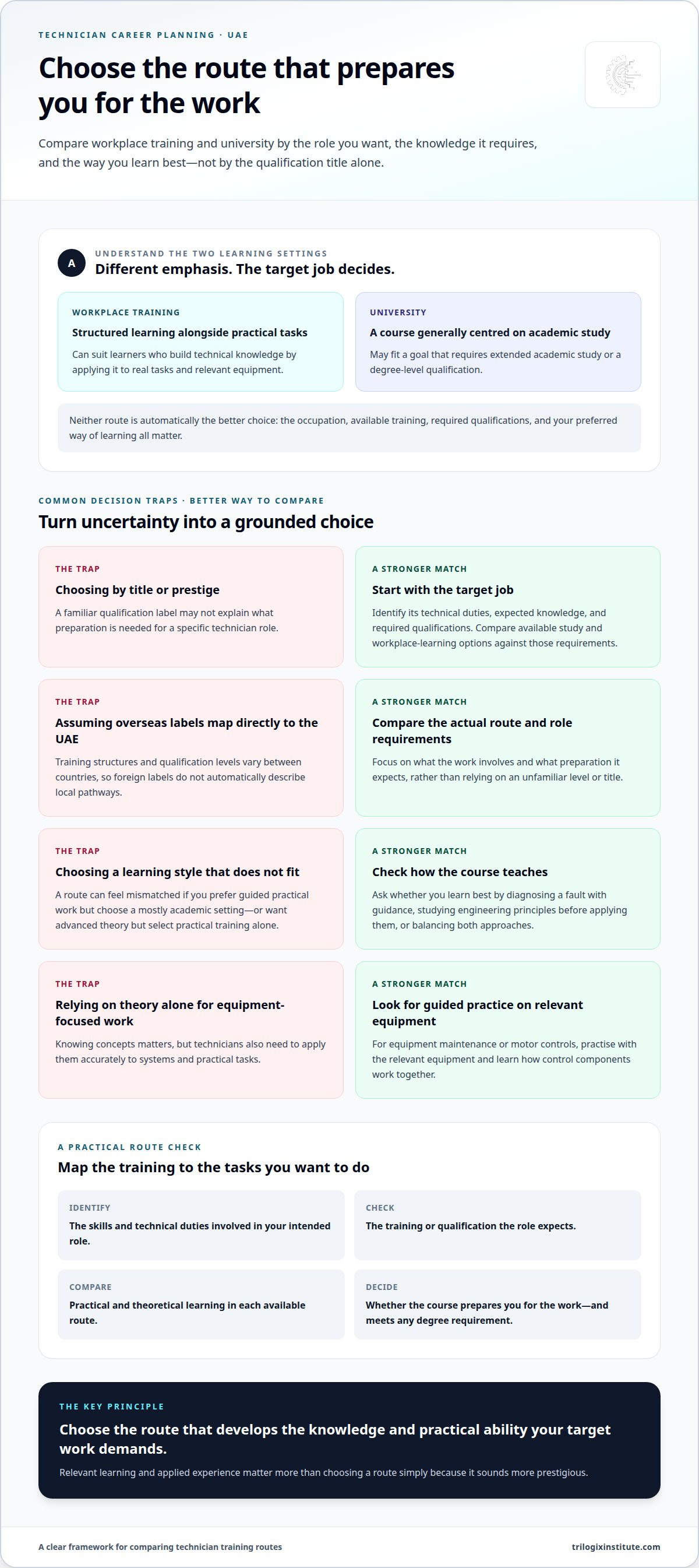
Workplace training can suit aspiring technicians who learn best by applying technical knowledge to real tasks. University may be a better fit if your goal requires extended academic study or a degree-level qualification. The right choice depends on the occupation, available training, and how you prefer to build expertise. For example, someone interested in equipment maintenance may value guided practical tasks alongside technical learning. Someone targeting engineering work centred on advanced theory may prefer a degree pathway.
In the UAE, compare routes by the role you want and the preparation it requires. Training structures and qualification levels vary between countries, so foreign labels don’t automatically describe local pathways. Start with the target job: identify its technical duties, expected knowledge, and required qualifications. Then compare available study and workplace-learning options with those requirements. This keeps your decision focused on the work, rather than an unfamiliar level or title.
Compare the learning experience, not just the qualification label. Workplace training combines structured learning with practical tasks, while a university course generally centres on academic study. In either route, competence depends on understanding systems and applying that knowledge accurately. Ask yourself which setting helps you learn: diagnosing a fault with guidance, studying engineering principles before applying them, or balancing both approaches. Knowing your preference can help narrow your options.
Hands-on experience can come from supervised workshop practice, equipment-based training, or tasks in a relevant workplace. Start by choosing a technical area, such as electrical systems or industrial machinery. Then look for training that lets you practise using tools, interpreting technical information, and following safe work procedures. For example, someone interested in motor controls should learn how control components work together, not rely on theory alone.
To gain hands-on experience as a technician, choose practical training with guided work on relevant equipment. Build skills through repeated tasks, such as inspecting components, recording observations, and explaining how you approached a fault. These activities connect classroom concepts with the decisions technicians make during maintenance or testing.
Before committing, map the route to your intended role. Identify the skills involved, the training or qualification it expects, and the balance of practical and theoretical learning. Compare those requirements with the course structure and learning environment. If the route prepares you for tasks you want to perform, it may be a stronger fit than choosing university solely for its title. If the role requires a degree, practical training alone may not meet that requirement.
Use this comparison to make a grounded decision: choose the route that develops the knowledge and practical ability your target work demands. A technician career grows through relevant learning and applied experience, not by choosing a route simply because it sounds more prestigious.
2. How to choose a career when you have no idea
Start with the work, not a job title. Technicians work across IT, healthcare, automotive, science, and engineering, with different equipment, environments, and daily tasks in each field. For example, an automotive technician may focus on vehicle systems, while an IT technician supports computer systems. Use these differences to identify the work that interests you.
Make a short list of tasks you enjoy and those you’d rather avoid. Think about school projects, hobbies, or previous jobs. Do you like finding out why a device stopped working? Do you prefer measuring, assembling, documenting, or explaining? Someone who enjoys troubleshooting a household appliance may want to explore equipment-focused roles. Someone who prefers helping users might investigate IT support or healthcare technology.
Research each potential role by looking at its actual responsibilities. Job descriptions can show whether technicians install equipment, run tests, maintain systems, or communicate issues. Compare several descriptions for the same role, then note the skills and tasks that recur. Keep the comparison practical:
- Work setting: Identify whether the role involves a workshop, facility, laboratory, vehicle, or office.
- Daily tasks: Record the tools, systems, and problems technicians handle.
- Core skills: Look for troubleshooting, communication, problem-solving, and careful record keeping.
- Training route: Note the knowledge and practical preparation the role expects.
Use the list to compare roles, not just industries. An engineering technician and an automotive technician may both diagnose faults, but they work with different systems. A laboratory technician may focus on tests and precise records, while an IT technician may resolve user or system problems. These examples can help you decide whether you prefer machinery, electronics, data, or direct support.
Test your assumptions before choosing a course. Speak with people familiar with the work, attend a relevant career event, or try a supervised practical activity. For instance, assembling a basic circuit can help you gauge your interest in electrical principles. A small coding exercise may reveal whether IT problem-solving holds your attention. Treat each activity as evidence about your preferences, not a final career decision.
Then narrow your options to roles that match both your interests and working style. If you enjoy practical tasks but dislike unpredictable environments, compare workshop-based jobs with field-service roles. If detailed testing appeals to you, explore science or engineering technician duties. Good career advice for aspiring technicians is to connect your preferences with real tasks, then choose training that develops the skills those tasks require.
Finally, write down one preferred role and one alternative. For each, list the tasks, skills, and training route you found. This simple comparison turns a broad question into a decision you can review, discuss, and refine as you learn more about technical work in the UAE.
3. Are engineering trades a good career choice?
Engineering trades can suit people who enjoy diagnosing faults and keeping equipment operational. Technicians may install, maintain, or repair machinery, run tests, record work, and report problems. A maintenance technician, for example, might notice unusual equipment behaviour, investigate its cause, and document the repair. In the UAE, assess opportunities by examining duties and sectors in current job descriptions. Prospects depend on the role, employer needs, and relevant skills.
Which technician specialties offer the best career prospects and pay? No single specialty leads across every UAE employer. Compare roles in areas such as electrical systems, industrial maintenance, automation, and equipment testing. Pay and prospects depend on responsibilities, experience, skills, and the employer’s sector. For a useful comparison, look at the systems each role supports, the tasks it involves, and the technical capabilities employers repeatedly request.
Aspiring technicians need practical ability and disciplined problem-solving. Troubleshooting helps identify faults, communication helps explain findings, and careful records help colleagues understand the work completed. Use these skills together: notice an irregular reading, investigate possible causes methodically, explain your finding clearly, and document the action taken. Attention to detail matters when a missed observation could affect the next maintenance decision.
What are the UAE licensing, safety, and work-permit requirements for technicians? Requirements depend on the role, duties, employer, worksite, and applicable authority. Identify any role-specific qualification or approval requirements, follow site safety procedures, and perform tasks only within your training and authorization. Electrical work and machinery maintenance can involve different equipment and hazards, so preparation depends on the work itself.
Build your technician CV around evidence, not broad claims. List relevant training, the systems or equipment you have practised with, and tasks you can explain accurately. For example, describe how you inspected a component, recorded an observation, or followed a troubleshooting sequence. Include teamwork or communication skills when you can connect them to a real project, practical exercise, or previous job.
For interviews, prepare a clear example of solving a technical problem. Explain what you observed, how you investigated it, and what action followed. If you’re new to the field, use a training exercise rather than implying workplace experience. Practise explaining how you respond when instructions are unfamiliar: pause, clarify the procedure, and prioritise safe handling before continuing. For candidates wanting to understand what specific companies look for during recruitment, resources like Job Hunt Mode Blog provide practical insights into major employers' hiring processes.
Finally, compare UAE job descriptions for your chosen specialty. Note recurring equipment, tasks, training expectations, and safety practices. Use that evidence to assess which skills you already demonstrate and which you need to develop. This gives you a practical basis for choosing training and presenting your experience to employers, without assuming every technician role has the same requirements.
4. Electrician training routes and career options
Electrical work spans installation, maintenance, controls, electric vehicle charging, and renewable technology. Each area involves different equipment and practical tasks. Start by identifying which systems interest you, then compare the skills each type of work uses. Someone drawn to control panels, for example, may prefer a different pathway from someone interested in maintaining building equipment.
In the UAE, choose training by matching its content to the electrical role you want. Compare vocational courses, workplace learning, and other study routes by their practical exercises, technical subjects, and preparation for specific duties. A route focused on electrical fundamentals may build a different foundation from one centred on controls or equipment maintenance.
What qualifications or certifications are required for technician jobs in the UAE? Requirements depend on the role, duties, employer, and applicable authority. Match your training to the electrical tasks involved, and identify any role-specific qualification or approval requirements before pursuing the position.
Compare routes by how they develop job-relevant ability. Technical study can build understanding before workplace application, while supervised workplace learning connects instruction with real tasks. Whichever path you consider, look for learning that links electrical principles to practical work, such as reading diagrams, identifying components, and explaining test results. This connection helps you understand not only what to do, but why each step matters.
Use UAE job descriptions to make the comparison concrete. Note recurring tasks and skills for roles that interest you. For example, compare an installation position with a maintenance role: one may focus on putting systems in place, while the other may focus on keeping equipment operating. Use these differences to identify gaps in your knowledge and choose relevant training.
Electrical work requires careful attention to safety and procedure. Practical preparation should help you recognise equipment, follow instructions, and understand why tasks must be performed in a specific sequence. Practise explaining your reasoning, such as why you would consult a diagram before tracing a circuit. Sound judgement matters alongside familiarity with tools.
Choose a route that aligns with the UAE role you’re targeting, not simply a familiar qualification label. Compare course content with the electrical systems and responsibilities involved. A practical match can help you build relevant skills for installation, maintenance, controls, or emerging electrical applications.
5. Engineering maintenance technician careers and progression
Engineering maintenance technicians help keep machinery and equipment working reliably. Their tasks can include installation, repairs, testing, work logs, and issue reporting. For example, a technician might inspect a machine, identify an abnormal reading, and document the finding. Practical repair and maintenance skills matter. According to the UK Government, engineering maintenance technicians need practical skills for repairing and maintaining equipment.
Fault diagnosis is central to the work. A technician identifies a defect, considers likely causes, then applies technical knowledge to resolve it. A clear process helps: observe the problem, consult relevant technical information, test likely causes, and record the action taken. Accurate records help colleagues understand what happened and support follow-up maintenance.
There are several entry routes in the UK: university, college, apprenticeship, or progression from an engineering operative position. These are UK pathways, not a description of UAE qualification rules. Preparation for a UAE role depends on its duties and employer expectations. Compare the practical content of training with the equipment and maintenance tasks involved.
Progression can take different directions. Experienced engineering maintenance technicians may move into engineering, technical sales, management, or contract management. In an in-house role, strong knowledge of site equipment can support supervisory, management, or senior technician responsibilities. Technical sales may suit someone who can explain equipment and maintenance needs clearly. Contract management draws on planning, communication, and coordination.
Experience also changes how technicians work. After ten years, many technicians have become independent practitioners, while some in-house technicians have advanced into senior or supervisory roles. This is a possible career pattern, not a fixed timetable. Progress depends on the work setting, accumulated expertise, and opportunities to take on broader responsibilities.
Independent work brings a different challenge: managing the workload. A technician working alone can handle only as much work as one person can complete. With five years of experience, independent technicians may have built a community reputation and steadier work. Reliable records, clear communication, and consistent repairs can help strengthen that professional standing.
Plan progression by tracking the problems you can solve and the equipment you can maintain. Record practical examples, such as diagnosing a fault or completing a test sequence. Then identify a next step: deepen your expertise in a system, take on coordination duties, or build communication skills for technical sales. This turns experience into evidence of readiness for broader work.
If electrical systems are your focus, explore practical electrical engineering training to build relevant technical foundations.
Trilogix Institute
Trilogix Institute helps aspiring technicians build practical foundations for engineering and electrical career paths. If you’ve identified electrical systems, motor controls, or automation as areas of interest, hands-on vocational training can connect technical concepts with applied skills. Options include TTI Dubai Foundation Electrical Engineering, TITP Beginner Essential Industrial Motor Control, and Industrial Automation Specialization. These courses suit learners seeking structured, instructor-led technical training rather than a university degree.
Use your career choice to guide the next step: consider which systems you want to work with and what capabilities you need to develop. To discuss training that aligns with your technical interests, contact Trilogix Institute.
Turn your interest into a practical next step
A technical career takes shape through deliberate choices: identify the work that interests you, then build knowledge relevant to it. Good career advice for aspiring technicians means turning that interest into a learning plan that develops skills you can apply and explain.
For learners considering technical training, Trilogix Institute offers TTI Dubai Foundation Electrical Engineering and TTI Dubai Advanced AutoCad 2D & 3D. It also offers TTI Dubai Professional Culinary Arts, a separate pathway for those whose interests lie beyond engineering. Choose according to the kind of work you want to pursue, rather than treating every course as a route into the same trade.
Your next step can be simple: define the systems or tasks you want to learn, then explore training that fits that direction. If you’re ready to discuss your interests and possible learning paths, contact Trilogix Institute today. A considered decision can help you move from curiosity toward focused, practical development.
Frequently Asked Questions
Are engineering trades a good career choice?
They can be a good fit if you value applied problem-solving and tangible work. Consider whether you enjoy diagnosing equipment, following technical procedures, and learning as systems change. Also think about the working environment: some roles involve workshops or industrial sites, while others focus on design support or testing. A realistic choice accounts for both the tasks you find rewarding and the conditions you’re willing to work in.
Can learning a trade lead to starting a business?
Yes, trade skills can provide a foundation for independent work, but technical ability is only one part of running a business. You’ll also need to manage customer communication, plan workloads, keep clear records, and understand the administrative requirements that apply to your business. For example, an experienced technician might offer a focused maintenance service, then build operations around the work they can perform competently and responsibly.
Does traditional careers advice suit everyone?
No. Advice based on a single, linear route may not reflect how each person learns, works, or changes direction. Use guidance as an input, not a fixed rule. If classroom study feels difficult, a practical activity may help reveal your strengths; if hands-on tasks appeal to you, technical training could be worth exploring. The useful question is whether a particular path fits your interests, circumstances, and preferred way of developing skills.
How do you choose a career if you have no idea what you want to do?
Begin by identifying what you want from everyday work, such as solving problems, using tools, or supporting people. Then choose a small experiment, like a basic electronics project or an introductory coding task, and note which parts hold your attention. Compare that experience with real job responsibilities. This gives you specific evidence to narrow your options, instead of feeling pressured to choose a permanent career immediately.
How should you research a career properly?
Use several types of evidence, not just an appealing job title. Compare current job descriptions for recurring tasks, tools, and expected skills, then consider what a typical workday might involve. A conversation with someone in the field can clarify details that advertisements leave out, such as how much time goes toward documentation or teamwork. Keep notes on what attracts you, what concerns you, and what training the role expects.
Is an apprenticeship a good alternative to university?
Workplace training can be a strong alternative when a target occupation values supervised practical learning alongside technical study. University remains relevant where a role requires degree-level academic preparation. Compare the entry requirements and learning outcomes for the specific job you want, rather than judging routes by status alone. For instance, someone focused on maintaining equipment may prioritise applied experience, while another engineering role may place greater weight on advanced theory.
Is university still worth considering?
Yes, university is worth considering if your intended career requires a degree or substantial theoretical study. It can also suit learners who want an academic foundation before specialising. Check how the course content connects to the work you hope to do, including its technical subjects and practical components. If your goal is a hands-on technician role, compare degree study with vocational routes to see which develops the abilities the position needs.
Should money influence your career choice?
Yes, finances should be part of the decision, but they need context. Consider your income needs, the time and costs involved in training, and expenses associated with reaching or doing the job. Don’t base your choice on a headline salary alone; responsibilities, working conditions, and opportunities to develop skills matter too. A practical comparison helps you weigh financial needs against the kind of work you can sustain and value.


