

Technical mastery can earn trust, but it rarely proves leadership on its own. Leveraging technical skills for promotion means using your expertise to solve meaningful problems and combining it with communication, sound judgement and collaboration. Employers want to see not only what you can do, but how you help a team deliver.
It’s natural to expect strong performance and deep technical knowledge to support career growth. They matter, but promotion often brings broader responsibilities: explaining complex ideas clearly, guiding colleagues through challenges, and making decisions that serve wider team goals.
This article explains what technical skills are and how they work alongside interpersonal strengths in promotion decisions. You’ll learn practical ways to demonstrate leadership without a formal title, show readiness for a higher role, and connect your development to your organisation’s needs. The aim is to make your contribution visible through evidence of impact, initiative, and the ability to help others succeed.
Key Takeaways
- Use technical expertise to solve meaningful problems, then make your reasoning clear so colleagues can act on it.
- Show leadership without a title by mentoring, inviting input and taking responsibility for work beyond your usual tasks.
- Build evidence of readiness by recording your results, feedback and skills relevant to the role you want.
- Employers weigh technical capability alongside communication, adaptability and the ability to support team goals.
- Choose development that strengthens practical expertise and prepares you to contribute at a broader level.
Demonstrating leadership without a title
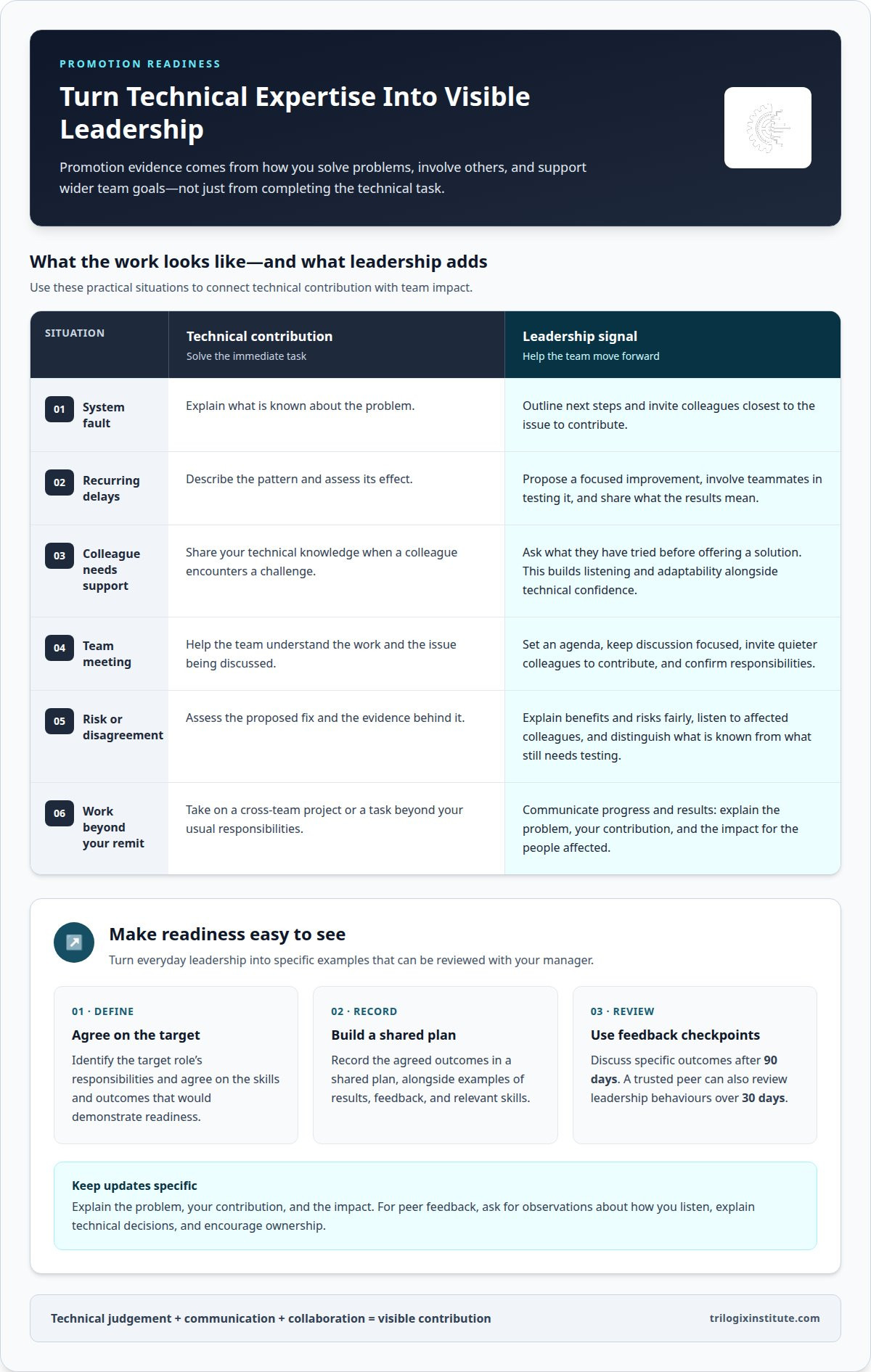
Formal authority isn’t the only way to demonstrate leadership. In a technical role, leadership shows in how you help colleagues understand a problem, coordinate the work, and take ownership of the outcome. For example, when a system fault interrupts a project, explain what’s known, outline the next steps, and invite those closest to the issue to contribute. That response connects expertise with team progress.
Move beyond execution by explaining why a task matters, not just how to complete it. If a process repeatedly causes delays, describe the pattern, assess its effect, and propose a focused improvement. Then involve teammates in testing the change and share what the results mean. This signals strategic thinking: you’re addressing the wider need, not just completing the immediate assignment.
Leadership without authority depends on influence, not control. Mentor a junior colleague by asking what they’ve tried before offering a solution; this builds listening and adaptability alongside technical confidence. You can also volunteer to run a team meeting. Set an agenda, keep the discussion focused, invite quieter colleagues to contribute, and end by confirming responsibilities. These actions help colleagues coordinate without micromanagement.
Ethical decision-making is visible in how you handle risk and disagreement. When a proposed fix involves trade-offs, explain the likely benefits and risks fairly, listen to affected colleagues, and choose an approach that supports the team’s wider goals. If evidence is incomplete, distinguish what you know from what still needs testing. This builds trust and shows that sound technical judgement includes responsibility for consequences.
To create a promotion plan with your manager, identify the target role’s responsibilities, agree on the skills and outcomes that would demonstrate readiness, and record them in a shared plan. Set a checkpoint after 90 days to discuss specific outcomes, as Julia Snedkova recommends, then adjust priorities using the feedback.
To gain visibility and take on higher-level responsibilities, volunteer for a cross-team project or a task beyond your usual remit, then communicate progress and results to the people affected. Share concise updates that explain the problem, your contribution, and the impact, rather than assuming decision-makers will notice your work.
Ask a trusted peer to review your leadership behaviours over 30 days, as Dror Allouche recommends. Invite specific observations about how you listen, explain technical decisions, and encourage ownership. Use those examples to select one behaviour to improve, then apply it in your next project or meeting. Consistent learning turns everyday responsibility into evidence of promotion readiness.
What do I mean by technical skills?
Technical skills are the practical methods and knowledge used to complete tasks in a specific field. A CAD designer applies drafting software to develop accurate drawings; an electrical technician interprets circuit diagrams to troubleshoot equipment. These capabilities develop through education, hands-on experience, and experimentation. They help you solve defined problems, but promotion usually requires you to contribute beyond the task itself.
Technical expertise becomes more valuable when soft skills help other people use it. For example, an analyst may identify a data error, explain its effect in plain language, and help a colleague choose the next action. The analysis solves the immediate problem; clear communication connects the finding to a decision. Listening, collaboration, and adaptability also help specialists work across teams with different priorities.
Balance scalability with current needs by separating an urgent fix from a durable solution. If a team repeatedly enters the same information into separate spreadsheets, a quick correction may help today. Mapping the workflow can reveal where errors begin and which shared process could prevent them. Consider who maintains the process, the risks of changing it, and whether the solution will remain usable as work expands.
Career advancement depends on applying skills to organisational priorities. A technically strong employee might improve a tool, but a promotion case is stronger when that work reduces friction for colleagues or supports a broader objective. Before investing in a new capability, connect it to a business need: better quality, clearer reporting, safer operations, or more dependable delivery. This makes learning purposeful rather than a collection of unrelated credentials.
Build a balanced development plan around the next role’s actual demands. Identify one technical capability to deepen, such as interpreting a design or diagnosing a fault, and one interpersonal skill to practise, such as presenting options to decision-makers. Apply both in a real project, then seek feedback on the result. The World Economic Forum says a significant proportion of workers’ skills will change by 2030, reinforcing the value of ongoing learning.
For instance, an employee advancing in design may need stronger drafting capability and the confidence to explain design choices. TTI Dubai Advanced AutoCad 2D & 3D offers a practical route to build relevant drafting skills; technical training courses can support learning that is directly applicable to workplace tasks. Pair structured training with opportunities to solve real problems, communicate trade-offs, and adapt your approach as team needs evolve.
Demonstrating readiness for a higher role
Readiness is demonstrated through sustained results, evidence of stronger skills, and work that reflects the target role. Use specific examples to show managers how your contribution has grown.
Showing Measurable Achievements
Measurable achievements connect your actions to a clear benefit for a team or organisation. They matter because managers can assess the impact, complexity, and consistency of your work. Include outcomes such as fewer errors, faster delivery, improved quality, or a process colleagues adopted. For each result, explain your role and how the evidence demonstrates your readiness for responsibilities in the higher position.
For example, a technician might document how a revised maintenance process reduced repeat faults, alongside records supporting that change. A project coordinator could describe how clearer handovers helped teams meet delivery milestones. Use figures only when your records support them, and explain the comparison: what changed, what you did, and who benefited. Strong evidence shows more than activity; it links your decisions to an outcome.
Consistent performance beyond expectations for six months or more can be one sign of promotion readiness. It isn’t a substitute for role-specific evidence. Compare your achievements with the higher role’s responsibilities, then identify where your results demonstrate the required judgement, ownership, or technical capability. This keeps your case focused on readiness rather than tenure alone.
Choose achievements that show increasing scope. A successful individual task matters, but leading a complex project or coordinating work across teams can reveal broader capability. Describe the challenge, your contribution, the outcome, and the skills you applied. This structure helps managers see how your performance maps to the demands of the next role.
Preparing Evidence for a Promotion Review
Promotion evidence is an organised record of outcomes, projects, feedback, and skills relevant to the role you seek. Preparing it matters because managers need specific examples to evaluate your contribution and readiness. Keep a concise log of project responsibilities, problems solved, relevant training, and positive feedback. Attach supporting records where appropriate, such as completed work or documented results.
Arrange your evidence by the competencies in the target role, rather than by date alone. For example, group examples under technical judgement, communication, or project ownership. Include feedback from managers, peers, or mentors, and note how you acted on it. A review is more productive when each claim has a concrete example and a clear connection to the role.
Ask your manager to agree on specific outcomes for a promotion checkpoint after 90 days, as Julia Snedkova recommends. Record the agreed goals, progress, and any changes in responsibility. At the review, use the documented results to identify strengths and remaining development needs. This turns feedback into a practical basis for the next career discussion.
Keep the case balanced: pair achievements with lessons learned and explain how you adjusted your approach. If a project missed an objective, state the cause, your response, and what changed afterward. Honest context helps managers assess judgement, not just results. Close by summarising the responsibilities you already handle and the evidence that shows your capacity to take on more.
Employer priorities in promotion decisions
Promotion decisions consider whether your strengths fit the next role, not just your current output. Individual contributors demonstrate deeper expertise and sound technical choices; managers must also guide people, align work, and build team capability.
Show business impact by linking a technical decision to a documented result, such as fewer repeat faults, clearer reporting, or more reliable delivery. Explain what changed, your contribution, and who benefited.
Strategic Thinking and Decisions
Strategic thinking means choosing work and solutions that advance organisational priorities, not just completing the immediate request. It matters because a higher role often involves responsibility for trade-offs and longer-term outcomes.
Before proposing a solution, define the problem and identify who it affects. Outline at least two alternative approaches, then weigh their benefits, risks, and resource demands. For example, a team addressing recurring equipment faults could compare a short-term repair with a process change designed to prevent repeat issues.
Explain why your recommendation fits the organisation’s needs. A technically elegant option may be less useful than a practical approach colleagues can maintain. This kind of thinking shows managers that your development includes judgement, prioritisation, and the ability to make effective decisions with the wider context in view.
Individual Contributor and Management Paths
Promotion criteria differ because individual contributors and managers create value through different responsibilities. An individual contributor may advance through technical depth, complex problem-solving, and influence across projects; a manager is assessed on team performance, direction, and people development.
For an individual contributor role, show how your expertise improves standards or helps others make better technical decisions. For example, an engineer might establish a clear review process that reduces avoidable design issues across a project. Your evidence should demonstrate impact beyond a single assigned task.
For a management path, show how you set priorities, delegate effectively, resolve competing needs, and develop colleagues. A project lead might clarify ownership when delivery risks emerge, then support team members in resolving blockers. Discuss the target path with your manager, since titles and criteria vary between organisations.
Demonstrating Business Impact
Business impact is the practical effect of technical work on organisational goals, such as quality, continuity, or delivery. Demonstrating it helps decision-makers understand why your contribution matters beyond the technical result.
Describe the situation before your work, the change you made, and the outcome supported by project records or feedback. For instance, if you revised a troubleshooting guide, explain how colleagues used it and whether it helped resolve recurring issues. Don’t claim a reduction or improvement unless you can support it with evidence.
Architectural decisions also show how you direct effort. When selecting a system design, explain the constraints, maintenance needs, and likely effects on connected teams. A choice that avoids unnecessary complexity may serve the organisation better than a more elaborate design. Present the trade-offs clearly, then connect the decision to the project’s objectives and the responsibilities you’re ready to assume.
Technical and interpersonal skills for promotion
The strongest promotion case combines technical capability with sound judgement and collaboration. Which technical skills matter most depends on the work: industrial roles value control systems and fault diagnosis, while data roles require analysis and careful tool selection.
Technical Skills Valued Across Industries
Technical skills are the field-specific methods and tools used to produce reliable work. Identifying the capabilities valued in your industry helps you focus training on the demands of your next role.
In industrial operations, understanding motor control and automation can help professionals diagnose equipment problems and support consistent processes. In software and data work, choosing suitable tools, interpreting results, and recognising flawed outputs can matter more than simply knowing a platform’s features. In design, accurate modelling and the ability to work with technical specifications support dependable project delivery.
These examples share a principle: employers value expertise that solves relevant problems. A professional who understands when a tool is appropriate can make more effective decisions than someone who applies it automatically. Keep learning as tools and methods change, and connect each new capability to a real work requirement.
Training can strengthen this foundation, but workplace practice shows how well a skill transfers. Apply a newly learned method to a live task, document the result, and seek feedback from colleagues who rely on your work. That evidence helps show that your technical development improves performance, rather than adding an isolated credential to your record.
Interpersonal Skills Alongside Technical Expertise
Interpersonal skills are the behaviours that help people communicate, collaborate, and make decisions together. They matter because colleagues need to understand and adopt technical recommendations for them to create value.
Explain complex information clearly for your audience. For example, when reporting a recurring equipment issue, distinguish the observed symptoms from the likely cause and proposed response. Invite operators to share what they have seen. Their practical knowledge may reveal a constraint that technical analysis alone missed.
Critical thinking also supports better technical work. Compare the available evidence, question assumptions, and explain why you selected one approach over another. In a cross-functional project, that might mean weighing operational needs against maintenance effort before recommending a change. This demonstrates judgement and helps colleagues understand the trade-offs.
Use collaboration to build trust across roles. Share progress early, listen without interrupting, and give feedback that focuses on the work and how to improve it. If a colleague challenges your recommendation, respond with evidence and curiosity rather than treating disagreement as a personal conflict. These habits make expertise easier to apply across a team.
For promotion, pair technical examples with the interpersonal behaviours that made them effective. Describe the problem, the skill you applied, how you involved others, and the resulting impact. That combination shows you can contribute independently while enabling colleagues to deliver stronger work together.
Trilogix Institute
Trilogix Institute supports career development through vocational training that builds practical technical skills. If your promotion goals call for stronger foundations in a technical field, relevant learning can help you prepare to contribute with greater confidence and capability.
Offerings include TTI Dubai Foundation Electrical Engineering, TTI Dubai Advanced AutoCad 2D & 3D, and TITP Beginner Essential Industrial Motor Control. Each relates to a different technical area, so consider which skills align with the responsibilities you want to take on. Training can complement workplace experience; apply what you learn to relevant projects and communicate the value of your contribution.
For information about training options that fit your development goals, contact Trilogix Institute.
Turn Your Next Skill Gap Into a Career Step
A deliberate approach to leveraging technical skills for promotion starts with choosing a capability that matches the work you want to take on. Once you identify that gap, build the skill through focused learning and apply it to practical tasks. Treat development as an ongoing part of your career, not a last-minute response to a promotion opportunity.
Trilogix Institute offers TTI Dubai Foundation Electrical Engineering, TTI Dubai Professional Culinary Arts, and TTI Dubai Advanced AutoCad 2D & 3D. These options support different vocational directions, so consider which area aligns with your intended role and the skills you want to strengthen. Training can help develop technical foundations that you can continue to apply and build on through workplace experience.
For a conversation about your goals and relevant training, contact Trilogix Institute to discuss your goals. Choose a clear next step, keep developing your capability, and make your contribution count.
Frequently Asked Questions
How Do I Get Promoted if My Company Has Limited Advancement Opportunities?
Build a case for broader responsibility even when a formal vacancy isn’t available. Ask your manager which higher-level tasks you could own, such as reviewing technical work or coordinating a handover. A practical way to leverage technical skills for promotion is to take on work that addresses a clear team need. Track its effect, then discuss whether progression could involve a specialist pathway, expanded scope, or a future role.
How Long Does It Take to Get Promoted?
Promotion timing depends on role requirements, performance evidence, business priorities, and the organisation’s review process. Clarify how decisions are made and when progress is discussed, then agree with your manager on outcomes that would show readiness. For example, a project assignment may let you demonstrate a new capability before the next review. Focus on building relevant evidence rather than relying on time in the role alone.
What about the employer’s perspective?
Employers assess whether a candidate can meet the demands of the next role and contribute to organisational priorities. They may consider the complexity of your work, how reliably you deliver, and whether colleagues can depend on your judgement. For example, a specialist who spots a recurring production risk and communicates its operational effect can demonstrate value beyond task completion. A promotion decision also considers which responsibilities the organisation needs to fill.
How can technical skills help earn a promotion?
Leveraging technical skills for promotion means using expertise to resolve difficult problems and produce dependable outcomes. For example, an employee who interprets equipment data may identify why a machine stops under a particular operating condition. Explaining the diagnosis and its practical implications makes the contribution easier to recognise. Connect each capability to the demands of the role you want, and show how applying it improves decisions or work quality.
How can I build leadership and communication skills alongside technical expertise?
Practise these skills in routine technical work. Lead a short project demonstration, explain a procedure to a colleague outside your specialty, or write a handover that makes the next action clear. Ask the recipient what information was useful or confusing, then refine your approach. These exercises develop audience awareness and accountability while keeping your technical knowledge in active use. A mentor can also help you identify habits to strengthen.
What are common risks of relying on technical skills alone when seeking promotion?
Relying only on technical ability can limit your influence if colleagues can’t understand, use, or trust your recommendations. For instance, a technically sound change may fail in practice if affected teams aren’t prepared to adopt it. Deep expertise can also make you a bottleneck when knowledge stays with you. Share methods, explain trade-offs, and involve relevant colleagues so your contribution strengthens the team, not just your individual output.


