

The first maintenance role can lead well beyond routine repairs. For anyone starting a career in industrial maintenance in the UAE, pay depends on factors such as experience, employer, shift pattern, and technical specialization. The work typically involves inspecting equipment, carrying out preventive maintenance, and troubleshooting mechanical, electrical, and control-system problems.
It’s sensible to consider earning potential alongside the day-to-day work when choosing a career direction. Technicians can develop specialties in areas such as motor control and automation, or progress into supervisory and operations roles as their skills grow.
This guide explains what shapes industrial maintenance pay in the UAE, what technicians do on the job, and how to explore career paths and specializations. You’ll also learn how practical training in electrical engineering and industrial motor control can help build relevant foundations for technical work.
Key Takeaways
- Assess industrial maintenance pay in the UAE against your experience, technical skills, employer, and shift pattern.
- Build practical electrical and motor-control skills to prepare for equipment troubleshooting and explore automation-focused work.
- Understand how inspections, preventive maintenance, and fault-finding help keep machinery operating reliably.
- Use accurate maintenance records and safe work practices to support dependable repairs and compliance.
- Explore how technical specializations can lead toward roles in supervision, reliability, controls, or plant operations.
How Much Does an Industrial Maintenance Technician Make?
In the UAE, industrial maintenance pay depends on experience, employer, shift pattern, and the systems a technician can maintain. Entry-level roles value mechanical aptitude, basic electrical knowledge, safe work habits, and a willingness to learn. A four-year degree is not the only route into the field.
- Build foundational electrical and mechanical skills. Start by learning how circuits, motors, bearings, belts, and couplings work. Practise identifying wear, recognizing unusual vibration, and using technical instructions before attempting repairs. For example, understanding how a motor connects to a driven pump can help you trace whether a fault is electrical or mechanical. Employers may train motivated entry-level candidates, especially those who show mechanical aptitude and a readiness to learn.
- Practise electrical troubleshooting and motor control. Learn to read circuit diagrams, identify control components, and understand how a motor starter operates. Motor-control knowledge helps technicians investigate why a conveyor motor will not start or stops unexpectedly. Build familiarity with electrical systems before working on more complex equipment. Follow equipment-specific procedures and workplace safety measures for every task. Safe habits matter as much as technical ability.
- Develop automation and PLC capability. Programmable logic controllers coordinate sequences in manufacturing equipment, such as a conveyor that starts when a sensor detects a product. Learn how inputs, outputs, sensors, and control logic interact. Tracing a signal through these components can help you narrow down a control-system failure. As automated facilities rely on connected machinery, PLC knowledge can support a path into controls or automation.
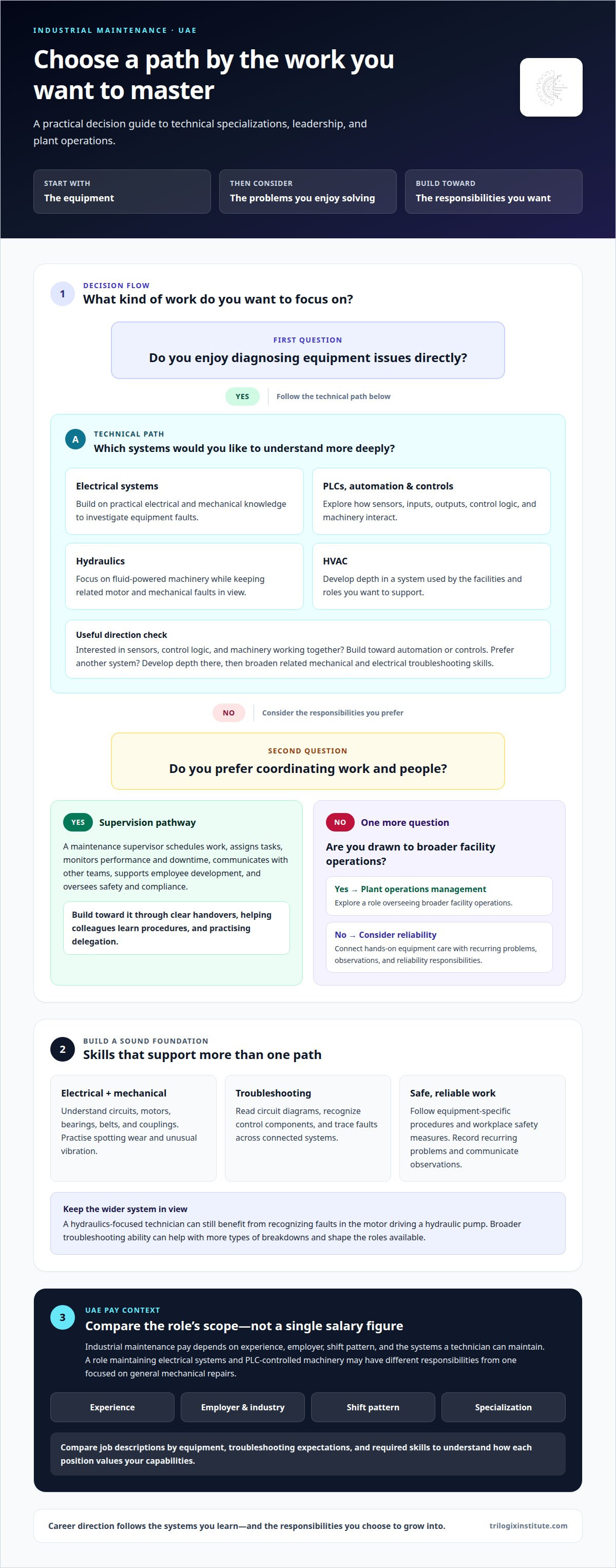
- Choose a system focus, then broaden your range. Industrial technicians may specialize in electrical systems, PLCs, hydraulics, or HVAC. Begin with equipment common to the role you want, then practise related mechanical and electrical maintenance skills. A hydraulics-focused technician, for instance, still benefits from recognizing faults in the motor driving a hydraulic pump. Broader troubleshooting ability can help you handle more types of breakdowns and may shape the roles available to you.
When discussing salary in the UAE, assess the role’s actual scope rather than relying on a single figure. A technician maintaining electrical systems and PLC-controlled machinery may have different responsibilities from one focused on general mechanical repairs. Employer, industry, experience, shift pattern, and specialization all affect compensation. Compare job descriptions by equipment, troubleshooting expectations, and required skills to understand how each position values your capabilities.
Career advancement and technical specializations
Industrial maintenance offers paths into technical, reliability, and leadership roles. Match your next step to the equipment and responsibilities you want to master.
-
Explore Career Advancement Pathways
List roles that build on your current work, then compare their daily responsibilities. A technician might progress into reliability, automation or controls, supervision, or plant operations management. Consider whether you prefer diagnosing equipment issues, coordinating maintenance, or overseeing broader facility operations. Focus on the skills and decisions each role requires, not just the title.
-
Specialize in Automation and Advanced Equipment
Choose a technical focus by studying the systems used in the facilities you want to support. Automation and controls work may suit technicians interested in how sensors, control logic, and machinery interact. As facilities become more automated, skilled technicians who can maintain complex equipment are increasingly important. Build on practical electrical and mechanical knowledge, and understand the wider system before narrowing your expertise.
- Build depth in a system that matches your goals. Compare electrical systems, programmable logic controllers, hydraulics, and HVAC as possible specializations. For example, a technician interested in automated production can develop toward controls, while someone drawn to fluid-powered machinery can focus on hydraulics. The best fit depends on the equipment you want to maintain and the problems you want to solve. Keep related mechanical systems in view because faults can cross system boundaries.
- Prepare for the responsibilities of leadership. A maintenance supervisor schedules work, assigns tasks, monitors performance and downtime, communicates with other teams, supports employee development, and oversees safety and compliance. Progress toward this role by practising clear handovers and helping colleagues learn procedures. Supervisors need to delegate and develop their teams rather than personally handling every task. If engineering design interests you, industrial maintenance engineers typically need a bachelor’s degree in industrial engineering, mechanical engineering, or a related field.
For focused development in controls, explore Industrial Automation Specialization as a practical learning direction. Match any specialization to the work you want to perform, then use that focus to guide your next career move.
Use day-to-day equipment care to prepare for more specialized work. Industrial maintenance technicians inspect machinery for wear, damage, or performance issues and perform preventive maintenance to reduce breakdowns. Recording recurring problems and communicating observations can connect hands-on work with reliability responsibilities. For shift-based roles, consider the schedule as well as the technical focus: industrial maintenance technicians may work rotating shifts, including nights or weekends.
Training can reinforce the foundations needed across these paths. Industrial maintenance technician training commonly covers mechanical fundamentals, electrical troubleshooting, motor controls, automation basics, preventive maintenance and safety protocols. The training described for industrial maintenance technicians consists of 34 half-hour courses totaling 17 hours. Use that coverage to identify areas for further practice, especially where your target equipment demands stronger troubleshooting or controls knowledge. Compensation can also vary with experience, specialization and schedule: senior industrial maintenance technicians, specialists, and technicians working premium shifts may earn $86,000+ annually. Treat that figure as a possible outcome rather than a guarantee, and weigh it alongside the work conditions and responsibilities you want in your next role.
Industrial maintenance technician responsibilities
A technician’s day can shift from planned checks to urgent troubleshooting as equipment needs change. For someone starting a career in industrial maintenance, understanding how inspections, repairs, and clear handovers fit together is a useful first step.
- Inspect equipment and identify changes. Begin with the machine’s condition, operating behavior, and maintenance history. Look for visible wear, damage, unusual noise, leaks, or changes in performance. For example, a technician inspecting a production line may notice a bearing becoming noisy before it stops the conveyor. Record the finding and report it through the facility’s maintenance process. Accurate observations help the team decide whether equipment needs monitoring, planned repair, or immediate attention.
- Perform preventive maintenance on schedule. Use the equipment’s maintenance plan to organize routine tasks and reduce breakdowns. A practical example is lubricating production line bearings every 1,000 operating hours. Another is inspecting HVAC systems in food processing facilities quarterly. Follow the task instructions, document completed work, and report defects that need follow-up. For those starting a career in industrial maintenance, learning to distinguish routine servicing from a repair requiring escalation is an important workplace skill.
- Troubleshoot faults methodically. When machinery stops, gather symptoms before replacing parts. Check the reported problem, inspect relevant components, and trace the fault through mechanical, electrical, or control systems. A conveyor that fails to start might have an issue with its motor, control circuit, or a sensor connected to a programmable logic controller. Use equipment documentation and workplace procedures to guide each step. Entry-level technicians often assist experienced staff with fault-finding, component checks, and repairs while developing sound diagnostic habits.
- Choose training that connects to workplace duties. Technical school can build foundations in mechanical maintenance, electrical troubleshooting, and motor controls. Industrial maintenance certificate programs typically take 6-12 months; associate degrees typically take about 2 years. Some employers train motivated candidates for entry-level roles, and some offer apprenticeships combining instruction with paid work experience. Compare training routes by their practical tasks, such as inspection, maintenance documentation, and solving equipment faults. This helps align learning with the responsibilities expected in a target role.
You can enter industrial maintenance without a traditional four-year degree. Consider training options in relation to the work technicians do: checking equipment, carrying out scheduled maintenance, documenting findings, and helping trace faults. Technical-school courses and certificate or associate-degree study can build relevant foundations. Employer training and apprenticeships are other ways to develop those skills.
Whichever route you take, connecting study with workplace duties helps make learning practical. Experience with inspection, maintenance records, and fault-finding supports the move from training to daily responsibilities. Technicians also need to follow task instructions, report defects, and communicate findings so repairs and follow-up can be coordinated through the facility’s maintenance process.
Maintenance documentation and safety compliance
Industrial maintenance combines equipment records with controlled work practices. Both support workers during production, especially when electrical or mechanical systems need attention.
Technicians use tools suited to the task, such as hand tools and electrical test instruments. Required protective equipment depends on the equipment, hazards, and workplace procedures.
Industrial maintenance involves risks from unexpected machine movement, electrical energy, and hot or pressurized equipment. Follow site procedures, including lockout/tagout steps, before starting maintenance.
- Record each maintenance task clearly. Document the equipment, reported issue, inspection findings, work performed, and any follow-up needed. For example, a technician servicing a production conveyor can record a worn component and note whether its replacement is still outstanding. Clear records help the next worker understand the machine’s condition. They also give supervisors useful details for planning work, reviewing repeated failures, or deciding whether a repair needs further investigation.
- Apply lockout/tagout procedures before intervention. Identify the equipment and follow the facility’s process for controlling hazardous energy. Use the assigned lock and tag, then follow site instructions to confirm the equipment is in a safe state. Do not rely on a stop button alone when maintenance exposes workers to moving machinery or electrical hazards. If equipment has multiple energy sources, account for each one using the approved workplace procedure before work starts.
- Select tools and protective equipment for the task. Use the correct hand tools and electrical test instruments for the equipment being serviced. Wear the protective equipment specified by the workplace risk controls, rather than assuming one set suits every task. NFPA 70E addresses arc-flash risk, personal protective equipment, boundaries, and safe electrical work practices. Treat it as a named electrical safety standard, not as a substitute for applicable UAE workplace procedures.
- Close out work with accurate updates. After maintenance, document the repair, parts or adjustments, and any remaining issue. For example, if a technician restores a pump but notices recurring vibration, record that observation for follow-up. Share relevant information with the supervisor and incoming shift. This helps teams solve problems and gives leadership a practical basis for prioritizing work, improving learning, and coordinating skilled workers around production needs.
Industrial maintenance career paths and job roles
Industrial maintenance career paths include technical specializations, reliability work, supervision, and plant operations management. As facilities become more automated, skilled technicians are increasingly needed to maintain modern equipment.
- Use an entry-level technician role to build breadth. Start by learning how maintenance work supports a facility’s production goals. A technician may coordinate with operators, inspect equipment, and assist with scheduled repairs. Notice which tasks call for mechanical judgment, electrical troubleshooting, or coordination across teams. This practical exposure helps you choose a career path based on the work you enjoy, rather than a title whose responsibilities you do not yet understand.
For example, supporting a production line can show whether you prefer diagnosing faults or planning maintenance. Record the systems and tasks you encounter, then use those observations to choose your next learning goal.
- Develop toward a technical specialization. Choose a focus such as reliability, automation, or controls by considering the problems you want to solve. A reliability technician studies recurring equipment issues and supports strategies to reduce unexpected failures. An automation or controls specialist focuses on automated equipment and control systems. In modern facilities, these roles combine electrical knowledge, mechanical systems, and an understanding of how equipment works together.
Build depth in one area while maintaining a working knowledge of related systems. This helps specialists understand how one fault can affect the wider production process.
- Prepare for maintenance supervision. A maintenance supervisor typically manages schedules, assigns work, monitors performance and downtime, and communicates with other teams. The role also includes supporting employee development and overseeing safety and compliance. Practise clear handovers and organized work coordination as you gain experience. Supervisors need to delegate effectively and help their teams develop, rather than personally completing every repair.
This path suits technicians who want to guide people and coordinate maintenance priorities. The daily focus shifts from individual repairs to team performance and facility needs.
- Consider plant operations or engineering as longer-term directions. Plant operations managers oversee broader operational priorities, connecting equipment availability with production demands. Industrial maintenance engineering is a distinct path, and these engineers typically need a bachelor’s degree in industrial engineering, mechanical engineering, or a related field. Compare roles by their core work: equipment troubleshooting, team leadership, facility operations, or engineering analysis.
Choose development steps that match your intended role. A technician aiming for operations leadership can build coordination skills, while an engineering goal calls for relevant degree study.
Trilogix Institute
Trilogix Institute offers practical technical training for people building skills relevant to industrial maintenance. TTI Dubai Foundation Electrical Engineering supports learning in foundational electrical concepts. For a focused introduction to motor-control principles, TITP Beginner Essential Industrial Motor Control is a relevant training option.
Choose the direction that matches your next step: foundational electrical learning or a focused start in industrial motor control. These courses support skill development but do not replace workplace-specific procedures or guarantee employment. They can help you build a clearer foundation before pursuing entry-level maintenance opportunities or developing a technical specialization.
To discuss your training direction, contact Trilogix Institute.
Choose Your First Development Step
Starting a career in industrial maintenance becomes more manageable when you turn a broad ambition into a practical learning goal. Decide which equipment or systems interest you, then identify the foundational knowledge that can help you contribute safely and effectively. You can refine your direction as you gain experience and see how maintenance supports real operations.
You do not need to map every future role today. Focus on building a useful foundation, learning workplace procedures, and choosing your next skill deliberately. This approach leaves room to move toward technical specialization, reliability work, or leadership as your interests develop.
Trilogix Institute offers vocational training relevant to technical skill development, including electrical engineering. If you’re ready to discuss a suitable training direction, contact Trilogix Institute. Take the next step with a clear goal and build your career one capability at a time.
Frequently Asked Questions
What does an industrial maintenance technician do day to day?
A technician balances planned work with incoming equipment issues. A shift might start with reviewing handover notes, then coordinating with production before servicing a machine. After completing a task, the technician records what changed and communicates any unresolved issue to the next shift. This coordination helps prevent missed follow-up and gives operators a clear picture of equipment status.
How can you get started in industrial maintenance with no experience?
Start by learning basic electrical and mechanical principles, then seek entry-level work where experienced technicians can guide your development. Build familiarity with technical diagrams, hand tools, equipment procedures, and maintenance records. In an interview, use examples from practical projects to demonstrate careful problem-solving and a willingness to learn. Employers may train motivated candidates who show mechanical aptitude and a responsible approach to workplace instructions.
Which industrial maintenance certifications are useful, and how much do they cost?
Choose training or certifications that match the equipment and duties you want to handle, such as electrical maintenance, motor controls, or automation. Costs vary by certification, training format, assessment requirements, and included materials. Compare the credential’s subject matter with your target job responsibilities, and distinguish course fees from any separate assessment charges. Avoid paying for a specialization that does not support your intended role.
What training programs, apprenticeships, or trade schools lead to industrial maintenance jobs?
Relevant routes include vocational courses, technical-school programs, and employer apprenticeships that combine instruction with workplace experience. Look for learning that connects electrical and mechanical concepts to equipment tasks, rather than focusing on theory alone. Apprenticeships can help newcomers apply classroom learning under workplace guidance. Trilogix Institute offers foundation electrical engineering and beginner industrial motor control training, two useful technical foundations.
What is the average industrial maintenance technician salary in the UAE?
Pay in the UAE depends on a role’s responsibilities, employer, experience, shift pattern, and technical specialization. A position focused on one equipment type can differ from one covering several systems or supporting automated operations. To assess an offer, compare its duties and schedule with your skills and experience. Broader troubleshooting capability and responsibility for complex equipment can influence compensation.
Which industries and employers in the UAE hire industrial maintenance technicians?
Manufacturing and food-processing facilities are examples of workplaces with production lines, HVAC systems, and automated equipment that require maintenance technicians.


