

A university degree isn’t the only route to a well-paid career in the UAE. The best-paid option among jobs that don’t require a university degree depends on the field, your experience, and the skills employers need. No single role pays the most for every candidate.
It’s reasonable to look for a career with a practical entry route and room to progress. Some roles call for focused vocational training or supervised experience rather than a university qualification, but pay and prospects vary by occupation and employer.
This guide compares career paths, highlights options that can be trained for in under a year, and explains what growth through 2034 may indicate. The growth figures discussed are U.S. projections for 2024-2034, so they offer a point of comparison rather than a UAE forecast. You’ll also see how to assess a role’s fit by weighing its training demands, earning potential, and opportunities to build experience.
Key Takeaways
- Compare career paths by training route, earning potential, and room to progress, not salary alone.
- Some roles use focused postsecondary training or supervised experience instead of a university degree.
- Commercial aviation, power operations, and technical trades feature among high-paying options, but each has distinct entry requirements.
- U.S. job-growth projections through 2034 can help identify expanding occupations, but they are not a forecast for the UAE.
- In the UAE, build your shortlist around practical skills and the work you want to do, then identify training that supports that direction.
1. Which of these careers can you train for in less than a year?
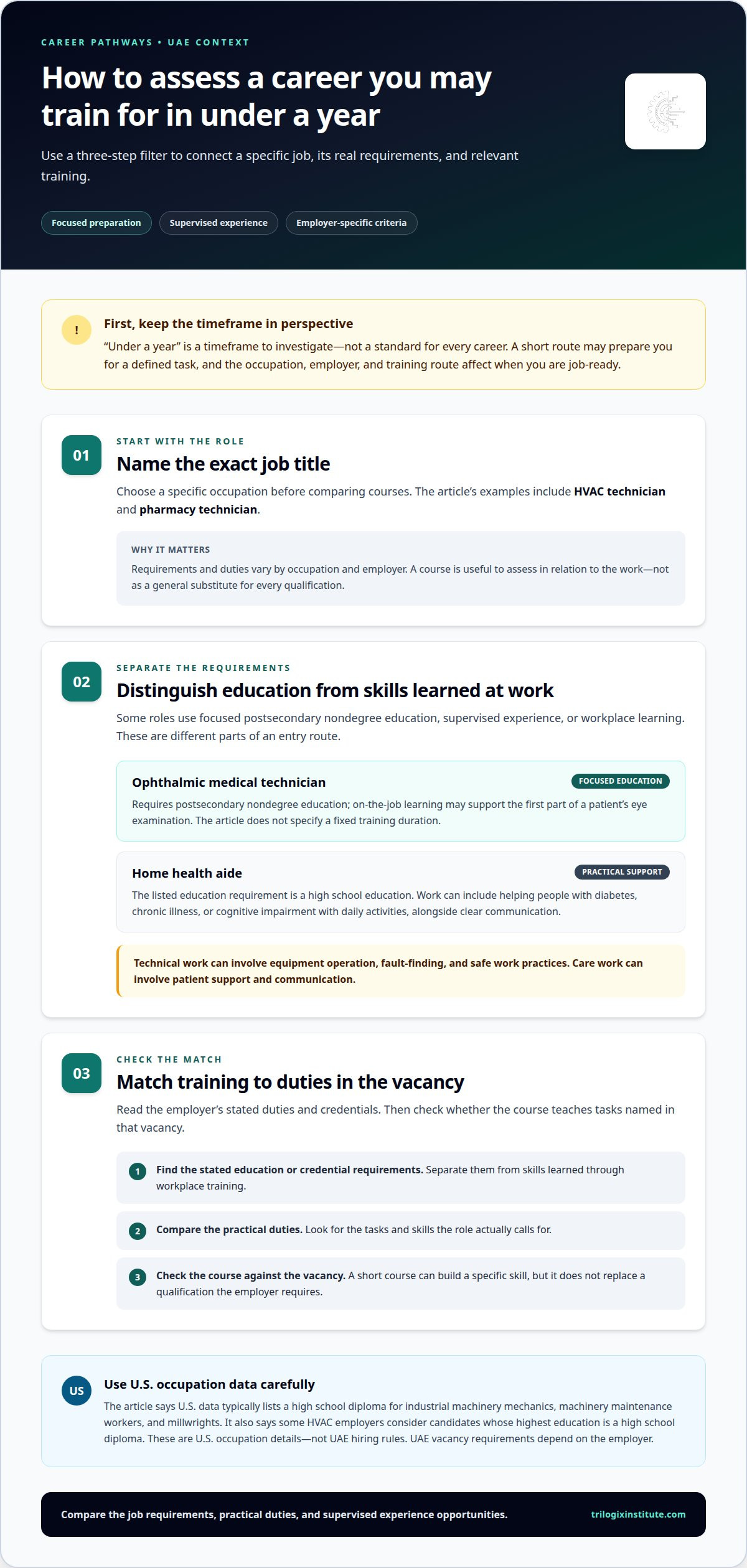
Shorter training routes usually prepare you for a defined task, not an entire profession. A postsecondary nondegree award can provide focused preparation without a university degree. The occupation, employer, and training route determine how quickly you become job-ready. Treat “under a year” as a timeframe to investigate, not a standard that applies to every career.
For UAE job seekers, industrial machinery maintenance and HVAC are practical job families to explore. The U.S. Bureau of Labor Statistics says industrial machinery mechanics, machinery maintenance workers, and millwrights typically need a high school diploma. It also reports that some HVAC employers consider candidates whose highest education is a high school diploma. These are U.S. occupation details, not UAE hiring rules. Local vacancy requirements depend on the employer.
The skills and credentials you need depend on the work. Technical roles can involve operating equipment, finding faults, and following safe work practices; care roles can involve patient support and clear communication. Employers set qualifications for each vacancy, so match your training to the stated duties and credentials. A short course can develop a specific skill, but it doesn’t replace a qualification required by an employer.
Healthcare illustrates why the entry route matters. Ophthalmic medical technicians need postsecondary nondegree education and may learn on the job to perform the first part of a patient’s eye examination. This shows how focused education and supervised practice can work together. It doesn’t establish a fixed training duration, so compare the occupation’s entry requirements with the time you have available to study.
Home health aides follow a different entry path: the listed education requirement is a high school education. Their work can include helping people with diabetes, chronic illness, or cognitive impairment with daily activities. The role relies on practical support and communication, not a university degree. In the UAE, specific duties and hiring criteria are set by the employer.
Use a three-step filter to compare options. First, identify the exact job title, such as HVAC technician or pharmacy technician. Next, separate education requirements from skills learned through workplace training. Finally, check whether the course teaches tasks named in the vacancy. This keeps a short course relevant to the work and avoids treating every certificate as interchangeable.
A role’s entry route can differ from its progression route. A high school credential may meet an initial education requirement in some occupation data, while vocational learning can build job-specific capability. Before choosing a path, compare the required credentials, practical duties, and opportunities for supervised experience. This makes training within a year a focused career decision, not a promise about course length.
2. What Is the Highest-Paying Job Without a Degree?
There isn’t one highest-paying occupation for every country or worker. In U.S. figures available for comparison, commercial pilots appear among high-paying careers that don’t require a degree. Power plant operators, distributors, and dispatchers also rank strongly. These examples show that specialized responsibility can support high earnings without a university qualification. They don’t establish UAE salary levels, where pay depends on local employers and employment terms.
A university degree isn’t a blanket prerequisite for every UAE occupation. Whether a role requires academic credentials depends on its job title, employer requirements, and applicable work-permit classification. When assessing a vacancy, distinguish the employer’s education criteria from permit requirements. This matters for candidates considering technical, operational, or service work.
Other high-paying examples in U.S. figures include transportation managers, elevator and escalator installers, and electricians. Commercial pilots typically need flight training from academies such as 2FLY Airborne and a commercial pilot’s license, as well as postsecondary nondegree education. These requirements highlight an important distinction: “no university degree” doesn’t mean “no specialist preparation.” A role may still require licensing, technical skills, or experience.
There is no single average salary for jobs without a degree in the UAE. Earnings vary by occupation, sector, experience, employer, and job responsibilities. Pilots, electrical workers, and transport managers follow different compensation structures. Compare salaries within the same job family and seniority level, since broad averages can hide important differences.
Consider the trade-offs, too. A role may involve demanding shifts, physical work, safety awareness, or ongoing practical training. Commercial aviation, for example, requires specialized preparation before employment. Technical maintenance work can call for diagnosing faults and handling equipment responsibly. Some non-degree pathways may also offer fewer advancement routes unless workers develop relevant skills or move into supervisory roles.
Assess total compensation, not the job title alone. Review the stated base pay, allowances, working hours, duties, and progression criteria in each vacancy. For a technical role, compare the hands-on skills required with your experience. For management work, look for responsibilities such as coordinating people, schedules, or operational decisions. These details make offers easier to compare.
Follow a practical sequence before choosing. First, identify a specific occupation, such as commercial pilot or elevator installer. Next, list its stated education, training, and licensing requirements. Then compare them with your capabilities and the role’s advertised compensation. This clarifies whether a high-paying career is accessible through vocational preparation, work experience, or additional qualifications.
High-earning non-degree pathways emphasize practical accountability and decision-making, rather than relying on title alone. The figures put commercial pilots at $133,101 per year, transportation managers at $88,870 per year, and nuclear power reactor operators at $81,361 per year. These examples reinforce that pay varies substantially across occupations, even among roles that may not require a university degree.
Other listed figures include $55,328 per year for air traffic controllers, a median salary of $62,350 for electricians, and ₤24,000 per year for plumbers. At Trilogix Institute, we advise students to treat these amounts as comparisons for the occupations shown, not as UAE salary guarantees. For a UAE vacancy, confirm the employer’s stated compensation and assess it alongside the duties, experience requirements, and employment terms.
3. Highest-paying careers without a degree
In the UAE, the highest-paying job without a university degree depends on the occupation, employer, and experience required. High-paying career lists include examples such as commercial pilot, power plant operator, elevator technician, and transportation manager, but they don’t establish a UAE salary ranking.
Compare these paths by responsibility and entry requirements, not title alone. Commercial pilots need flight training and a commercial pilot’s license before starting work. Power plant operators, distributors, and dispatchers handle complex operational responsibilities. Elevator and escalator installers and repairers work with specialized systems. Each path requires skills beyond a university credential.
Wind turbine technician is another technical career to examine. In the United States, its median annual salary is listed at $62,580, and employment is projected to grow by 50% between 2024 and 2034. These figures describe the U.S. market, not UAE pay or hiring demand. They do show why renewable-energy maintenance appears in discussions about career growth.
Other U.S. occupation data highlights strong earning potential in specialized work. Elevator and escalator installers and repairers have a listed median annual salary of $106,580. Power plant operators, distributors, and dispatchers have a median annual salary of $103,600. These are U.S. figures, so don’t treat them as AED estimates or local salary offers.
To build a UAE shortlist, compare occupations with clear technical or operational responsibilities. Examples include electrical work, industrial maintenance, aviation, transport operations, and renewable-energy maintenance. Then review UAE vacancies for the exact job title, required experience, credentials, and compensation structure. This distinguishes local opportunities from international salary rankings.
Training needs vary even within technical careers. Commercial aviation requires flight training and licensing, while electrical and maintenance roles focus on practical systems knowledge. Similarly, specialized technical fields such as geographic information systems (GIS) rely on targeted vocational coursework from organizations like Formation SIG to build job-ready digital skills. Relevant experience can also affect which vacancies are accessible. Match your preparation to the advertised duties instead of choosing a course simply because a career appears on a high-pay list.
Wind turbine work deserves a closer look if you prefer field-based technical tasks. The U.S. growth projection of 50% from 2024 to 2034 indicates strong projected expansion there, but it doesn’t promise the same trend in the UAE. Compare that occupation with established technical paths, such as elevator maintenance or power operations, using local vacancy requirements.
To assess potential, make a short comparison of the role, entry credential, specialist training, experience expectations, and UAE compensation. Use the same criteria for a commercial pilot and an industrial technician. This keeps international salary figures in context and helps you identify which high-responsibility career matches your capabilities and preferred working environment.
U.S. News ranks ophthalmic medical technician 1, home health aide 2, and solar photovoltaic installer 3.
4. Projected job growth from 2024 to 2034
Growth projections help compare future demand, but geography matters. The figures below cover U.S. occupations from 2024 to 2034, not UAE hiring forecasts. Wind turbine technician jobs are projected to grow by 50%, the strongest percentage among these examples. Industrial machinery mechanic, maintenance worker, and millwright jobs are projected to grow by 13%. These projections indicate anticipated change, not guaranteed openings.
Several skilled technical occupations also show projected growth. Hearing aid specialist jobs are projected to grow by 18% between 2024 and 2034. Electrician jobs are projected to grow by 9%, while heating, air conditioning, and refrigeration mechanic and installer jobs are projected to grow by 8%. The figures make technical careers worth comparing, but they don’t establish which role has the most UAE vacancies.
Healthcare and workplace safety add another comparison. Occupational health and safety specialist and technician jobs are projected to grow by 12% between 2024 and 2034. Medical records specialist jobs are projected to grow by 7% over that period. Home health aide roles have 739,800 projected jobs, while ophthalmic medical technicians have 15,600 projected jobs. Job counts and growth rates describe different things, so read them separately.
Food service management offers a different path. Food service manager jobs are projected to grow by 6% between 2024 and 2034. Construction worker jobs have a projected count of 106,500. The first figure describes expected percentage growth; the second is a job count. Neither directly measures how easy it is to enter a role or how many vacancies will suit a particular applicant.
Use projections as one filter, then consider the work itself. Wind turbine technicians and industrial machinery mechanics, for example, both work with technical systems, but their settings and equipment differ. Compare each occupation’s core tasks, training route, and experience expectations. A higher growth percentage can signal expanding demand, but it doesn’t show whether the day-to-day duties suit your strengths.
For UAE career planning, treat U.S. projections as context, not local evidence. Search UAE vacancies by exact job title and compare the qualifications employers request. An electrician vacancy, for instance, may describe a different scope of work from an industrial machinery role. Look for skills that recur across openings, then target training that develops them.
A practical comparison can use three measures: projected growth, projected job count, and role requirements. Wind turbine technicians lead this set by projected growth at 50%; home health aides have 739,800 projected jobs. Those measures answer different questions. Pair them with the UAE vacancy picture and the work’s entry requirements before prioritizing a career path.
5. What jobs pay well without a university degree in the UAE?
In the UAE, technical trades and operational roles can offer career routes without a university degree. Jobs that don’t require a university degree may include electrician, HVAC technician, industrial machinery mechanic, and safety coordinator roles. Pay varies by employer, experience, responsibilities, and technical scope. Compare salaries in AED for the same occupation and seniority level; international wage figures don’t establish UAE compensation.
Electrical work can reward practical capability, but entry routes differ. Career guidance describes a two-year apprenticeship or a community college certificate as possible pathways to becoming an electrician. Treat these as general examples, not UAE licensing rules. For local vacancies, compare the stated duties, credentials, and experience with your training before assessing compensation.
According to the U.S. Bureau of Labor Statistics, industrial machinery mechanics, machinery maintenance workers, and millwrights typically need a high school diploma. That U.S. education profile doesn’t determine UAE hiring requirements. Local employers may emphasize troubleshooting, equipment knowledge, and relevant experience. The bureau also reports that some HVAC employers consider candidates whose highest education is a high school diploma.
Safety coordination offers another route into construction-related work. Career information describes two to three years of sector experience as a requirement for safety coordinator roles. Site experience is therefore important, alongside safety knowledge and communication. Consider this path if your background includes construction operations, rather than assuming it is an immediate entry-level option.
There is no single average salary for all UAE jobs without a degree. Electricians, HVAC technicians, and safety coordinators work in different settings and need different skills, so their compensation structures vary. Pay can reflect experience, job scope, employer, and specialist capability. Compare advertised AED salaries for similar roles, then assess allowances and working conditions separately.
For people exploring jobs that don't require a university degree, practical skills can help build readiness for equipment-focused work. TITP Beginner Essential Industrial Motor Control introduces a relevant technical area, while Industrial Automation Specialization suits learners interested in automation. These offerings are for people exploring industrial systems; they don’t represent every occupation or replace experience employers require. Explore industrial training if motor control or automation fits your career direction.
Build a UAE shortlist by matching each role to its entry requirements. Start with the job title, then record the advertised education, experience, technical skills, and AED pay. Compare electrician vacancies separately from maintenance or safety coordinator roles. This can clarify which jobs that don't require a university degree suit your background and where focused preparation may help.
There is no single average salary for UAE jobs that don’t require a degree. Pay varies by occupation, employer, experience, job scope, and specialist skills.
Trilogix Institute
Trilogix Institute helps learners build practical skills for career paths where applied training can complement education and experience. If you’re exploring technical work, TTI Dubai Foundation Electrical Engineering, TTI Dubai Advanced AutoCad 2D & 3D, and TITP Beginner Essential Industrial Motor Control offer focused areas to consider. The right fit depends on the work you want to pursue and the skills it calls for.
For automation-focused interests, Industrial Automation Specialization is another option. These courses support skill development; they don’t guarantee employment or replace requirements set by employers. Consider vocational training when you’ve identified a direction and want structured learning connected to that field. To discuss your learning goals, contact Trilogix Institute.
Choose your next skill with purpose
Turn your career interest into a focused learning plan. Choose a role that fits the work you want to do, then identify the practical skills and qualifications its employers expect. This connects training to a clear direction instead of collecting credentials without a defined goal.
For jobs that don’t require a university degree, progress can come from applying relevant skills, building experience, and taking on greater responsibility. The right starting point depends on your interests and the capabilities you want to develop. Trilogix Institute offers hands-on vocational training in electrical engineering, culinary arts, and AutoCAD, giving learners practical fields to explore.
Discuss your goals and the training direction that suits them. Contact Trilogix Institute to take the next step toward building skills for your chosen path. A clear plan can help turn your career ambition into purposeful action.
Frequently Asked Questions
What Is the Highest-Paying Job Without a Degree?
There isn’t a verified UAE-wide salary ranking that identifies one highest-paying job without a degree. Compare specific vacancies by base pay, variable compensation, allowances, experience requirements, and responsibility. A commercial pilot and an industrial operations role, for example, have very different entry routes and pay structures. Use UAE job listings for the same occupation and seniority level to make a meaningful comparison.
Which of these careers can you train for in less than a year?
The timeline depends on the role and training route, so don’t assume every non-degree career can be entered within a year. Ophthalmic medical technicians need postsecondary nondegree education and may also receive on-the-job training. To judge whether a pathway fits your timeframe, distinguish course study from supervised workplace learning and any separate credential requirements. Those stages affect how soon someone is ready for a particular vacancy.


