

A longer course isn’t automatically the better career move. For future prospects in India, artificial intelligence and machine learning, cybersecurity, data science, and cloud computing are among the technical fields associated with strong salary potential. AI and machine learning courses are listed at 6-12 months, while the right choice depends on your starting point and the skills you want to build.
Look beyond a course title: employers need people who can apply technical knowledge, not just describe it. Course duration, entry requirements, practical training, and the kind of work you enjoy all matter when choosing a path.
This guide compares technical fields and the skills they develop, explains how course length and entry requirements can vary, and shows what to look for in hands-on learning. You’ll be able to weigh future career prospects against your interests and priorities, including whether practical training in electrical engineering, automation, or design software fits your goals in the UAE.
Key Takeaways
- Match a course’s duration and entry requirements to your current education, experience, and available study time.
- Compare technical fields by the practical skills they develop, not salary potential alone.
- Prioritise hands-on learning that lets you apply concepts to realistic tasks and equipment.
- Assess how industry demand, your strengths, and long-term career goals align before choosing a specialisation.
- Understand what technical certifications demonstrate, and how they complement practical training and relevant experience.
1. Course duration, eligibility, and skills
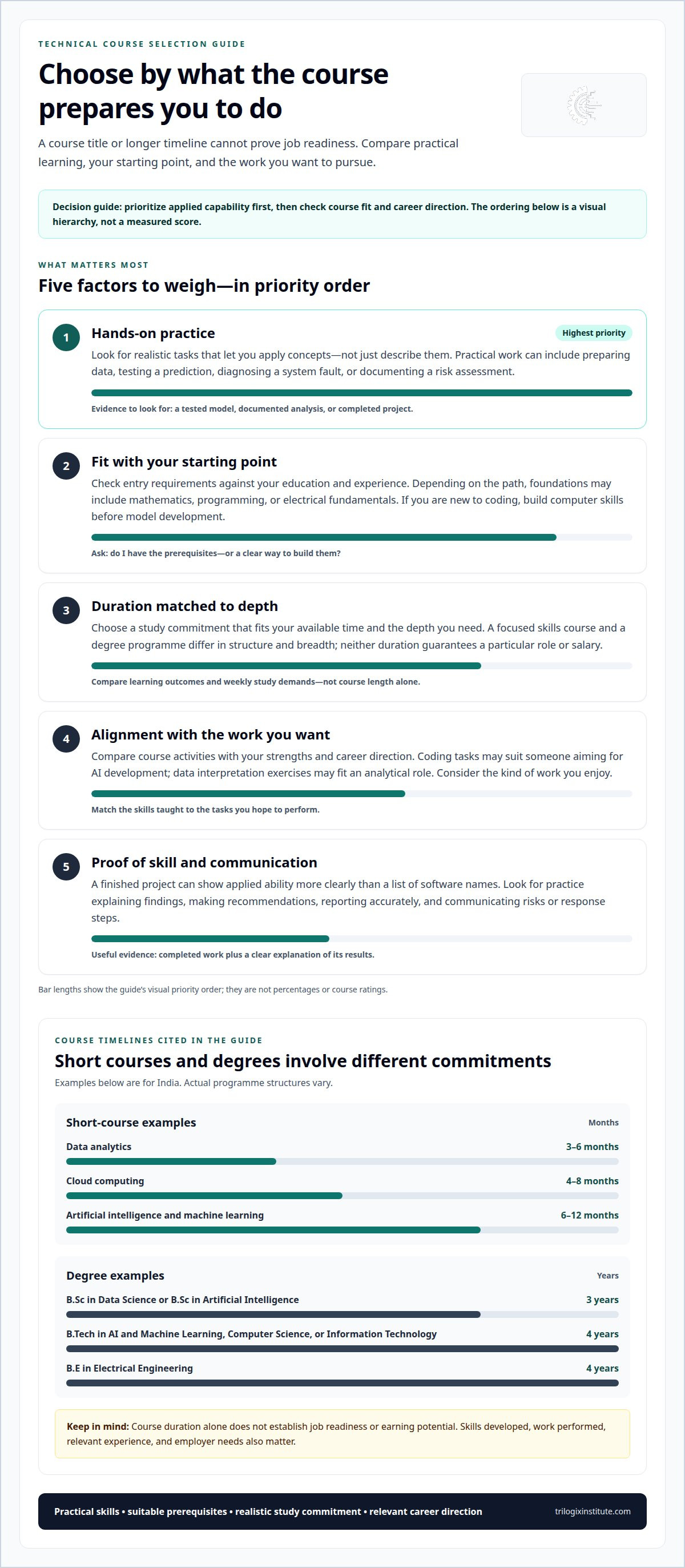
Course length signals the depth of training, but it doesn’t measure job readiness by itself. In India, artificial intelligence and machine learning courses are listed at 6-12 months. A B.Sc in Data Science and a B.Sc in Artificial Intelligence each take 3 years, while a B.Tech in Artificial Intelligence and Machine Learning takes 4 years. For readers comparing the best technical courses for high salary, these timelines show how short courses and degree programmes differ in commitment and structure.
Start with eligibility. Degree programmes generally set academic entry requirements, while vocational courses can suit learners with varied educational and work backgrounds. The right fit depends on prerequisites such as mathematics, programming, or electrical fundamentals. For example, comfort with algebra can make introductory machine-learning concepts easier to grasp. If you are new to coding, build computer skills before tackling model development.
High-value workplace skills extend beyond technical tools. Data scientists must turn findings into clear recommendations; cybersecurity professionals need to document risks and communicate response steps. Across fields, analytical thinking, accurate reporting, collaboration, and problem-solving support technical work. A completed project can demonstrate these capabilities more clearly than a list of software names.
Course demand can attract students to a popular specialisation, but selection should begin with ability and career direction. Compare weekly learning activities, not just course titles. Coding tasks suit someone aiming for AI development; data interpretation exercises may fit an analytical role. Review relevant course options to understand how structured training connects to practical skills.
- Check prerequisites: Identify required mathematics, coding, or technical foundations before enrolling.
- Match duration to depth: A 6-12-month AI course differs from a 3-year science degree.
- Look for applied work: Choose learning tasks that produce evidence, such as a tested model or documented analysis.
- Build communication: Practise explaining technical findings in plain language for workplace decisions.
Training is an investment, so assess whether a course develops skills relevant to your target role. Compare its learning outcomes with real tasks, such as preparing data, diagnosing a system fault, or presenting a risk assessment. The best technical courses for high salary connect your starting point and study commitment with practical capabilities for a chosen career direction.
2. Course durations and entry requirements
Popular technical courses range from short-term study to full degree programmes. In India, data analytics courses can take 3-6 months, while cloud computing courses are listed at 4-8 months. A B.Tech in Computer Science, B.E in Electrical Engineering, or B.Tech in Information Technology takes 4 years. These timelines help students compare a targeted skills course with a longer academic pathway.
Entry requirements vary by programme. A short data analytics course may suit someone building spreadsheet and data-interpretation skills. Degree programmes have formal academic admission requirements, and technical subjects may require relevant foundations. Compare prerequisites with your education and experience before enrolling. For example, cloud infrastructure study involves learning how systems, networks, and data environments connect.
How long do popular high-paying technical courses take to complete? In India, short data analytics courses take 3-6 months, cloud computing courses 4-8 months, and degree programmes such as a B.Tech in Computer Science take 4 years. The right timeline depends on whether you need focused job skills or broader academic study.
Duration also shapes how learners approach practice. A 3-6-month analytics course needs a focused schedule for tools, assignments, and a portfolio project. A 4-year engineering degree provides more time for foundational study and advanced subjects. Neither length guarantees a particular role or salary. Earning potential depends on the skills developed, the work performed, and how well a qualification matches employers’ needs.
Compare salary prospects carefully. Data science and analytics can lead to analyst roles, but job titles alone do not determine earning potential. Employers assess applied ability, relevant experience, and the complexity of the work. When exploring the best technical courses for high salary, compare course outcomes with actual tasks, such as cleaning data, interpreting results, or explaining a recommendation.
Programme fees vary by course and institution. Degree tuition and short-course fees are not directly comparable: duration, curriculum, delivery format, and practical resources affect the overall commitment. Compare programme structures, not headline fees alone. Factor in assignment time and independent practice, especially if you are studying alongside work. The best technical courses for high salary align learning outcomes with a realistic role and the time you can dedicate to study.
- Set your timeline: Match a short course or a 4-year degree to your study capacity.
- Review prerequisites: Connect admission requirements to your education and technical foundation.
- Compare outcomes: Look for practical tasks relevant to roles such as data analyst or infrastructure specialist.
- Assess the full commitment: Weigh course length, learning format, and approximate fees together.
For a structured comparison of technical learning options, explore the course formats and subjects. A clear match between entry point, study time, and intended role makes the next decision more practical.
3. Factors to consider when choosing a course
Start with the work you want to do, then compare courses against it. Someone drawn to science and evidence may prefer data science, while a learner who enjoys systems may favour cloud computing. In the UAE, consider whether the skills connect to roles you can realistically pursue and support your longer-term career growth.
Demand matters, but a popular field is not automatically the right fit. Compare a course’s stated outcomes with job descriptions in your target field. A data analyst role, for example, may involve data preparation, interpretation, and clear reporting. A course focused only on tool demonstrations may not develop those practical skills sufficiently.
Assess course content by looking at how the learning is sequenced. Look for defined modules, relevant assignments, and assessments that test applied skills. An AI course, for instance, might progress from data preparation to model testing and result interpretation. This shows whether students practise the complete task rather than study isolated concepts.
Interpret credentials carefully. A qualification’s name or certificate alone does not show what a learner can do. Review the awarding organisation, stated learning outcomes, assessment method, and relevance to the field. A cybersecurity course, for example, should clearly define its scope, such as security awareness or incident response, rather than rely on a broad label.
Learning format affects how well technical concepts transfer into practice. Instructor-led lessons support discussion and guided exercises, while project work gives students a chance to apply a method from start to finish. Compare formats with your schedule and learning habits. If you are balancing employment with study, map out class time and independent assignments before committing.
Expensive courses carry a risk of paying for broad promises without enough structured learning or relevant practice. Assess quality by examining the curriculum, instructor expertise, assessment approach, practical exercises, and the specific skills learners should demonstrate by completion.
Personal strengths matter, too. Someone who enjoys troubleshooting may engage more deeply with cybersecurity or cloud infrastructure than with interface design. Try a sample task, such as interpreting a dataset or mapping a basic network, and notice which activity holds your attention. This can clarify which field suits your working style.
- Map your goal: Name a target role, such as data analyst, before comparing course titles.
- Inspect the curriculum: Match each module to a skill or workplace task.
- Test the format: Check whether lessons include feedback, assessment, and applied practice.
- Weigh long-term fit: Consider interests, strengths, demand, and room for career growth together.
A sound decision balances market relevance with personal fit. Compare a few programmes using the same criteria, then choose the one whose content and learning format best prepare you for the work you want to pursue.
4. Technical courses and practical training
Practical training turns technical concepts into repeatable workplace actions. In electrical study, learners connect fundamentals with power distribution and industrial electrical safety. A useful exercise might involve identifying a circuit component, explaining its function, and following a safe work sequence. Each task links knowledge to a realistic technician responsibility.
Automation training should connect control principles with digital systems and sensors. For example, a learner can trace how a sensor signal relates to a control response, then describe the system’s purpose. Exposure to Industry 4.0 fundamentals helps place those components within connected industrial operations. The value lies in understanding how systems interact, not memorising equipment names.
Mechanical courses build a different practical foundation. Machinery, maintenance concepts, and engineering fundamentals help learners understand how equipment operates and where support is needed. A maintenance exercise could ask students to describe machine components and document an observed issue. This develops methodical observation and technical reporting alongside subject knowledge.
Cybersecurity practice also benefits from realistic scenarios. A course might ask learners to identify a suspicious message, explain the potential risk, and outline a response for a supervisor. The exercise strengthens attention to detail and communication. As digital systems become more common across workplaces, cybersecurity awareness is useful beyond dedicated security roles.
Which UAE training providers offer accredited technical courses, and are online options available? Choose a provider that identifies accreditation for the specific course and explains its scope, rather than relying on a general institutional claim. Online learning can support theory, but equipment-based subjects such as electrical work and automation need practical exercises to develop applied competence.
Match the training format to the task. An online lesson can introduce electrical terminology or explain a control diagram. A supervised practical exercise then lets learners work with equipment and connect diagrams to physical components. For cybersecurity, scenario-based digital exercises build analysis skills, while instructor feedback helps clarify why a response is appropriate.
Practical course outcomes can support entry-level pathways, including apprentice electrical technician, maintenance support, and industrial electrical trainee roles. Mechanical study may relate to mechanical assistant, industrial trainee, or technical support work. These are possible directions, not guaranteed outcomes: employers assess demonstrated capability and how well training matches role requirements.
- Inspect the practice: Identify the equipment, systems, or scenarios learners will use.
- Connect practice to work: Match exercises to tasks such as documenting a fault or tracing a sensor signal.
- Review feedback: Look for assessment that explains both correct actions and errors.
- Match the format: Use online theory where suitable, with practical instruction for equipment-based skills.
Strong technical learning combines explanation, practice, and feedback. Learners who can describe a process, perform a task, and document the result show clearer evidence of applied ability than those who have studied terminology alone. This structured approach to hands-on proficiency is also evident in specialized technical paths like aviation, where institutions such as Aero Global Aviation Academy emphasize comprehensive flight training and practical certification over mere theoretical study.
5. What are the most respected technical certifications among UAE employers?
There is no single technical certification for every UAE employer or role. A credential’s value depends on its subject, assessment, and relevance to the work. A cybersecurity qualification, for example, supports a different technical pathway from an electrical engineering credential.
Match a certification to a job function before comparing names. Cybersecurity candidates can look for qualifications focused on security principles, risk, or incident response. IT infrastructure roles may call for evidence of networking or cloud knowledge. In each case, the syllabus should map to skills named in relevant job descriptions.
Specific credentials can signal a defined area of study, but they do not replace experience or practical ability. CISSP is a cybersecurity certification name; PMP relates to project management. They support different professional goals, so neither is a universal technical credential. Choose according to the work you intend to pursue.
Check what a credential assesses. A course completion certificate may show participation, while a professional certification may require a separate examination or assessment. Read the awarding body’s description, prerequisites, exam scope, and renewal conditions. This helps distinguish demonstrated knowledge from attendance alone.
UAE employers may weigh credentials alongside applied skills, relevant experience, and communication. A candidate for a technical support role, for instance, may need to explain how they diagnose an issue, document their actions, and escalate it. A certificate is more useful when its learning prepares someone to perform those tasks confidently.
Use this practical review before selecting a certification:
- Start with the role: Identify whether your target is cybersecurity, cloud infrastructure, electrical work, or project management.
- Read the scope: Compare the syllabus with the technical tasks required in that field.
- Understand assessment: Confirm whether the credential involves an exam, practical evaluation, or course attendance.
- Check prerequisites: Note any prior knowledge or experience needed to prepare effectively.
- Consider ongoing requirements: Review whether the credential has renewal or continuing-learning conditions.
Certification and practical training serve different purposes. A credential can structure learning around a recognised subject, while hands-on exercises develop task-based competence. Studying industrial controls, for example, is stronger preparation when learners also interpret a control diagram and explain how its components function together.
For UAE career planning, compare certification content with the responsibilities of your target role. Do not choose solely by a credential’s name or the promise of high earnings. Look for training that develops relevant knowledge, assesses it clearly, and complements the experience you can demonstrate.
Trilogix Institute
Trilogix Institute helps learners build practical technical skills through focused vocational training. If your career direction points toward electrical systems, industrial controls, or design software, its TTI Dubai Foundation Electrical Engineering, TITP Beginner Essential Industrial Motor Control, and TTI Dubai Advanced AutoCad 2D & 3D courses connect learning with applied skills. These options suit readers seeking structured, hands-on preparation rather than a university degree.
Choose a course based on the tasks you want to learn and the technical foundation you need. For broader control-system learning, Trilogix Institute’s Industrial Automation Specialization may fit your goals. The TTI Dubai Professional Culinary Arts programme is a separate vocational pathway, not a technical engineering course. Contact Trilogix Institute to discuss which training direction aligns with your interests and next career step.
Turn Your Training Goal Into a Clear Next Step
A career decision is more useful when it connects to a specific kind of work. Before choosing among the best technical courses for a high salary, identify the tasks you want to perform and the skills you want to strengthen. This focus helps you choose training that serves your direction, rather than following a popular course title without a clear purpose.
Think of your next course as the beginning of a skills pathway. You might start with a technical foundation, then move towards more specialised work as your experience develops. Decide which learning environment and subject fit your current goals. A focused conversation can help you explore that direction and consider suitable training options.
Trilogix Institute offers vocational training including TTI Dubai Foundation Electrical Engineering, TTI Dubai Professional Culinary Arts, and TTI Dubai Advanced AutoCad 2D & 3D. Contact Trilogix Institute today to discuss your learning goals and take a confident step toward developing practical skills.
Frequently Asked Questions
Which course is best for future in India?
For future prospects in India, AI and machine learning, cybersecurity, data science, and cloud computing are strong options to compare. Choose according to the role you want: model development, security operations, data analysis, or infrastructure. A student who enjoys logic and programming may gravitate toward AI, while someone drawn to risk investigation may prefer cybersecurity. Compare course outcomes with actual job tasks, rather than choosing by field label alone.
So which one should you actually pick?
Choose a course that prepares you for a specific role you can describe clearly. Write down the work you want to do, such as analysing customer data or supporting industrial control systems, then compare programmes by their relevant learning outcomes. Consider your current skills, preferred learning format, and study time. A course that fits all three is more actionable than choosing a field solely because it seems popular.
Which technical courses lead to the highest salaries in the UAE?
No single technical course can be named as the highest-paying across UAE employers. Salary potential depends on the position, experience, sector, and demonstrated capability. AI and machine learning, cybersecurity, data science, cloud computing, and industrial automation are fields to assess against UAE job descriptions. Compare responsibilities and career progression for specific roles rather than treating a course title as a salary ranking.
How much do leading technical courses and certifications cost in the UAE?
UAE course and certification costs vary by subject, programme length, learning format, and whether assessments or equipment are included. Compare the full learning package, not just tuition, and note what the quoted amount covers. Pricing depends on the case and is provided after a quote request. Use AED when comparing UAE quotes, and keep any separately listed examination costs distinct from course fees.
What prerequisites and skills are needed for high-paying technical courses?
Prerequisites depend on the course. For electrical or automation study, comfort with technical diagrams, measurement, and methodical fault tracing can help. Data-focused courses benefit from numerical reasoning and spreadsheet familiarity. Across technical fields, clear notes and the ability to explain decisions support effective teamwork. Review the entry requirements against your education, then strengthen a relevant foundation skill before starting your programme.


