

Your next engineering skill shouldn’t be chosen by trend alone. If you’re asking how to future-proof my engineering career, start by separating durable engineering fundamentals from tools and methods that are changing. In 2026, AI, automation, data, and connected systems are influencing engineering work, but sound technical judgment and problem-solving remain essential.
It’s understandable to worry that your current experience or training could become outdated. The answer isn’t to chase every new technology or assume another qualification is always the best next step. Identify the skills your work requires, verify where your abilities need strengthening, and choose learning that helps you apply those skills.
This guide gives you a practical way to assess skill gaps and build a balanced development plan, combining strong fundamentals with relevant technical capabilities. You’ll learn how to weigh workplace experience, formal education, and focused practical training, then choose a next step based on its relevance to your goals and opportunities to practise. The aim is steady career resilience, not a one-time fix.
Key Takeaways
- Define how you want your engineering work to develop, then use role requirements to identify skills worth prioritizing.
- Build on engineering fundamentals while selecting new tools and techniques that fit your discipline and target work.
- Use a flexible 90-day plan to assess your starting point, learn, apply a priority skill, and review your progress.
- To future-proof my engineering career, verify skill gaps and choose learning that includes relevant opportunities to practise.
- Compare structured training with workplace experience and other learning options by checking how well each matches your skill gap and career objective.
What does it mean to future-proof your engineering career?
Engineering tools, job responsibilities, and employer expectations can change, so it’s reasonable to question whether your current skills will stay relevant. That uncertainty doesn’t mean engineering work is disappearing. It means a career plan needs to account for change instead of relying on one qualification or toolset to serve you indefinitely.
Career resilience is the ability to adapt your engineering capabilities as work changes, while continuing to apply sound fundamentals to real problems. Future-proofing isn’t about finding a permanently secure role or predicting exactly which technology will dominate. It’s a repeatable practice: understand what your target work requires, strengthen any gaps, and look for evidence that you can apply what you learn.
Some capabilities endure; others depend on the discipline, project, and workplace. Engineering draws on scientific and mathematical principles to solve practical problems, as outlined in this overview of engineering fundamentals. Those principles help you assess whether a new tool’s output makes sense, rather than relying on it without understanding the system behind it.
Which parts of an engineering career are most likely to change?
Monitor the parts of your work that depend on specific technologies or organizations: design and analysis software, automation systems, digital workflows, technical standards, and employer-specific procedures. One role may require regular CAD work, while another may prioritize equipment troubleshooting or process control. These are examples, not universal requirements. What matters is whether a skill appears in credible descriptions of the work you want to do.
The pace and type of change vary across disciplines, seniority levels, and working environments. A graduate may need to build confidence with core methods and tools; an experienced engineer may need to coordinate across teams or evaluate new processes. Review developments against your actual responsibilities, not headlines alone.
What should remain central to your career plan?
Keep problem-solving, technical communication, safety awareness, and engineering judgment at the centre. Fundamentals help you define a problem, check assumptions, interpret results, and troubleshoot when conditions differ from a clean example. They also make it easier to learn unfamiliar systems without treating every new platform as a completely new profession.
When you ask how to future-proof my engineering career, look beyond course completion or certificates. Seek opportunities to apply a skill, explain your approach, and produce evidence of what you can do, such as a documented task, design decision, or practical exercise. Learning becomes more useful when it connects to the work you want to perform.
How to identify the engineering skills worth developing next
Start with the work you want to do, not a list of fashionable technologies. A skill is worth prioritizing when it closes a credible gap between your current capability and the responsibilities you’re targeting. Compare your current work with several relevant role descriptions and employer requirements, then look for repeated expectations rather than treating one vacancy as a universal standard.
Prioritize engineering skills by clarifying your target work, reviewing evidence of your abilities, identifying gaps, validating demand, and choosing a way to practise. This process is more reliable than searching for one definitive engineering skills list, because requirements vary by discipline, organization, and role.
- Clarify: Name the type of work or responsibility you’re aiming for.
- Review: Record tasks you’ve completed and evidence of what you can do.
- Identify: Separate demonstrated strengths from skills you still need to build.
- Validate: Check whether the gap appears in credible role descriptions and employer requirements.
- Practise: Choose a relevant project, workplace task, or structured learning option.
How can you assess your current engineering skill set?
Make an inventory of technical tasks completed, tools used, problems solved, and feedback received. Add a brief project example for each capability: what was the problem, what did you do, and what was the result? This helps distinguish practical ability from familiarity with terminology. Ask a supervisor, instructor, or experienced colleague for specific feedback, such as which task you could handle more independently or where your method needs strengthening.
Then mark each skill as demonstrated, developing, or untested. A tool listed on your CV may show exposure, but a concrete example of using it to complete a task is stronger evidence. Keep the assessment factual. It’s a planning tool, not a verdict on your potential.
How do you verify that a skill is relevant to your goals?
Review several suitable job descriptions in your target discipline and work context. Note recurring responsibilities and technical requirements, then compare them with your inventory. If a skill appears only once or belongs to a different type of role, it may be interesting without being a priority. Focus first on gaps that repeatedly connect to the work you want to perform.
Record where each requirement came from and revisit the list as roles and expectations evolve. If you’re considering structured technical learning, compare the verified gap with the technical courses offered, then check course content and practical components before deciding whether they fit your objective. This is a more focused way to future-proof my engineering career than collecting credentials without a clear application.
Can engineering fundamentals and new technology skills work together?
Yes. A resilient skill set combines durable engineering fundamentals, discipline-specific techniques, and tools that may be tied to a particular workplace. Fundamentals help you reason through unfamiliar problems. Discipline-specific techniques equip you to work within your field. Workplace-dependent tools help you complete tasks using the systems an employer or project relies on.
Consider troubleshooting an electrical motor control issue. Understanding circuit behaviour helps you reason about possible causes. Knowing the relevant diagnostic procedure guides your investigation. Familiarity with a particular software interface may help you record or monitor results, but knowing which buttons to press won’t explain why the system behaves unexpectedly. Tool knowledge is useful; it works best when supported by technical understanding.
| Skill category | Purpose | Useful evidence | Suitable practice |
|---|---|---|---|
| Engineering fundamentals | Explain and solve underlying technical problems | A clear explanation of assumptions, method, and reasoning | Work through technical problems and check results against expected behaviour |
| Discipline-specific techniques | Apply methods used in a field, such as electrical or mechanical work | A completed task, analysis, or technical record | Practise with relevant procedures, examples, or supervised tasks |
| Workplace-dependent tools | Complete tasks using a particular platform, process, or system | A deliverable produced with the tool and checked for accuracy | Use the tool on a defined task, following workplace guidance |
What is the difference between transferable skills and tool familiarity?
Transferable skills include reasoning, communication, and documentation, but they don’t replace technical competence or discipline-specific knowledge. A well-documented troubleshooting record helps a colleague review your steps, understand what you observed, and continue the work safely. Clear handovers make technical decisions easier to verify. Software fluency supports the task; sound engineering practice determines whether the result is useful.
When should you choose a course, project, or workplace learning?
Match the learning method to the gap. Instructor-led practice can suit skills that benefit from demonstration, feedback, or access to equipment. A supervised workplace task may be appropriate when the work is safe to assign and expectations are clear. Self-study can fill a focused knowledge gap, provided you check the material’s accuracy and apply it to a relevant task.
Continuous reskilling can sound like an endless list, but it doesn’t need to be. Choose one real task, identify the capability it requires, and learn enough to perform or explain that task more effectively. If you’re asking how to future-proof my engineering career, build depth in fundamentals and add targeted technical skills where your work calls for them.
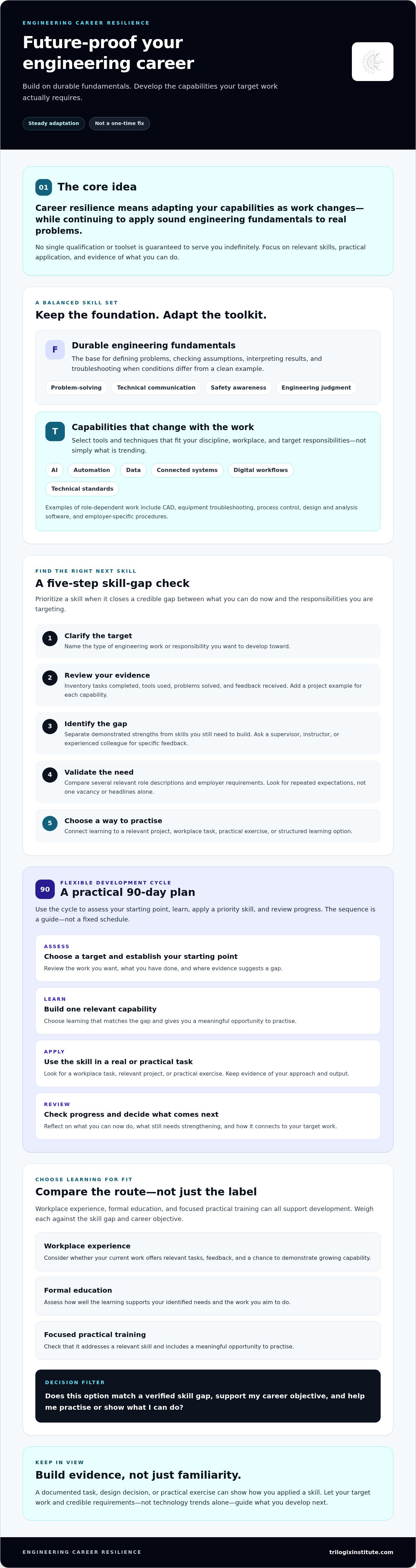
How to build a practical 90-day engineering development plan
A 90-day plan gives you a defined period to build and test a capability, not a guarantee of a new role or a fixed result. Keep it focused: choose one career direction and one or two priorities supported by evidence, such as recurring requirements in relevant job descriptions or feedback on your current work.
Use four phases: assess, learn, apply, and review. Adjust the timing around your workload. What matters is moving from identifying a gap to practising a skill and checking what you can demonstrate.
What should you do in the first 30 days?
Choose a target responsibility, then compare its requirements with tasks you’ve completed and feedback you’ve received. Select one priority gap and describe competent performance in observable terms. For example, instead of “learn automation,” define a relevant task you want to explain, configure, or complete with appropriate supervision.
Next, choose a suitable learning method. A workplace mentor may help with a role-specific process; self-study may suit a focused knowledge gap; instructor-led training may be useful when demonstration, feedback, or equipment-based practice matters. Check that the learning option addresses your defined gap, and confirm its current format and practical components before enrolling.
How can you measure progress by day 90?
Set a practical output you can review. Depending on your field and access, this could be a documented technical task, a drawing reviewed against clear criteria, or a completed supervised exercise. Keep notes on what you did, the methods or tools used, feedback received, and any remaining questions.
- Assess: Record your target responsibility, current evidence, and priority gap.
- Learn: Work through selected material, instruction, or guidance tied to that gap.
- Apply: Complete a suitable task or exercise, following relevant safety and review requirements.
- Review: Ask a qualified reviewer for specific feedback, then decide what to strengthen next.
Measure progress by the quality of your applied work and the clarity of your reasoning, not course completion alone. If you’re planning how to future-proof my engineering career, use the review to adjust your next priority rather than assuming the original plan must stay unchanged.
For a verified technical gap, you can explore Trilogix Institute’s technical courses as one possible structured learning option. Compare the relevant course content and practical format with your objective before deciding whether it fits your plan.
How can structured engineering training help me future-proof my engineering career?
Structured training can help address a verified technical gap when you need guided instruction, feedback, or practice with equipment. Start with your objective, not the course title: identify the task you want to perform, the capability it requires, and the kind of practice that would help you build it. Then check whether a course’s content and learning activities match that need.
Training is one part of career development. It can strengthen capability, but it doesn’t guarantee hiring, promotion, or job placement. Its value lies in what you learn and can apply, alongside your existing experience and continued practice.
What should you check before choosing an engineering course?
Before enrolling, confirm the course topic, instructor involvement, practical activities, equipment access, and current delivery details. Ask how learning is assessed and whether the exercises reflect the skill you want to develop. Check that the level suits your experience, too. A course that assumes more prior knowledge than you have may not address your actual gap.
- Relevance: Does the content match a skill you’ve verified as useful for your target work?
- Practice: Will you have opportunities to apply the concepts, receive feedback, or use relevant equipment?
- Evidence: What work or assessment will help you judge what you’ve learned?
- Claims: If a certification is mentioned, confirm who awards it and what it represents before enrolling.
When might Trilogix Institute’s technical training fit your plan?
Trilogix Institute offers technical training in foundation electrical engineering, industrial automation, motor control, and AutoCAD. Its instructor-led approach and use of real-world equipment may suit learners looking for guided technical practice. For example, if your development plan identifies a need to strengthen electrical engineering knowledge or practise with equipment, compare that need with a course topic and verify the current format and practical components.
Relevant options include Foundation Electrical Engineering, Advanced AutoCAD 2D & 3D, and Essential Industrial Motor Control. Consider vocational training as a focused way to develop applied capability, not as a substitute for a university degree or workplace experience. It may fit an electrical engineering career-readiness objective when the course content aligns with the work you’re targeting. Assess any course against a specific skill gap, a meaningful practice opportunity, and a clear next step in your plan.
Review the technical course information and confirm current course names, delivery details, and equipment access before deciding whether a program fits your learning goals.
Make your next engineering skill a deliberate choice
A resilient engineering career is built through steady decisions, not a single qualification or a rush to learn every new tool. Keep your plan anchored in strong fundamentals, choose skills that support the work you want to do, and look for practical evidence that you can apply what you learn. A focused development plan can turn the question “How can I future-proof my engineering career?” into a clear next step.
Structured training may be one way to address a verified technical gap, especially when you benefit from instructor guidance and equipment-based practice. Trilogix Institute offers instructor-led technical training designed to support practical skill development. Review the course topic and current delivery details to decide whether an option matches your learning objective.
Explore Trilogix Institute’s technical courses and consider how a relevant course could complement your experience and ongoing learning. Choose deliberately, practise consistently, and build your career resilience one capability at a time.
Frequently Asked Questions
What does it mean to future-proof an engineering career?
Future-proofing means adapting your capabilities as engineering work and employer requirements change, rather than relying on one job or qualification to remain relevant indefinitely. Build on durable fundamentals, monitor the needs of your target roles, and develop technical skills that support those responsibilities. Then look for practical ways to apply and demonstrate what you’ve learned. It’s an ongoing career habit, not a guarantee of permanent job security.
Which engineering skills are most likely to remain useful?
Problem-solving, sound technical judgment, safety awareness, and clear communication are useful across many types of engineering work. Discipline-specific knowledge remains essential, too, though the methods and tools used to apply it may vary. For example, an engineer needs to understand the system being assessed, not just how to operate a particular software interface. Combine these durable capabilities with technical skills relevant to your discipline and responsibilities.
Can AI replace engineering jobs?
AI can assist with tasks such as generating design options, summarizing information, or supporting code and data work, but that doesn’t establish that it can replace engineering roles as a whole. Engineers still need to define problems, check outputs, consider safety, and make decisions in context. The impact will differ by discipline and workplace. Learn where AI fits in your work, and develop the judgment to assess its results rather than accepting them without review.
How do I know which engineering skill to learn next?
Start with a specific role or responsibility you want to pursue. Compare its requirements with examples of tasks you’ve completed, tools you’ve used, and feedback you’ve received. Review several credible job descriptions to see which skills recur, then prioritize a gap that connects to your direction. Choose a learning method that lets you practise it. This evidence-based approach is more useful than selecting a skill simply because it’s trending.
Are engineering courses enough to future-proof my career?
No single course can future-proof a career. Training can build knowledge or practical capability, but it works best alongside relevant experience, ongoing learning, and opportunities to apply skills to real tasks. Before enrolling, check that the course addresses a verified gap, includes suitable practice, and matches your experience level. Track what you can demonstrate afterward, not just whether you completed the course or received a document of completion.
Is hands-on engineering training better than online self-study?
It depends on the skill and how you learn best. Self-study can suit focused knowledge gaps, especially when you can check information against reliable sources and apply it to a task. Instructor-led, equipment-based practice may be more suitable when you need demonstrations, feedback, or experience with real-world equipment. Compare the learning method with your goal, and check the course’s current delivery details and practical activities before deciding.
How often should engineers update their skills?
There’s no single schedule that suits every engineering discipline or role. Review your capabilities when responsibilities change, new tools enter your workflow, or feedback and role requirements reveal a gap. A regular development check can help you spot changes before they become urgent, but avoid learning for its own sake. Set a focused priority, practise it, review evidence of your progress, and adjust your next step as your work evolves.


