

Spending four years deriving theoretical calculus formulas will not prepare you to troubleshoot a live automation panel or wire an industrial motor. When weighing trade school vs university for engineering, the real choice isn't just about prestige; it's about whether you want to research concepts on paper or master practical execution on physical equipment.
It's completely natural to fear investing years into higher education only to graduate with substantial debt and minimal hands-on capability. You might also wonder whether employers genuinely respect vocational qualifications alongside traditional academic degrees, or how technician duties actually differ from licensed engineering roles. Getting clarity on these distinctions is essential before committing your time and resources.
This decision guide helps you discover whether technical vocational training or an academic degree aligns with your career timeline, budget, and engineering goals. Ahead, we dissect the fundamental differences in curricula, day-to-day workplace duties, and industry advancement pathways so you can enter the modern industrial workforce efficiently.
Key Takeaways
- Understand the foundational trade school vs university for engineering divide, contrasting theoretical calculus and research design with applied physical troubleshooting.
- Discover why modern industrial employers heavily prize verifiable competencies logged on live equipment over passive classroom lecture hours.
- Clarify distinct career pathways to determine whether your ambitions align with practical field commissioning and maintenance or licensed professional engineering.
- Evaluate your overall return on investment by comparing swift industrial workforce entry against extended academic timelines and financial overhead.
- Apply a structured four-step decision framework to align your personal learning style, budget, and immediate professional milestones with the correct pathway.
Core Differences: Trade School vs University for Engineering Explained
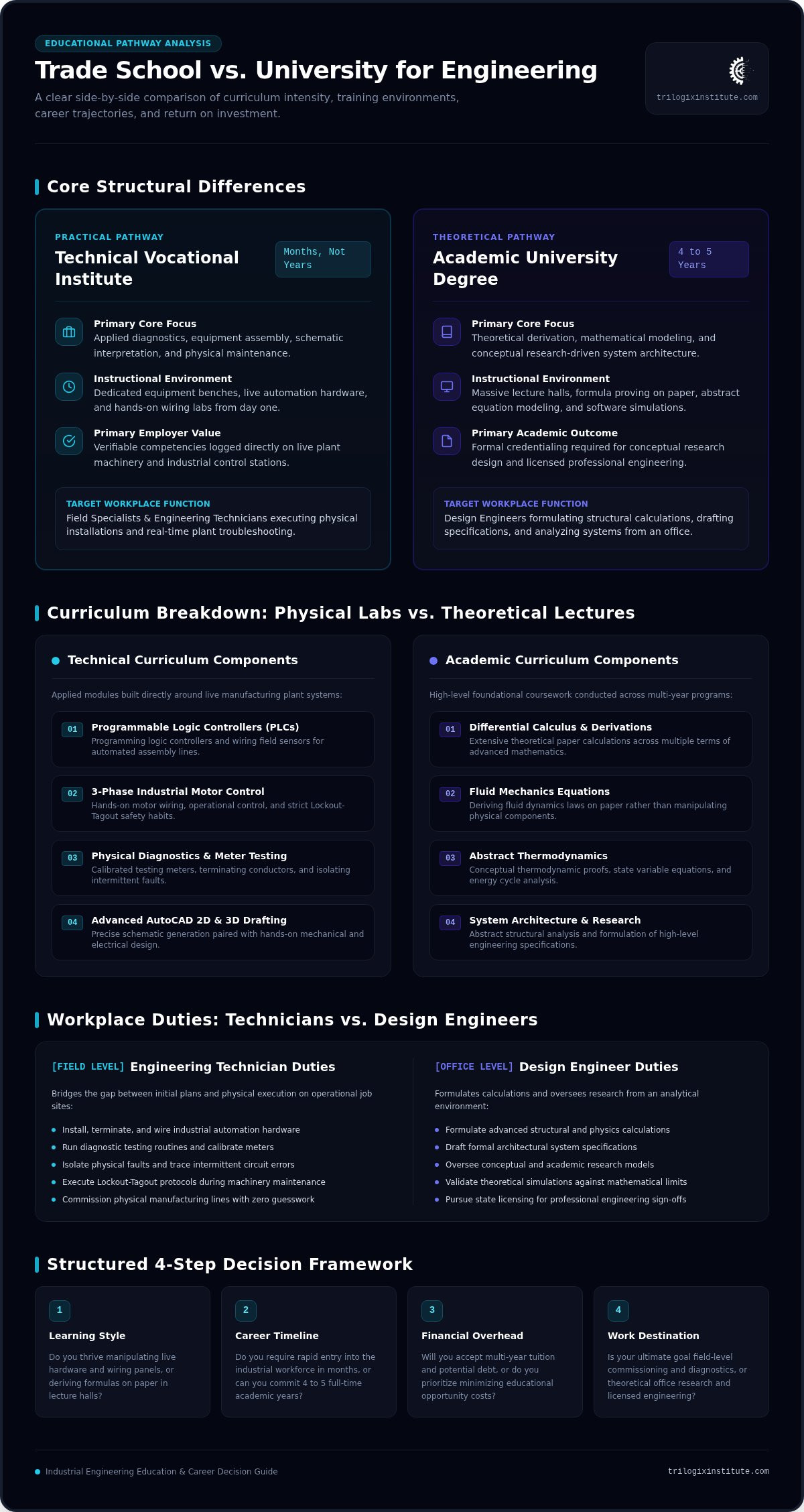
Evaluating trade school vs university for engineering requires looking past institutional marketing and examining the daily mechanical realities of both tracks. University engineering operates on high-level theoretical derivation, mathematical modelling, and research-driven system architecture. In contrast, an accredited vocational school centers its curriculum on applied diagnostics, equipment assembly, schematic interpretation, and physical maintenance.
These distinct educational approaches prepare learners for fundamentally different workplace roles:
- University Programs: Train design engineers to formulate structural calculations, draft specifications, and oversee conceptual research from an office or analytical environment.
- Technical Vocational Institutes: Train technicians and field specialists to install hardware, run diagnostic testing, maintain complex systems, and troubleshoot operational equipment directly on industrial job sites.
Theoretical Foundations vs Applied Technical Training
Academic degrees dedicate terms to differential calculus, fluid mechanics equations, and abstract thermodynamics. Students spend most of their time in lecture halls proving formulas on paper rather than manipulating physical components. Vocational training reverses this balance. Technical curricula prioritize physical wiring, component isolation, programmable logic controllers, and calibrated testing meters, ensuring learners spend their instructional hours directly on operational equipment benches.
Program Duration and Accelerated Career Entry
Traditional engineering degrees demand four to five years of full-time academic enrollment before graduation. Dedicated technical training concentrates exclusively on essential workplace competencies, enabling students to finish focused modular programs in months rather than years. This compressed timeline slashes the opportunity cost of multi-year study, placing qualified technicians into industrial employment years ahead of their university peers.
Deciding between these pathways comes down to your personal career objective. If your ambition is conceptual research, a multi-year degree remains the required standard. If you want direct technical employment without years of abstract lectures, specialized vocational courses provide the most efficient route into the modern industrial workforce.
Curriculum Breakdown: Classroom Lectures vs Physical Lab Equipment
Most debates around trade school vs university for engineering treat vocational education as simple construction trade training. That is an outdated perspective. Contemporary technical institutes focus heavily on advanced industrial automation, mechatronics, and electrical control systems. While university programs ground students in conceptual physics across massive lecture halls, vocational tracks immerse learners in physical equipment labs from day one.
Industrial plant managers consistently favor candidates with verifiable hours logged on live machinery. Engineering technicians bridge the gap between initial plans and physical execution, meaning their training must mirror actual plant conditions.
The Role of Physical Equipment in Technical Education
Working on live electrical benches builds tactile muscle memory that software simulations simply cannot replicate. Tracing physical circuits, terminating conductors, and isolating intermittent faults teach genuine spatial awareness. Direct interaction with three-phase industrial motor control stations instills strict lockout-tagout procedures and personal safety habits, turning abstract workplace safety regulations into second nature.
Drafting, Automation, and Industrial Control Systems
Modern industry requires precise documentation and automated control. Technical vocational curricula integrate intensive technical drafting modules, specifically Advanced AutoCAD 2D and 3D applications, to teach schematic generation alongside mechanical design. Paired with dedicated industrial automation benches, this instruction enables students to program logic controllers, wire field sensors, and commission manufacturing lines with zero guesswork.
Instructor-Led Mentorship vs Self-Paced Academic Study
Large university engineering courses frequently leave undergraduate students to decipher difficult coursework independently or rely on graduate teaching assistants. Technical institutes replace this detached model with direct, instructor-led mentorship in small cohorts. When you encounter a complex industrial wiring fault or a timing error during relay logic setup, an experienced instructor steps in immediately to demonstrate proper diagnostic procedures.
Mastering modern industrial hardware demands tactile experience rather than passive screen time. If your goal is to build verifiable competency on physical test benches, exploring practical vocational courses provides direct access to industry-standard equipment and seasoned mentorship.
Career Pathways: Engineering Technicians vs Theoretical Design Engineers
Clarifying career outcomes is critical when assessing trade school vs university for engineering. Many students wrongly assume these paths compete for the exact same jobs. In reality, they prepare candidates for complementary, interdependent positions within modern engineering teams. While degreed engineers oversee system architecture and analytical compliance, vocational graduates keep complex facilities running safely on the ground.
A typical industrial facility relies on a clear operational division of labor:
- Design Engineers: Focus on feasibility studies, mathematical modeling, capital budgets, and regulatory code certifications from an engineering office.
- Engineering Technicians: Perform physical installation, sensor calibration, routine diagnostic testing, and emergency mechanical or electrical repairs directly on active processing lines.
Roles and Responsibilities on the Modern Industrial Floor
Technicians and engineers work closely together, but their daily duties look radically different. An engineer designs a high-voltage distribution layout or programs a complex control philosophy. The technician translates those technical schematics into physical reality. Technicians pull wiring, terminate leads, align motor shafts, and execute field commissioning. When a system trips under heavy load, the technician conducts immediate root-cause diagnostics to restore production.
Industry Demand for Specialized Technical Talent
Modern industrial operations face an acute shortage of technical professionals who can wire equipment panels, calibrate sensors, and isolate automated motor faults. Facilities with high-speed packaging, automated warehousing, or advanced manufacturing cannot operate on theory alone. They require operational specialists capable of keeping high-value hardware online.
Hiring managers increasingly value targeted technical credentials because they validate tangible readiness. A candidate who holds specialized training in foundational electrical systems or industrial motor control can step into plant maintenance roles immediately. Technicians who demonstrate strong diagnostic skills frequently advance into maintenance supervision, controls engineering, or field service management over time.
The right decision depends entirely on where you want to spend your working hours. If you prefer conceptual planning and analytical documentation, pursuing a traditional university degree fits your trajectory. If you thrive on hands-on mechanical execution, electrical wiring, and physical troubleshooting, technical vocational training offers a faster route to high-demand industrial positions.
Evaluating ROI: Time Commitment, Debt, and Earning Potential
Calculating return on investment between trade school vs university for engineering requires assessing more than just exit salaries. You have to evaluate the total capital outlay, debt obligations, and the critical variable of lost time. Enrolling in an extended academic program means absorbing years of substantial tuition, fees, and living expenses before collecting your first engineering paycheck.
Financial return is directly tied to how quickly your education turns into active income. Consider how these paths diverge economically:
- Vocational Technical Route: Low upfront capital outlay, zero to minimal debt, and direct workforce entry within months to generate immediate earnings.
- Academic University Route: Substantial multi-year financial investment, potential long-term debt repayment, and several years of delayed earnings while completing theory coursework.
Debt Avoidance and Accelerated Workforce Entry
Vocational learners bypass extended tuition cycles and the heavy loan obligations that often burden university graduates. By completing intensive hands-on modules quickly, technicians enter industrial facilities years ahead of degree students. Those extra years in the workforce generate immediate income while establishing vital seniority. While an engineering student continues sitting in lecture halls, an active technician earns steady wages, logs project hours, and starts building financial security immediately.
Long-Term Career Earnings and Skill Stacking
Compensation in applied technical fields expands rapidly through strategic skill stacking. Technicians rarely stay at entry-level compensation. Adding focused credentials in motor control systems, advanced computer-aided drafting, or automated machinery qualifies technicians for specialized field roles, shift lead positions, and maintenance management. Many industrial employers actively sponsor further academic training for top-performing technicians, allowing ambitious professionals to complete advanced qualifications later on company funding.
Weighing trade school vs university for engineering ultimately comes down to capital efficiency and career speed. If you want to accelerate your entry into the industrial workforce without taking on years of debt, enroll in specialized technical training to start building high-value, marketable capabilities today.
How to Decide: Selecting the Right Engineering Path for Your Goals
Choosing between trade school vs university for engineering requires an honest assessment of your cognitive strengths, financial parameters, and daily workplace preferences. Instead of relying on generic advice, evaluate your future through a structured operational lens. Each educational model serves a specific purpose; your objective is aligning that purpose with your professional ambitions.
A 4-Step Framework for Choosing Your Educational Route
Work through these four evaluation points before submitting an application:
- Learning Style: Determine whether you master concepts faster by wiring physical test benches and diagnosing live hardware, or by analyzing abstract equations in lecture halls. Tactile learners thrive in trade institutes; conceptual thinkers excel in universities.
- Career Timeline: Decide how quickly you need to start earning. If your priority is entering the workforce within months, technical training accelerates that timeline. If you can afford four to five years of full-time academic commitment, a degree path remains viable.
- Capital Investment: Weigh your comfort with long-term student debt. Technical programs minimize upfront financial exposure, allowing you to generate income immediately rather than paying off multi-year tuition balances.
- Daily Work Environment: Identify where you want to spend your career. Vocational paths lead straight to active plant floors, field commissioning, and automated machinery. Degree tracks lead primarily to office desks, CAD stations, and compliance reviews.
Launching Your Technical Career Through Specialized Vocational Training
For candidates focused on tangible systems, vocational training provides a direct launchpad into essential industrial roles. High-intensity modules in foundational electrical engineering, industrial motor control, and automation bench troubleshooting equip you with verifiable competencies that industrial employers immediately look for on a resume.
You don't need to spend half a decade studying theoretical formulas to build a viable, respected technical career. Take the decisive step toward career readiness with Trilogix Institute technical programs, where instructor-led equipment labs bridge the gap between technical ambition and immediate industrial employment.
Accelerate Your Engineering Career on the Industrial Floor
Resolving the debate between trade school vs university for engineering comes down to where you want to apply your talents. Academic universities develop conceptual researchers and structural designers through years of abstract mathematics. Conversely, technical institutes prepare practical technicians who can wire, troubleshoot, and maintain the automated systems driving modern industrial facilities.
Instead of absorbing multi-year degree timelines and accumulating substantial debt, you can build verifiable technical capability right now. Comprehensive hands-on labs with physical electrical hardware and industrial motor control benches replace passive lectures with immediate diagnostic competence. Structured, instructor-led workshops eliminate theoretical fluff so you master the exact competencies plant managers look for when hiring.
Your pathway into modern industry starts with practical action. Explore Hands-On Technical Training at Trilogix Institute and equip yourself with the functional expertise needed to build a confident, high-demand technical career.
Frequently Asked Questions
Can you become an engineer through a trade school?
You can become an engineering technician or field specialist through a trade school, but not a licensed professional engineer. Vocational programs concentrate on applied diagnostics, hardware wiring, and equipment maintenance. If your objective is structural sign-off authority or theoretical research, an accredited university degree is mandatory. For hands-on plant operations, vocational training delivers the exact credentials industrial employers demand.
Is trade school cheaper than a four-year university for engineering?
Trade schools require substantially less capital investment than four-year universities. Academic degree tracks incur multi-year tuition rates, campus service charges, and textbook expenses that often lead to heavy debt burdens. Vocational technical institutes focus exclusively on intensive, career-specific modules. This compressed training model minimizes institutional overhead, allowing students to avoid massive loans and preserve their capital.
What types of engineering programs are available at technical trade schools?
Technical institutes concentrate on applied disciplines like foundation electrical engineering, industrial automation, motor controls, and computer-aided drafting. Rather than teaching abstract formulas, these programs train students on physical wiring, programmable logic controllers, and AutoCAD 2D and 3D modeling. This practical scope prepares learners directly for critical maintenance, installation, and field commissioning roles across automated manufacturing facilities.
Do employers respect vocational technical certificates compared to engineering degrees?
Industrial employers hold vocational technical certificates in high regard for plant maintenance and commissioning positions. When companies evaluate trade school vs university for engineering graduates, they value vocational candidates for their immediate equipment familiarity. Plant supervisors often prefer hiring certified technicians who can troubleshoot live control panels on day one without requiring extensive on-the-job machine training.
Can you transfer vocational trade school credits toward an engineering degree later?
Credit transferability depends entirely on institutional accreditation and the specific university policies you encounter. While theoretical lecture credits often transfer between academic colleges, vocational lab hours emphasize practical execution over calculus derivations. Many technical graduates successfully transition into engineering degree tracks later by leveraging workplace tuition reimbursement, though some academic courses must still be completed directly.
Which educational path offers faster employment: trade school or university?
Technical vocational training provides the fastest route to paid industrial employment. In the ongoing comparison between trade school vs university for engineering, trade programs take only months to complete compared to four or five years of university enrollment. This accelerated timeline lets technicians secure salaried positions, earn immediate income, and establish vital workplace seniority years ahead of academic students.


