

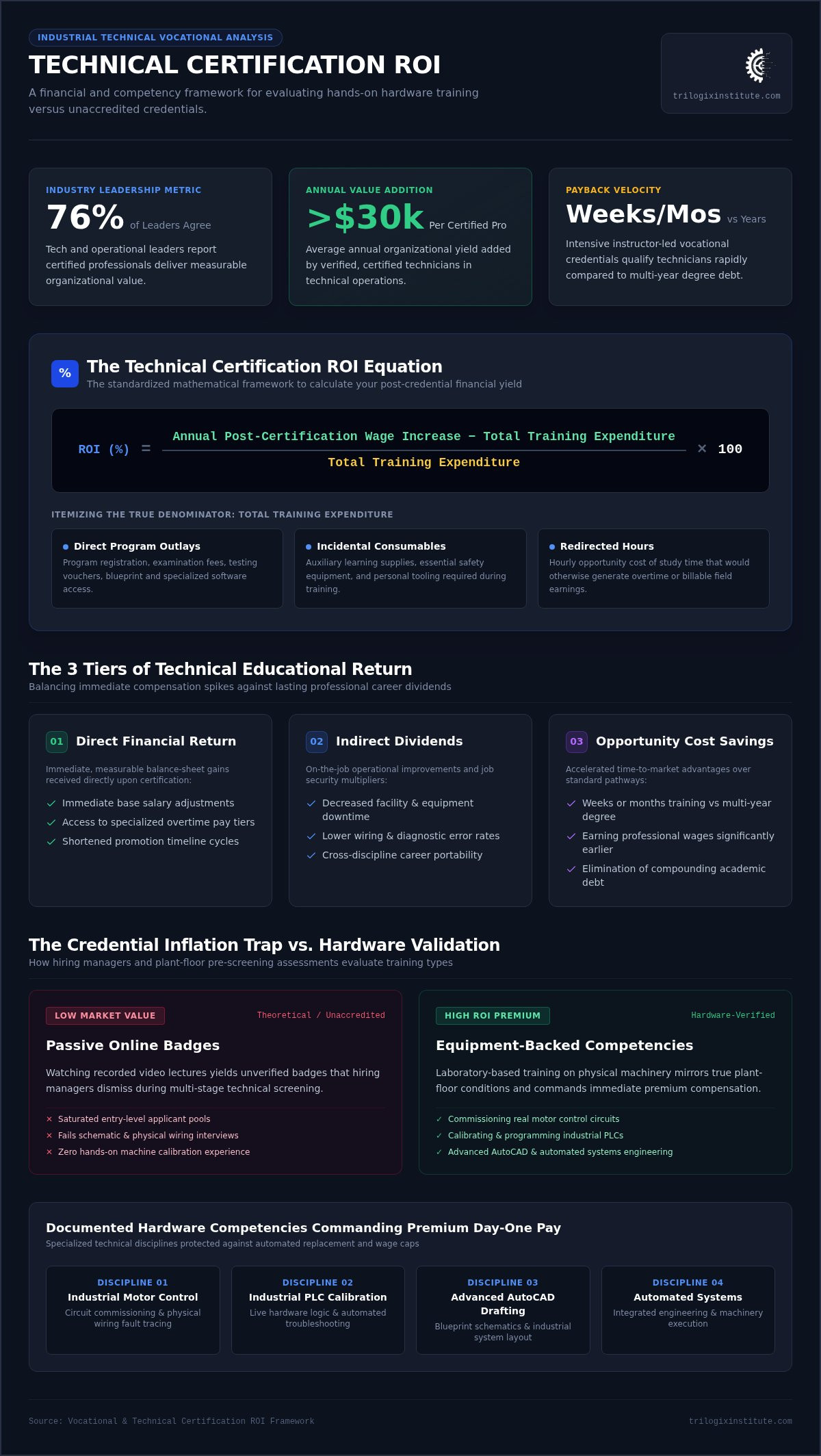
A digital certificate means nothing if you can't troubleshoot real hardware under pressure. While 76% of tech and operational leaders report that certified professionals add over $30,000 in annual organizational value, far too many ambitious technicians invest hard-earned savings into credentials that hiring managers dismiss as superficial theory. You already know the frustration of parsing through unaccredited badges and purely theoretical coursework, wondering if your effort will ever translate into a tangible promotion or pay raise. If you can't forecast your technical certification ROI before you enroll, you're essentially gambling with your career timeline.
You don't have to guess which credentials command respect in the field. This guide provides the tools to calculate, evaluate, and maximize your technical certification ROI using practical career benchmarks and industrial validation metrics. We'll contrast passive online badges against equipment-verified competencies, analyze realistic payback periods across technical trades, and deliver a reliable formula to ensure every training dollar converts directly into long-term earning power.
Key Takeaways
- Calculate your exact technical certification ROI using a structured financial equation that accounts for exam fees, study time, and post-credential earning trajectory.
- Understand why industrial employers place a higher premium on physical machinery operation than on passive, unaccredited online badges.
- Master a practical evaluation framework to align your credential choices with verified industrial demand and hardware-focused curricula.
- Discover how intensive, instructor-led vocational training provides a rapid payback timeline compared to multi-year academic degrees.
What Is Technical Certification ROI and Why Does It Matter?
Technical certification ROI measures the direct financial and professional yield generated from targeted vocational training relative to the total capital and time committed. Unlike academic diplomas that demand multi-year commitments and generate significant debt, focused vocational credentials accelerate workforce integration. The economics are straightforward. Holding unverified or outdated skill sets carries a silent, compounding penalty: suppressed wage ceilings, passed-over promotions, and vulnerability to automated replacements. Industrial employers no longer reward generalist credentials. They hire for verifiable execution on real hardware.
Understanding this return requires separating formal accreditations from casual training. A recognized professional certification validates that a technician meets rigorous, standardized operational benchmarks established by industry authorities. When training mirrors true plant-floor conditions, your investment transforms immediately into demonstrable market leverage.
The Core Components of Educational Return
Evaluating your true yield involves balancing immediate financial windfalls against sustained career mobility across three practical tiers:
- Direct Financial Return: Measurable gains including immediate base salary adjustments, access to specialized overtime rates, and shortened timelines between promotion cycles.
- Indirect Professional Dividends: Concrete on-the-job improvements such as decreased equipment downtime, lower wiring and diagnostic error rates, and cross-discipline career portability.
- Opportunity Cost Savings: Intensive vocational programs qualify technicians in weeks or months rather than years, letting you earn professional wages long before a university graduate enters the job market.
The Credential Inflation Trap in Technical Trades
The vocational sector faces an influx of low-barrier digital certificates that provide zero practical competency. Watching recorded video lectures to earn an unverified completion badge simply doesn't prepare a technician to commission a motor control circuit or calibrate industrial PLCs. Modern automated facilities use sophisticated multi-stage pre-screening assessments. When an applicant cannot interpret a real schematic or trace physical wiring faults during a technical interview, passive credentials get dismissed immediately.
Maximizing technical certification ROI means avoiding introductory courses that saturate entry-level applicant pools. True career resilience demands specialized, equipment-backed proficiencies; such as industrial motor control, advanced AutoCAD drafting, and automated systems engineering; where documented hardware competency commands premium compensation from day one.
Calculating Your Technical Certification ROI: The Financial Framework
Determining your personal rate of return requires moving past vague promises of advancement and applying cold arithmetic. The foundational formula for calculating your technical certification ROI balances net financial gain directly against true preparatory outlays:
Technical Certification ROI (%) = [(Annual Post-Certification Wage Increase − Total Training Expenditure) / Total Training Expenditure] × 100
Industrial technicians often overlook the full denominator. Industry guidelines on calculating training ROI demonstrate that true costs involve more than an enrollment receipt. To model a reliable break-even timeline, you must itemize every variable that factors into upskilling.
Itemizing the Real Investment Costs
A complete financial audit captures both direct and indirect commitments:
- Direct Program Outlays: Program registration, formal examination fees, testing vouchers, and specialized blueprint or software access.
- Incidental Consumables: Auxiliary learning supplies, safety equipment, and personal tooling required during training.
- Productive Hours Redirected: The hourly opportunity cost of study time that could otherwise generate overtime or billable field earnings.
Selecting an all-inclusive, laboratory-based learning environment eliminates unanticipated out-of-pocket expenses. When training institutions furnish calibrated bench tools, heavy machinery, and testing simulators upfront, your upfront budget remains accurate and predictable.
Modeling Short-Term Payback vs Long-Term Yield
Break-even velocity defines modern vocational economics. Industry data indicates tech and engineering leaders frequently offer higher starting salaries for documented competencies, with certified specialists averaging up to $18,000 in annual wage increases across technical domains. Consider a practical comparison:
| Metric | 4-Year Academic Degree | Intensive Vocational Certification |
|---|---|---|
| Time to Completion | 48 to 60 Months | 1 to 6 Months |
| Debt Incurred | Substantial Multi-Year Debt | Low, Fixed Direct Investment |
| Initial Payback Window | 5 to 10 Years Post-Graduation | 4 to 10 Months on Plant Floor |
| Focus of Competency | Broad Academic Theory | Specific Hardware Execution |
If a certified electrical or automation technician achieves an incremental earnings lift of $600 to $1,200 per month, focused programs typically break even within four to ten months. Over a five-year horizon, that compounding wage differential yields significant excess liquidity compared to an academic path burdened with multi-year debt. To evaluate how structured hands-on pathways match your career objectives, explore the professional courses designed for verified operational application.
Equipment-Based Labs vs. Online Modules: Evaluating Credential Value
Plant managers and engineering directors spot paper qualifications quickly. While web platforms offer endless libraries of recorded lectures, industrial recruiters routinely discard candidates who only possess unproctored, multiple-choice certificates. A digital quiz confirms memorization, but it proves nothing about your ability to wire a three-phase breaker panel or align an automated optical sensor. For a deeper breakdown of structural trade credentials, read our vocational training vs university degree analysis. In operational trades, true technical certification ROI hinges on verified machine competence.
Recruiters actively look for verified hardware mastery. When unexpected production stoppages cost industrial plants thousands of dollars per minute, supervisors cannot afford to let technicians learn through trial and error on active infrastructure.
The Practical Reality of Industrial Learning
Physical machinery doesn't behave like a browser sandbox. Pure digital modules cannot replicate the vibration of an overloaded motor, the physical resistance of terminal blocks, or the tactile nuances of industrial drafting equipment. Hardware-centered training bridges that gap across several critical domains:
- Direct Machinery Operation: Engaging with physical motor control cabinets, variable frequency drives, and Programmable Logic Controllers (PLCs) develops essential diagnostic reflexes.
- Rigorous Safety Enforcement: Safe lock-out/tag-out procedures, live-circuit testing, and arc flash safety protocols require physical execution under structured supervision.
- Tactile Troubleshooting: Isolating real-world wiring ground faults or component failures directly slashes future machinery downtime on the production floor.
Instructor Mentorship as an ROI Accelerator
Self-paced learning libraries lack critical real-time error correction. In an intensive physical workshop, seasoned engineering instructors spot improper meter placements, loose terminal connections, or schematic misreadings before they turn into dangerous working habits. This targeted feedback compounds your technical certification ROI by converting classroom hours into operational competence.
Veteran instructors also share vital shop-floor protocols that textbooks skip. From interpreting ambiguous mechanical blueprints to navigating manufacturer-specific wiring oddities, this practical insight delivers real authority. When an instructor endorses your operational discipline, hiring managers take note, giving your resume immediate credibility over applicants armed with nothing more than video completion badges.
How to Choose High-ROI Technical Certifications in 2026
Selecting the right credential requires a rigorous selection process rather than following general industry hype. With approximately 87% of technology and operational supervisors offering higher initial pay to candidates with targeted competencies, your training pathway must align directly with industrial requirements. To maximize your technical certification ROI, evaluate every prospective program against five operational benchmarks:
- Step 1: Audit Industrial Skill Demand: Review regional facility job boards to identify acute technical bottlenecks in plant operations.
- Step 2: Inspect Lab Hardware: Confirm the program trains students on physical consoles rather than browser simulations.
- Step 3: Vet Instructor Field Experience: Ensure mentors possess verified track records running industrial job sites.
- Step 4: Align with Specialized Curricula: Map training toward established technical disciplines that command wage premiums.
- Step 5: Project the Payback Horizon: Compare realistic salary differentials against your initial training footprint to ensure rapid capital recovery.
Identifying In-Demand Technical Disciplines
Certain specializations yield superior career dividends due to complex infrastructure requirements. Manufacturing plants rely heavily on automated systems, making an industrial automation specialization an exceptional driver of career yield. Similarly, facilities cannot function without certified technicians who understand heavy infrastructure circuits, which you can master through an accredited motor control certification. For design, completing an advanced AutoCAD 2D 3D course validates technical drafting precision across commercial and engineering projects.
Screening Training Institutes for Accountability
Not every vocational center upholds industrial standards. Screen potential academies ruthlessly to safeguard your time and resources:
- Transparent Lab Facilities: Walk away from centers that refuse to detail their bench equipment or omit physical laboratory walkthroughs.
- Dedicated Workstations: Ensure every cohort member works on dedicated wiring rigs rather than sharing a terminal among several observers.
- Modern Tool Standards: Confirm that multimeters, PLC hardware, and CAD suites reflect modern operational facilities rather than legacy systems.
A rigorous audit ensures your investment produces tangible career momentum. To review accredited, equipment-backed programs built around physical hardware, explore the training options at Trilogix Institute courses.
Maximizing Your Career Return with Trilogix Institute
Achieving measurable technical certification ROI requires an educational environment built entirely around practical application. Trilogix Institute bridges the critical gap between career ambition and operational readiness by replacing passive lectures with intensive, instructor-led lab training. Rather than memorizing theoretical frameworks that dissolve under plant pressures, technicians work on physical equipment to master core competencies across foundational electrical engineering, industrial automation, and CAD design.
Every laboratory module simulates daily plant conditions. Students confront actual operational challenges, diagnose real hardware faults, and build the physical muscle memory that employers actively look for during technical screenings. This pragmatic methodology ensures that your credential reflects validated competency, accelerating your transition from training into productive field roles.
Hands-On Infrastructure Designed for Measurable ROI
Modern industrial facilities rely on complex machinery that leaves no margin for error. Trilogix Institute structures its curriculum around physical hardware, deploying industry-grade equipment across every technical path:
- Physical Automation and Motor Control: Work directly on commercial motor panels, variable frequency drives, and industrial automation rigs.
- Industrial Drafting Workstations: Develop production-ready technical schematics using professional AutoCAD 2D and 3D suites.
- Monitored Diagnostic Drills: Master live troubleshooting and safety verification under the active oversight of seasoned technical instructors.
Students looking to target high-yield engineering disciplines can explore our structured, hardware-focused tracks across the full catalog of technical courses.
Taking the Next Step in Your Technical Career
Building long-term earning power starts with choosing training that the industrial market recognizes and rewards. Instead of collecting unaccredited digital badges, investing in physical tool mastery and verified hardware execution establishes an unassailable career advantage. Whether you're entering the electrical engineering sector or upskilling into advanced automated systems, structured vocational training delivers the shortest path to field competence.
Consulting with experienced vocational advisers helps clarify which technical credentials align with your specific professional background and local trade demands. Take control of your career trajectory and discover how targeted, laboratory-based learning transforms technical capability by visiting Trilogix Institute.
Turn Practical Competency into Lasting Earning Power
Your career advancement shouldn't rest on passive credentials that plant managers dismiss. Maximizing your technical certification ROI requires looking beyond digital badges and prioritizing physical operational execution. When you choose programs built around verifiable hardware benchmarks, you turn study hours into immediate earning leverage, collapsing years of traditional academic payback into a matter of months.
Equipment-based training facilities designed around actual industrial machinery deliver the exact diagnostic reflexes modern facilities demand. Under the direct guidance of experienced instructors, you master the real-world operational workflows driving foundational electrical engineering, industrial automation, motor control, and technical CAD drafting. This rigorous, hardware-first foundation ensures your qualifications translate into day-one workplace performance.
Industrial facilities are actively seeking certified technicians who can troubleshoot complex systems under pressure. Take full control of your professional trajectory today; explore high-yield technical courses and hands-on programs built to deliver measurable career results.
Frequently Asked Questions
How long does it usually take to achieve a positive technical certification ROI?
Most professionals recover their training investment within four to ten months of entering the field or securing an operational promotion. Because focused vocational programs avoid multi-year overhead and allow immediate workforce entry, technicians quickly offset up-front expenses through shift differentials, overtime, or higher baseline compensation. Achieving a swift technical certification ROI depends on selecting programs verified on genuine hardware rather than purely theoretical credentials.
Why do employers prefer hands-on lab certifications over online digital badges?
Industrial employers prioritize physical lab credentials because they validate actual diagnostic ability on live machinery rather than test-taking skills. In fast-paced operational environments, unverified candidates create severe downtime risks and equipment damage hazards. Monitored lab training proves that a technician can interpret wiring schematics, isolate circuit faults, and operate dangerous equipment safely from their first day on the plant floor.
Can a technical vocational certification replace a traditional four-year university degree?
Yes, for specialized operational, technical, and maintenance roles, vocational certifications frequently replace university degrees entirely. Modern industrial hiring focuses heavily on skills-based competencies. While academic degrees teach broad theory, manufacturers and engineering contractors need technicians who can configure automated systems, build motor controls, and draft production blueprints immediately. Vocational graduates enter the workforce years earlier without accumulating severe academic tuition debt.
What technical fields offer the highest return on investment in 2026?
Industrial automation, motor control systems, foundational electrical engineering, and precision computer-aided design generate the highest career yields. These disciplines sit at the heart of plant modernizations and infrastructure expansions. Specialized training in automated controllers, heavy motor drives, and advanced drafting software directly addresses severe labor shortages. Professionals holding verified hardware proficiencies in these sectors consistently command premium wages and rapid career mobility.
How do equipment-based technical courses improve everyday workplace safety and efficiency?
Equipment-based courses instill vital physical safety reflexes through direct repetition on energized hardware and industrial machinery. Reading safety regulations in an online manual cannot replace physically practicing lock-out/tag-out procedures, arc flash protocols, and live circuit metering. Technicians trained in physical lab environments diagnose problems methodically, avoid hazardous wiring mistakes, and resolve mechanical faults faster, significantly reducing costly plant downtime.
Does Trilogix Institute offer job placement guarantees with its technical programs?
No, Trilogix Institute does not provide job placement guarantees. The institute focuses strictly on delivering rigorous, instructor-led vocational training utilizing real industrial machinery, motor control benches, and professional drafting tools. Career outcomes depend entirely on individual student dedication, competency mastery, and prevailing market hiring demands. Trilogix Institute equips learners with standardized operational skills that reputable industrial employers actively seek.
What factors should I evaluate before investing in a technical certification program?
You should evaluate physical hardware availability, instructor field backgrounds, curriculum relevance, and net payback timelines before enrolling. Confirm that the facility provides dedicated workstations with actual industrial machinery rather than shared software simulations. Transparent curricula, reputable accreditation, and practical diagnostic training ensure your investment delivers a strong technical certification ROI that translates into measurable salary increases and long-term career growth.


