

Mastering an intricate dinner party menu won't prepare you for the relentless pressure of a two-hundred-cover service. Making the leap from hobby cook to professional chef isn't about creative intuition; it demands industrial equipment fluency, strict physical pace, and systemized back-of-house execution.
It's natural to question whether your domestic cooking skills translate to a high-volume commercial line. You might worry about wasting years on expensive academic degrees, or wonder if self-paced online cooking tutorials carry genuine industry credibility. Head chefs don't evaluate theoretical knowledge. They look for disciplined station management, uncompromising food safety compliance, and the ability to operate high-capacity commercial equipment under pressure.
This 2026 transition guide delivers the exact roadmap, technical proficiencies, and vocational training pathways required to transform your culinary drive into an industry-ready career. We'll examine the operational realities of professional kitchens, detail the hands-on competencies employers demand, and outline a pragmatic route to earning respected credentials.
Key Takeaways
- Understand the operational divide between casual home prep and commercial line cooking, where speed, volume, and uniform consistency govern every service.
- Identify the core technical competencies, from industrial kitchen equipment operation to rapid knife precision, that head chefs expect on day one.
- Accelerate your transition from hobby cook to professional chef by choosing focused, equipment-based vocational training over costly multi-year degrees.
- Execute a structured transition blueprint that methodically builds physical stamina, back-of-house discipline, and station timing.
- Secure recognized third-party food safety and culinary credentials that validate your hands-on kitchen readiness to commercial employers.
Home Cooking vs Commercial Kitchens: Understanding the Professional Shift
Transitioning from hobby cook to professional chef requires an unvarnished look at back-of-house realities. Domestic cooking centers on creative exploration, relaxed pacing, and individual preferences. Commercial operations function like precision manufacturing plants. Kitchens demand relentless consistency, strict portion yields, and rigid adherence to hygiene standards across grueling shifts. You aren't simply preparing meals; you're executing a systemized production line where station timing and discipline dictate survival.
The Brigade de Cuisine: Hierarchy and Station Roles
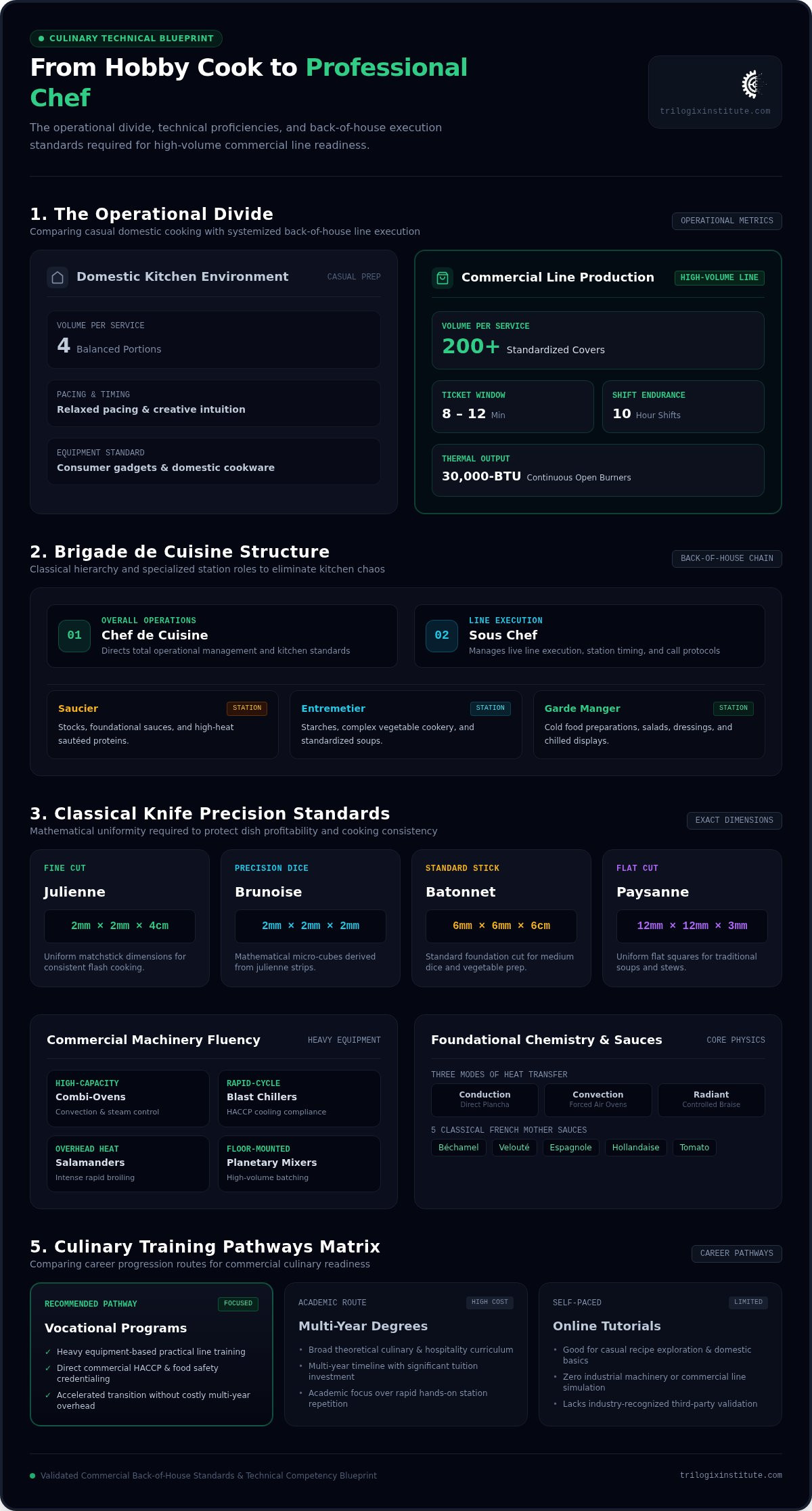
Professional back-of-house teams rely on the classical brigade de cuisine system, a structured hierarchy developed to eliminate chaos during service. The chef de cuisine directs overall operations, while the sous chef manages line execution. Station specialists handle distinct responsibilities: the saucier prepares stocks, sauces, and sautéed proteins; the entremetier commands starches, vegetables, and soups; and the garde manger oversees cold preparations. Clear call-and-response protocols maintain order, ensuring every cook executes assignments without hesitation.
Pace, Volume, and Ticket Times in Commercial Service
Plating four balanced portions at home bears zero resemblance to firing two hundred standardized covers during a dinner rush. Orders arrive via digital kitchen display systems with strict ticket windows of eight to twelve minutes. Line cooks coordinate multiple pans simultaneously so that proteins, sides, and reductions arrive at the pass piping hot at the exact same second. Sustaining that pace over a ten-hour shift requires physical stamina, posture discipline, and sharp cognitive focus under intense heat.
Commercial Kitchen Tools vs Domestic Utensils
Bridging the divide from hobby cook to professional chef means setting aside consumer gadgets in favor of heavy industrial machinery. Professional lines rely on high-capacity combi-ovens, rapid-cycle blast chillers, commercial salamanders, and floor-mounted planetary mixers. Domestic cookware quickly fails when subjected to continuous 30,000-BTU open burners. Operating heavy commercial kitchen equipment safely demands rigorous sanitation habits, proper physical stance, and strict workflow procedures to prevent burns, mechanical injuries, and operational bottlenecks.
Core Technical Competencies Every Aspiring Professional Chef Must Master
Entering a commercial kitchen tests technical fundamentals rather than culinary flair. Head chefs don't evaluate entry-level applicants on creative plating or bespoke recipes; they assess repeatable mechanics, speed, and strict hygiene discipline. When transitioning from hobby cook to professional chef, mastering standardized execution protects operating margins, guarantees consistency, and keeps guests safe.
Precision Knife Skills and Classical Cutting Standards
Commercial prep demands mathematical uniformity delivered at blistering speed. You must execute classical dimensions without hesitation: fine julienne (2mm × 2mm × 4cm), brunoise (2mm cubes), batonnet (6mm × 6mm × 6cm), and flat paysanne (12mm × 12mm × 3mm). Maintaining a secure pinch-grip and mastering honing steel technique prevent wrist fatigue while maximizing product yield. Slicing with precision isn't just aesthetic; uneven cuts cook erratically and erode dish profitability through avoidable scrap waste.
Thermal Physics and Foundational Sauce Fabrication
Reliable line production requires an intuitive grasp of heat transfer: direct conduction on a plancha, forced convection in industrial ovens, and controlled radiant braising. Aspiring cooks must master the five classical French mother sauces-béchamel, velouté, espagnole, hollandaise, and tomato-alongside rapid pan reductions and stable fat emulsification. The Bureau of Labor Statistics guide on chefs and head cooks notes that professional culinary roles require commanding these foundational preparation methods to maintain flavor consistency across high-volume service.
HACCP Principles, Cross-Contamination, and Food Safety Compliance
Commercial kitchens operate under mandatory Hazard Analysis Critical Control Point (HACCP) frameworks rather than domestic habits. Cooks must vigilantly police the commercial temperature danger zone (41°F to 135°F, or 5°C to 57°C) and adhere to strict two-stage cooling protocols: reducing cooked foods from 135°F to 70°F within two hours, and reaching 41°F or below within an additional four hours. Preventing cross-contact across major food allergens and keeping accurate sanitization logs are daily legal obligations. Developing these habits early through practical training, such as the hands-on Trilogix Institute Professional Culinary Arts program, instills the back-of-house compliance that hiring managers demand.
Culinary Training Pathways: Vocational Programs vs Degrees vs Online Courses
Selecting how you train directly dictates your career velocity, technical competence, and financial outlay. Progressing from hobby cook to professional chef requires a learning model that emphasizes equipment immersion over abstract theory. Review our vocational training comparison guide to analyze how direct technical instruction contrasts with traditional collegiate programs.
University Degree Programs: Timeline and Academic Scope
Associate and bachelor degree programs often demand two to four years of study. A significant portion of that time and tuition funds non-culinary general education lectures, including humanities and social sciences. While suitable for corporate hospitality administrators targeting executive office roles, multi-year degrees prove slow and expensive for aspiring line cooks. You spend valuable semesters in lecture halls rather than standing in front of high-capacity ranges, delaying your entry into the workforce.
The Limits of Purely Online Culinary Classes
Self-paced digital tutorials cannot replicate the realities of a commercial kitchen. Video demonstrations can't teach you palate development, sauce seasoning balance, or proper pan thermodynamics. Employer skepticism remains high for certificates earned without certified kitchen hours, as remote courses leave out high-stress brigade dynamics. Working isolated at home also ignores the strict sanitary discipline mandated by commercial FDA Food Code regulations.
Instructor-Led Vocational Training with Real Equipment
Hands-on vocational institutes strip away academic filler to concentrate exclusively on practical station mastery. Operating in purpose-built commercial environments provides immediate, tactile feedback from veteran chef instructors who correct knife angles, heat management, and station organization in real time. This equipment-based approach shortens the path from hobby cook to professional chef, preparing you directly for back-of-house expectations. You can explore structured, hands-on culinary options on our technical courses page to build verifiable commercial capability.
From Hobby Cook to Pro Chef: Step-by-Step Blueprint
Leaping into the culinary industry without an operational roadmap invites fast fatigue. Converting your love for food into a viable commercial career demands a structured sequence that replaces domestic habits with rigorous production standards. Following a proven progression ensures you build technical stamina while protecting your time and capital.
Step 1: Conduct a Technical and Operational Self-Audit
Before buying professional knives or applying to kitchens, execute an honest personal evaluation. Benchmark your core skills: time how long it takes to process a five-kilogram sack of onions into uniform dice, and check whether you can work cleanly without consulting written recipes. Test your physical readiness to stand on hard quarry tile for ten hours without breaks, lift heavy stockpots safely, and maintain composure when receiving direct, blunt critiques from senior staff during rush hours.
Step 2: Complete Rigorous Equipment-Based Training
Self-directed practice at home won't prepare you for industrial production. Enroll in intensive vocational instruction centered on hands-on workstation management and industrial machinery operation. Targeted coursework teaches you to manage ticket pacing, master HACCP logging, and execute multi-station prep under realistic deadlines. Read our guide to professional culinary arts training to evaluate curriculum benchmarks and equipment standards. To take direct action toward your career goals, apply for the TTI Dubai Professional Culinary Arts program to master commercial cooking techniques.
Step 3: Gain Practical Staging Experience and Network
Once you develop foundational competence, arrange unpaid observational shifts, known in the industry as stages. A stage allows you to observe commercial kitchen choreography, absorb speed expectations, and prove your work ethic to head chefs. Arrive early, keep your station spotless, carry a notebook, and follow instructions without question. Building professional alliances with instructors and peers accelerates your transition from hobby cook to professional chef. Learn about our vocational training philosophy on our about page to discover how focused mentorship shapes industry-ready culinarians.
Launching Your Culinary Career: Certification and Commercial Readiness
Completing practical vocational training provides the technical baseline, but entering a commercial kitchen demands proof of operational competence. Executive chefs look for demonstrated station reliability, equipment fluency, and accredited food safety credentials rather than amateur enthusiasm. Making the shift from hobby cook to professional chef means presenting yourself as a disciplined back-of-house technician ready to contribute from day one.
Building an Industry-Standard Technical Resume
Commercial kitchens disregard generic resumes. Format your background around verified competencies: total supervised equipment hours, combi-oven operation, blast chiller experience, and formal food safety credentials. If you're a career switcher, highlight transferable disciplines such as inventory control, stress regulation, and team communication. Use industry-standard kitchen terminology rather than hobbyist phrasing. Quantify your prep capacity to showcase your readiness to step onto the line without remedial coaching.
Excelling in the Working Kitchen Interview
Culinary hiring relies on the practical audition, commonly known as a trail. Expect an executive chef to hand you a knife and request classical cuts or an un-browned French rolled omelet to test your pan control and seasoning instincts. Keep your station immaculate at all times. Work with speed, maintain clean sanitation towels, and communicate loudly when crossing behind colleagues. Ask focused questions about prep schedules and station handovers to demonstrate situational awareness.
Long-Term Career Progression: Commis to Head Chef
Culinary careers build from the ground up. You will likely enter the line as a commis cook, mastering repetitive prep and station sanitation. Sustained reliability and sharp speed unlock promotions to chef de partie, sous chef, and eventual head chef positions. Long-term upward mobility requires pairing physical kitchen execution with menu costing, supplier management, and line leadership. Connect with training advisors through our contact page to explore vocational pathways that accelerate your journey from hobby cook to professional chef.
Step onto the Commercial Line with Confidence
Transitioning from hobby cook to professional chef isn't an overnight pivot, but a methodical transformation. Success back-of-house doesn't hinge on delicate plating or complex domestic recipes; it demands industrial station discipline, speed under intense pressure, and uncompromising food safety execution. By prioritizing practical equipment fluency over multi-year academic degrees laden with general education filler, you protect your financial resources and accelerate your technical readiness.
True kitchen mastery develops directly on the line alongside commercial combi-ovens, high-heat ranges, and real-time instructor feedback. When you're ready to build verifiable competencies aligned with modern commercial standards, take the next decisive step. Explore Professional Culinary Arts Training at Trilogix Institute to immerse yourself in focused, instructor-led vocational training. Your passion has brought you to the kitchen door; disciplined technical preparation will carry you across the pass.
Frequently Asked Questions
Can you become a professional chef without going to university?
Yes, commercial kitchens prioritize technical competence, station speed, and food safety compliance over academic degrees. Most executive chefs look for documented hours working with industrial equipment rather than general education lecture credits. Instructor-led vocational programs provide an intensive, equipment-based alternative that develops the practical muscle memory, knife work, and hygiene discipline needed to secure entry-level commis positions quickly.
How long does it take to transition from a home cook to a professional chef?
Transitioning from hobby cook to professional chef typically requires six to twelve months of focused technical training followed by one to two years of line experience. Intensive vocational coursework builds foundational prep skills, equipment familiarity, and kitchen discipline within months. From there, working as a commis or line cook cements real-time coordination, allowing disciplined cooks to advance to chef de partie within several years.
Is it possible to switch to a professional culinary career in your 30s or 40s?
Yes, career changers frequently excel because professional kitchens value mature workplace habits. Adult learners bring punctuality, emotional composure under pressure, and effective communication skills that younger apprentices often lack. Success depends on physical preparation for long shifts and choosing targeted vocational instruction over multi-year university tracks. This approach allows switchers to master commercial equipment quickly without wasting years in traditional lecture halls.
Why are purely online cooking courses insufficient for commercial kitchen jobs?
Purely online courses lack physical equipment immersion, olfactory feedback, and the tactile corrections required to handle commercial volume. Watching video modules won't teach you how to operate a 30,000-BTU range safely, judge sauce reductions by aroma, or handle brigade line pressure. Commercial employers rarely recognize self-paced digital certificates that lack certified, supervised hours logged inside an actual commercial kitchen environment.
What is the difference between a cook and a professional chef?
A cook executes station prep and follows specific recipes during service shifts, whereas a professional chef directs production systems, kitchen safety, and business operations. Making the jump from hobby cook to professional chef involves mastering recipe costing, inventory yields, menu development, and staff leadership. Cooks focus purely on execution; chefs manage food safety systems, kitchen finances, and total line coordination.
What qualifications do commercial kitchens look for in entry-level culinary hires?
Commercial kitchens look for accredited food safety credentials, verifiable equipment training, and immaculate knife handling. Hiring chefs want to see that an applicant understands HACCP temperature controls, practices clean workstation habits, and moves efficiently without constant supervision. A practical demonstration during an audition shift matters far more to kitchen managers than academic transcripts or home cooking portfolios.
How physically demanding is the transition to working in a professional kitchen?
The physical shift is substantial, requiring cooks to stand on hard quarry tile for eight to twelve hours in ambient heat exceeding 35 degrees Celsius. Commercial work involves continuous bending, reaching, and safely carrying twenty-kilogram stockpots and ingredient crates. Aspiring chefs must build core strength, adopt supportive nonslip footwear, and practice proper posture to sustain high productivity without experiencing chronic physical strain.


