

What if the primary barrier to your next salary jump isn't your years of experience, but a specific gap in your ability to handle industrial automation hardware? Many skilled tradespeople across the Emirates find themselves plateauing in routine maintenance roles, watching high-value contracts go to specialists who understand the language of PLCs and motor controls. It's a common frustration to feel your income is capped simply because you lack the niche technical training that modern industry demands. Investing in targeted professional development for electricians is no longer an optional extra; it's the only way to remain competitive in a market that's rapidly shifting toward smart infrastructure and automated systems.
You don't need another four-year academic degree to prove your worth. This guide provides a clear, pragmatic roadmap to help you master industrial equipment and advanced drafting through hands-on technical training. We'll break down the transition from basic wiring to industrial automation, showing you how to gain the recognition of a specialist technician. You'll discover exactly which practical certifications bridge the gap between ambition and a high-paying career in the 2026 electrical landscape.
Key Takeaways
- Identify the three most profitable niches in the 2026 industrial landscape and how they build on your existing engineering foundation.
- Discover how strategic professional development for electricians allows you to transition from routine maintenance to high-value automation roles.
- Learn why hands-on equipment mastery is the only safe way to prepare for the complexities of modern industrial motor control.
- Follow a step-by-step roadmap to audit your technical gaps and choose the right foundational courses for career advancement.
- See how a practical, equipment-focused training model serves as a direct alternative to lengthy university degree programs.
Why Professional Development for Electricians is Non-Negotiable in 2026
Professional development for electricians in 2026 isn't just about keeping a license active. It's the deliberate acquisition of advanced technical competencies that go far beyond standard residential or commercial wiring. As the UAE accelerates its transition toward smart cities and automated manufacturing hubs, the industrial landscape has transformed. We're seeing a massive shift toward smart grids and decentralized power systems that demand a much higher level of expertise than in previous decades.
The "Skill Gap" has become a significant hurdle for many tradespeople. Basic electrical knowledge is no longer sufficient to secure high-tier industrial contracts or work on 24/7 mission-critical infrastructure. Static career paths are disappearing; they're being replaced by the rapid growth of "Technician-Specialists." These professionals don't just pull wire. They understand the intersection of hardware and software. Researching electrician licensing and specialisation paths shows that the most successful individuals are those who move beyond generalist roles into niches like industrial automation and motor control.
The Economic Impact of Upskilling
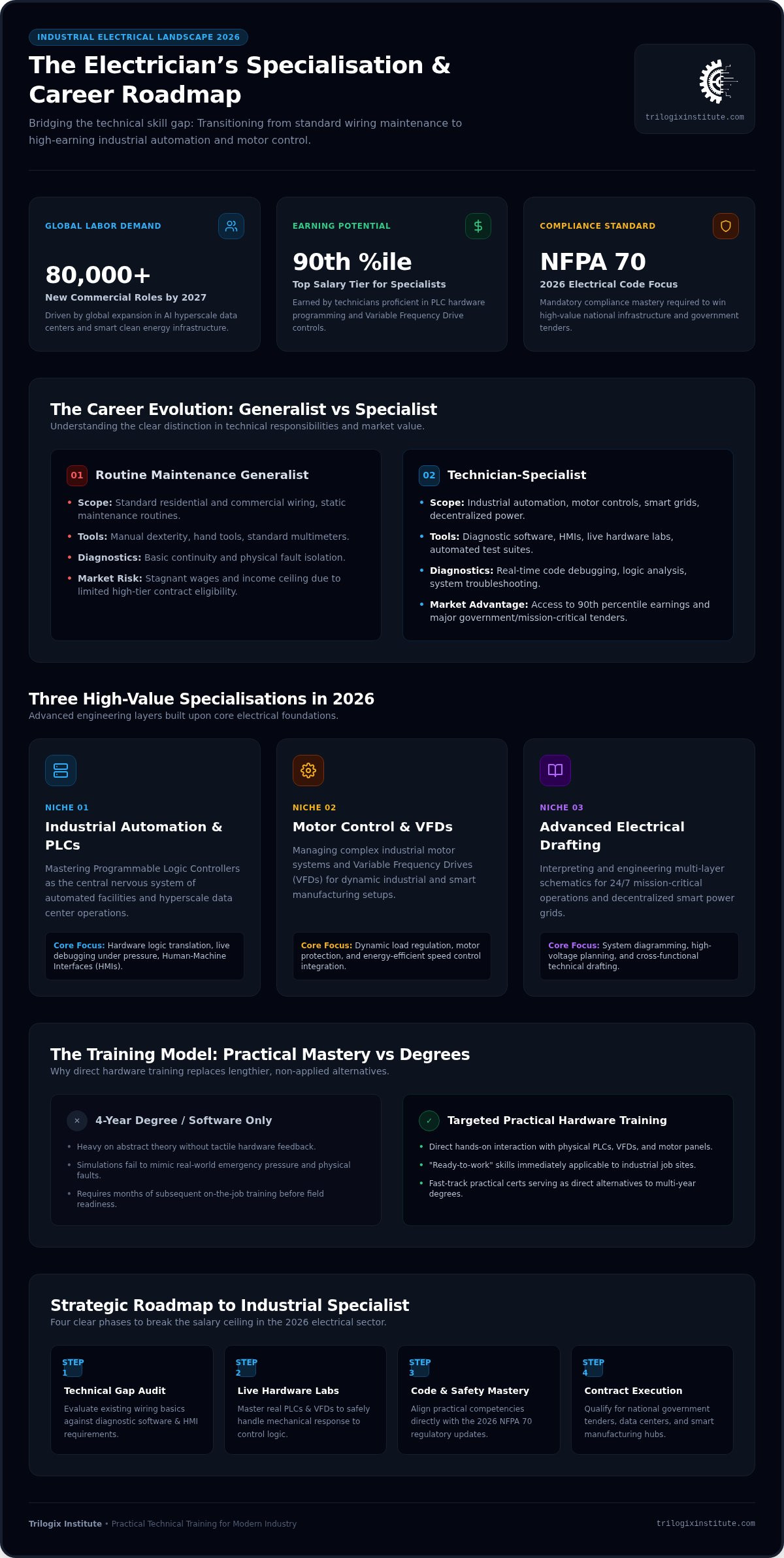
Specialized automation technicians command a substantial salary premium in today's market. While generalists often face stagnant wages, those who master Programmable Logic Controllers (PLCs) and Variable Frequency Drives (VFDs) frequently enter the 90th percentile of earners. This growth is fueled by a global labor gap, with the industry needing over 80,000 new commercial electrical positions by 2027 to support AI data centers and clean energy infrastructure.
Beyond individual paychecks, professional development for electricians directly improves project outcomes. Specialized training reduces job-site errors and ensures strict compliance with the updated 2026 National Electrical Code (NFPA 70). For contractors in the UAE, having a team of certified specialists is often a mandatory requirement for securing lucrative national government tenders and large-scale infrastructure projects.
Beyond the Licence: What Employers Seek
Modern employers in high-growth sectors aren't just looking for manual dexterity. They've moved from manual troubleshooting to a requirement for diagnostic software proficiency. The ability to use Human-Machine Interfaces (HMIs) and debug complex code is now as essential as using a multimeter. Employers want "ready-to-work" skills that don't require months of on-the-job training.
Companies prioritize candidates who have trained on real-world equipment and understand international safety protocols. This practical readiness is what separates a standard wireman from a specialist. To see how these competencies are built in a controlled, professional environment, you can explore the specialized technical courses designed for the modern industrial era. Mastering these standards ensures your skills are transferable across the global market, providing long-term career security.
High-Value Specialisations for Modern Electrical Professionals
Choosing a niche is the most effective way to break through the salary ceiling. In the 2026 market, three specific specialisations offer the highest return on investment: Industrial Automation, Motor Control, and Design. These fields aren't separate from your existing knowledge; they are advanced layers built upon a solid foundation of electrical engineering. According to the Bureau of Labor Statistics electrician career profile, the demand for electricians who can handle complex systems is growing significantly faster than the average for all occupations. This shift makes professional development for electricians a prerequisite for anyone aiming for senior technician or project management roles.
Industrial Automation and PLC Systems
Programmable Logic Controllers (PLCs) act as the central nervous system of modern industrial operations. They control everything from robotic assembly lines to complex HVAC systems in hyperscale data centers. Mastery of these systems requires more than just theoretical understanding. You need to work with live hardware to understand how code translates into physical mechanical action. Learning through real-world labs ensures you can troubleshoot under pressure, a skill simulations simply cannot replicate. For those ready to commit to this path, the Industrial Automation Specialization Course provides the equipment-based training necessary to handle Tier-1 hardware from vendors like Siemens and other leading automation manufacturers.
Mastering Advanced AutoCAD 2D & 3D
Drafting skills serve as the bridge between field execution and project design. By mastering Advanced AutoCAD 2D & 3D, electricians can transition from physical installation into high-level design and consultancy roles. This shift often results in a more sustainable career path with reduced physical strain. Speed and accuracy in professional 2D and 3D industrial modeling are critical for meeting tight project deadlines and ensuring safety compliance. Today, AutoCAD proficiency is no longer a luxury; it is a standard requirement for industrial electrical documentation and project management. If you want to move beyond the tools and into the office, refining your technical skills training is the logical next step.
Finally, understanding Essential Industrial Motor Control remains the ultimate gateway to factory and plant maintenance. It provides the core logic needed to manage heavy machinery, pumps, and conveyors. This specialisation ensures you remain indispensable in the UAE's expanding manufacturing sector.
Hands-On Training vs. Online Theory: Making the Right Choice
Can you truly master high-voltage skills through a computer screen? It's a question many tradespeople ask when considering their next step. While digital platforms are excellent for reviewing code updates or theoretical physics, they fail when it's time to wire a complex industrial enclosure. Professional development for electricians requires a tactile connection to the hardware. Relying on theoretical-only training in high-stakes industrial environments is not just ineffective; it's dangerous. Without the physical experience of handling components, a technician lacks the essential muscle memory needed to react correctly during a fault condition.
Following OSHA electrical safety standards and training regulations is impossible if your only experience is clicking through a slide deck. Real safety comes from the repetition of physical lockout-tagout procedures and the weight of a multimeter in your hand. When deciding on your education path, it's vital to weigh the merits of Vocational Training vs. University Degree programs. Practical vocational labs offer a speed of competency that academic settings often lack.
The Role of Equipment-Based Learning
Instructor-led labs provide access to real industrial motors and control panels. This equipment-based approach allows you to engage in real-world troubleshooting that no simulation can replicate. There is a significant psychological benefit to "breaking things" in a controlled lab environment. Seeing a contactor fail or a PLC loop error in a lab removes the fear of the unknown. It builds the confidence required to handle live systems on a job site without hesitation. You learn how to listen to the equipment, identifying mechanical stress before it leads to a total system failure.
Why Instructor-Led Modules Outperform Self-Paced Courses
Self-paced courses often leave students stranded when they hit a complex design hurdle. Instructor-led modules provide immediate feedback, which is critical when learning the nuances of industrial motor control. Peer-to-peer learning in a physical lab also replicates the team dynamics of a real industrial plant. You're forced to communicate, collaborate, and solve problems as a unit. When choosing an institute, look for facilities that prioritize equipment-based curriculum over static presentations. Check for specialized technical labs that use current industry hardware. This ensures your learning is directly transferable to the workplace from day one.
A Strategic Roadmap for Career Advancement
Advancing your career in the UAE requires a shift from reactive learning to a deliberate, multi-step strategy. Waiting for your employer to provide training is a gamble that rarely pays off in a fast-moving market. Instead, you must own your professional development for electricians by following a structured path that targets high-demand competencies. This roadmap moves you from a generalist role to a recognized specialist technician.
- Step 1: Audit technical gaps. Review 2026 job descriptions for senior roles. Identify where your current skills fail to meet the requirements for automated systems or smart grid management.
- Step 2: Solidify your foundation. Choose a foundational course to ensure your theoretical base is current with the latest NFPA 70 standards and national regulations.
- Step 3: Pursue technical specialisation. Focus on intensive modules in Motor Control or Industrial Automation to gain hardware-specific expertise.
- Step 4: Integrate design skills. Complete an Advanced AutoCAD course to transition from installation to project documentation and design.
- Step 5: Achieve industry certification. Validate your practical expertise with credentials that prove you can handle live equipment in high-pressure environments.
Evaluating Short-Term Technical Courses
When selecting a training program, you must prioritize the return on investment (ROI). In the national market, the highest ROI comes from courses that are KHDA-accredited and led by instructors with active industry experience. A course is only as good as the equipment you touch. Ensure the facility offers dedicated labs rather than just classroom lectures. For a detailed look at national training options, read our guide on Electrical Engineering Courses in the UAE to ensure your choice aligns with 2026 career readiness standards.
Building a Portfolio of Technical Certifications
A "stack" of smaller, intensive certifications often carries more weight with high-tier employers than a single, broad academic degree. Employers value proof that you can troubleshoot a Siemens PLC or wire a complex motor starter today. When presenting your credentials, highlight the specific hardware you've mastered and the safety protocols you followed. Stackable credentials represent the future of vocational education, allowing you to build a specialized resume without the multi-year commitment of a traditional university program. This modular approach ensures your skills remain relevant as technology evolves. To begin building your professional portfolio, enroll in a specialized technical module that targets your specific career goals.
The Trilogix Institute Advantage: Practical Mastery for Professionals
Trilogix Institute operates on a singular philosophy: education must serve as a functional tool for advancement. We don't view learning as a purely academic pursuit; we view it as a vital mechanism for career progression. This pragmatic approach defines our role as an authoritative industry insider. By focusing on professional development for electricians that translates directly to the workplace, we help tradespeople bridge the gap between their current roles and high-tier technical positions. Our goal is to provide the specific keys needed to meet the demands of a fast-moving global market.
The TTI Dubai Foundation Electrical Engineering program exemplifies this commitment to practical readiness. It moves beyond abstract concepts to provide a structured, equipment-based foundation for those entering the industrial sector. For professionals seeking immediate specialized skills, the TITP Beginner Essential Industrial Motor Control module offers 40 hours of intensive, hands-on mastery. These programs ensure your skills align with global standards and the specific regulatory requirements of the UAE. We focus on utility, ensuring every hour spent in the lab results in a transferable workplace skill.
State-of-the-Art Labs and Real-World Equipment
Our facilities prioritize tactile learning over static slide-deck presentations. We provide specialized labs equipped with real industrial motors, control panels, and PLC systems from Tier-1 global vendors like Siemens and Schneider Electric. This environment allows you to practice troubleshooting on the same hardware you'll encounter on a mission-critical job site. Our curriculum meets current industrial standards in the UAE and Philippines, backed by KHDA accreditation in Dubai. This accreditation ensures your training is recognized by major contractors and government entities. You can explore the full range of our instructor-led Trilogix Courses to find the program that fits your specific technical goals.
Your Next Step: From Ambition to Employment
Success in the 2026 industrial landscape requires a shift from theory to verified competency. You've seen the roadmap; now it's time to execute your career strategy. Choosing an equipment-based learning model ensures you're ready to work without requiring extensive on-the-job training. Trilogix Institute acts as your partner in this journey, offering a clear-eyed, no-nonsense path to becoming a specialist technician. We provide the environment, the equipment, and the expertise; you provide the ambition. Don't let your career plateau in a low-level maintenance role. Contact Trilogix Institute today to begin your specialization journey and secure your place in the future of the electrical industry.
Secure Your Future in Industrial Automation
The 2026 electrical landscape rewards technicians who move beyond standard wiring into the complexities of industrial control and advanced design. By auditing your technical gaps and pursuing stackable, equipment-based certifications, you transition from a generalist role to a high-value specialist. Professional development for electricians is the most reliable way to secure your standing in an industry increasingly dominated by smart grids and automated manufacturing. Real mastery requires instructor-led training where you can engage with live hardware in a controlled environment.
Trilogix Institute provides the pragmatic, career-focused curriculum needed to bridge the gap between technical ambition and high-tier employment. Our specialized labs and industry-aligned vocational certifications ensure you're prepared to handle mission-critical systems across the UAE. It's time to take control of your career trajectory and break through the income ceiling that holds many generalists back. Explore Our Hands-On Electrical Specialisation Courses and begin your journey toward technical mastery today. Embrace the challenge of modern industry and establish yourself as an authoritative expert in your field.
Frequently Asked Questions
What are the best professional development courses for electricians in 2026?
The most effective professional development for electricians in 2026 involves mastering industrial automation and motor control. Courses like the TTI Dubai Foundation Electrical Engineering provide the technical grounding necessary for modern infrastructure. Additionally, specializing in Programmable Logic Controllers (PLCs) or advanced drafting ensures you remain competitive as the UAE shifts toward smart manufacturing. These programs focus on high-impact skills that general licensure often overlooks.
Can I complete electrical professional development courses while working full-time?
Most vocational programs are specifically designed for working professionals. Instructor-led technical modules often feature flexible scheduling or intensive short-term formats that don't require you to leave your current role. This allows you to apply new skills on the job site immediately. Unlike lengthy university programs, these equipment-based courses focus on rapid competency acquisition, making them ideal for electricians balancing a full-time career with upskilling.
Is an AutoCAD certification useful for a field electrician?
AutoCAD certification is highly valuable for field electricians looking to transition into project management or design consultancy. Mastering TTI Dubai Advanced AutoCAD 2D & 3D allows you to interpret and create complex industrial schematics with precision. This skill is now a standard requirement for high-tier industrial documentation. It bridges the gap between physical installation and high-level project design, offering a more sustainable career path with reduced physical strain.
How much more do industrial automation specialists earn compared to general electricians?
Specialized technicians command a substantial salary premium over generalists. Industry data for 2026 shows that those in the 90th percentile, such as automation and mechatronics specialists, can earn significantly more than standard commercial electricians. In high-growth sectors like AI data centers and manufacturing, the demand for these technical competencies allows specialists to negotiate better compensation packages. Targeted professional development for electricians is the primary driver behind this income growth.
What is the difference between a vocational certificate and an engineering degree?
The primary difference lies in the application of knowledge. An engineering degree focuses on theoretical principles over several years, whereas a vocational certificate emphasizes immediate, equipment-based readiness. Trilogix Institute prioritizes instructor-led labs using real-world hardware, allowing students to master specific industrial tools in weeks rather than years. This practical model is designed to get you into high-tier technical roles faster than a traditional academic path.
Why is hands-on equipment training better than online electrical courses?
Hands-on training is superior because it builds essential muscle memory that online courses cannot replicate. Working with live industrial motors and control panels in a lab prepares you for real-world troubleshooting and fault conditions. It's impossible to master complex safety protocols or physical wiring through a screen. Equipment-based learning ensures you can safely handle high-stakes environments, reducing the risk of job-site errors that theoretical-only students often face.
What certifications are required for industrial motor control roles?
Roles in industrial motor control require specialized certifications that validate your ability to manage heavy machinery and logic systems. The TITP Beginner Essential Industrial Motor Control program is a key credential for those entering factory or plant maintenance. Additionally, certifications in PLC integration and VFD management are highly sought after by industrial employers. These credentials prove you have the technical mastery required for mission-critical equipment maintenance and troubleshooting.
How long does it take to complete a professional development course in electrical engineering?
Course duration depends on the specific technical depth required for the role. For example, the TTI Dubai Foundation Electrical Engineering program typically spans three months with 36 hours of total instruction. More intensive modules, like the TITP Beginner Essential Industrial Motor Control, can be completed in five days of concentrated, 40-hour lab work. These short-term, high-impact formats allow professionals to gain specialized certifications without the multi-year commitment of traditional academic routes.


