

By the start of 2026, a university degree will no longer be the primary currency of the national job market. The economy will belong to professionals who master the high-demand technical skills 2026 requires to bridge the gap between digital design and physical implementation. You've likely felt the frustration of sitting through theoretical lectures that offer zero insight into how to actually operate industrial hardware. It's a common fear that automation might replace your role if you don't possess the technical expertise to command it.
This analysis clarifies the current industry ambiguity by identifying the specific proficiencies needed for career longevity. We focus on industry-recognized certifications that prioritize equipment-based mastery over abstract concepts. You'll discover a clear roadmap of vocational skills and identify training providers who use real-world tools rather than just textbooks. We'll examine the critical intersection of traditional engineering and new technology, covering essential areas like industrial motor control and advanced AutoCAD. This guide ensures you're prepared to lead the workforce with confidence and practical authority.
Key Takeaways
- Identify how the national workforce is shifting toward specialized vocational roles that require high-demand technical skills 2026 to bridge the gap between digital design and physical execution.
- Understand the critical role of industrial motor control and Programmable Logic Controllers (PLCs) as the backbone of modern automated manufacturing environments.
- Explore how foundational electrical engineering and advanced technical design tools like AutoCAD are essential for building the smart infrastructure of the future.
- Learn to evaluate training providers based on their access to specialized labs and real-world equipment rather than purely theoretical curriculum.
- Gain a clear perspective on why hands-on vocational certifications provide a more direct path to professional readiness than traditional university programs.
The Evolution of High-Demand Technical Skills for 2026
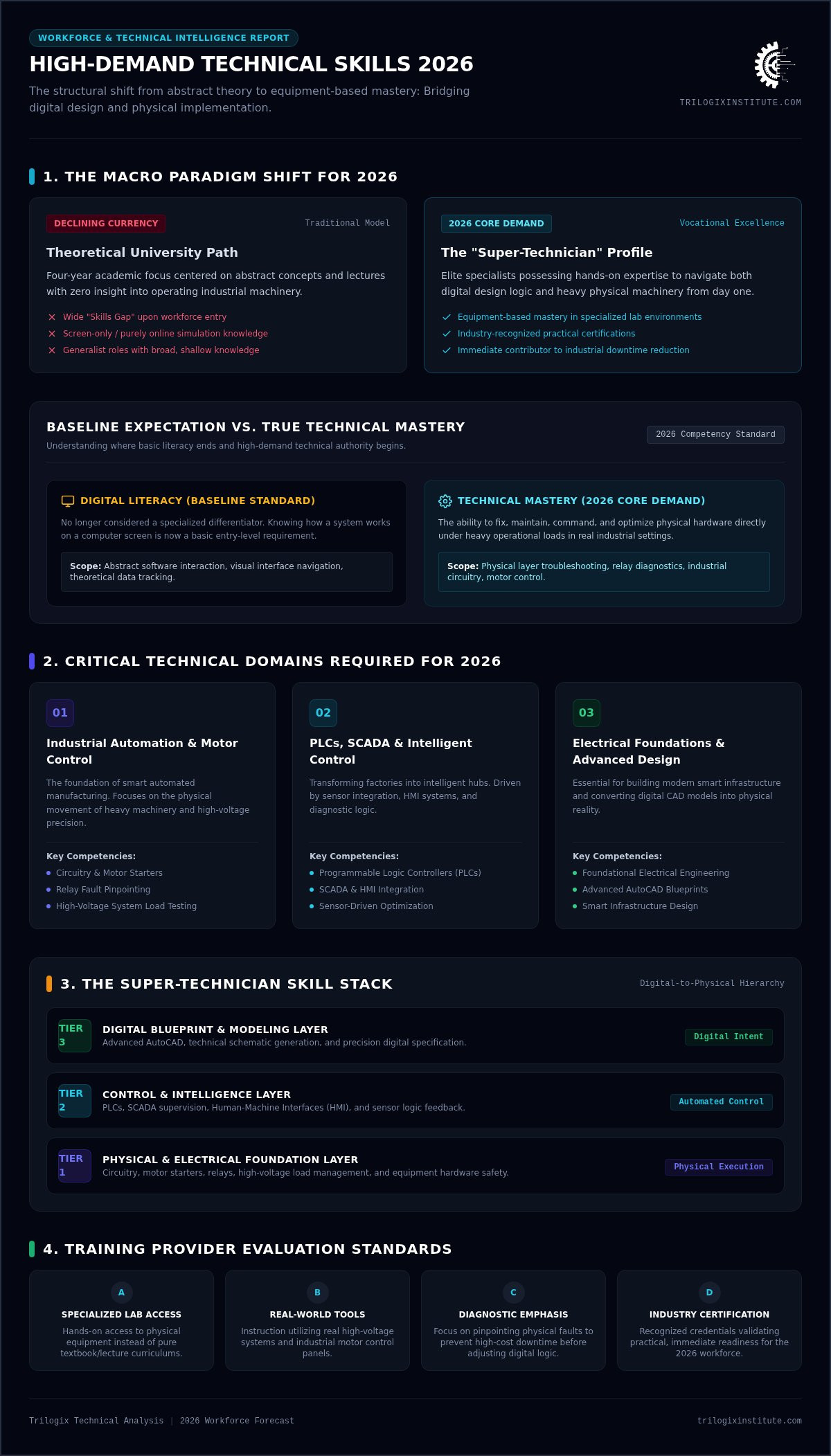
The definition of professional competence is undergoing a radical shift. By 2026, high-demand technical skills 2026 will be defined by the ability to bridge the gap between digital design and physical execution. National industries are no longer satisfied with generalist roles that offer broad but shallow knowledge. Instead, the focus has shifted toward specialized vocational technicians. These are professionals who possess the specific, hands-on expertise required to manage complex industrial systems from the moment they are hired.
This evolution is a direct response to a growing national "Skills Gap." Many traditional academic paths focus heavily on theory, leaving graduates unprepared for the realities of modern equipment. Vocational training provides the fastest solution to this problem. By emphasizing vocational education and training, ambitious professionals can gain the practical experience that national industries now prioritize over traditional four-year degrees.
Digital Literacy vs. Technical Mastery
In the coming years, digital literacy will be considered a basic requirement rather than a specialized skill. Knowing how a system works on a computer screen is no longer enough. True technical mastery involves knowing how to fix, maintain, and optimize hardware in industrial settings. Software proficiency must be paired with physical implementation. You can't learn the nuances of industrial motor control through a purely online course. It requires instructor-led guidance in a lab environment where you can interact with real-world equipment. This is where theory meets reality.
The 2026 National Job Market Forecast
The forecast for the national job market in 2026 points toward massive growth in infrastructure, smart manufacturing, and advanced professional services. This growth is fueling the rise of the "Super-Technician." These are elite professionals who can navigate both the digital and physical worlds with ease. They aren't just laborers; they are highly trained experts who hold industry-standard certifications. For those looking to lead the workforce, the path is clear. Focusing on technical course offerings that lead to mastery in areas like AutoCAD or industrial automation is the most reliable way to ensure career longevity. Employers want candidates who are ready to contribute immediately. Aligning your training with the high-demand technical skills 2026 trajectory is the key to meeting that demand.
Industrial Automation and Motor Control: The Core of Modern Industry
Industrial automation isn't just about software; it's about the physical movement of heavy machinery. Industrial motor control serves as the foundational skill for this transition. As national manufacturing moves toward sensor-driven, automated environments, the demand for technicians who can handle the hardware has spiked. This mastery is a core component of the high-demand technical skills 2026 workforce needs to secure. Equipment-based training is vital here. Safety and precision cannot be learned from a screen. You must understand how high-voltage systems react under load to ensure both operational efficiency and personal safety.
Mastering Essential Industrial Motor Control
To manage a modern factory, you must first understand circuitry, relays, and motor starters. These components are the building blocks of any automated system. An Industrial Motor Control training program provides the essential foundation required to move into advanced automation. Beyond installation, the real value lies in diagnostic skills. When a high-value industrial asset fails, a technician who can pinpoint a faulty relay saves the company thousands of dirhams in downtime. It's about practical reliability. Mastering these basics ensures you can troubleshoot the physical layer before attempting to adjust the digital logic.
The Rise of Industrial Automation Specialization
The integration of SCADA and HMI systems is transforming national factories into intelligent hubs. According to the World Economic Forum's Future of Jobs Report, the acceleration of industrial automation is creating a specific need for analytical and technical competencies. This has paved a clear career path for the Industrial Automation Specialist. To reach this level, hands-on lab experience with Programmable Logic Controllers (PLCs) is non-negotiable. These controllers act as the brain of the factory. You need to wire the PLC to the motor and watch the logic execute in real time to truly understand the system. This practical mastery allows you to program complex sequences that reduce waste and increase output.
For those ready to move from theory to the factory floor, exploring an Industrial Automation Specialization is the next logical step in your professional development.
Electrical Engineering Foundations and Smart Infrastructure
The national landscape is evolving at an unprecedented pace. Large scale infrastructure projects and the push for sustainable energy are driving a massive surge in the need for qualified electrical experts. While digital tools are essential, they can't function without a robust physical power supply. This makes foundational electrical engineering one of the most versatile high-demand technical skills 2026 will require. It's the bedrock upon which all other industrial systems, from HVAC to heavy manufacturing, are built. Without a solid understanding of power distribution, the smart cities of the future simply cannot exist.
The U.S. Bureau of Labor Statistics occupational outlook highlights a consistent growth trend for technicians who can manage integrated control systems. Locally, this translates to a job market that prizes professionals who understand national safety standards and regulatory codes. It's no longer just about basic wiring. It's about ensuring that complex systems meet rigorous national requirements for safety and efficiency. This foundational knowledge allows you to pivot into various specialized fields as the market continues to shift toward sustainable energy distribution and smart grid management.
The Role of the Modern Electrical Technician
Modern technicians carry a heavy responsibility that extends far beyond simple repairs. Their daily tasks involve intricate wiring design, complex system troubleshooting, and the maintenance of high-value infrastructure. If you're planning your professional path, reviewing a Foundation Electrical Engineering guide can provide the clarity you need to align your training with industry demands. Success in this field requires mastery of real-world equipment. You can't simulate the weight of industrial cabling or the complexity of a main distribution board through a screen. Practical, instructor-led training ensures you're prepared for the physical demands of the site from day one.
Smart Systems and Electrical Design
The integration of IoT devices into commercial and residential buildings has changed the nature of electrical design. By 2026, technicians must be adept at managing both high-voltage power lines and low-voltage data lines simultaneously. This convergence is a key part of the high-demand technical skills 2026 landscape. There's also a growing demand for experts who can integrate green energy solutions, such as solar arrays, into existing electrical frameworks. Understanding how to bridge the gap between traditional power and renewable sources is a high-value skill set. For those looking to master these modern requirements, exploring technical foundation programs is the most effective way to secure a competitive edge in the national workforce.
Advanced Technical Design and Professional Arts
Precision in design and execution defines the modern professional. While previous sections focused on the power and logic of industrial systems, the high-demand technical skills 2026 market also values the "Technical Arts." This includes advanced drafting and professional culinary mastery. These fields share a common thread; they require absolute accuracy and the efficient management of specialized equipment. Professionals who master these disciplines ensure that projects are delivered on time and that service standards meet international benchmarks. The transition from manual labor to technical mastery is the most reliable way to secure long-term career growth in the national economy.
Precision Drafting with Advanced AutoCAD
Digital modeling has moved far beyond simple lines on a screen. Modern engineering workflows rely on 3D modeling to identify potential conflicts before a single dirham is spent on construction. While 2D drafting remains the foundation for electrical schematics, 3D modeling provides the spatial awareness needed for complex industrial layouts. National construction projects are increasingly moving toward Building Information Modeling (BIM). This shift makes an Advanced AutoCAD 2D & 3D course a vital investment for those in design roles. Precision drafting doesn't just improve aesthetics; it significantly reduces waste by ensuring every component fits perfectly the first time. Technicians who can navigate these software environments possess a level of career longevity that purely manual roles lack.
Professional Culinary Arts as a Technical Discipline
It's a mistake to view culinary training as purely creative. In the national hospitality sector, professional cooking is a technical vocational skill that involves rigorous process control and equipment mastery. From managing industrial-scale kitchen hardware to maintaining strict food safety protocols, the role is highly disciplined. Certified professionals are in high demand as the national tourism and service sectors continue to expand. High-demand technical skills 2026 include the ability to operate complex culinary technology with precision and speed. Reviewing a Professional Culinary Arts training guide is the first step for those looking to enter this high-demand field. Mastery here means understanding the chemistry of ingredients and the mechanics of large-scale service, ensuring consistent quality in high-pressure environments.
Ready to master the tools of the trade? Explore our full range of technical design and professional arts programs to start your journey toward professional excellence.
Choosing the Right Vocational Path for Career Growth
Deciding between vocational training vs. university degrees is a pivotal choice for any ambitious professional. While a traditional degree offers academic breadth, vocational paths focus on the precise high-demand technical skills 2026 employers are actively seeking. The national market is shifting toward candidates who can demonstrate immediate technical proficiency. Stacking specialized certifications is the most effective way to maximize your employability. By starting with foundational engineering and moving into specialized automation, you create a robust professional profile that is difficult to replicate.
When evaluating a technical training institute, you shouldn't settle for purely theoretical courses. Use this checklist to ensure your chosen path leads to genuine mastery:
- Hardware Access: Does the institute provide specialized labs for motor control and industrial automation?
- Instructor Expertise: Are the sessions led by industry insiders with real-world experience?
- Curriculum Alignment: Is the training aligned with industry-specific certifications?
- Practical Assessment: Will you be tested on your ability to operate and troubleshoot physical equipment?
The Trilogix Advantage: Equipment-Based Training
Our philosophy focuses on bridging the gap between ambition and employment through practical, instructor-led sessions. You won't just watch videos of a PLC; you'll program one. You won't just read about electrical circuits; you'll wire them. Learning on the same equipment used in national industries ensures your skills are directly transferable to the workplace. This hands-on approach eliminates the ambiguity often found in software-only training. We invite you to visit the Trilogix gallery to see our specialized labs in action and understand the professional environment where you'll master your craft.
Taking the Next Step in Your Technical Career
Selecting the right course requires an understanding of national industry growth trends. If you're starting your journey, foundation electrical engineering provides the most versatile base for future specialization. For those already in the field, moving into industrial automation or advanced technical design can significantly increase your market value. The enrollment process is designed to be efficient, moving you from inquiry to training without unnecessary delays. Don't let your career stall in theory while the market moves forward. Take the first step by contacting an admissions advisor today to discuss which program best aligns with your goals for 2026 and beyond.
Secure Your Leadership in the 2026 Workforce
The transition toward specialized vocational expertise is a permanent shift in the national economy. To lead in this environment, you must master the high-demand technical skills 2026 requires, focusing on the critical intersection of digital logic and physical hardware. Success belongs to those who move beyond software proficiency to achieve true equipment mastery. By prioritizing hands-on training in specialized labs, you gain the diagnostic precision and operational safety that employers value most. This pragmatic approach ensures your skills remain relevant as infrastructure and automation continue to evolve.
Trilogix Institute stands as your partner in this journey, providing the expert instructor-led guidance needed to bridge the gap between theory and reality. Our focus on practical employability means you don't just learn about systems; you gain the authority to command them. Whether you're entering industrial automation or mastering advanced technical design, the path to professional excellence is clear and attainable. Mastery of these vocational disciplines provides the career longevity that traditional academic paths often lack.
Explore Our 2026 Technical Training Programs today to align your expertise with the future of the national workforce. Your commitment to practical mastery is the most reliable investment you can make in your professional journey.
Frequently Asked Questions
What are the most high-demand technical skills for 2026?
The high-demand technical skills 2026 workforce needs include several key areas of expertise:
- Industrial automation and PLC programming
- Essential industrial motor control
- Advanced electrical engineering and design
- Professional culinary arts and process management
National industries prioritize professionals who can bridge the digital-physical gap through specialized technical drafting and hardware implementation.
Is vocational training better than a university degree for engineering?
Vocational training offers a more direct path to technical roles by prioritizing equipment-based mastery over abstract theory. While university degrees provide academic breadth, vocational programs focus on the practical application required for immediate employability. National employers often favor candidates who have trained on real-world industrial hardware. This approach addresses the current skills gap more efficiently, allowing professionals to enter the workforce with industry-recognized certifications in a fraction of the time.
Can I learn industrial motor control or PLC online?
True mastery of industrial motor control or PLC systems requires physical interaction with real-world equipment. While online modules can introduce basic concepts, they can't simulate the safety protocols and precision required in a live industrial environment. Instructor-led training in a specialized lab is essential for understanding how high-voltage systems react under load. This hands-on experience ensures you can troubleshoot and maintain high-value assets with the confidence that purely digital simulations cannot provide.
Why is AutoCAD still considered a high-demand skill in 2026?
AutoCAD remains a critical tool because it has evolved from simple 2D drafting to complex 3D modeling and Building Information Modeling (BIM). In 2026, precision drafting is vital for reducing material waste and optimizing project timelines in national construction projects. Technicians who can navigate advanced design software are essential for creating the spatial layouts required for modern smart infrastructure. It's a foundational skill that supports everything from electrical schematics to industrial manufacturing workflows.
What industries in the national market are hiring the most technicians?
National hiring trends show significant demand across several key sectors:
- Infrastructure development and smart manufacturing
- Sustainable energy distribution and smart grid management
- Hospitality and professional culinary services
These industries prioritize professionals who possess the high-demand technical skills 2026 requires to manage both sophisticated software and heavy industrial machinery efficiently.
How long do short-term technical courses typically take to complete?
Short-term technical courses are designed for efficiency, typically taking a few weeks to several months to complete depending on the specialization. Unlike multi-year university degrees, these programs focus exclusively on the specific competencies required for a particular role. This allows you to stack certifications and update your skill set rapidly as technology changes. This accelerated timeline is ideal for professionals looking to transition careers or gain immediate technical authority in the national market.
Do I need prior experience to start a foundation electrical engineering course?
Foundation electrical engineering courses are specifically designed as entry-level starting points for those without prior field experience. These programs introduce the basic principles of power distribution, circuitry, and safety standards from the ground up. It's the most versatile technical base, allowing you to eventually specialize in areas like motor control or industrial automation. Starting with a foundation course ensures you build the physical confidence needed to operate industrial equipment safely and effectively.
Are culinary arts considered a technical vocational skill?
Professional culinary arts are increasingly recognized as a technical vocational discipline involving rigorous process control and equipment mastery. Beyond creative cooking, the role requires managing industrial-scale kitchen hardware and maintaining strict safety protocols. High-demand technical skills 2026 include the ability to operate complex culinary technology with precision and speed. Certified professionals who understand the mechanics of large-scale service are essential for the national hospitality sector's continued growth and international service standards.


