

In the UAE's rapidly advancing economy, your ability to master a physical skill often carries more weight than a four-year academic degree. You've likely noticed that entry-level roles often demand years of experience you don't have, while traditional education feels too slow and expensive for today's market. It's frustrating to feel stuck between a lack of practical certifications and the high cost of university. This guide shows you exactly how to learn a trade in UAE by focusing on practical, instructor-led training that bypasses the fluff.
You'll discover the most direct path to acquiring high-demand technical skills and launching a rewarding vocational career across the Emirates. We'll break down the highest-demand industries for 2026, how to find programs using real industrial equipment, and which certifications actually matter to local employers. Whether you're interested in electrical engineering, industrial automation, or the culinary arts, the focus here is on utility and readiness. It's time to bridge the gap between your ambition and a paycheck through a clear, results-oriented training path.
Key Takeaways
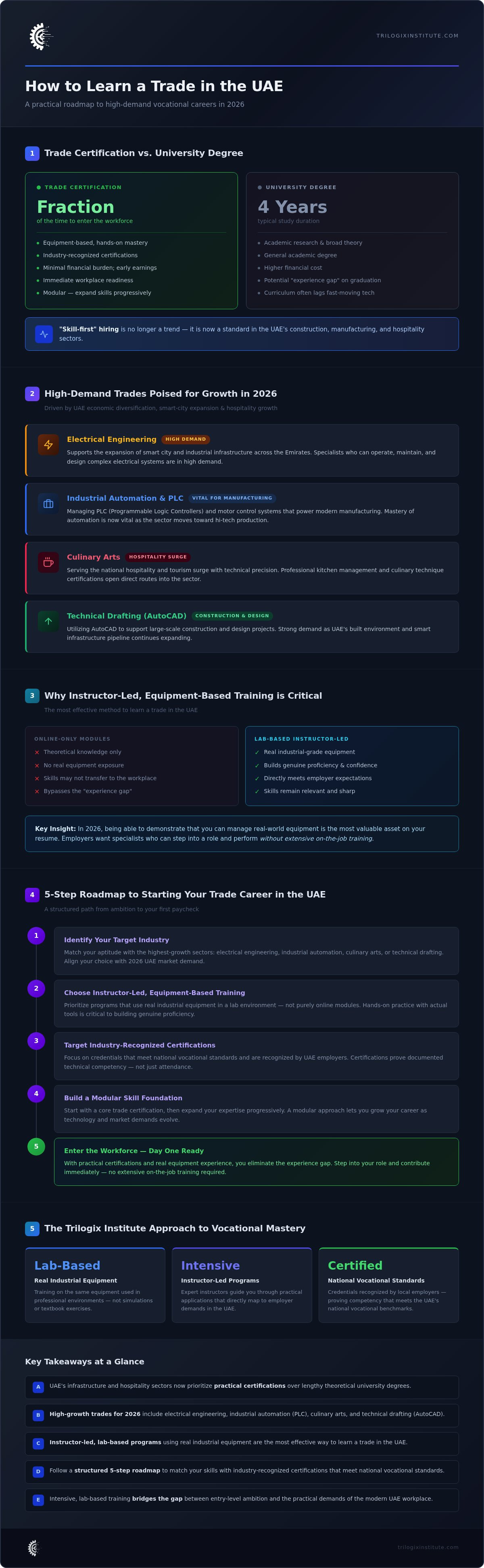
- Understand why the UAE’s infrastructure and hospitality sectors now prioritize practical certifications over lengthy, theoretical university degrees.
- Identify the high-growth trades for 2026, including electrical engineering and industrial automation, that offer the strongest professional stability.
- Discover the most effective way to learn a trade in UAE by choosing instructor-led programs that utilize real industrial equipment instead of purely online modules.
- Follow a structured five-step roadmap to match your skills with industry-recognized certifications that meet national vocational standards.
- Learn how intensive, lab-based training environments bridge the gap between entry-level ambition and the practical demands of the modern workplace.
The Rise of Vocational Careers in the UAE
Learning a trade involves the acquisition of specific, transferable manual or technical skills that solve tangible problems in the real world. In the UAE's 2026 economic landscape, the focus has shifted from generalized academic knowledge to specialized industrial utility. Employers in construction, manufacturing, and hospitality are increasingly looking for individuals who possess documented technical competency. If you want to learn a trade in UAE, you're choosing a professional path that prioritizes immediate workplace readiness over abstract theory. This vocational route offers a streamlined entry point into the workforce, saving both time and financial resources while aligning with the nation's ambitious smart-infrastructure goals.
The transition toward a "skill-first" hiring model is no longer a trend; it's a standard. Companies are moving away from traditional degree requirements for roles that demand high-level technical precision. By focusing on vocational mastery, you position yourself as a practical expert who can contribute to the economy from day one. This approach is particularly effective for those looking to enter fast-moving sectors like renewable energy, logistics, and advanced manufacturing where the pace of technology often outstrips traditional university curricula.
Trade vs. Degree: Understanding the Difference
The fundamental difference between these two paths lies in how knowledge is applied. Traditional university degrees often center on academic research and broad theoretical frameworks that take years to complete. In contrast, vocational education focuses on equipment-based mastery and specific industrial applications. While a university path typically requires four years of study, intensive trade certifications can prepare you for the field in a fraction of that time. This speed-to-market is a significant advantage in an economy that values agility.
You aren't just reading about a circuit or a recipe in a textbook; you're actively working with industrial-grade equipment to build proficiency. This hands-on intensity ensures that your skills remain relevant and sharp. For many, the cost-benefit analysis favors this direct approach, as it minimizes the financial burden of long-term schooling and maximizes early career earnings. It's about building a modular foundation of skills that you can expand as your career progresses.
Why Practical Utility Wins in the UAE Job Market
The UAE's massive infrastructure projects and expanding hospitality sector don't just need managers; they need experts who can operate, maintain, and design complex systems. Practical utility is the primary metric for success in these technical fields. When you learn a trade in UAE, you gain industry-recognized certifications that serve as a standard of competency for potential employers. These credentials prove you can handle the pressure of a professional kitchen or the technical demands of a modern industrial motor control system.
By focusing on utility, you eliminate the "experience gap" that often plagues university graduates who lack hands-on time. If you're still weighing your options, our Vocational Training vs. University Degree guide offers a deeper look at which path aligns best with your long-term professional goals. In 2026, being able to demonstrate that you can manage real-world equipment is the most valuable asset on your resume. Employers want specialists who can step into a role and perform without extensive on-the-job training.
Essential Trades Poised for Growth in 2026
The UAE’s economic diversification strategy has created a massive demand for technical specialists who can deliver immediate results. In 2026, the focus is on sectors that drive infrastructure, manufacturing, and world-class hospitality. To successfully learn a trade in UAE, you should target industries where practical skills are the primary barrier to entry. This alignment ensures your training translates directly into professional opportunity. Key sectors poised for significant growth include:
- Electrical Engineering: Supporting the expansion of smart city and industrial infrastructure.
- Industrial Automation: Managing the PLC and motor control systems that power modern manufacturing.
- Culinary Arts: Serving the national hospitality and tourism surge with technical precision.
- Technical Drafting: Utilizing AutoCAD to support large-scale construction and design projects.
Industrial automation, specifically the mastery of Programmable Logic Controllers (PLC), is now vital for the manufacturing sector as it moves toward higher efficiency. The Industrial Automation Specialization focuses on these advanced control systems, allowing you to design and troubleshoot the logic that drives modern production lines. By identifying these growth areas, you can learn a trade in UAE that offers long-term stability and professional advancement.
Electrical and Industrial Technical Skills
Programs like the TTI Dubai Foundation Electrical Engineering provide a versatile entry point for multiple industries. This course covers the essential principles required to navigate complex electrical systems safely and efficiently. For those looking at automation roles, the TITP Beginner Essential Industrial Motor Control program is critical. Mastery of these systems requires intensive lab time with real-world equipment. You can't learn electrical safety or system design through a screen. You need to handle the components you'll face in the field to build genuine competence and ensure workplace safety.
Creative and Design Trades
The hospitality sector continues to expand nationally, making the TTI Dubai Professional Culinary Arts course a strategic choice for aspiring chefs. This program moves beyond basic cooking to focus on kitchen management, food safety, and technical precision in a high-pressure environment. Similarly, the construction surge relies on skilled drafters who can translate concepts into technical reality. The TTI Dubai Advanced AutoCad 2D & 3D course equips you with the tools needed to support architectural and engineering projects with absolute accuracy. These creative trades are essential to the nation’s tourism and urban development goals. If you're ready to gain these skills, you can view our full list of instructor-led courses to find your specific path.
Why Instructor-Led, Equipment-Based Training is Critical
Digital tutorials offer convenience, but they fail to provide the tactile feedback necessary for technical mastery. To effectively learn a trade in UAE, you must move beyond the screen. Watching a video on circuit wiring isn't the same as stripping a wire, grounding a system, or managing a live control panel. Professional competency requires physical interaction with industrial-grade components. This instructor-led approach ensures you don't just understand the theory but possess the physical capability to execute it under real-world conditions.
Safety is a primary concern in technical trades like electrical engineering and culinary arts. Supervised practice prevents the formation of dangerous habits that often go unnoticed in self-paced, online environments. An instructor provides immediate, corrective feedback. This guidance ensures your technique aligns with global safety standards and national vocational requirements before you ever set foot on a professional job site. It's about building a foundation of reliability and precision that protects both you and your future employers.
The Role of Real-World Labs
Real-world labs bridge the critical gap between a diagram on a screen and a physical control panel. By simulating industrial faults in a controlled environment, these labs build the troubleshooting and problem-solving skills required in high-stakes settings. You develop muscle memory through consistent repetition on actual equipment. This physical familiarity is vital when you're tasked with managing complex motor control systems or operating in a high-pressure professional kitchen. Mastery comes from the hands, not just the eyes.
The transition from a student to a practitioner happens in these lab spaces. You learn to interpret technical readings and react to equipment behavior in real-time. This exposure reduces the learning curve when you eventually transition into the workforce. Employers value candidates who've already handled the specific tools of the trade, as it demonstrates a level of readiness that theoretical study cannot replicate.
The Advantage of Industry-Centric Instruction
Industry-centric instruction connects you with practitioners who understand the current demands of the UAE market. These instructors bring practical insights that aren't found in textbooks, such as specific local regulations and common field challenges. Being in a physical training environment also offers significant networking benefits. You're surrounded by peers and experts, creating a professional community that supports your career growth. Explore our lab-based curricula to see how we prioritize hands-on mastery through equipment-focused training. This methodical approach ensures you are prepared for the technical realities of your chosen field.
5 Steps to Starting Your Trade Career in the UAE
Transitioning into a vocational career requires a methodical approach that prioritizes skill acquisition over passive observation. If you want to learn a trade in UAE, you must align your training with the specific technical demands of the local market. This roadmap ensures you move from an entry-level enthusiast to a workplace-ready practitioner with efficiency and confidence.
- Assess your technical aptitude. Determine if your strengths lie in the mechanical precision of electrical systems or the creative management of a professional kitchen. Matching your passion to a high-growth sector like automation or hospitality is the first step toward long-term career satisfaction.
- Vet your training provider. Choose an institute that emphasizes hands-on lab time over classroom lectures. A certified provider should offer a curriculum that mirrors the real-world challenges you'll face in the field.
- Master foundational principles. Complete a core program like the TTI Dubai Foundation Electrical Engineering to build your technical baseline. This foundation is essential before moving into complex niche specializations.
- Pursue advanced certifications. Differentiate yourself in a competitive market by mastering advanced tools. Programs like the Industrial Automation Specialization or TTI Dubai Advanced AutoCad 2D & 3D provide the high-level skills that employers value most.
- Validate your expertise. Use your lab-based certifications to build a portfolio. Documenting your ability to operate real industrial equipment proves your readiness to potential employers.
Evaluating Training Institutes
When you decide to learn a trade in UAE, the quality of your training facility directly impacts your professional trajectory. Look for institutes that maintain a low equipment-to-student ratio. This ensures you spend more time operating machinery and less time watching others. Modern labs should feature the same industrial equipment used in the UAE's current infrastructure and hospitality sectors. Verify that your instructors are seasoned practitioners who can provide insights into local industry standards and safety protocols. To see these environments in action, you can visit the Trilogix Gallery and observe our specialized lab setups.
Transitioning from Training to Industry
Translating lab experience into a professional resume requires a focus on specific, verifiable competencies. Instead of listing general "knowledge," highlight the exact tasks you can perform. Mention your ability to troubleshoot PLC logic or manage high-volume kitchen operations with precision. The vocational market moves fast; maintaining technical relevance requires a commitment to continuous learning as new equipment and standards emerge. If you're ready to start your journey, enroll in a professional trade course today to secure your place in the UAE's growing technical economy.
The Trilogix Institute Approach to Vocational Mastery
Trilogix Institute (TTI) operates on a simple premise: education must lead directly to professional utility. We don't offer university degrees. Instead, we provide the specific technical keys needed to unlock the global job market. When you choose to learn a trade in UAE through our institute, you're opting for a curriculum built around immediate readiness. Our programs prioritize rapid skill acquisition, allowing you to transition from the classroom to the industrial floor or professional kitchen with documented competency. It's a pragmatic path designed for individuals who want to bridge the gap between their current ambition and future employment.
We understand that the UAE market demands specialists who can troubleshoot complex systems from day one. This is why our training environments replicate real-world industrial settings. Whether you're wiring a control panel or designing a 3D architectural model, you're using the same tools and software used by the nation's leading firms. This equipment-based approach eliminates the guesswork and builds the steady confidence required to excel in high-stakes vocational roles. You aren't just a student here; you're a practitioner in training.
Specialised Technical Programs
Our technical curricula focus on the foundational and advanced skills that drive the nation's infrastructure. The TTI Dubai Foundation Electrical Engineering course establishes the core principles of safety and system design. For those targeting the manufacturing sector, the TITP Beginner Essential Industrial Motor Control program provides the specific logic and hardware experience needed for automation roles. We also offer TTI Dubai Advanced AutoCad 2D & 3D for those pursuing careers in technical drafting. You can explore our Electrical Engineering Career Guide to see how these certifications align with current industry standards. These programs aren't just about passing a test; they're about demonstrating mastery to future employers through hands-on performance.
Professional Culinary Arts Training
The TTI Dubai Professional Culinary Arts program provides an immersive experience within a high-standard kitchen environment. We move beyond basic cooking techniques to focus on the operational precision required by the UAE's world-class hospitality sector. You'll master kitchen management, food safety, and technical execution under the guidance of seasoned practitioners. This intensive training ensures you're ready to step into a professional role with a clear understanding of industry expectations. If you're ready to learn a trade in UAE that offers a direct path to success, contact Trilogix Institute today to discuss your career transition. Our focused, results-oriented approach is the fastest way to turn your technical interest into a rewarding profession.
Bridge the Gap Between Ambition and Employment
The UAE economy in 2026 demands more than just theoretical knowledge; it requires proven technical utility. You've seen how specialized fields like industrial automation and electrical engineering provide a faster, more cost-effective path to professional stability than traditional degrees. By focusing on instructor-led sessions with real industrial equipment, you ensure your skills are sharp, safe, and ready for the immediate demands of the field. This direct approach to training eliminates the fluff and focuses on what actually matters to modern employers.
Choosing to learn a trade in UAE is a strategic investment in your professional future. Our specialized labs for engineering and culinary arts prioritize practical mastery over academic theory, giving you the specific muscle memory needed for high-stakes industrial environments. This pragmatic approach bridges the gap between your ambition and the employment market. It's time to stop observing and start doing. Explore our hands-on vocational courses and start your career today. Your journey toward a rewarding and stable technical career begins with a single, results-oriented step.
Frequently Asked Questions
Do I need a university degree to work in a trade in the UAE?
No. Many technical roles prioritize practical certifications and hands-on competence over academic degrees. Employers in sectors like construction and industrial automation value your ability to operate equipment immediately. To learn a trade in UAE, you should focus on intensive vocational training that builds specific skills. This approach allows you to enter the workforce faster and with less financial burden than a four-year university program.
How long does it take to get certified in a technical trade?
Certification timelines vary based on the complexity of the discipline. Most intensive vocational programs are designed for rapid skill acquisition, often taking a few weeks to several months rather than years. For example, foundational engineering or specialized AutoCAD courses focus on high-impact learning modules. This streamlined path ensures you gain the technical readiness required for the 2026 job market without the time commitment of traditional academic routes.
Are vocational certifications from Trilogix Institute industry-recognised?
Yes, our certifications focus on industry-specific standards required across the Emirates. We design our curriculum to meet the practical demands of the modern workforce, particularly in electrical engineering and culinary arts. These credentials prove to employers that you've undergone instructor-led training using real industrial equipment. This validation of your technical competency is vital for securing roles in the nation's competitive infrastructure and hospitality sectors.
Can I learn AutoCAD or Motor Control if I have no prior technical background?
You can certainly begin these programs as a newcomer. Our foundational courses, such as the TTI Dubai Foundation Electrical Engineering, are structured to build your knowledge from the ground up. We use a methodical progression that starts with core principles before moving into advanced technical applications. This ensures that even those without a background in engineering or design can achieve professional mastery through consistent, instructor-led practice in our labs.
What is the difference between an online course and instructor-led training for trades?
Online courses often lack the tactile feedback and safety supervision essential for manual trades. In contrast, instructor-led training provides immediate guidance and access to real industrial equipment. This physical interaction is critical for building muscle memory and preventing dangerous technical habits. You don't just watch a screen; you actively engage with the tools and systems you'll encounter in a professional workplace, ensuring genuine field readiness.
Is culinary arts considered a high-demand trade in the UAE for 2026?
Culinary arts is a vital sector within the nation's expanding tourism and hospitality industry. As new world-class venues open, the demand for skilled chefs who understand professional kitchen operations continues to grow. Choosing to learn a trade in UAE within the culinary field offers a stable career path focused on technical precision and management. Our immersive training environments prepare you for the high-pressure demands of modern commercial kitchens.
What equipment will I use during my electrical engineering training?
You will work with the same industrial-grade components found in modern commercial and industrial facilities. This includes Programmable Logic Controllers (PLC), industrial motor control systems, and specialized electrical panels. Our labs are equipped to simulate real-world faults, allowing you to practice troubleshooting in a controlled setting. Using actual hardware instead of software simulations ensures you possess the practical confidence required to manage complex electrical infrastructure safely and efficiently.
How do I know which trade is right for my career goals?
Identifying the right path involves matching your natural aptitudes with the current needs of the national economy. If you enjoy technical problem-solving and logic, industrial automation or electrical engineering may be ideal. If you prefer creative, high-energy environments, culinary arts is a strong choice. Evaluate your long-term interests and research which sectors offer the most stability. Focus on trades where you can demonstrate mastery through practical, equipment-based certifications.


