

The traditional belief that a four-year university degree is the only gateway to a prestigious engineering career has become an expensive myth. In 2026, the UAE industrial sector is prioritizing hands-on proficiency over academic theory, creating a massive opportunity for those interested in getting a technical job without a degree. You've likely felt the frustration of being stuck in a non-technical role while watching others spend years and significant tuition fees on degrees that offer little practical experience. It's common to fear that online certificates won't impress a hiring manager looking for real engineering talent.
We understand that you need a faster, more reliable path to professional stability. This guide provides the exact roadmap to launching a high-paying technical career through vocational mastery and hands-on skills rather than long-term academic study. You'll discover how to master real-world equipment and earn industry-recognized certifications that command respect in the local market. We'll explore the shift toward skills-based hiring, the essential tools you must master, and the specific training modules that bridge the gap between your current ambition and future employment.
Key Takeaways
- Learn how the 2026 UAE job market is prioritizing practical competency, allowing skilled professionals to bypass the high costs and long durations of traditional university degrees.
- Discover the proven roadmap for getting a technical job without a degree by focusing on specialized sectors like industrial motor control and electrical engineering.
- Understand the critical difference between online-only certificates and equipment-based training, and why hands-on lab experience is the gold standard for technical hiring.
- Identify the specific industry-recognized certifications in AutoCAD and automation that immediately signal your workplace readiness to top industrial employers.
- Follow a clear, two-step process to audit your current skills and enroll in instructor-led programs that translate directly into high-paying technical roles.
The 2026 Technical Job Market: Why Degrees Are No Longer Mandatory
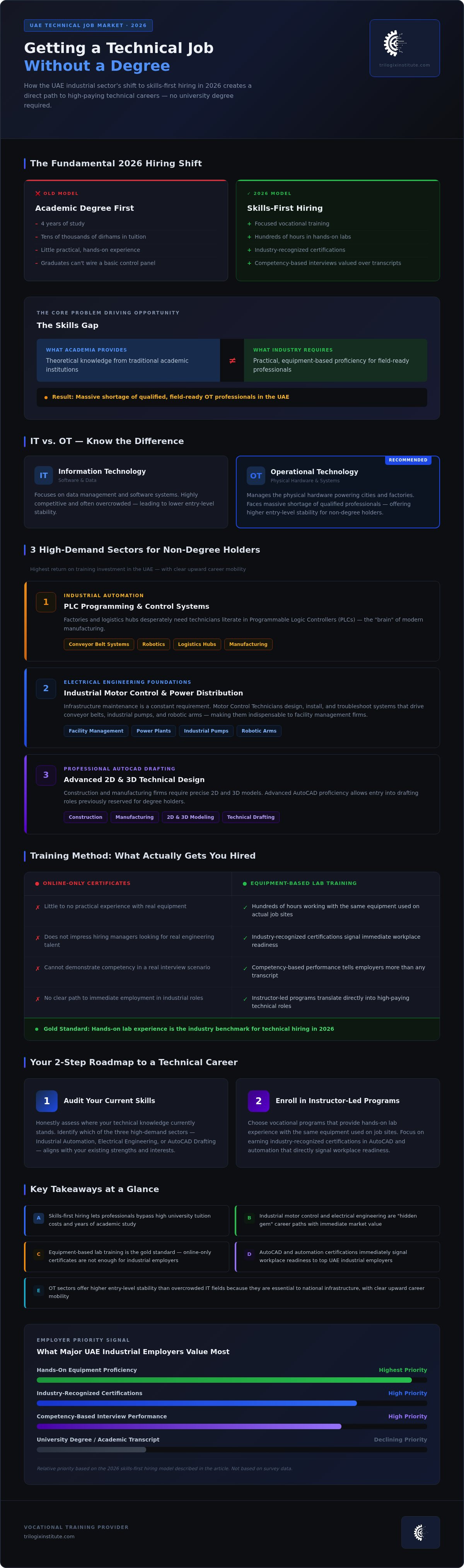
The UAE industrial sector is undergoing a fundamental shift in how talent is acquired. In 2026, the "skills-first" hiring approach defines a market where recruiters prioritize your ability to operate, troubleshoot, and maintain systems over your academic history. While Information Technology (IT) focuses on data management and software, Operational Technology (OT) manages the physical hardware that powers our cities and factories. This distinction is vital for anyone interested in getting a technical job without a degree, as the OT sector faces a massive shortage of qualified, field-ready professionals. The "Skills Gap" is the persistent disparity between the theoretical knowledge provided by traditional academic institutions and the practical, equipment-based proficiency required by modern industrial employers.
The Decline of Degree Requirements in Engineering
Major national employers are moving away from traditional recruitment filters. They've discovered that a candidate's performance in a competency-based interview tells them more about job success than a university transcript ever could. This evolution is driven by a pragmatic cost-benefit analysis. A four-year degree requires a significant investment of time and tens of thousands of dirhams, yet often leaves graduates without the ability to wire a basic control panel. In contrast, a focused path through vocational education offers an intensive route to mastery. Modern industry standards now prioritize candidates who have spent hundreds of hours in hands-on labs working with the same equipment used on the job site. It's about readiness, not just research.
High-Growth Sectors for Non-Degree Holders
The demand for specialized technical talent is surging across several key UAE industries. If you're looking at getting a technical job without a degree, three specific areas offer the highest return on your training investment:
- Industrial Automation: Factories and logistics hubs desperately need technicians who are literate in Programmable Logic Controllers (PLCs). This is the "brain" of modern manufacturing.
- Electrical Engineering Foundations: Infrastructure maintenance is a constant requirement. Mastering industrial motor control and power distribution makes you indispensable to facility management firms.
- Professional AutoCAD Drafting: Construction and manufacturing firms require precise 2D and 3D models. Proficiency in advanced AutoCAD training allows you to step into drafting roles that were previously reserved for degree holders.
These sectors don't just offer jobs; they offer careers with clear upward mobility. By focusing on these high-demand niches, you bypass the academic gatekeepers and move straight into the workforce with skills that have immediate market value.
Identifying High-Demand Technical Skills: Beyond Coding and IT
While many career guides focus exclusively on software development, the physical infrastructure of the UAE requires a different set of competencies. The industrial sector is currently seeking professionals who can bridge the gap between digital design and physical execution. If you're serious about getting a technical job without a degree, you must look toward "hard" skills that keep factories, power plants, and construction sites operational. These high-demand technical occupations often offer higher entry-level stability than overcrowded IT fields because they're essential to national infrastructure.
Mastering Industrial Motor Control
Industrial motor control is the "hidden gem" of technical careers. On a daily basis, a Motor Control Technician designs, installs, and troubleshoots the systems that drive conveyor belts, industrial pumps, and robotic arms. This skill is the lifeblood of manufacturing and automation. Without these systems, production lines stop and revenue is lost. To understand how to enter this field and what equipment you'll need to master, review our Motor Control Certification: 2026 Professional Buying Guide for a detailed breakdown of the required competencies.
The Power of Professional Drafting with AutoCAD
Design workflows have evolved far beyond simple sketches. Modern technical drafting requires moving from basic 2D layouts to advanced 3D industrial modeling. This allows junior designers to simulate stress tests and material requirements before a single dirham is spent on construction. Earning a certification through an Advanced AutoCAD 2D & 3D Course bridges the credential gap, proving you can handle the sophisticated drafting needs of UAE’s architectural and engineering firms without a university diploma.
Foundation Electrical Engineering remains the bedrock of all technical infrastructure. Every smart building and automated warehouse depends on stable power distribution and circuit integrity. Identifying your natural aptitude is the first step toward success. If you enjoy solving logical puzzles and working with your hands, motor control or electrical wiring may be your ideal path. If you prefer precision, visualization, and digital modeling, AutoCAD drafting is likely your best fit. Getting a technical job without a degree is entirely feasible when you align your training with these critical industry needs. You can explore our full range of technical training programs to see which equipment-based lab matches your career goals.
Hands-on Lab Training vs. Online Courses: Which One Gets You Hired?
While self-paced online modules offer convenience, they often fail to prepare you for the physical realities of the industrial sector. Clicking through slides isn't the same as wiring a control panel or troubleshooting a live circuit. For those focused on getting a technical job without a degree, the method of instruction is just as critical as the subject matter. Equipment-based training is the gold standard because it bridges the gap between theoretical knowledge and workplace performance. UAE employers prioritize candidates who can demonstrate proficiency on actual hardware because it reduces their onboarding costs and safety risks.
There's a significant difference between a "certificate of completion" and a "competency certification." A completion badge often signifies little more than attendance. In contrast, a competency certification proves you've passed rigorous, instructor-led assessments on real equipment. According to Bureau of Labor Statistics data on technology occupations, technical roles require a high degree of practical problem-solving that simulators simply cannot replicate. Simulators don't vibrate, they don't have loose physical connections, and they don't provide the tactile feedback necessary for true mastery.
Why Real-World Equipment Mastery Matters
Physical troubleshooting in a lab environment forces you to engage with the equipment's unique quirks. You learn to identify faults by sound, heat, and visual cues that a digital interface misses. Hiring managers in the engineering sector view lab experience as a proxy for job readiness. They know that if you've handled industrial motor controls in a controlled setting, you're less likely to make costly mistakes on the job site. To understand how these labs compare to traditional education, read our guide on Vocational Training vs. University Degree: Choosing Your Path in 2026 for a deeper analysis.
The Instructor-Led Advantage
Learning in a classroom provides immediate feedback loops that online videos can't offer. When you hit a roadblock, an expert instructor can provide a course correction in real-time. This interaction builds "soft skills" like communication and teamwork within a technical context. Your instructors are often active industry insiders. They provide networking opportunities that are unavailable to those studying in isolation. This human element is often what transforms a student into a professional, providing the confidence needed to excel in competency-based interviews.
Your Step-by-Step Roadmap to a Technical Career Without a Degree
Transitioning into a specialized technical field requires a methodical approach that replaces academic theory with practical evidence. In the UAE market, industrial employers are looking for an immediate return on investment. They want to know you can handle high-value equipment on day one. By following a structured roadmap, you can bypass the traditional university route and move straight into a high-growth industrial role. This process is designed to build the "vocational maturity" that recruiters value most.
- Step 1: Audit and Niche Selection. Evaluate your natural aptitudes. Choose a high-demand technical niche like industrial automation or electrical maintenance where the skills gap is most acute.
- Step 2: Hands-on Enrollment. Join an equipment-based vocational program. Mastery comes from physical repetition on actual hardware, not just watching instructional videos.
- Step 3: Portfolio Development. Document every lab project. A visual and technical record of your achievements provides the "proof of work" that recruiters demand during the hiring process.
- Step 4: Certification Acquisition. Secure industry-recognized credentials. Programs like the TTI Foundation Electrical Engineering course signal your alignment with professional standards.
- Step 5: Strategic Networking. Use your vocational credentials to connect with industry insiders. Many technical roles in the UAE are filled through professional referrals rather than public job boards.
Building a Non-Traditional Technical Portfolio
Your portfolio is your most powerful tool for getting a technical job without a degree. Instead of a list of completed classes, show recruiters what you've actually built. Include high-resolution photos of wired control panels, detailed circuit logic flows, and professional-grade project documentation created in AutoCAD. When describing these projects on your CV, focus on the specific technical challenges you overcame. Use power verbs like "installed," "troubleshot," and "optimized" to demonstrate your active role in the lab. This modular evidence proves you possess the practical readiness required for junior engineering positions.
Acing the Technical Interview Without a Degree
The technical interview is where you bridge the gap between training and employment. Shift the conversation away from academic history and toward how you solve real-world problems. When asked about your experience, describe specific lab scenarios where you identified a fault and implemented a solution. If the interview includes a practical assessment, demonstrate your equipment familiarity with steady confidence. Show that you understand safety protocols and standard operating procedures used in the UAE industrial sector. Emphasize your commitment to continuous learning by highlighting specialized courses you've completed. You can begin your professional journey by exploring our technical training programs today.
Accelerating Your Career with Trilogix Institute's Vocational Programs
Trilogix Institute (TTI/TITP) serves as a national leader in equipment-led vocational training. We focus on bridging the gap between ambition and employment by providing the specific skills that UAE industrial sectors demand. For those focused on getting a technical job without a degree, our programs offer a streamlined path to professional mastery. We don't prioritize abstract theory. Instead, we teach you how to operate the actual hardware used in modern facilities. This "Equipment-First" philosophy ensures you graduate with the confidence to handle high-value systems from your first day on the job.
Our curriculum is built for speed and utility. You can transition from a beginner to a certified technician in months, not years. Whether you enroll in the TTI Foundation Electrical Engineering course or the Industrial Automation Specialization, the focus remains on workplace readiness. We align our training with global standards. This ensures your skills are portable and highly valued by local employers across the UAE looking for immediate technical proficiency.
Our Equipment-Based Training Environment
Inside our labs, you'll find the same industrial motor controls and PLC systems found in modern production facilities. Our instructor-led model provides a level of depth that purely online alternatives cannot match. You get immediate feedback on your wiring, logic flows, and troubleshooting techniques. This immersive environment is where true competency is forged. For a detailed breakdown of our specific modules and lab setups, visit our courses page for specific program details.
- TITP Beginner Essential Industrial Motor Control: Master the foundations of automation hardware.
- TTI Advanced AutoCad 2D & 3D: Develop professional-grade drafting skills for engineering projects.
- Industrial Automation Specialization: Advance your knowledge of complex control systems.
The Path Forward: Enrolling at Trilogix
Choosing the right course depends on your career goals and natural aptitude. If you prefer physical system design, our electrical engineering track is ideal. If you enjoy digital precision, AutoCAD drafting is a better fit. Getting a technical job without a degree is a journey that begins with a single, focused decision. We invite applicants from across the UAE to join our upcoming cohorts. Our team is ready to help you map out a training schedule that fits your life and career aspirations. Contact Trilogix Institute today to start your technical career and secure your place in our next hands-on lab session.
Build Your Technical Future Today
The roadmap to a successful career in engineering no longer requires a four-year university commitment. In 2026, skills matter most. By prioritizing equipment-based mastery and industry-aligned certifications, you're positioning yourself at the forefront of the UAE's industrial growth. We've explored how specialized skills in motor control and AutoCAD drafting provide a faster, more reliable route to employment than general academic degrees.
Focusing on getting a technical job without a degree allows you to enter the workforce with practical competency that employers respect. Trilogix Institute provides the instructor-led training and real industrial equipment necessary to build a professional portfolio. Our accelerated pathways are designed to meet 2026 market demands, ensuring you're ready for the field in months rather than years.
Your transition from ambition to employment starts with the right training partner. Explore our hands-on technical courses and launch your career. The industrial sector is waiting for experts who can solve real problems. It's time to become one of them.
Frequently Asked Questions
Can I really get a technical job without a university degree in 2026?
Yes, it's entirely possible to secure a high-paying role by getting a technical job without a degree in 2026. UAE industrial sectors now prioritize practical competency and equipment mastery over theoretical academic backgrounds. Employers look for candidates who can troubleshoot live systems and maintain infrastructure immediately. By focusing on specialized vocational training, you can demonstrate the specific field-readiness that national industries require to bridge the current skills gap.
Which technical certifications are most valued by employers today?
Employers highly value certifications that prove proficiency on real-world industrial hardware. Some of the most sought-after credentials include:
- TITP Beginner Essential Industrial Motor Control
- TTI Dubai Advanced AutoCad 2D & 3D
- Industrial Automation Specialization
These specific certifications signal to recruiters that you possess the technical literacy and safety awareness needed for operational technology roles without requiring a four-year university diploma.
How long does it take to complete a vocational technical program?
Most vocational technical programs at Trilogix Institute are designed for efficiency, typically taking a few months to complete rather than several years. These accelerated pathways focus exclusively on high-impact skills like electrical engineering foundations or professional drafting. This modular approach allows you to gain workplace readiness quickly. You don't spend time on general education subjects, focusing instead on the intensive lab work required to master specific industrial equipment.
What is the difference between a technician and an engineer in the job market?
In the 2026 job market, technicians primarily focus on the hands-on implementation, maintenance, and troubleshooting of physical systems. Engineers often handle broader design and theoretical planning. However, the distinction is narrowing as modern technicians increasingly use advanced tools like AutoCAD for professional modeling. Getting a technical job without a degree usually starts with a technician or junior engineer role where your value is based on your direct interaction with operational hardware.
Are vocational courses at Trilogix Institute recognized by national industries?
Yes, our courses are designed to align with national industrial standards and global professional requirements. Trilogix Institute focuses on industry-specific certifications that employers recognize as evidence of practical skill. By using real-world industrial equipment in our labs, we ensure that the training is directly transferable to the workplace. This alignment makes our graduates attractive to firms in the automation, construction, and manufacturing sectors across the country.
Do I need prior experience to enroll in a Foundation Electrical Engineering course?
You don't need prior engineering experience to begin the TTI Dubai Foundation Electrical Engineering course. This program is structured to take you from basic concepts to advanced troubleshooting through instructor-led lab sessions. We provide the foundational knowledge and technical safety training required to work with electrical systems. It's an ideal entry point for those transitioning from non-technical roles who want to build a career based on measurable vocational skills.
How much can I expect to earn in a technical role without a degree?
Salary ranges for technical roles in the UAE vary by specialization, but skilled technicians often earn competitive wages that rival entry-level degree holders. Professionals with mastery in industrial motor control or automation can command strong starting salaries in the industrial sector. While we don't provide specific salary quotes, industry reports suggest that vocational expertise in high-demand niches leads to significant earning potential and long-term career stability within the national economy.
Why is AutoCAD training essential for non-degree technical jobs?
AutoCAD training is essential because it's the universal language of technical design and documentation. Proficiency in Advanced AutoCAD 2D & 3D allows you to create the precise models and logic flows that engineering firms require. For those getting a technical job without a degree, this skill serves as a powerful credential. It proves you can translate complex technical ideas into professional-grade drafts, making you an asset in construction and manufacturing workflows.


