

A certification is only as valuable as the hardware you have actually programmed, wired, and debugged. In a region where the UAE Ministry of Industry and Advanced Technology is pushing for a massive AED 300 billion industrial contribution by 2031, simply knowing the theory is no longer enough. You likely realize that a university degree or a purely online course cannot prepare you for the high-pressure reality of a malfunctioning production line. Professional success depends on your ability to handle physical PLCs and industrial motor controls with total confidence.
By pursuing a practical industrial automation certification, professionals in the Emirates can bridge the gap between academic concepts and factory floor execution. This guide provides a clear roadmap to mastering the technical skills required for Industry 4.0 through an equipment-based learning model. We'll examine why hands-on experience with Siemens and Allen-Bradley systems is the gold standard for 2026 and how instructor-led training ensures you can troubleshoot complex systems independently. You're about to discover how to transform from a theoretical learner into a high-value technical expert ready for the UAE's rapidly evolving industrial landscape.
Key Takeaways
- Understand why Industry 4.0 is transforming the UAE manufacturing sector and how specialized training bridges the gap between theory and shop-floor reality.
- Identify the essential technical modules, including PLC programming and HMI configuration, required to manage the brain of modern industrial systems.
- Evaluate the high ROI of equipment-based training compared to online courses when seeking an industrial automation certification Dubai employers respect.
- Learn how to verify KHDA-aligned accreditation and assess your current skill level to select the most effective vocational training path.
- Discover how integrating Industrial Motor Control with automation specialization creates a comprehensive skill set for independent system troubleshooting.
Why Industrial Automation Certification is Essential in the UAE for 2026
The industrial sector in the United Arab Emirates is undergoing a radical transformation. As we approach 2026, the gap between academic engineering theory and the practical demands of the shop floor has never been more apparent. An industrial automation certification Dubai professionals obtain serves as a vital bridge, turning abstract concepts into functional expertise. Local industries are shifting rapidly from manual maintenance to sophisticated, automated system monitoring. This transition requires a workforce that doesn't just understand diagrams but can command the industrial control systems that power modern production lines.
The Role of Automation in UAE Industry 4.0
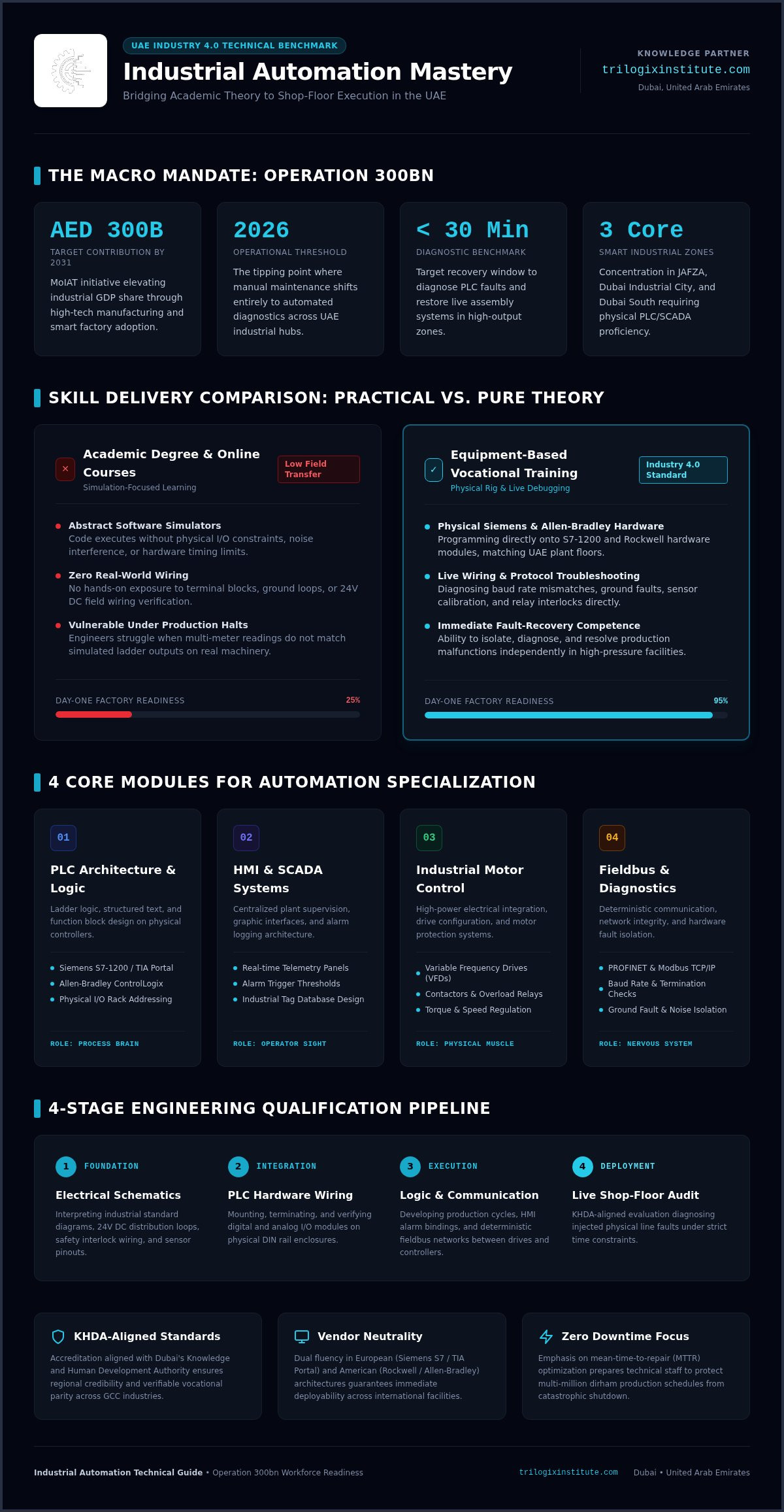
The UAE Ministry of Industry and Advanced Technology (MoIAT) is driving this change through the "Operation 300bn" strategy. This initiative aims to increase the industrial sector's GDP contribution to AED 300 billion by 2031. For technicians and engineers, this means the demand for automation expertise is skyrocketing across energy, logistics, and manufacturing sectors. Smart factories are no longer a future concept; they are the current standard in hubs like JAFZA and Dubai Industrial City. To remain relevant, professionals must master PLC-literate operations. Technical managers in these high-stakes environments prioritize candidates who hold specialized certifications because they represent a readiness to work with physical hardware from day one. Securing an industrial automation certification Dubai employers recognize ensures you're not just a spectator in this industrial revolution.
Skill Mastery vs. Academic Theory
Many university graduates enter the UAE job market with high-level theoretical knowledge but struggle when faced with a physical system failure. Academic degrees often lack the granular, equipment-ready focus needed for immediate troubleshooting. A professional certification provides a standardized proof of competency that employers trust. It demonstrates that you've moved beyond simulations to master real-world equipment. You can explore specialized options through Trilogix Institute courses to see how this transition works in practice.
Key benefits of choosing a practical certification path include:
- Direct experience with physical PLC wiring and I/O modules.
- Ability to diagnose ground faults and baud rate mismatches in real time.
- Alignment with KHDA-recognized technical standards for career mobility across the GCC.
In the competitive Dubai market, being "equipment-ready" is the most significant advantage you can have. It transforms your resume from a list of subjects studied into a portfolio of systems you can actually manage. It's about bridging the gap between ambition and employment with a no-nonsense approach to technical mastery.
Core Modules of a Professional Industrial Automation Specialization
Achieving technical proficiency in the UAE's manufacturing sector requires a deep understanding of several interconnected technologies. As the UAE Operation 300bn industrial strategy accelerates the adoption of smart manufacturing, the curriculum for an industrial automation certification Dubai professionals seek must reflect these high-tech requirements. Mastery isn't just about understanding one component; it's about managing the entire ecosystem of an automated facility. This involves a modular approach where each skill builds upon the last to create a versatile technical profile.
PLC Programming and Troubleshooting
Programmable Logic Controllers (PLCs) act as the central intelligence for industrial processes. Training must move beyond basic ladder logic to include functional blocks and structured text. While software simulations are a starting point, true competency is built by interfacing with physical Siemens S7-1200 or Allen-Bradley hardware. PLC mastery is the ability to diagnose faults in under 30 minutes. This speed is critical for minimizing downtime in high-output environments like those found in JAFZA or Dubai South. Technicians who can wire, program, and debug physical I/O modules are far more valuable than those who have only used browser-based emulators.
SCADA and Data Visualization
Supervisory Control and Data Acquisition (SCADA) and Human-Machine Interfaces (HMI) represent the crucial link between human operators and machine logic. A professional specialization focuses on designing intuitive dashboards that provide real-time visibility into complex processes. This involves setting up data logging and alarm management systems that facilitate predictive maintenance. Advanced modules also cover the integration of SCADA with Enterprise Resource Planning (ERP) systems, allowing for seamless communication between the factory floor and management level. Learning these skills through the Industrial Automation Specialization ensures you're prepared for the IT/OT convergence happening in modern UAE factories.
Managing mechanical output through Variable Frequency Drives (VFDs) and industrial motor controls is another essential pillar. This includes configuring drives to control motor speed and torque, which is vital for energy efficiency and precision in packaging and logistics. Finally, industrial networking binds everything together. Mastering protocols like PROFINET, Modbus TCP, and OPC-UA allows you to connect sensors, controllers, and cloud systems. This connectivity is the backbone of the smart factories envisioned for Dubai's industrial future. Obtaining a comprehensive industrial automation certification Dubai programs offer means you can navigate these complex networks with ease, ensuring all field devices communicate flawlessly with the supervisory layer.
Equipment-Based Training vs. Online Theory: Which Delivers ROI?
Online learning has its place, but not on the factory floor. When you're facing a production line that's costing a company thousands of dirhams per minute in downtime, a PDF certificate won't help you find a loose wire or a misconfigured VFD. To secure an industrial automation certification Dubai employers actually value, you must move beyond the screen. Physical equipment labs are non-negotiable because they simulate the stress and complexity of real-world troubleshooting. You can't feel the heat of a motor or hear the click of a relay through a browser window.
The ROI of your training is measured by your independence. If you finish a course but still need a senior engineer to help you wire a controller, the training failed. Benchmarking your skills against the Certified Automation Professional (CAP) program standards reveals that true mastery requires hands-on diagnostic capability. Being "day-one ready" means you can step onto a site and contribute immediately, which is the fastest way to increase your market value in the UAE.
The Trilogix Approach to Hands-On Learning
We don't use simulations as a substitute for reality. Our labs feature industry-standard hardware, including Siemens and Allen-Bradley PLCs. The feature-to-benefit logic is simple: by training on the exact equipment used in JAFZA and Dubai South, you gain the confidence to lead projects without hesitation. You can learn more about our equipment-based technical training and how it prepares you for immediate shop-floor responsibility. This practical exposure ensures that when you see a controller in the field, it's a familiar tool rather than an intimidating mystery.
Why Instructor-Led Training Prevails
Self-paced modules often lead to "tutorial hell," where you can follow a video but can't solve a problem from scratch. Instructor-led environments provide real-time feedback that an algorithm cannot. When you make a mistake in wiring, an expert mentor is there to explain the "why" behind the failure. This structured approach provides a psychological benefit; it builds a steady confidence that comes from repeated, successful physical application. Networking is another critical factor. Training in a classroom allows you to connect with peers and industry insiders, which is vital in the Dubai industrial landscape. Choosing an industrial automation certification Dubai offers through an instructor-led model ensures you're not just watching-you're doing.
Choosing the Right Automation Training Path in the UAE
Selecting a training provider is a strategic career decision. In the UAE, where industry standards evolve rapidly, you need a framework to distinguish between generic theory and high-impact skill acquisition. Don't settle for an institute just because it's nearby or offers a low price. Instead, look for an industrial automation certification Dubai programs offer that aligns with the specific hardware found in local power plants and manufacturing hubs. The goal is to ensure your time in the classroom translates directly to competence on the shop floor.
Identifying Your Career Specialization
Your starting point depends on your current technical baseline. Beginners should prioritize foundational motor control and basic PLC logic to build a strong operational base. Experienced technicians might look for advanced multi-brand integration to broaden their marketability across different sectors. Design skills are equally critical in the 2026 market. Mastering the physical layout of a control panel is just as important as writing the logic that runs it. For those focusing on the design and documentation phase, reading an Advanced AutoCAD 2D & 3D Course: The 2026 Professional Buying Guide helps you understand how to integrate drafting into your automation career.
Evaluating Institute Credibility
Accreditation is your primary filter. In Dubai, a certificate carries weight only if it's aligned with KHDA technical standards. This approval is essential for visa title regularization and career mobility across the GCC. Beyond paperwork, inspect the lab facilities. Are you working on modern Siemens TIA Portal systems or Rockwell Automation hardware? Relevant training uses the same brands you'll encounter in JAFZA or Dubai South. Expert instructors who have actually managed industrial systems provide the context that textbooks miss. They don't just teach you how to program; they teach you how to avoid common field errors that lead to costly downtime.
When evaluating a potential training path, use this checklist:
- Hardware Relevance: Does the lab use physical Siemens S7-1200 or Allen-Bradley CompactLogix controllers?
- Instructor Background: Do the trainers have at least 5 to 10 years of field experience in UAE industries?
- Accreditation: Is the institute listed in the KHDA directory for vocational training?
- Curriculum Depth: Does the course include VFD configuration and industrial networking protocols?
A practical expert doesn't just collect certificates; they build a toolkit. Ensure the curriculum covers the exact brands prevalent in the UAE. This alignment ensures your skills are immediately transferable to the workplace. You can view our specialized vocational courses to find a path that fits your specific professional goals. Choosing the right path now prevents wasting time on redundant theory and positions you as a high-value asset in the UAE's Industry 4.0 expansion. Obtaining a recognized industrial automation certification Dubai provides is the most direct route to technical mastery.
Trilogix Institute: Specialized Industrial Automation Training
Trilogix Institute operates as a practical expert in the UAE's vocational landscape. We understand that in high-stakes engineering environments, technical proficiency is the only currency that matters. Our Industrial Automation Specialization program isn't an academic exercise; it's a career-driven roadmap designed for those who value results over theory. By focusing on instructor-led, equipment-based sessions, we ensure that every student gains the confidence to lead projects independently. Obtaining an industrial automation certification Dubai professionals respect requires this commitment to hardware mastery and real-world application.
Integrated Motor Control and Automation
Technical systems don't exist in isolation. Our Essential Industrial Motor Control course serves as a critical prerequisite, ensuring you understand the mechanical output and hardware wiring before you master the logic that controls it. This integrated approach allows you to see the entire lifecycle of an automated process, from the initial power circuit to the final PLC command. You can explore the specifics of this foundational training in our Motor Control Certification: 2026 Professional Buying Guide. During these sessions, students work on the same panels found in local factories, ensuring that the transition from the lab to the shop floor is seamless and intuitive.
The Trilogix Difference: No Fluff, Just Skills
We eliminate the fluff often found in traditional academic settings. Every hour spent in our lab serves a specific purpose: to build your ability to troubleshoot, program, and maintain industrial systems. This focus on utility makes us a partner in your career journey rather than just a training provider. We provide an authoritative path for electricians and junior technicians looking to transition into the role of a specialized automation technician. This shift requires more than just a certificate; it requires a deep, functional understanding of how IT and OT converge on the modern factory floor.
Our commitment to KHDA-aligned standards ensures that your training is recognized by local employers and regulatory bodies. We don't offer job placement guarantees or purely online modules because we know that true technical mastery is forged through physical practice and expert mentorship. If you're ready to move beyond simulations and master the tools that power the UAE's industrial future, contact us to start your technical journey. Securing a recognized industrial automation certification Dubai offers through Trilogix Institute is the most direct route to becoming a high-value asset in the 2026 job market.
Mastering the Future of UAE Manufacturing
The industrial landscape in the Emirates is evolving rapidly. Success in this environment requires more than a certificate; it demands the ability to command complex systems with total confidence. We've seen that a practical, equipment-based approach is the only way to bridge the gap between university theory and the high-pressure reality of the shop floor. By mastering physical PLC programming and industrial motor controls, you position yourself as a high-value asset in the UAE's Industry 4.0 expansion.
Securing a recognized industrial automation certification Dubai offers is a strategic investment in your technical authority. Our career-ready curriculum focuses on high-impact skills that lead to immediate professional advancement. We provide instructor-led sessions with real-world equipment to ensure you're prepared for the specific demands of local factories. It's time to move beyond simulations and start building your future as a pragmatic engineering expert.
Explore our Industrial Automation Specialization Course and take the first step toward technical mastery. Your journey from a theoretical learner to an industry-ready technician starts with the right hands-on training. We look forward to seeing you in the lab.
Frequently Asked Questions
What is the duration of an industrial automation certification in Dubai?
Certification duration varies based on the specific module's complexity. Short courses covering PLC or SCADA basics typically require 20 to 30 hours of instruction. More comprehensive programs that integrate PLC, SCADA, VFD, and HMI modules range from 40 to 80 hours. We focus on instructor-led sessions to ensure you achieve technical mastery within these timeframes. This structured pace respects your time while ensuring you gain deep, functional expertise.
Is PLC training included in the industrial automation specialization?
Yes, PLC training is a fundamental component of the Industrial Automation Specialization. You'll learn to program and troubleshoot the logic that drives modern production lines. Our sessions use physical Siemens and Allen-Bradley hardware rather than just software simulations. This ensures you can manage real-world I/O modules and diagnose faults independently. It's a pragmatic approach designed to turn you into a confident technical lead on the factory floor.
Do I need a university degree to enroll in automation training?
No, you don't need a university degree to enroll in our technical programs. We design these courses for technicians, electricians, and career-driven individuals who prioritize practical skill acquisition. Our curriculum focuses on equipment-ready expertise that university degrees often overlook. We value your ability to handle physical hardware and solve real-world industrial problems. This vocational path provides a direct route to professional advancement without the need for traditional academic prerequisites.
Are the certificates from Trilogix Institute recognized in the UAE?
Yes, certificates from Trilogix Institute (TTI Dubai) are permitted and listed under the Knowledge and Human Development Authority (KHDA). This alignment with local regulatory standards ensures that an industrial automation certification Dubai professionals earn here is recognized for professional development. Our programs meet KHDA-aligned technical standards, which is essential for career mobility and corporate compliance across the UAE. This recognition provides you with a reliable and authoritative credential for your portfolio.
What brands of PLC and SCADA systems will I learn on?
You'll master the platforms most commonly used in the UAE's industrial sectors. This includes hands-on training with Siemens SIMATIC S7-1200 and S7-1500 hardware using TIA Portal. We also provide extensive experience with Rockwell Automation's Allen-Bradley CompactLogix and ControlLogix systems. Learning on these specific brands ensures your skills are immediately transferable to local energy, logistics, and food processing facilities. This focus on industry-standard hardware eliminates the guesswork when you're on the job.
Can I take these courses if I am currently working full-time?
Yes, our training schedules are designed to support working professionals. We offer flexible instructor-led sessions that allow you to balance your full-time job with advanced skill acquisition. This pragmatic structure ensures you don't have to choose between your current income and your future career growth. You can apply the troubleshooting techniques you learn in our lab to your workplace the very next day, delivering an immediate return on your investment.
What is the difference between vocational training and a university degree for automation?
Vocational training focuses on equipment-based mastery and "how-to" skills, while university degrees often emphasize theoretical concepts. We don't offer degree programs; we provide specialized technical training using real-world hardware. Our curriculum bridges the gap between academic ambition and shop-floor employment. You'll gain the practical confidence to troubleshoot physical systems independently, a skill that is often missing from lecture-heavy university courses. It's a no-nonsense path to becoming an industry insider.
How much hands-on lab time is included in the program?
We prioritize hardware interaction, ensuring that at least 40% to 60% of your training time is spent on physical test benches. You'll wire controllers, configure VFDs, and debug live systems under expert supervision. This high ratio of hands-on work is what makes an industrial automation certification Dubai through Trilogix so effective. You won't just watch a screen; you'll handle the actual equipment found in modern smart factories, ensuring you're day-one ready for technical roles.


