

If your 3D models break the moment you change a single dimension, you aren't actually modeling; you're just drawing in three dimensions. For many professionals, the transition from basic drafting to high-level industrial design is a path filled with broken constraints and assembly errors. You've likely felt the frustration of a complex project failing because the parametric logic wasn't robust enough to handle a simple design change. It's a common bottleneck that prevents talented designers from reaching senior roles and slows down critical production cycles.
Mastering advanced 3D modeling for engineers is about more than learning a software interface. It's about adopting a methodology of design intent and structural integrity. This guide provides the professional workflows you need to manage massive assemblies and generate error-free fabrication data. We'll examine the specific techniques utilized in expert training like TTI Dubai Advanced AutoCad 2D & 3D to ensure models remain stable and scalable. By the end of this article, you'll understand how to bridge the gap between theoretical CAD concepts and workplace-ready engineering excellence.
Key Takeaways
- Understand the critical shift from descriptive drafting to functional engineering to reduce prototyping costs and accelerate time-to-market.
- Master the core principles of advanced 3D modeling for engineers by prioritizing design intent and parametric integrity in every project.
- Implement top-down and bottom-up assembly methodologies to manage complex industrial systems without compromising software performance.
- Adopt a professional step-by-step workflow that ensures your 3D models translate into precise, error-free fabrication data for the workshop floor.
- Explore how instructor-led programs like TTI Dubai Advanced AutoCad 2D & 3D provide the practical, equipment-based experience required for senior design roles.
The Strategic Importance of Advanced 3D Modeling for Industrial Engineers
The transition from descriptive 2D drafting to functional 3D engineering represents a fundamental change in how we build. For decades, drafting was merely a way to document a design that already existed in the engineer's mind. Today, advanced 3D modeling for engineers serves as the primary environment where design actually happens. This shift isn't just about visual depth; it's about embedding intelligence into geometry. When you move beyond flat lines, you create a dynamic database that dictates how a part is manufactured, tested, and maintained throughout its lifecycle.
Adopting these sophisticated workflows directly impacts the bottom line. By utilizing high-fidelity models, firms can simulate physical stresses and mechanical fits long before a single piece of material is cut. This capability reduces prototyping costs significantly and drastically shortens the time-to-market. In modern fabrication, 3D data feeds directly into CNC machines and additive manufacturing systems, making precision non-negotiable. For those aiming for senior engineering roles, basic drafting skills are no longer the benchmark. Professional mastery now requires the ability to manage complex data structures that bridge the gap between a concept and a finished industrial product.
Beyond Visualization: 3D Models as Digital Twins
A professional 3D model acts as the single source of truth for an entire project. It's no longer just a picture; it's a digital twin. This means every component carries specific material properties, weight calculations, and physical constraints. When you integrate these details, you can predict how a system will behave under real-world conditions. This level of detail is vital for effective maintenance and lifecycle management. It allows teams to identify potential failure points or wear patterns without ever touching the physical equipment. To reach this level of proficiency, many professionals seek specialized guidance through programs like TTI Dubai Advanced AutoCad 2D & 3D, where the focus is on practical, equipment-based application.
The Professional Drafting Standard in 2026
Current industry expectations for technical roles have moved toward "intelligent objects." In this environment, a hole isn't just a circle on a screen; it's a feature with specific threading data, tolerances, and assembly relationships. This methodology facilitates seamless cross-disciplinary collaboration. When the mechanical engineer updates a 3D model, the electrical and structural teams see the impact immediately. Transitioning to advanced 3D modeling for engineers means learning to think in systems rather than isolated parts. It requires a disciplined approach to design intent, ensuring that every modification to the model is logical, parametric, and robust enough to survive the rigors of a professional production environment.
Core Principles of Advanced Modeling: Parametric vs. Direct Workflows
Professional engineering requires a clear distinction between how a model is built and how it is edited. In the world of advanced 3D modeling for engineers, two primary workflows dominate: parametric and direct modeling. Parametric modeling relies on a history-based approach where every feature is driven by specific dimensions and geometric constraints. This method ensures that if you change the diameter of a bolt hole, the entire assembly updates automatically to maintain alignment. It is the gold standard for industrial projects where precision and traceability are mandatory.
Direct modeling offers a different advantage by allowing designers to "push and pull" geometry without worrying about the underlying feature history. While parametric workflows are robust, they can become rigid during early-stage conceptualization. Direct modeling provides the speed necessary for rapid iteration. Most high-level professionals now utilize hybrid workflows. They use direct techniques to explore shapes and parametric logic to lock in final production specs. Balancing these two methods allows for both creative flexibility and technical rigor, ensuring that your projects move quickly from a sketch to a functional prototype.
Establishing Robust Design Intent
Design intent is the foundational logic of parametric modeling that dictates how a geometric feature responds to dimensional changes. To build a reliable model, you must define parent-child relationships carefully. If a hole is "child" to a specific face, moving that face should move the hole; deleting the face, however, could break the model. Best practices involve fully defining sketches using geometric constraints like tangency and parallelism before adding numerical dimensions. This discipline prevents the "broken" models that often plague self-taught designers. For those looking to master these technical nuances, the TTI Dubai Advanced AutoCad 2D & 3D program provides the instructor-led guidance necessary to build professional-grade design logic.
Advanced Surfacing and Geometric Complexity
Moving beyond basic primitives like blocks and cylinders is essential for modern industrial design. Advanced surfacing techniques allow engineers to create ergonomic or aerodynamic components that meet strict performance requirements. This involves mastering continuity levels:
- G1 Continuity: Ensuring tangency where two surfaces meet to avoid sharp edges.
- G2 Continuity: Achieving curvature continuity for a seamless, smooth transition that is vital for high-end aesthetics and fluid dynamics.
Executing Complex Assemblies and Ensuring Design Integrity
Managing complex systems requires more than just knowing how to mate surfaces. It involves strategic planning to ensure the digital model accurately reflects the physical reality of a factory floor or industrial machine. Advanced 3D modeling for engineers focuses on maintaining design integrity as the component count grows from dozens to thousands. This is where the choice between top-down and bottom-up methodologies becomes critical. While bottom-up modeling is useful for individual components, professional industrial design often demands a more integrated approach to prevent geometric conflicts and system lag.
To maintain performance in large-scale assemblies, engineers must use simplified representations and lightweight loading techniques. This prevents the software from becoming unresponsive while still allowing for critical checks. Integrating standard components and vendor libraries is another hallmark of professional mastery. Rather than modeling every motor or fastener from scratch, engineers utilize validated 3D data from suppliers. This practice ensures that clearances for maintenance and assembly are accurate, allowing for rigorous collision detection and clearance analysis early in the design phase.
Top-Down Design for Large-Scale Projects
In large-scale projects, top-down design utilizes a "skeleton" or master model to control the primary dimensions of all sub-assemblies. This centralized logic ensures that if the main frame dimensions change, every connected bracket and panel updates automatically. Managing these inter-part dependencies effectively prevents the circular reference errors that often crash unorganized models. Mastering these high-level architectural skills is a core focus of the Advanced AutoCAD 2D & 3D Course, which bridges the gap between basic part creation and complex system management.
Validating Models with Stress and Motion Analysis
A professional model must do more than look correct; it must perform under load. Modern advanced 3D modeling for engineers includes preliminary Finite Element Analysis (FEA) directly within the modeling environment. This allows you to identify stress concentrations and optimize material usage before finalizing the design. Simulating mechanical movement further verifies that moving parts don't strike stationary components during their full range of operation.
These intelligent assemblies also serve as the primary source for an accurate Bill of Materials (BOM). When a model is built with professional discipline, the BOM is generated automatically, capturing part numbers, material specifications, and exact quantities. This automation eliminates human error in procurement and ensures that the fabrication team receives precise data for production. By validating both the physics and the logistics of the design, you ensure a seamless transition from the digital workspace to the physical assembly line.
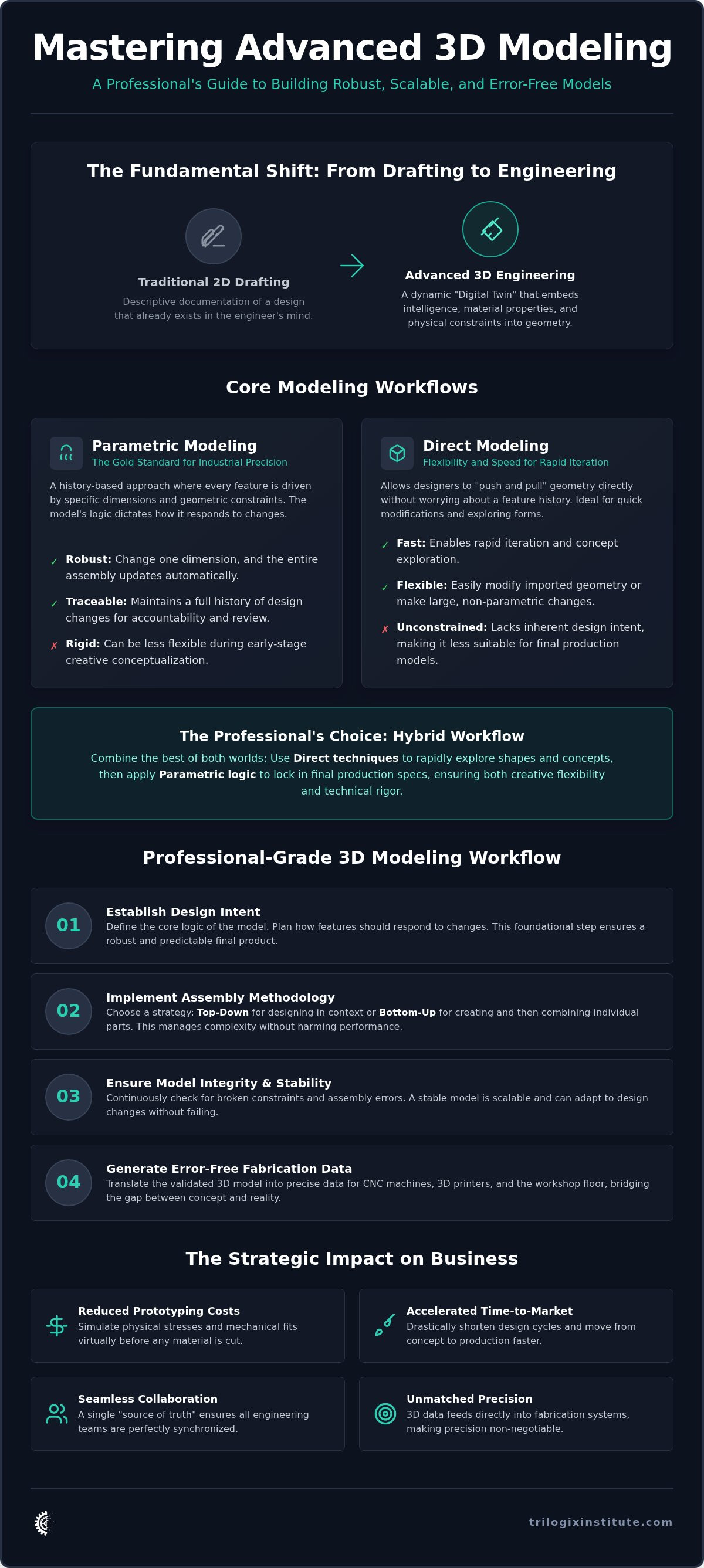
How to Build a Professional-Grade 3D Model: A Step-by-Step Engineering Workflow
Building a model that survives the rigors of industrial production requires a disciplined, methodological approach. Professional advanced 3D modeling for engineers isn't just about using software tools; it's about executing a sequence of operations that ensures accuracy and scalability. Without a structured workflow, models often become "heavy," prone to errors, and difficult for other team members to modify. By following a standardized engineering process, you transform a simple digital shape into a robust piece of technical data ready for the workshop floor.
Step 1-3: From Concept to Core Geometry
Every professional project begins with a deep requirement analysis. Before placing a single point in the workspace, you must identify the primary design constraints, material requirements, and assembly interfaces. Once the scope is clear, the technical work starts by establishing a Global Coordinate System (GCS) and defining datum planes. These act as the anchor for your entire design, ensuring that sub-assemblies align perfectly without manual adjustment.
The next phase involves creating a master sketch. This sketch contains the "skeleton" dimensions that drive the primary features of the part. By using robust parametric techniques, you link these dimensions to the core geometry. This ensures that a change in the master sketch ripples through the model logically, preventing the geometry from collapsing during design updates. This foundational stability is what separates amateur drafting from professional engineering.
Step 4-5: Refinement and Professional Documentation
Once the core geometry is stable, you move into feature refinement. This stage involves adding industrial detailing such as fillets for stress relief, chamfers for assembly ease, and modeled threads where specific clearance checks are required. These details must follow international standards to ensure they are manufacturable. Accuracy at this stage prevents costly mistakes during the fabrication process, as the 3D model serves as the ultimate reference for CNC programming and inspection.
The final step is the integration of Geometric Dimensioning and Tolerancing (GD&T). Professional 3D models include annotations that define the allowable variation for every critical feature. Translating these 3D models into 2D fabrication drawings must happen without data loss, providing the shop floor with a clear, unambiguous roadmap for production. To master these high-level documentation standards, many designers enroll in specialized AutoCAD classes for professionals to refine their technical output. Adopting this workflow ensures your designs meet global industrial standards and perform reliably in real-world applications.
Ready to elevate your design capabilities? Explore our professional engineering courses to master the workflows required for senior design roles.
Advancing Your Career Through Equipment-Based 3D Modeling Mastery
The ultimate goal of mastering advanced 3D modeling for engineers is to bridge the gap between digital concepts and physical results. While software tutorials provide a basic understanding of commands, they often fail to address how a digital model interacts with actual industrial hardware. True proficiency comes from understanding the logic behind the geometry. This is why instructor-led training is vital. It moves beyond the screen to demonstrate how design choices impact assembly, maintenance, and long-term operational reliability on the factory floor.
Trilogix Institute differentiates itself through equipment-based learning. Instead of working in a vacuum, students solve engineering problems that mirror industrial reality. This pragmatic approach ensures that every model you build is not just a visual representation but a functional tool for production. Transitioning from a technician to a design lead requires this level of depth. It requires the ability to lead a design cycle with the confidence that your models won't fail when they reach the fabrication stage.
The Value of Hands-On, Instructor-Led Labs
Hands-on labs provide real-time feedback that you simply can't get from a pre-recorded video. When a constraint breaks or an assembly becomes unstable, an instructor helps you diagnose the underlying logic error immediately. This prevents the development of inefficient modeling habits that can plague your professional reputation. By solving real-world engineering problems using industrial-grade software, you gain the technical readiness demanded by global employers. These sessions bridge the software theory discussed in previous sections with the practical application required for complex, multi-component systems.
Next Steps for Engineering Professionals
Advancing your career requires identifying the specific technical skills that align with your trajectory. If you're aiming for senior design roles, the TTI Dubai Advanced AutoCad 2D & 3D course offers a direct path to mastery. This program focuses on practical skill acquisition, ensuring you're prepared for the immediate demands of the job market. Leveraging industry-specific certifications is a proven strategy for securing senior-level positions and demonstrating your commitment to global standards.
Professional growth is a methodical process. It starts with choosing a partner that views education as a functional tool for advancement. If you're ready to master advanced 3D modeling for engineers and take the next step in your professional journey, you can reach out to Trilogix Institute for specialized training programs. Our instructor-led labs are designed to turn your ambition into workplace readiness.
Elevating Your Professional Design Standards
Mastering advanced 3D modeling for engineers is the definitive step in transitioning from a technical drafter to an authoritative design lead. By prioritizing parametric integrity and adopting a methodological approach to complex assemblies, you ensure your designs remain robust during the most demanding design cycles. This level of expertise doesn't just reduce prototyping costs; it secures your reputation as a reliable professional capable of delivering precise, fabrication-ready data for any industrial project.
Realizing your full potential in this field requires practical, equipment-based experience that goes beyond basic software theory. Trilogix Institute provides instructor-led sessions and hands-on technical labs specifically tailored for engineering professionals. Our industry-aligned curriculum focuses on practical skill acquisition, ensuring you're prepared to meet the rigorous demands of the global job market. Explore Advanced AutoCAD 2D & 3D courses at Trilogix Institute today to elevate your technical capabilities and lead with confidence. Your path to senior design excellence is built on a foundation of professional mastery and practical application.
Frequently Asked Questions
What is the difference between 2D drafting and advanced 3D modeling for engineers?
2D drafting focuses on documenting geometry through flat views and lines. Advanced 3D modeling for engineers involves creating intelligent, parametric objects that contain material properties and functional constraints. While 2D is a representation, 3D is a digital twin that allows for stress analysis, collision detection, and automated Bill of Materials generation. This shift ensures higher precision and reduces the risk of errors during the fabrication process.
Which software is best for advanced 3D modeling in industrial engineering?
Industry leaders typically rely on AutoCAD for versatile 2D and 3D design, along with specialized parametric suites. The best choice depends on your specific sector, but AutoCAD remains a global standard for its cross-disciplinary compatibility. Mastering programs like TTI Dubai Advanced AutoCad 2D & 3D ensures you can manage complex assemblies and generate accurate fabrication data. Focus on software that supports both direct and parametric workflows to maintain maximum design flexibility.
Do I need a university degree to become a professional 3D designer?
No, a university degree is not a mandatory requirement for professional 3D design roles in many technical industries. Employers increasingly prioritize practical skill acquisition and industry-specific certifications over academic credentials. Vocational training that offers hands-on technical labs provides the workplace readiness needed for senior roles. By focusing on equipment-based learning, you can demonstrate the specific competencies required to handle real-world engineering projects and complex industrial assemblies.
How long does it take to master advanced 3D modeling techniques?
Mastery depends on your starting point, but intensive, instructor-led programs can significantly accelerate the process. While basic software navigation might take weeks, mastering advanced 3D modeling for engineers requires a deep understanding of design intent and parametric logic. Typically, professionals achieve proficiency through several months of consistent, hands-on application. Specialized courses focus on condensed, high-impact training to bridge the gap between theoretical knowledge and professional-grade industrial execution efficiently.
What is parametric modeling and why is it important for engineers?
Parametric modeling is a history-based methodology where geometric features are driven by specific dimensions and constraints. It's critical for engineers because it ensures design integrity when modifications occur. If one dimension changes, all related components update automatically to maintain the correct relationships. This robustness prevents broken models and assembly errors, allowing for faster design cycles and more reliable fabrication data. It is the foundational logic for modern industrial design projects.
Can I learn advanced 3D modeling through online self-paced courses?
While self-paced videos offer a basic introduction, they often lack the depth required for professional engineering. Trilogix Institute doesn't offer purely online self-paced modules because complex 3D logic requires real-time feedback. Instructor-led sessions allow for immediate correction of logic errors and deeper exploration of industrial standards. Hands-on, equipment-based training is essential for mastering the nuances of advanced 3D modeling for engineers and ensuring workplace readiness.
How does 3D modeling integrate with industrial automation systems?
3D modeling provides the precise geometric data needed to program and simulate industrial automation systems. Digital twins created in CAD environments allow engineers to verify robot reach, sensor placement, and conveyor alignments before physical installation. This integration reduces commissioning time and prevents costly hardware collisions. By using accurate 3D data, automation specialists can ensure that the physical system behaves exactly as the digital model predicted during the design phase.
What are the career prospects for engineers with advanced AutoCAD 3D skills?
Engineers with advanced AutoCAD 3D skills are highly sought after for senior design lead and project management roles. These competencies allow you to move beyond basic technician tasks into high-level system architecture and assembly management. Industries ranging from manufacturing to construction value professionals who can manage complex data and ensure design integrity. Specialized vocational training, such as the TTI Dubai Advanced AutoCad 2D & 3D program, provides the credentials necessary for career advancement.


