

A culinary certificate is only as valuable as the hours you spend behind a professional stove, not a computer screen. If you're searching for a culinary arts certificate UAE, you already know that reading about a roux is nothing like whisking one over a high-heat commercial burner. It's a common concern to worry about investing your hard-earned AED into a program that prioritizes textbooks over technique. You need a path that respects your time and provides the intensive, equipment-based training required to survive and thrive in a modern commercial kitchen.
This guide identifies how to select a program that masters professional kitchen skills through direct, hands-on experience. We'll examine the importance of vocational recognition and explain how the Trilogix Institute Professional Culinary Arts curriculum aligns with global industrial standards. You'll discover how to evaluate training schedules for flexibility and ensure your chosen course provides mastery of commercial equipment. By the end of this article, you'll have the framework to choose a certificate that bridges the gap between your passion for food and a successful professional career.
Key Takeaways
- Understand why vocational certification is the preferred benchmark for professional growth within the UAE's competitive hospitality sector.
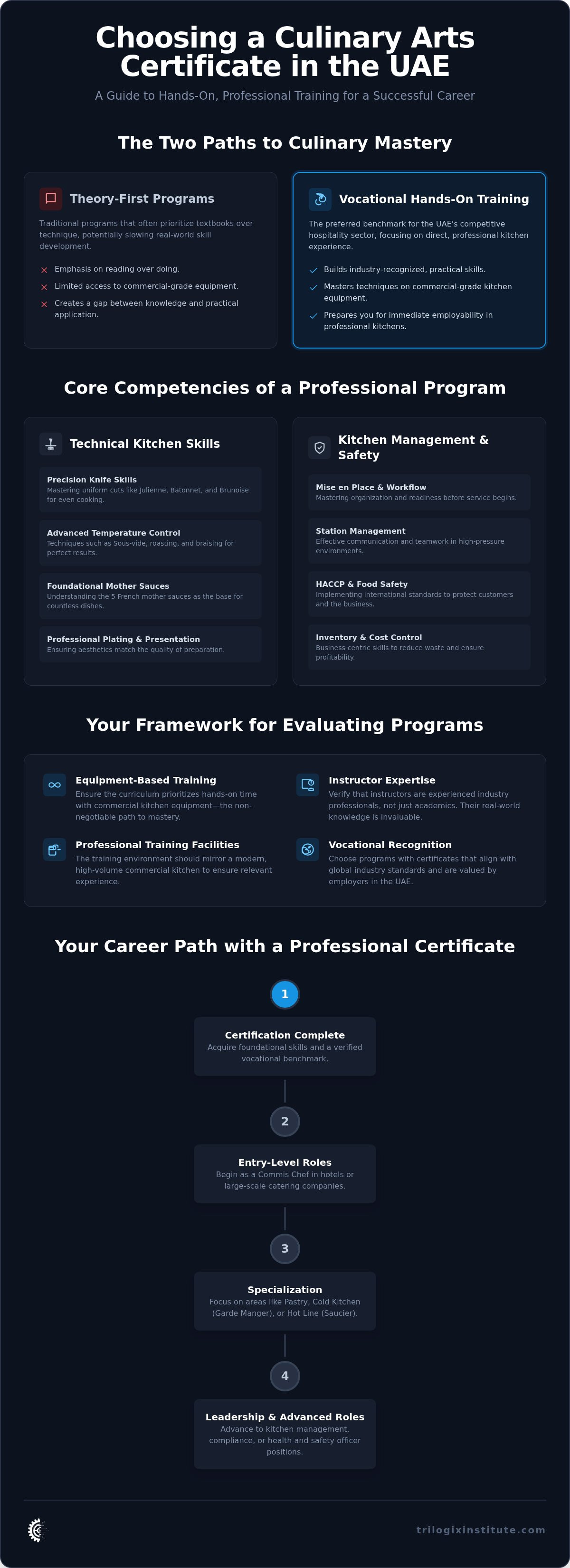
- Identify the essential competencies, such as knife skills and station management, that a high-quality culinary arts certificate UAE must provide.
- Learn why equipment-based training is non-negotiable for mastering the technical demands of a commercial kitchen compared to theory-heavy courses.
- Discover a step-by-step framework for evaluating training facilities and instructor expertise to ensure your investment leads to industry-recognized skills.
- Explore how the TTI Dubai Professional Culinary Arts program provides a pragmatic, instructor-led path to immediate employability in professional kitchens.
The Value of a Culinary Arts Certificate in the UAE
Earning a culinary arts certificate UAE serves as a professional signal to employers. It transforms an interest in cooking into a verified vocational skill set. In the Emirates, where the hospitality sector sets global benchmarks for luxury and efficiency, a certificate is more than a credential. It is a vocational benchmark that proves you can handle the pressure of a high-volume commercial kitchen. National hospitality groups prioritize candidates with structured certifications because they represent a standardized level of competence. These organizations don't have the time to teach basic knife safety or the fundamentals of cross-contamination. They need staff who arrive ready to contribute.
For those transitioning from other industries, a culinary arts certificate UAE provides the accelerated technical foundation required to bridge the skills gap. You don't need a four-year academic degree to become a chef. You need a program that validates your knowledge of food safety, industrial kitchen protocols, and station management. This training ensures that you understand the "why" behind every procedure, from the proper storage temperatures for high-risk ingredients to the maintenance of specialized industrial equipment. It builds steady confidence that translates directly to the workplace.
Career Pathways for Certified Professionals
A professional certificate opens doors across a diverse range of sectors. Many graduates begin their journey in entry-level roles, such as a Commis Chef, within international hotel chains or large-scale commercial catering companies. These roles provide the foundation for future specialization. You might choose to focus on pastry, cold kitchen preparation, or hot line management. Beyond the cooking itself, certification is vital for administrative and health-safety compliance. Most reputable kitchens in the UAE require documented proof of training to meet strict municipal regulations and international HACCP standards. Your certificate is your license to operate in these regulated environments.
National Industry Standards
The UAE is home to some of the world's most prestigious dining destinations. This environment demands culinary excellence and a deep understanding of global standards. Vocational training aligns your skills with the specific requirements of major industry players, ensuring you're prepared for the fast-paced nature of the local market. Employers look for professionals who can maintain consistency under pressure while adhering to rigorous safety guidelines. A culinary certificate serves as a practical validation of industrial readiness.
Core Competencies of a Professional Culinary Program
A comprehensive culinary arts certificate UAE focuses on specific, repeatable outcomes. It's about moving beyond basic recipes to understand the mechanics of flavor, heat, and chemistry. Mastery begins with the five French mother sauces, which form the foundation of countless international dishes. Students must also gain technical knowledge in food science and nutrition to meet the dietary demands of a modern, health-conscious public. A professional culinary arts certificate UAE is designed to turn these fundamental techniques into second nature.
Technical Kitchen Skills
Precision is the hallmark of a professional chef. High-level programs prioritize knife skills, requiring students to execute uniform cuts like julienne, batonnet, and brunoise consistently. This isn't just about appearance; uniform cuts ensure even cooking across all ingredients. You'll also master temperature control through advanced methods. Sous-vide cooking requires exact thermal management, while roasting and braising demand an intuitive understanding of moisture and heat transfer. Finally, professional presentation standards are taught to ensure that plating aesthetics match the quality of the preparation.
Kitchen Management and Safety
Technical skill is useless without organization. Understanding industrial kitchen workflow involves mastering "mise en place," which is the practice of having every ingredient and tool ready before service begins. This organization extends to station management, where effective communication and teamwork are essential in high-pressure environments. Safety is equally critical. Implementing HACCP standards ensures that food safety regulations are met, protecting both the customer and the reputation of the business. These protocols are the backbone of any world-class kitchen operation.
A chef is also a manager of resources. You'll learn inventory management techniques to reduce food waste and maintain strict cost control. These business-centric skills allow a kitchen to remain profitable while delivering high-quality results. If you're ready to start this journey, reviewing the professional culinary training modules can help you identify which skills align with your career goals. This pragmatic approach ensures you're prepared for the technical and administrative demands of the industry.
Equipment-Based Training vs. Theory-Only Learning
Theory provides the foundation, but it cannot replace the physical reality of a professional kitchen. A culinary arts certificate UAE is only effective when it prioritizes the tactile experience of food preparation. Many aspiring chefs fall into the trap of self-paced online modules. While these courses cover the "what," they often fail to explain the "how" in a technical sense. You cannot develop muscle memory by watching a video. Mastering a professional kitchen requires sensory feedback; you must smell the caramelization, feel the resistance of the dough, and hear the sizzle of a perfectly seared protein.
The psychological benefit of training on real-world equipment is significant. Stepping into a commercial kitchen for the first time can be overwhelming. Students who have already spent hundreds of hours operating heavy-duty appliances feel a sense of steady confidence. They aren't intimidated by the heat, the noise, or the speed. This familiarity reduces the learning curve during first-time employment, allowing you to focus on your craft rather than struggling to understand how to operate a specialized range or industrial mixer.
The Advantage of Instructor-Led Instruction
Real-time guidance is the most valuable asset in vocational training. An experienced mentor identifies errors in technique or safety protocols before they become dangerous habits. They provide immediate correction, ensuring that your knife grip is secure and your station is organized. Beyond technical skills, instructors teach the "rhythm" of the industry. This is the unspoken timing and coordination required to keep a kitchen running smoothly during peak hours. For a deeper look at selecting the right program, consult our Professional Culinary Arts Training in Dubai: The 2026 Buying Guide.
Training with Industrial-Grade Equipment
Transitioning from domestic tools to heavy-duty commercial appliances is a critical step in your development. Commercial ovens, high-pressure ranges, and large-scale mixers operate on a different scale than home kitchen gear. Understanding the maintenance and safety of this equipment is mandatory for any professional. Equipment-based training ensures you know how to:
- Calibrate and monitor industrial temperature controls for consistency.
- Maintain and clean complex machinery to meet strict hygiene standards.
- Operate high-capacity equipment safely under high-pressure conditions.
This pragmatic approach ensures that your culinary arts certificate UAE represents true industrial readiness. You won't just know the theory; you'll have the hands-on experience to back it up. This preparation is what distinguishes a professional from an amateur.
How to Evaluate Vocational Training Providers Nationally
Selecting the right provider for a culinary arts certificate UAE is a strategic decision that impacts your immediate employability. You must move beyond marketing brochures to evaluate the actual training environment. Start by inspecting the kitchen facilities. A professional lab should mirror the intensity and layout of a high-volume commercial kitchen. If the equipment looks like domestic appliances found in a home, the training won't prepare you for industrial standards. Equipment-based training is the only way to build the muscle memory required for professional success.
Reviewing the instructor’s background is equally critical. You need a mentor who has navigated the pressures of a professional line, not someone who only understands the theory of cooking. Ask about the practical-to-theory ratio. A pragmatic program should dedicate the majority of its hours to hands-on training. Finally, ensure the curriculum evolves with current trends, incorporating modern techniques like sustainable sourcing and advanced thermal preparation. This alignment ensures your skills are relevant the moment you graduate and enter the workforce.
Questions to Ask Before Enrolling
Before you commit your time and AED, ask direct questions to verify the program's value. Is the training entirely equipment-based, or are there significant online components that could be learned elsewhere? You should also confirm the specific professional certifications awarded upon completion. Ensure the labs are designed to simulate a real-world kitchen environment, including the high-heat zones and rapid-pace workflow you'll encounter on the job. These details distinguish a serious vocational institute from a hobbyist cooking school.
Analyzing Program Duration and Intensity
Your choice often comes down to timing. Short-term intensive courses are designed for those who need to transition into a culinary role quickly. These programs strip away the academic fluff found in three-year degrees, focusing instead on the technical skills that matter to employers. Finding a schedule that balances professional depth with time efficiency is essential for career changers looking for a culinary arts certificate UAE. For a more detailed comparison, read our guide on Vocational Training vs. University Degree: Choosing Your Path in 2026. This understanding helps you select a path that respects your career timeline.
Finding a provider that meets these criteria is the first step toward a professional career. If you want to see how these standards are applied in practice, book a facility tour to experience our professional kitchen labs firsthand.
Advancing Your Career with TTI Dubai Professional Culinary Arts
The TTI Dubai Professional Culinary Arts program is built for those who value practical skill over academic abstraction. At Trilogix Institute, we recognize that the path to a head chef position doesn't require a four-year degree. It requires a mastery of the tools and techniques used in today's most demanding kitchens. By earning your culinary arts certificate UAE through our institute, you're choosing a path that prioritizes vocational excellence and industrial readiness. We act as a bridge between your culinary ambition and the reality of professional employment.
Our curriculum is instructor-led, meaning you're never left to guess the correct technique. You receive immediate, actionable feedback from industry insiders who understand the UAE's high standards. This approach ensures you can apply what you learn the very next day in a commercial setting. We focus on the pragmatic realities of the job, from station management to advanced thermal prep, ensuring you graduate with a portfolio of skills that hospitality groups actually respect.
Pragmatic Education for Future Chefs
We've designed our training environment to be a professional lab, not a classroom. This distinction is vital for career-driven individuals who don't have time for theory-heavy courses. You'll spend your hours operating industrial-grade equipment and refining your precision under the guidance of experts. Our program is tailored for adults who need an intensive, results-oriented schedule that fits their professional goals. You can explore our vocational courses to see how our specific modules prepare you for the technical demands of the industry.
Every session is an opportunity to build muscle memory. Whether you're mastering the mother sauces or implementing HACCP safety standards, the focus remains on hands-on execution. This immersive style of learning is what makes a culinary arts certificate UAE from TTI so valuable. It proves to employers that you don't just know the definitions; you know the craft.
Your Next Steps to Certification
Transitioning into the UAE’s thriving food industry requires a clear plan. The application process for the TTI Dubai Professional Culinary Arts program is straightforward and designed for immediate entry. We help you prepare for a technical career by providing the specific keys to meet global market demands. You'll enter the workforce not as a student, but as a prepared professional ready to contribute to a world-class kitchen team.
Don't let uncertainty delay your career progression. The hospitality sector in the Emirates is moving quickly, and the demand for certified, equipment-trained professionals is higher than ever. To secure your place and begin your transformation, contact Trilogix Institute to begin your culinary journey. Our team is ready to guide you through the enrollment process and help you take the first step toward professional mastery.
Take the First Step Toward Professional Mastery
Choosing a career in the kitchen requires more than just passion; it demands technical precision and industrial readiness. You've learned that a high-quality culinary arts certificate UAE is defined by the hours spent in instructor-led practical labs rather than behind a screen. Mastering industrial-grade equipment and understanding the rhythm of a commercial kitchen are the non-negotiable foundations for success in the Emirates' world-class hospitality sector. Relying on theory alone won't prepare you for the heat and speed of a professional line.
Trilogix Institute provides an industry-aligned curriculum designed to bridge the gap between your ambition and a professional role. Our equipment-based vocational training ensures you graduate with the steady confidence to lead and the technical skills to execute under pressure. By focusing on pragmatic, results-oriented education, you position yourself for immediate employability in a thriving market. It's time to transition from home cooking to professional mastery and secure your future in the culinary world.
Master the Kitchen with TTI Dubai Professional Culinary Arts
Frequently Asked Questions
How long does it take to get a culinary arts certificate in the UAE?
The duration varies depending on the intensity of the program, but most vocational certificates take between three to six months to complete. These programs prioritize technical mastery over academic filler, allowing you to enter the workforce faster than a traditional degree. Intensive tracks might condense the curriculum into a shorter window for career changers who need immediate results. You'll focus on repeatable skills that hospitality groups value.
Is a culinary arts certificate better than a university degree for finding a job?
A culinary arts certificate UAE is often preferred for technical kitchen roles because it demonstrates practical readiness. While a university degree covers broad management theory, a professional certificate proves you have mastered knife skills and industrial equipment. Employers in the UAE's fast-paced hospitality sector prioritize candidates who can contribute immediately. This pragmatic approach bridges the gap between academic ambition and the realities of a commercial kitchen.
What are the entry requirements for a professional culinary program?
Most professional culinary programs require basic English literacy and a commitment to vocational excellence. You don't need a specific academic background or a university degree to enroll. Institutes like Trilogix focus on career-driven individuals who are ready to engage in instructor-led, equipment-based training. Some programs might require a basic health certificate to ensure you can safely operate within a regulated food preparation environment.
Are culinary certificates in the UAE recognized internationally?
Certificates that align with global industrial standards and HACCP regulations are widely recognized by international hotel chains and catering groups. A culinary arts certificate UAE from a reputable vocational institute validates your understanding of professional kitchen protocols. This recognition is based on your ability to operate commercial equipment and maintain safety standards that are universal across the global food and beverage industry.
Can I take a culinary arts certificate course while working full-time?
Many vocational institutes design their schedules to accommodate working professionals and career changers. You'll often find evening or weekend batches that allow you to balance your current employment with intensive practical labs. This flexibility is essential for those transitioning into the industry. The focus remains on instructor-led training, ensuring you don't lose the benefit of hands-on experience while managing a busy full-time schedule.
What is the difference between a diploma and a culinary arts certificate?
A certificate is a specialized credential that focuses on specific vocational competencies and technical skills. Diplomas often involve a broader scope of study and longer durations. For individuals seeking immediate employability, a professional certificate is more efficient because it targets the exact skills needed for kitchen roles. It strips away general academic requirements to focus entirely on mastery of commercial equipment and professional food preparation techniques.
Do I need prior kitchen experience to enroll in a professional culinary course?
You don't need prior professional experience to enroll in an entry-level professional culinary course. These programs are designed to take you from a beginner level to industrial readiness through structured, equipment-based training. Instructors guide you through every stage, from basic knife safety to advanced station management. This makes vocational training an ideal path for career changers who have a passion for food but lack formal commercial experience.
How much of the culinary training is practical versus theoretical?
High-quality vocational programs dedicate the majority of their curriculum to hands-on practical labs. At Trilogix Institute, the TTI Dubai Professional Culinary Arts program focuses on instructor-led, equipment-based training. While essential theory regarding food safety and nutrition is covered, the emphasis is always on direct application. You'll spend most of your time operating industrial ranges, mixers, and ovens to ensure you develop the muscle memory required for the job.


