

What if you could build practical engineering skills without first earning a university degree? There’s an important distinction: training for non-degreed engineers can help you develop and demonstrate specific technical abilities, but it doesn’t remove degree requirements for roles that require one. It may, however, help you explore hands-on technical work that matches your experience and goals.
If you’re unsure whether employers will value practical training or how to distinguish an applied course from a theory-heavy program, start by identifying the tasks you want to pursue. This article explains how to assess realistic technical pathways, check prerequisites, and compare programs by their instruction, equipment, and assessment. You’ll also learn how to describe your training and experience clearly and accurately to employers.
For example, instructor-led, equipment-based electrical engineering training may help you build a technical foundation. Trilogix Institute’s Foundation Electrical Engineering program is one option to consider, but it isn’t a university degree or a substitute for degree requirements. Before enrolling in any course, confirm its entry requirements, learning outcomes, practical activities, assessment method, and credential details. Then choose a next step that fits your current skills.
Key Takeaways
- Use training for non-degreed engineers to build targeted technical skills, while checking whether your chosen roles require a university degree or other credentials.
- Look for learning that goes beyond explanation to include guided equipment practice, troubleshooting, feedback, and assessment.
- Compare vocational courses, self-study, and degree programs by the skills and formal requirements each is designed to address.
- Before enrolling, clarify prerequisites, curriculum, instructor access, practical activities, assessment, and the credential awarded.
- Record what you practise and how it is assessed, then describe your training and prior experience accurately when discussing opportunities with employers.
Training for Non-Degreed Engineers: What It Can and Cannot Do
Practical training can help you build technical capability without awarding a university qualification. Focused learning may strengthen your knowledge and ability to perform defined tasks, but it doesn’t automatically meet an employer’s degree requirement or qualify you for every engineering responsibility.
Definition: Training for non-degreed engineers is structured instruction that develops specific technical knowledge and practical skills. It is not a university degree or a guarantee of professional status or employment.
Engineering knowledge can include principles for understanding systems and solving technical problems. Technician-level competencies may focus on applying procedures, operating equipment, identifying faults, or supporting a project. Regulated responsibilities and employer criteria are separate considerations. What a person may do in a role depends on the work, applicable requirements, and the employer’s qualifications for that position. Before choosing a course, check the requirements for the work you hope to pursue.
What does training for non-degreed engineers mean?
Targeted instruction focuses on defined outcomes, such as understanding electrical fundamentals or practising with equipment under guidance. For context, an overview of traditional engineering education can help explain how degree-based study differs from vocational training in scope and structure.
Electrical training, for example, can introduce system concepts and practical skills. Trilogix Institute offers instructor-led vocational learning with equipment, including its Foundation Electrical Engineering program. Treat this as one possible route for building a foundation, not as a degree or permission to carry out unrestricted electrical work. Check a course’s prerequisites, learning outcomes, assessment, and credential details before enrolling.
Which roles may value practical technical skills?
Practical capability may be relevant to technician, maintenance, drafting, or technical-support pathways, depending on the role and the candidate’s background. These are possibilities, not promised outcomes. Job titles don’t have consistent requirements across employers: one position may prioritize equipment familiarity, while another may require a relevant degree, specific experience, or other qualifications.
Read job descriptions before selecting training. Look for the tasks employers list, such as interpreting technical drawings, assisting with inspections, or supporting troubleshooting. Note recurring skills and required credentials, then compare them with the course curriculum. This helps you identify a specific learning gap rather than relying on a broad course title or assuming that course completion will qualify you for a particular position.
How Practical Engineering Training Builds Job-Relevant Capability
A course title can sound relevant without showing what you’ll actually learn to do. To assess practical engineering training, look at the learning sequence: an instructor explains a concept, demonstrates a procedure, and guides learners as they practise. Learners can then troubleshoot, receive feedback, and repeat tasks until they can demonstrate the skill against stated outcomes.
Supervised practice turns engineering concepts into observable technical skills by asking learners to apply a method, check the result, correct errors, and explain what happened. Repetition matters because one successful attempt may not show that someone can perform a task consistently. A course should make clear which skills learners practise and how progress is assessed, rather than relying on broad claims about workplace readiness.
Why equipment-based instruction matters
Equipment gives abstract ideas a physical context. A learner studying electrical fundamentals, for example, can connect a diagram to components, take measurements, and observe how a system responds. Industrial control is another area to explore, although the specific topics and activities vary by course. Ask providers to confirm what equipment and curriculum are included instead of assuming the course title tells the whole story.
Trilogix Institute describes its vocational training as instructor-led and equipment-based. Its offerings include Foundation Electrical Engineering and industrial motor control training. These are examples of practical learning areas, not a claim that every listed topic or task is covered in a particular way. Confirm the curriculum, practice activities, and assessment details directly with the provider. Training equipment also has limits: it can support structured learning, but may not reproduce every workplace condition, system, or safety procedure.
How to recognize meaningful skill development
Look for a clear learning process, not just phrases such as “hands-on” or “industry-focused.” Ask whether the course specifies:
- Learning outcomes and the tasks learners will practise.
- Access to relevant equipment and instructor guidance during practice.
- Feedback on technique, results, and troubleshooting decisions.
- An assessment that shows how learners demonstrate the stated outcomes.
For example, ask how learners practise safe procedures and approach common faults, and what evidence shows they can carry out the assessed tasks. An assessment result can document performance in the course; it doesn’t, by itself, prove readiness for every workplace or role. Institutions also use “non-degree” to describe different formats. Columbia University’s Non-Degree Engineering Programs page is a useful reminder to examine a program’s structure and outcomes, not just its label.
If you’re comparing equipment-based options, review Trilogix Institute’s technical course offerings and verify the practical components, prerequisites, and assessment method for the course you’re considering.
Practical Courses, Self-Study, or a Degree: How to Compare Your Options
The right learning route depends on the work you want to pursue and the gap you need to close. Training for non-degreed engineers can help build targeted technical skills. Independent study offers flexibility, while a university degree provides broader academic education that may meet formal requirements for particular roles. These routes serve different purposes, and one isn’t automatically a substitute for another.
Instructor-led vocational training combines structured teaching with practical activities and opportunities to ask questions. It can suit learners seeking guided development in a defined area, such as foundational electrical engineering. Self-study lets you set your pace and focus on selected topics, but you may need to find your own equipment, feedback, and ways to assess whether you can apply what you’ve learned. University education typically follows a broader, more sustained academic program. Depending on a role’s criteria, that qualification may be essential.
For a wider discussion of how to weigh these routes, see vocational training and university degree options.
When can focused vocational training be a sensible choice?
A course makes sense when it aligns with a specific learning objective. If you have experience in a related field but need a stronger grounding in electrical concepts, for example, a relevant instructor-led course may provide a structured way to develop that foundation. Let your existing knowledge shape the next step: a beginner may need core concepts, while someone with related experience may be ready to deepen a particular skill.
Before enrolling, review the prerequisites and intended outcomes. Ask what you’ll learn, what practical activities are included, how progress is assessed, and what credential the course awards. A program’s title alone won’t tell you whether its content fits your goal.
When might a degree or another route be necessary?
Start with the work itself. Check job descriptions for required qualifications, experience, and responsibilities, then verify any applicable professional requirements with the relevant source. Employers can set different criteria, and certain positions may require an academic qualification or authorization beyond what a practical course provides.
Focused training can build a foundation or complement existing education and experience. It doesn’t replace academic depth, grant a degree, or automatically authorize someone to perform regulated work. If your target role calls for both formal education and practical proficiency, treat them as complementary parts of a learning plan rather than assuming you must choose one or the other.
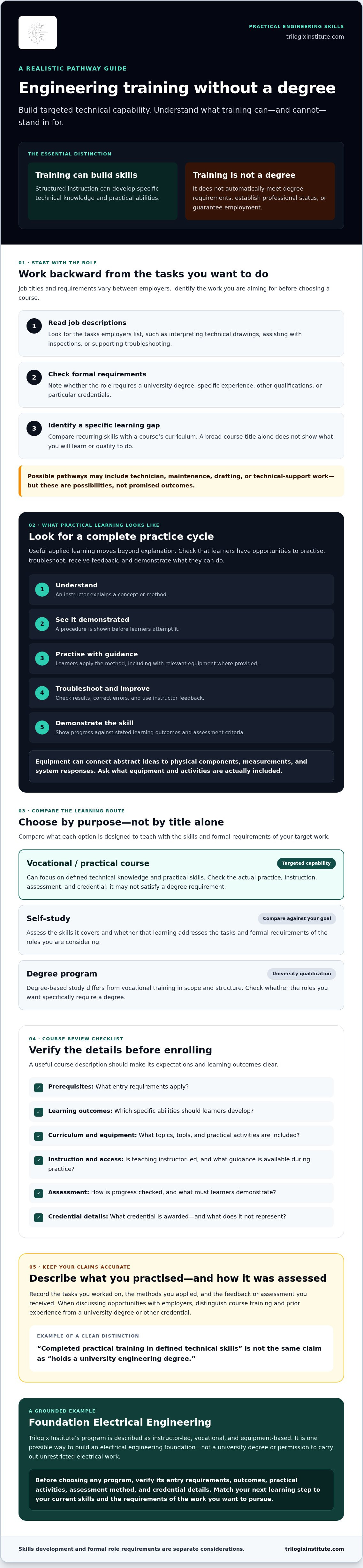
How to Choose Engineering Training Without a Degree
Choose a course by starting with a task or skill you want to develop, then check whether the training teaches and assesses it. A careful comparison helps you avoid relying on impressive-sounding labels or assuming that course completion meets an employer’s requirements. Use this checklist to assess your options:
- Define a target task. Identify a practical area you want to understand or practise, such as electrical fundamentals, automation, or motor control.
- Check prerequisites. Confirm the knowledge or experience expected before enrolling, and compare it with your current background.
- Inspect the curriculum. Look for specific learning outcomes and topics, then compare them with skills requested in relevant job listings.
- Assess the practice and proof. Ask what equipment learners use, how much instructor guidance is available, how progress is assessed, and what credential is awarded.
Job advertisements can help define a realistic learning goal. If a role repeatedly asks for a skill you don’t yet have, check whether a course teaches it directly. If the listing requires a degree or another qualification, don’t assume vocational training will replace it.
Questions to ask before enrolling
Ask providers what learners practise, how instructors give feedback, and how assessment shows whether a learning outcome has been met. Confirm entry requirements, schedule, delivery format, and credential details. If promotional language promises “practical experience” or “career readiness” without explaining the activities or evidence involved, request specific examples. Clear answers help you judge what the course covers and what it doesn’t claim to provide.
Match a course to your next technical step
Compare the course content with what you already know and the gap you want to address. A learner exploring electrical fundamentals, for instance, may need a different foundation from someone seeking instruction in automation or motor control. Trilogix Institute offers instructor-led vocational courses in these areas. Verify the specific curriculum, prerequisites, and assessment details with the provider before deciding. For related context, review this guide to electrical engineering course information. Course participation builds learning, not guaranteed eligibility for a job or authorization to perform particular duties.
Use this checklist to compare technical training courses and identify which option best fits your next learning goal.
A Realistic Next Step: Build Skills and Verify Your Career Requirements
Technical capability can grow through focused learning and practice, but a course can’t guarantee a job or replace qualifications a role requires. Treat training for non-degreed engineers as one part of a career plan: identify the skills you want to build, confirm what employers expect, and keep clear evidence of what you’ve learned.
How to turn training into evidence of capability
Keep a record of the tasks you complete, the equipment you practise on, the feedback you receive, and any assessment results. This gives you concrete details to discuss on a CV or in an interview. Describe your experience precisely, such as “completed supervised practice with electrical training equipment,” rather than implying you have independently performed workplace duties you haven’t done.
Be equally clear about credentials. Course completion is not a university degree, professional license, or employment guarantee. State the course name and the skills or tasks assessed, then let employers evaluate that evidence against the position’s requirements.
What to confirm before making a decision
Before enrolling, verify the provider’s current entry requirements, curriculum, schedule and duration, delivery format, assessment method, and credential awarded. Ask for clarification if an important detail isn’t clear. Then check relevant job descriptions and employer criteria independently; course information alone can’t confirm your eligibility for a specific role.
For a possible foundation-building route, Trilogix Institute offers instructor-led vocational training, including Foundation Electrical Engineering. Review the course overview, then confirm the program’s current learning outcomes and practical components directly with the provider. Consider whether they align with your background and intended next step, without assuming that training substitutes for a degree or other role-specific requirement.
A measured plan is still progress: choose a defined skill goal, complete relevant practice, document what you can demonstrate, and verify the qualifications your target roles request. If you’re considering the Foundation Electrical Engineering program or another listed course, contact the training team with specific questions about course fit and current details. Understand what the training covers before deciding whether to enroll.
Build Your Next Step on Clear Evidence
Practical learning can help you strengthen defined technical skills, but a course doesn’t replace a degree or other qualification required for a particular role. Start with a clear goal: identify the skills relevant employers request, choose training that teaches and assesses them, and confirm the course’s prerequisites and credential details before enrolling.
Training for non-degreed engineers is most useful when it supports a realistic next step and gives you specific learning to describe honestly. Trilogix Institute offers instructor-led technical courses with equipment-based learning, including Foundation Electrical Engineering and Industrial Automation Specialization. These are possible routes for building technical foundations, not guarantees of employment or role eligibility.
Review the practical technical training options and compare the course details with your goals. Ask about learning outcomes, practical activities, assessment, and credentials before deciding. If you’re considering a course, contact Trilogix Institute to ask about its fit with your learning goals and confirm current program details.
Frequently Asked Questions
Can you work as an engineer without a degree?
It depends on the role, employer, and any applicable professional requirements. Some technical positions may prioritize practical skills or relevant experience, while others require a university qualification. Job titles alone don’t establish eligibility or define the work involved. Review the specific job description and confirm relevant requirements with the employer or appropriate authority before presenting yourself as qualified for a particular engineering responsibility.
What training can non-degreed engineers take?
Training for non-degreed engineers can focus on defined technical areas, such as electrical engineering fundamentals, industrial automation, AutoCAD, or industrial motor control. Trilogix Institute offers instructor-led vocational courses in these fields, with equipment-based learning. Course content and credentials vary, so check prerequisites, learning outcomes, practical activities, assessment, and the credential awarded before choosing a program.
Is hands-on engineering training worth it without a degree?
It can be worthwhile if the course develops skills relevant to your goal and gives you a way to practise and demonstrate them. Equipment-based instruction may help connect technical concepts with components, measurements, or system behaviour. Its value depends on the actual curriculum, instructor guidance, and assessment, not just the course title. Practical training can strengthen your capabilities, but it doesn’t guarantee employment or satisfy every role’s qualification requirements.
Can vocational training replace an engineering degree?
No. Vocational training can build focused technical knowledge and practical skills, but it doesn’t award a university degree or automatically meet formal requirements for a role. A degree may be necessary where an employer or applicable professional requirement specifies one. Treat vocational learning as a targeted skills pathway or as a complement to other education and experience. Check the qualifications for your intended work before deciding which route fits.
How do I choose an engineering course if I have no degree?
Start with a specific skill or task you want to learn, then compare course outcomes with the requirements in relevant job listings. Check entry prerequisites, curriculum, instructor access, equipment practice, assessment, schedule, and credential details. Consider whether the course suits your existing knowledge. If a target position requires a degree or another qualification, confirm that independently; don’t assume course completion is an equivalent substitute.
Will technical training guarantee me an engineering job?
No course can guarantee that you’ll get an engineering job. Training may help you develop and document specific skills, but employers also consider role requirements, your experience, qualifications, and other criteria. Before enrolling, compare course outcomes with the work you’re pursuing. Keep a clear record of assessed tasks and describe your training accurately on your CV. Don’t present course completion as a degree, license, or proof of eligibility for every role.
What should I ask a training provider before enrolling?
Ask what skills and tasks the course covers, what learners practise, which equipment they use, and how instructors provide feedback. Confirm prerequisites, schedule, delivery format, assessment method, and the exact credential awarded. Request measurable learning outcomes if course descriptions use broad claims such as “industry-ready.” Also ask how assessment results are documented. Then compare the course details with employer requirements to make an informed decision about fit.


