

An internship isn't the only way to build engineering experience. If job listings seem to demand a track record you haven't had a chance to develop, learning how to get practical experience in engineering starts with a more achievable goal: practise relevant skills, then show what you can do.
For beginners, it can be hard to know whether coursework, lab work, personal projects, or vocational training will count, especially without workplace references. Supervised practice and clear evidence can make your capabilities easier for employers to assess.
This guide explains how to choose opportunities that fit your technical direction, practise through projects or structured training, and document your work in a portfolio. You'll learn how to describe what you did, the tools and methods you used, and what you learned from the result. For electrical engineering learners, instructor-led, equipment-based vocational training is one route to applied practice. The right option depends on your goals, and a focused plan can help you build credible evidence before your first engineering role.
Key Takeaways
- Practical experience can come from more than paid work. Apply engineering concepts to a task, then document your process and results.
- Learn how to get practical experience in engineering with a repeatable approach: choose a discipline, practise a manageable task, test your work, and record what you learn.
- Compare projects, supervised labs, vocational courses, internships, and entry-level roles by their equipment, feedback, safety oversight, collaboration, and evidence.
- Build skills safely through suitable supervision, guided projects, simulations, team activities, or permitted volunteering.
- Turn practice records into clear CV and interview examples, distinguishing personal projects and supervised coursework from paid employment.
What Counts as Practical Experience in Engineering?
Entry-level engineering roles may ask for evidence of applied skills before beginners have had the chance to build a work history. That can make the first step feel like a catch-22. Employers can assess more than where you gained experience: they can also look at what you did, how you approached it, and what you learned.
Practical engineering experience means applying technical concepts to a task, working within its constraints, testing the result, and evaluating the outcome. The activity might take place in a lab, supervised training environment, personal project, volunteer setting, or workplace. Each setting demonstrates different things, so describe the experience accurately.
Supervised practice provides guidance and oversight as you use tools or equipment. Personal and team projects can show how you plan and make design choices. Volunteering may offer useful experience when the work is permitted and appropriately supervised. Internships and paid engineering roles add exposure to team coordination, deadlines, and delivery requirements. Structured cooperative education programs combine classroom learning with practical work experience. Coursework can demonstrate technical learning, but it isn't the same as employment.
Which activities count as engineering experience?
Lab exercises can show that you follow procedures, use tools safely under required supervision, take measurements, and troubleshoot methodically. A project can demonstrate other skills, such as defining a task, comparing design options, testing a model or system, and refining it when results reveal a problem. Workplace experience adds the realities of contributing to a team and meeting delivery constraints. Each route provides evidence of particular skills, not a substitute for every other route.
What evidence makes experience credible?
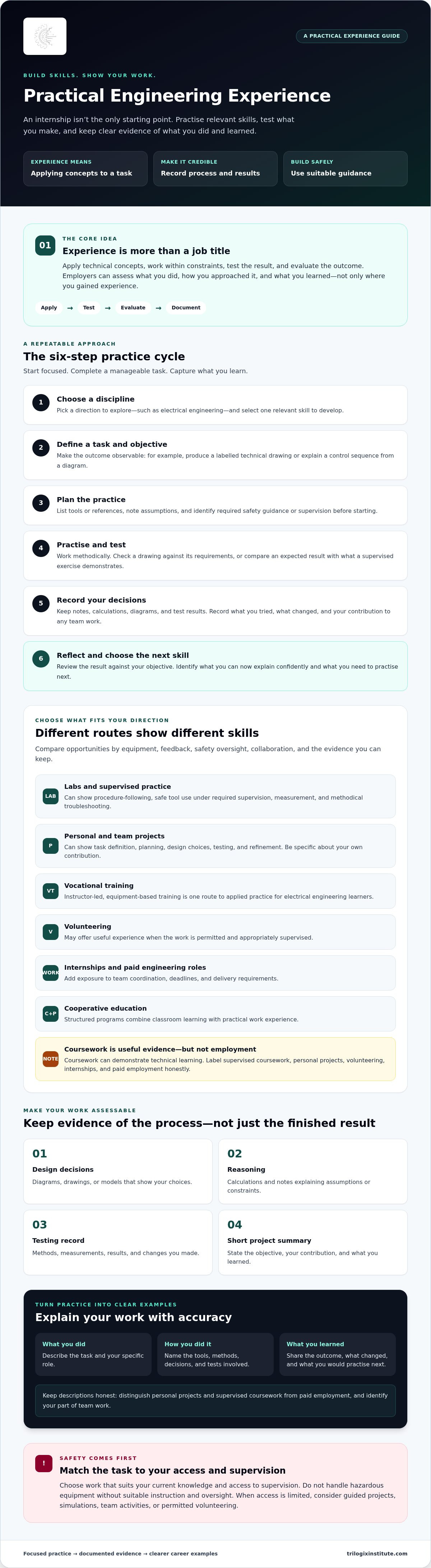
Keep records that show your process, not just a photo of the finished result. Depending on the task, useful evidence may include:
- Diagrams, drawings, or models that show your design decisions.
- Calculations and notes that explain assumptions or constraints.
- Test logs recording methods, measurements, results, and changes.
- A short project summary stating the objective, your contribution, and what you learned.
Be precise about your role, especially in team work. Identify the parts you completed, the decisions you influenced, and the work done by others. Label supervised coursework, personal projects, volunteering, internships, and paid employment honestly. That distinction strengthens your credibility and helps you explain how to get practical experience in engineering that fits your career direction.
How to Get Practical Experience in Engineering: A Step-by-Step Plan
If you're figuring out how to get practical experience in engineering, make the process repeatable: choose a direction, complete a manageable task, and capture what you learn. A small, well-documented exercise can be more useful than a broad project without a clear objective.
Choose a focused skill and practice task
Start with a target discipline or role, such as electrical engineering, rather than trying to practise every engineering area at once. Choose a task that matches your current knowledge and access to supervision. For example, you might read a basic circuit diagram and explain how its control sequence should work. Don't handle hazardous equipment without suitable instruction and oversight.
Follow a six-step practice cycle
- Choose a discipline. Identify the kind of engineering work you want to explore, then select one relevant skill to develop.
- Define a task and objective. Make the outcome observable, such as producing a labelled technical drawing or explaining a control sequence from a diagram.
- Plan the practice. List the tools or references you need, note your assumptions, and identify the safety guidance or supervision required before starting.
- Practise and test. Complete the task methodically. Check your drawing against the requirements, or compare an expected result with what a supervised exercise demonstrates.
- Record your decisions. Keep notes, calculations, diagrams, and test results. Include what you tried, what changed, and your own contribution if you worked with others.
- Reflect and choose the next skill. Review the result against your original objective. Identify what you can now explain confidently and what you need to practise next.
Don't hide a mismatch between expected and observed results. Describe it, consider possible causes, and explain what you would check or change in a further test. That reflection shows a methodical approach, even when your first attempt doesn't go as planned.
For electrical practice involving equipment, structured instruction can be more appropriate than attempting unfamiliar tasks alone. Trilogix Institute describes its technical training as instructor-led and equipment-based. Learners considering this route can review the available engineering and technical courses and confirm current course details directly.
Compare your practice task with the skills and experience requested in relevant role descriptions. Requirements vary by discipline and position, so check details with prospective employers or the appropriate professional organization. Use those expectations to identify a realistic next skill to practise, rather than assuming one exercise will meet every role's needs.
How to Compare Engineering Experience Routes and Prove Your Skills
The best route depends on your target discipline, equipment access, available time, and current knowledge. Compare options by what they let you practise and what evidence you can produce, not by their title alone. A personal project can show initiative, while supervised training may offer equipment access and guided feedback. Neither automatically provides workplace experience.
| Route | Equipment access | Feedback and safety oversight | Collaboration | Evidence you could produce |
|---|---|---|---|---|
| Personal project | Depends on tools and materials you can safely access | Self-directed; arrange qualified guidance where needed | Optional, often individual | Design notes, models, test records, and revisions |
| Supervised lab | Access to the equipment provided for the exercise | Structured instruction and oversight | May include paired or group tasks | Lab notes, measurements, calculations, and results |
| Vocational course | Depends on the course and its equipment access | Can provide instructor guidance; check the specific format | May include shared learning activities | Practice records, drawings, and completed exercises |
| Internship | Depends on the role and employer | Workplace guidance and safety procedures vary | Exposure to team workflows | Permitted work samples and a record of your contribution |
| Entry-level role | Determined by the job responsibilities | Follows workplace processes and supervision arrangements | Ongoing team collaboration | Documented responsibilities and approved examples of work |
Exposure means encountering a task; demonstrated competence means showing how you approached it, checked the result, and explained your decisions. This distinction can help you choose a route that builds the evidence you need. For instance, an electrical engineering learner seeking structured equipment practice might compare supervised training with a home project limited to diagrams or simulations. Trilogix Institute describes its technical training as instructor-led and equipment-based. Review its engineering and technical courses to see whether structured learning aligns with your goals, and confirm current course details directly.
Build a concise project record
For each activity, create a short portfolio entry covering the objective, your role, tools, process, tests, result, and lessons. Add a clear diagram, annotated drawing, calculation, or photograph when sharing is permitted. Protect confidential or sensitive information, and get permission before including workplace material. In team projects, state which decisions or tasks were yours. Don't present the group's result as solely your work.
How to Build Experience Safely When You Have Limited Access
You don't need to wait for an internship or paid engineering role to start developing useful skills. A carefully scoped personal project, simulation, team activity, supervised lab, or permitted volunteering task can help you practise and document your approach. Choose an activity that matches your current knowledge and provides appropriate guidance when tools, equipment, or site conditions introduce risk.
Practise without an engineering job
Start with low-risk tasks: interpret a circuit diagram, create a technical drawing, work through a simulation, or build a simple model using safe, accessible materials. Guided team projects can add collaboration and review. If you need to work with real equipment, instructor-led training can provide demonstrations, equipment-based practice, and direct feedback. Compare learning routes before deciding. This comparison of vocational training and degree study can help you consider which format aligns with your goals.
For electrical work, keep the boundary clear: reading diagrams or discussing a control sequence is different from handling live systems. Don't attempt work on live electrical equipment or other hazardous systems without qualified supervision. A project beyond your capability isn't a suitable way to prove initiative.
Check that the learning is structured and supervised
A responsible practical learning opportunity has a defined task, suitable instruction, clear safety guidance, appropriate oversight, and a way to review what you learned. Before committing, check that:
- The activity and expected outcomes are explained clearly.
- Equipment is appropriate to the task, with instructions available.
- A qualified instructor or supervisor is accessible for work that needs oversight.
- Safety procedures and site rules are explained before practice begins.
- Feedback is provided, and learners can ask questions or repeat tasks.
Follow equipment instructions, site rules, and instructor guidance at every stage. If directions are unclear or conditions change, pause and ask instead of guessing. Keep notes on questions, feedback, errors, and corrections. Repeating a task after guidance can help you improve consistency and show how your method changed.
To explore structured, instructor-led technical practice, review Trilogix Institute's engineering and technical courses. Check current course details, equipment access, and supervision arrangements to see whether an option suits your experience level and learning goals.
How to Turn Engineering Practice into a Career-Ready Next Step
Practice becomes useful in an application when you can explain what you did and connect it to the role. Choose a work sample that relates to a job requirement, such as interpreting drawings, documenting tests, or using a technical tool. A focused example is easier to discuss than a portfolio containing every exercise you've completed.
Present your experience clearly and honestly
Shape a CV bullet around action, task, method, and result. For example: “Created an annotated technical drawing from a project brief, checked it against the stated requirements, and revised the layout after review.” Include numbers only when you can verify them. Label each example accurately as a personal project, supervised coursework, internship, volunteering, or paid employment. Don't imply that a practice exercise was a workplace assignment.
Prepare to discuss one example in an interview. What decision did you make? What obstacle came up? How did you test your work, and what changed after you reviewed the result? Ask an instructor or mentor to check that your explanation is clear, technically accurate, and appropriate to share. Remove confidential details and get permission before using restricted material.
Consider structured electrical engineering practice
Independent projects can build initiative, but they may not provide equipment access or timely feedback. Guided, equipment-based training may suit learners who want practical demonstrations and instructor input. Trilogix Institute offers foundation electrical engineering training for learners focused on the discipline. It complements other learning routes; it isn't a university degree or a promise of employment. Review Trilogix Institute course information and verify current modules, equipment access, assessment methods, and enrolment details before deciding.
Set a focused plan for the next 30 days
- Days 1-7: Select one target role and skill. Define a safe, manageable task with a clear output, such as a drawing or a written explanation of a technical process.
- Days 8-21: Complete the exercise and record your method, decisions, checks, and result. Request feedback from a qualified instructor or mentor.
- Days 22-30: Revise your work where appropriate, write a concise CV bullet, and identify the next skill gap by comparing your evidence with target role requirements.
This cycle turns how to get practical experience in engineering into a practical next step: build evidence, explain it accurately, and use feedback to guide what you learn next.
Build Your Next Engineering Step with Purpose
Practical experience doesn't have to begin with a job offer. Choose a task that fits your target discipline, practise it safely, and keep clear evidence of your decisions, tests, and results. Match that evidence to role requirements and state honestly whether it came from a personal project, supervised training, or employment.
That's a practical way to approach how to get practical experience in engineering: build skills through focused practice, document what you can demonstrate, and use feedback to identify your next learning goal. For learners who want structured guidance, Trilogix Institute describes its technical training as instructor-led and equipment-based. Relevant options include foundation electrical engineering, AutoCAD, and industrial motor control. Check current course details to see whether the training aligns with your goals.
Explore Trilogix Institute's practical engineering training options and choose one manageable next step. Review the course details, then plan a task you can practise safely and document clearly.
Frequently Asked Questions
How can I get engineering experience with no experience?
Start with a beginner-level task related to the engineering discipline you want to pursue. Set a clear objective, such as producing a technical drawing or explaining a process from a diagram, then complete the task safely and record your method and result. Supervised practice, guided projects, simulations, and vocational training can help you build evidence before applying for roles. Describe each activity honestly as practice or coursework, not employment.
Do personal projects count as practical engineering experience?
Yes, personal projects can demonstrate practical skills if you explain the work behind the finished result. Describe the objective, your design choices, tools or methods, tests, changes, and lessons learned. Keep the scope safe and appropriate to your knowledge. A project can show initiative and problem-solving, but it isn't the same as supervised workplace experience. If you worked with a team, clearly identify your own contribution.
Is an internship the only way to gain practical experience in engineering?
No. Internships are one route, but supervised labs, vocational courses, guided projects, simulations, team activities, and permitted volunteering can also help develop and demonstrate applied skills. Each option offers different levels of equipment access, feedback, collaboration, and workplace exposure. Choose based on your target discipline and learning needs. Be clear on your CV about whether an example came from a project, coursework, volunteering, or paid work.
How do I get hands-on engineering experience without a job?
Look for safe practice opportunities that match your current ability, such as supervised training, structured lab exercises, guided projects, or simulations. For electrical engineering, diagram-reading and control-sequence exercises can build understanding, while work involving live systems or hazardous equipment requires qualified supervision. Follow instructions and safety guidance, and keep records of your decisions, tests, and feedback. These activities can show applied learning without being represented as employment.
What should I include in an engineering project portfolio?
Include a concise record of each relevant project: its objective, your role, tools or methods, process, tests, result, and lessons learned. Add supporting material such as diagrams, annotated drawings, calculations, models, or photographs when sharing is permitted. Explain what you contributed, especially in team projects, and protect confidential information. Select work samples that relate to the role rather than sending every exercise you've completed.
Can vocational training provide practical engineering experience?
Vocational training can provide structured practice in applying technical concepts, particularly when it is instructor-led and equipment-based. Trilogix Institute describes its technical training this way, with offerings including foundation electrical engineering, AutoCAD, and industrial motor control. Check the course's current modules, equipment access, assessment methods, and enrolment details to see whether it fits your goals. Training can complement other learning, but it doesn't by itself equal paid workplace experience.
How do I describe engineering experience on a CV if it is coursework?
List relevant coursework or supervised exercises under a clear heading such as “Projects” or “Technical Training,” rather than presenting them as paid employment. Use an action, task, method, and result structure. For example, explain how you produced or reviewed a drawing and which requirements you checked. Include only verified measurements or outcomes, state your contribution accurately, and be ready to discuss your decisions and learning in an interview.


