

A long module list doesn’t prove a course will prepare you to work with industrial electrical systems. The industrial electrician course curriculum matters most when its topics lead to clear skills learners can practise and demonstrate. Course titles can be difficult to compare: “electrical systems” could mean basic theory, industrial wiring, or hands-on control work, while a description may not explain how much supervised equipment practice is included.
This guide explains the core subject areas to look for, how to distinguish electrical fundamentals from industrial controls, and how to check whether practical work and assessment are part of a program. You’ll learn to compare curricula by reviewing learning outcomes, supervised practice, and assessment methods, with examples involving motors, control circuits, drives, electrical testing, troubleshooting, and safety. A course alone doesn’t guarantee employment, so use these criteria to decide what to ask providers and which learning step fits your goals.
Key Takeaways
- Assess an industrial electrician course curriculum by the skills learners are expected to demonstrate, not by module titles alone.
- Look for coverage of foundational electrical concepts alongside industrial equipment and control systems, while treating topic lists as comparison guides rather than provider-specific promises.
- Ask how supervised equipment practice and assessment are integrated, and what learners should be able to do after each subject area.
- Check whether safety and troubleshooting are practised throughout training, including a structured approach to testing and diagnosing faults.
- Match your next learning step to your experience and goals; review the institute’s Foundation Electrical Engineering offering for provider-specific details, including its current syllabus.
What an Industrial Electrician Curriculum Should Teach You
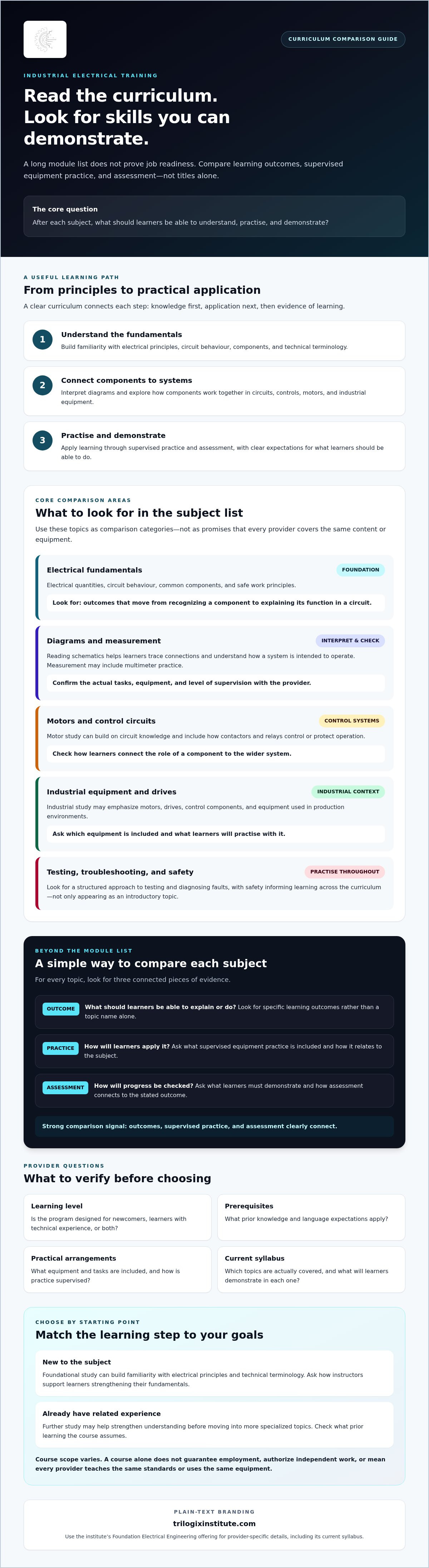
A useful curriculum is more than a list of subjects. It sets out learning outcomes, gives learners supervised opportunities to apply new knowledge, and checks progress through assessment. For example, learners might first study how electrical circuits work, then explore how components interact in a control circuit, and finally explain or carry out a related task under appropriate supervision.
This progression matters because industrial electrical work can involve motors, control systems, and equipment used in production environments. The context differs from typical residential work, where the systems and tasks may be different. A credible industrial electrician course curriculum should make its intended scope clear: what learners are expected to understand, practise, and demonstrate.
Course titles alone won’t tell you whether that progression is in place. “Industrial electrical training” might describe foundational study or more specialized topics. Compare detailed learning outcomes, practice arrangements, and assessments instead. The subject areas in this guide are benchmarks for comparing programs, not a claim that every provider covers the same content or uses the same equipment. For broader context on trade roles and levels of practice, see this Electrician trade overview.
Which learners benefit from industrial electrical training?
Entry-level learners can use foundational training to build familiarity with electrical principles and technical terminology. Learners with related experience may pursue further study to strengthen their understanding before moving into more specialized topics. These are different starting points: foundational study develops core knowledge, while advanced specialization has a narrower focus or assumes prior learning. Neither course type, by itself, guarantees a particular job or career outcome.
Before enrolling, check the intended learner level, prerequisites, and language expectations. Ask whether the program is designed for newcomers, people with existing technical experience, or both. If you’re new to the subject, also ask how instructors support learners who need to strengthen their fundamentals.
How is an industrial electrician curriculum different from a general electrical course?
Foundational electrical principles remain essential, but industrial study may place greater emphasis on motors, control components, industrial equipment, and systematic troubleshooting. These topics help learners understand how electrical systems support machinery and processes, rather than focusing only on installations commonly found in homes.
Look for a clear connection between theory and application. Can learners explain what a component does, interpret how it fits into a system, and practise relevant tasks with supervision? Course scope varies, so don’t assume every provider includes identical equipment, teaches the same standards, or authorizes learners to work independently. Confirm the syllabus and practical arrangements directly with each provider.
Core Topics to Look for in an Industrial Electrician Course Curriculum
Use subject areas as comparison categories, not as promises about what any named provider teaches. A strong outline shows how foundational electrical knowledge progresses toward industrial applications and what learners should be able to explain or demonstrate at each stage. For every topic, look for its learning outcome, related practice, and assessment. A topic name alone is only a starting point.
Electrical fundamentals, diagrams, and measurement
Check whether the curriculum develops understanding of electrical quantities, circuit behaviour, and common components before moving into specialized applications. A clear learning path takes learners from recognizing a component to explaining its function in a circuit. Safe work principles should inform this learning throughout, rather than appear only as a brief introductory topic.
Look for outcomes involving reading and interpreting electrical schematics. Diagrams help learners trace how components connect and understand how a system is intended to operate. Measurement can also be a useful comparison point: a course might include practice using a multimeter to check electrical values. Confirm the actual equipment, tasks, and level of supervision with the provider.
Motors, control circuits, and industrial equipment
Motor topics can build on foundational circuit knowledge. Learners might study how a motor works, then examine how components such as contactors and relays control or protect its operation. Compare the expected outcomes carefully: identifying components, explaining a control sequence, interpreting a diagram, and practising a task on supervised equipment are different levels of learning. Ask which of these the course includes.
Programmable logic controllers (PLCs) may be part of a more specialized automation pathway, but don’t assume they’re included in every introductory industrial program. If motor controls are your main interest, the article Motor Control Certification: 2026 Professional Buying Guide may help you explore that specialization further. Confirm provider-specific content directly.
When comparing an industrial electrician course curriculum, scan for evidence across the full learning sequence:
- Fundamentals: electrical quantities, circuit concepts, components, and safe work principles.
- Technical interpretation: schematic reading and equipment documentation.
- Application: relevant measurement practice and supervised work with equipment, where specified.
- Progression: clear connections from circuit fundamentals to motors and control components.
For provider-specific information, review the institute’s course information and confirm the current syllabus, practical activities, and learning outcomes. Trilogix describes its technical training as instructor-led and equipment-based. Check the details of the particular course rather than assuming it covers every topic in these general curriculum benchmarks.
How to Compare Industrial Electrician Curricula Beyond the Module List
Put providers side by side. A compact comparison table can show whether similar course titles represent similar learning experiences. For each subject area, record what learners should know, what they practise, how progress is assessed, and what they need before starting.
| Comparison point | Question to ask |
|---|---|
| Learning outcomes | What can learners explain or demonstrate by the end of this subject? |
| Theory | Which principles and concepts are taught? |
| Supervised practice | What equipment do learners use themselves, and under whose supervision? |
| Assessment | How is understanding tested: written questions, practical tasks, or both? |
| Prerequisites | What prior knowledge or experience is expected? |
Use the same questions for each provider. This makes it easier to judge whether an industrial electrician course curriculum offers a coherent progression or simply a broad collection of topics.
What makes practical training meaningful?
“Equipment access” can mean different things. Ask whether learners operate equipment themselves or watch an instructor’s demonstration, which tasks they complete, and how instructors supervise practice and correct errors. A useful exercise might connect a schematic to components and measurements, then ask learners to explain a troubleshooting decision. Request examples of actual activities rather than relying on general claims about hands-on learning.
How should theory, assessment, and prerequisites be compared?
Check whether assessments test applied understanding as well as terminology. For example, can learners interpret a diagram or explain why a measurement matters, rather than only define a component? If you’re new to electrical study, ask what foundational knowledge the course assumes and how it supports learners without prior experience.
Certificates, accreditation, and recognition can mean different things. Confirm directly with each provider what document is awarded, who recognizes it, and whether any claim applies to the specific course. Don’t infer professional authorization or industry recognition from a certificate title alone.
For broader course-comparison context, look for guidance that evaluates learning outcomes, supervised practice, and assessment. To check provider-specific details, review electrical course information and ask about the current syllabus, practical activities, assessment, and prerequisites before deciding.
How to Evaluate Safety, Troubleshooting, and Hands-On Practice
Safety should shape the whole learning experience, not sit in a single checklist or introductory lecture. In a useful industrial electrician course curriculum, learners encounter safety expectations alongside equipment handling, measurement, and fault-finding activities. Training can build awareness and sound habits, but completing a course should not be treated as permission to perform electrical work independently. Authorization depends on applicable requirements, qualifications, and workplace conditions.
What safety learning should a curriculum make visible?
Ask how safety is taught during practical activities. Does the course explain risk awareness, isolation principles, and the limits of a learner’s role? How are exercises supervised, and what should a learner do if unsure or if they spot a hazard? These questions reveal more than a broad claim that safety is included. Confirm the provider’s specific approach and syllabus. For the UAE, verify any applicable requirements with authoritative local sources before relying on a course description. Don’t present general safety guidance as a legal requirement or formal qualification.
How can learners assess troubleshooting practice?
Good troubleshooting practice develops a method, not guesswork. Ask whether learners work through structured fault scenarios using diagrams, relevant measurements, and instructor feedback. A useful progression might begin with describing the reported symptom, then reviewing available documentation, identifying what evidence is needed, and explaining a reasoned diagnosis. Any equipment-based activity should take place under appropriate supervision and within safe training conditions. This isn’t a guide to testing live circuits; hazardous work requires qualified oversight.
Look for assessment that asks learners to explain how their conclusion follows from the evidence. Can they distinguish an observed symptom from a suspected cause, interpret a measurement in context, and describe what they would check next within the exercise’s safety boundaries? This shows a deeper level of understanding than simply naming a component.
Match the amount and type of practice to your goals. If you’re building foundational knowledge, ask whether the course develops safe reasoning and basic fault-finding concepts. If you already have experience, check whether the exercises offer suitable technical depth. In either case, course completion shouldn’t be taken as authorization for independent work.
For confirmed information about Trilogix Institute’s offering, review TTI course information.
Choosing a Course That Fits Your Goals and Next Steps
Use your experience and intended direction to narrow the options. If you’re new to electrical study, prioritize foundations and ask how the course introduces technical concepts. If you understand the basics and want to focus on industrial machinery, compare motor-control learning. If your goals involve connected or automated processes, explore whether further study in industrial automation is relevant. The right sequence depends on your starting point, not on which title sounds most advanced.
TTI Foundation Electrical Engineering is an option to consider if you’re seeking foundational technical learning. Don’t assume its title confirms particular industrial modules or practical tasks. Check the current syllabus and compare its stated outcomes with the skills you want to develop. Further learning in motor control or automation may suit some goals, but confirm the provider, course scope, prerequisites, and delivery details directly.
Questions to ask before enrolling
Before deciding, request clear answers to these questions:
- Can I review the current syllabus and learning outcomes?
- How is learning assessed, and what practical tasks are included?
- What equipment do learners use, and how much of the practice is individually supervised?
- What prior knowledge is expected, and what are the entry requirements?
- How is the course delivered, and what credential, if any, is awarded?
Confirm availability and any claims about recognition directly with the institute. These details help you compare documented course information with your goals. They also make it easier to distinguish a course that develops foundational knowledge from one intended for learners with prior experience.
Where foundational learning can lead next
Once you’ve built a foundation, consider whether your next step should deepen your understanding of motor control or move toward industrial automation. Choose based on the systems and skills you want to learn about, not an assumption that one pathway guarantees a particular role. Trilogix lists Foundation Electrical Engineering and separate specialized training offerings. Keep provider and course distinctions clear, and verify the relevant details before enrolling.
For a broader look at automation-focused study, see industrial automation specialization course. To assess the foundational option, review the Foundation Electrical Engineering course information and ask the institute about its current syllabus and delivery. Use the comparison criteria in this guide to make an informed next-step decision, without treating course completion as a guarantee of employment.
Take Your Next Step With a Clear Curriculum in View
A strong industrial electrician course curriculum connects foundational electrical knowledge with relevant practical learning, clear assessment, and safety-conscious instruction. Compare what learners are expected to demonstrate, how practice is supervised, and whether the course level fits your experience. Those details provide a more useful basis for choosing than a title or module list alone.
If you’re building your technical foundation, TTI offers Foundation Electrical Engineering. Trilogix describes its technical courses as instructor-led and equipment-based, factors to consider as you review course details. Check the current syllabus, learning outcomes, delivery, and any credential information directly with the institute. Course completion can support learning, but it doesn’t guarantee employment or authorize independent electrical work.
Ready to compare the offering with your goals? Explore Trilogix Institute’s technical course information and review the current syllabus before choosing your next learning step.
Frequently Asked Questions
What subjects are usually included in an industrial electrician course curriculum?
An industrial electrician course curriculum commonly builds from electrical fundamentals into industrial applications. Comparison categories may include circuit concepts, components, electrical diagrams, measurement, safe work principles, motors, contactors, relays, and control circuits. Some programs also cover troubleshooting or specialized automation topics. Course scope varies, so treat these as subjects to ask about, not guaranteed modules. Request the provider’s current syllabus and ask what learners should understand or demonstrate in each area.
Is an industrial electrician course mostly theory or hands-on training?
The balance varies by provider and course level. Theory helps learners understand circuit behaviour, components, and diagrams; supervised practice gives them a chance to apply that knowledge to tasks or equipment. Ask whether learners operate equipment themselves or mainly observe demonstrations, which activities they complete, and how instructors supervise and assess practice. Trilogix describes its technical courses as instructor-led and equipment-based, but confirm the practical details for the specific course you’re considering.
Can a beginner take an industrial electrician course?
Yes, some courses introduce foundational electrical knowledge, while others expect prior technical experience. Before enrolling, check the stated learner level, prerequisites, and language expectations. If you’re a beginner, ask how the course introduces core concepts and supports learners who haven’t studied electrical subjects before. Don’t assume that a course with “industrial” in its title starts at entry level; confirm its requirements and syllabus with the provider.
How do I compare two industrial electrician course curricula?
Compare more than course titles and topic lists. Review each provider’s learning outcomes, theory coverage, supervised practice, assessment methods, and prerequisites. Ask what learners can demonstrate by the end of each subject area, what equipment they’ll use, and whether they complete practical tasks or watch demonstrations. Also verify any claims about certificates or recognition directly with the provider. This approach helps you judge the learning experience, not just the advertised modules.
Does an industrial electrician course qualify me to work independently?
Not necessarily. Completing a course can develop knowledge and practical skills, but it doesn’t automatically grant authorization to carry out electrical work independently. Requirements depend on the work and applicable rules, so check current UAE requirements with authoritative sources and confirm what a provider’s credential represents. Ask whether the course is intended as foundational training or meets a specific qualification requirement. Don’t treat supervised learning as a substitute for appropriate workplace authorization.
Does an industrial electrician curriculum include PLC training?
Not always. PLCs may feature in a specialized industrial automation pathway, but shouldn’t be assumed to form part of every foundational or industrial electrical course. Check the syllabus for explicit PLC learning outcomes, practical tasks, and assessment details. Trilogix lists an Industrial Automation Specialization, but confirm its current content directly with the institute rather than assuming it includes a particular PLC platform or exercise. Match the course level to your experience and learning goals.


