

What if a course titled “PLC and SCADA” offers more demonstrations than opportunities to practise? It’s a fair concern: course names don’t always reveal which systems, tasks, or equipment learners will use. Strong PLC and SCADA systems training should build practical skills you can verify, rather than rely on a promising title. This guide gives you a checklist for comparing course content, hands-on learning, prerequisites, teaching format, and assessment, so you can judge whether a program fits your technical goals.
You’ll learn what a well-rounded course may cover, what to ask about equipment and practical exercises, and how to weigh training against your current skills and career direction. Trilogix Institute’s Industrial Automation Specialization is one relevant pathway to explore. Before deciding, confirm directly whether the current syllabus includes PLC and SCADA instruction, which platforms and practical tasks are covered, and what assessment or credential is included. The goal is a grounded next step, with career preparation in view and no assumption that training guarantees a job.
Key Takeaways
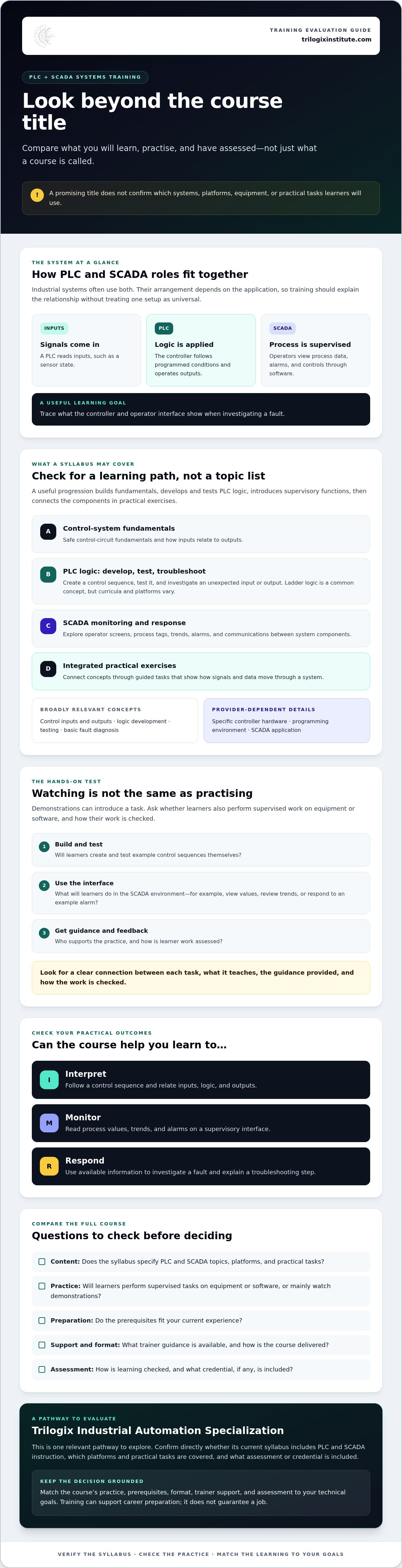
- Understand how PLC control logic and SCADA supervisory monitoring can work together, while recognizing that system configurations vary.
- Use a syllabus checklist to distinguish core automation concepts from platform-specific topics that depend on the provider’s equipment and curriculum.
- For PLC and SCADA systems training, verify that learners perform supervised tasks on equipment or software rather than only watching demonstrations.
- Compare prerequisites, trainer support, assessment, and delivery format with your experience and technical goals.
- Explore Trilogix’s Industrial Automation Specialization as a relevant pathway, and confirm its current PLC and SCADA content, practical work, platforms, and credential details directly.
PLC and SCADA Training: What Should You Learn?
PLC training teaches you how to program a controller to read inputs, apply control logic, and operate outputs according to defined conditions. SCADA training focuses on supervisory monitoring, helping operators view process data, alarms, and controls through a software interface.
Industrial systems often use both. A PLC may manage local machine or process logic, while a SCADA system gives operators a broader view of status and activity. The arrangement depends on the application, so training should explain how components interact without presenting one setup as universal. Useful learning goals include interpreting control logic, monitoring a process, and investigating a fault by tracing what the controller and operator interface show.
A course title alone doesn’t tell you whether you’ll access equipment, which software you’ll use, or how your skills will be assessed. For a foundation on controller functions and components, see this overview of the Programmable Logic Controller (PLC). Then compare the course outline with the tasks learners are expected to complete.
What does PLC training cover?
Start with inputs, outputs, and conditions. For example, a controller may read a sensor and switch a motor output when programmed criteria are met. Ladder logic is a common programming concept, but platforms and curricula vary. Check whether learners create, test, and troubleshoot example control sequences themselves, and whether exercises show how changes in inputs affect outputs.
What does SCADA training cover?
SCADA instruction may cover operator screens, tags that identify process values, trends that show changes over time, alarms that flag conditions, and communications between system components. The exact software and functions depend on the syllabus. Ask which platform is taught and what you’ll practise, such as viewing live or simulated values, acknowledging an alarm, or adjusting an operator control in a training environment.
Look for a clear connection between concepts and practice. A well-structured course should explain what each task teaches, how learners receive guidance, and how their work is checked. Watching an instructor demonstrate a sequence can introduce the process, but it isn’t the same as building or troubleshooting it yourself.
Use these practical outcomes to assess whether PLC and SCADA systems training matches your goals:
- Interpret: Follow a control sequence and identify how inputs, logic, and outputs relate.
- Monitor: Read process values, trends, and alarms on a supervisory interface.
- Respond: Use available information to investigate a fault and explain the next troubleshooting step.
What a Strong PLC and SCADA Training Syllabus Should Include
A useful syllabus builds skills in stages: establish control-system fundamentals, develop and test PLC logic, introduce supervisory-system functions, then bring the components together in practical exercises. This progression helps learners understand not just which actions to perform, but how signals and data move through a system. The NIST definition of Industrial Control Systems offers formal context for the systems these skills support.
Some learning outcomes are broadly relevant across providers; others depend on the equipment, software, and curriculum. Core concepts may include safe control-circuit fundamentals, input/output relationships, logic development, testing, and basic fault diagnosis. Platform-specific content might include a particular controller, programming environment, or SCADA application. A course should identify these clearly rather than imply that one platform represents every industrial setup.
Core PLC and control-system learning outcomes
Look for a sequence that moves from understanding control inputs and outputs to developing a simple response to defined conditions. Learners should be able to test that sequence and diagnose a straightforward issue, such as an unexpected input state or an output that doesn’t behave as intended. Before enrolling, ask which PLC hardware and programming environment are used, how much learner practice is included, and whether exercises involve supervised work or instructor demonstrations only.
SCADA, communications, and integrated exercises
A strong syllabus may include configuring an operator display, identifying process values, reviewing a trend, and responding to an example alarm. Ask whether these tasks use the same environment throughout the course and whether learners connect a PLC to a supervisory interface or see the systems in separate demonstrations. Integrated work can help learners trace how a controller’s data becomes information an operator can monitor.
Check that communications and data flow are explained in practical terms. Learners should be able to describe what information is exchanged between components and identify where a problem might interrupt that exchange. Exercises might progress from viewing a process value to checking an alarm condition and investigating a simulated fault. Confirm how the instructor guides each task and how learning is assessed.
Cybersecurity and industrial networking are relevant areas to ask about, but they aren’t guaranteed syllabus components. Check whether a course introduces network basics, access control, or secure system practices, and how much depth is appropriate for its level. Treat these as specific questions, not assumptions based on a course title.
- Essential concepts: Control fundamentals, logic development, testing, monitoring, and basic troubleshooting.
- Provider-dependent details: PLC and SCADA platforms, equipment access, communications exercises, and cybersecurity coverage.
If you’re comparing pathways, review Trilogix Institute’s course information and confirm directly whether its Industrial Automation Specialization currently covers PLC and SCADA topics, which equipment and platforms learners use, and how practical skills are assessed.
How to Compare PLC and SCADA Courses Beyond the Course Title
“Hands-on” can mean anything from watching an instructor operate a system to configuring it yourself. For useful PLC and SCADA systems training, ask providers to describe learner tasks, equipment access, and assessment in writing. Compare evidence, not promotional labels.
| What to compare | Questions to ask | Useful evidence |
|---|---|---|
| Syllabus depth | Which PLC and SCADA topics are covered, and what will learners be able to do? | A current outline with modules, practical tasks, and stated outcomes. |
| Equipment and software | Which hardware and software are used? Is practice on operational hardware, simulation, or both? | Named platforms and a clear explanation of each learner’s access. |
| Trainer support | Is instruction instructor-led? How can learners get help during exercises? | Details on class structure, instructor guidance, and feedback. |
| Assessment | How are practical skills checked? Is there a final task or other evaluation? | Assessment methods tied to specific course outcomes. |
| Delivery format | How is theory taught, and where does supervised practice take place? | A clear description distinguishing instruction from learner practice. |
How to verify hands-on PLC and SCADA practice
Ask whether each participant gets time to configure, test, and troubleshoot, rather than simply watching a demonstration or reading software documentation. Request examples, such as writing a short control sequence, viewing process values, responding to an alarm, or tracing a simulated fault. Confirm whether the setup uses operational hardware, simulation, or a combination, and how much guided practice is included. “Equipment-based” alone doesn’t tell you how actively each learner uses it.
How to assess instruction, assessment, and credentials
Check prerequisites, instructor-led contact, class structure, and the support available during practice. Find out how instructors assess skills and whether learners receive a completion credential. Ask for the exact credential name and who awards it; don’t assume a course certificate has broad industry recognition. Request written details about assessment criteria and what successful completion represents, so you can evaluate the credential accurately.
Before enrolling, request the provider’s current written syllabus and compare it with your goals. If you’re considering Trilogix Institute’s Industrial Automation Specialization, review its course information and ask directly whether the current program includes PLC and SCADA instruction, what equipment and software it uses, how practical skills are assessed, and whether a credential is awarded.
Choose PLC and SCADA Training That Fits Your Starting Point
The right course depends on what you already know and what you want to do next. Before comparing providers, follow a simple sequence: assess your electrical foundations, define your target skills, check course prerequisites, then compare the written syllabus and practice details. This keeps you focused on a suitable learning step instead of choosing by title alone.
- Assess your foundations. Note your familiarity with basic electrical concepts, control circuits, and industrial equipment.
- Define your goal. Identify the tasks you want to learn, such as understanding control logic or monitoring process information.
- Check prerequisites. Ask what knowledge the provider expects and whether foundational topics are included.
- Compare evidence. Review the syllabus, practice access, schedule, instructor support, and assessment method.
Newcomers may benefit from a course that explains core concepts before introducing programming and supervisory systems. Technicians with control-system experience may be ready to focus on a specific platform, troubleshooting, or integrated PLC and SCADA tasks. Either way, confirm that the course matches your starting level rather than assuming the title reveals its difficulty.
Which foundations should learners have first?
Basic electrical knowledge can make it easier to understand how control inputs and outputs relate to equipment behavior. Beginners should ask whether these fundamentals are taught or assumed, and what preparation is recommended. If you’re building familiarity with motor-control principles, this beginner motor control training guide offers related context for considering your next learning step.
Match course depth to your practical goal
Write down the tasks you want to perform before you enrol. Someone aiming to support maintenance may want practice reading control logic and tracing straightforward faults. A learner interested in automation support may want to ask about controller configuration and supervisory-system exercises. For system familiarization, clarify whether the course provides guided exposure or expects independent troubleshooting. These are questions for comparing learning outcomes, not promises of eligibility for a specific job or a guaranteed career result.
Prepare questions about schedule, prior knowledge, individual practice time, and how skills are assessed. Ask the provider to map your target tasks to specific syllabus outcomes. For broader pathway context, read this guide to the Industrial Automation Specialization.
Trilogix Institute offers an Industrial Automation Specialization and beginner industrial motor control training. To assess whether a pathway fits your goals, review Trilogix Institute’s course information and confirm directly whether the current syllabus includes PLC and SCADA topics, what practical work is included, and which prerequisites apply.
Evaluate Trilogix Industrial Automation Training and Take the Next Step
Trilogix Institute offers an Industrial Automation Specialization that may be relevant if you’re exploring industrial control skills. The available information doesn’t confirm whether its current syllabus includes PLC and SCADA instruction, which platforms are covered, what practical equipment learners use, or whether the program awards a completion credential. Treat it as a pathway to enquire about, then verify the details against your goals before deciding.
Questions to ask about the current specialization
Request current, written program information so you can distinguish confirmed learning outcomes from assumptions. In particular, ask:
- Syllabus: Does it explicitly cover PLC programming and SCADA instruction? Which topics and practical tasks are included?
- Equipment and software: Which hardware and software are used? Is practice on operational equipment, simulation, or both?
- Practice format: What will each learner do directly, and how much individual practice is available?
- Entry requirements: What prerequisites or prior electrical knowledge are expected?
- Assessment and credential: How are skills evaluated, and is a completion credential awarded? If so, what is its exact name?
- Schedule: What is the current schedule and delivery format?
Make an informed enrolment decision
Use the answers to compare the program with the checklist in this guide. A clear match means the documented syllabus, practice tasks, and assessment align with the skills you want to build. If a detail is unclear, ask for clarification rather than relying on a course title or general description. Evaluate practical PLC and SCADA systems training by what learners are expected to do and how that learning is supported.
Start by reviewing Trilogix technical course information, then ask about the current Industrial Automation Specialization’s syllabus, equipment access, platforms, prerequisites, assessment, schedule, and credential details. Trilogix describes its technical training approach as instructor-led and equipment-based, but confirm which elements apply to the current program you’re considering.
Once you have those details, compare them with your target tasks and experience level. If you still have questions about fit or current availability, contact the training team to verify the information before making your decision.
Choose Your Next Training Step with Confidence
Judge effective PLC and SCADA systems training by what you’ll learn and practise, not by the course title alone. Compare the syllabus, equipment and software access, instructor support, assessment, and prerequisites. Then match those details to your current experience and the tasks you want to develop.
Trilogix Institute offers an Industrial Automation Specialization and describes its technical training as instructor-led and equipment-based. The available information doesn’t confirm whether the current specialization includes PLC and SCADA instruction, which platforms it covers, or its practical exercises and credential details. Verify these points directly before deciding whether it fits your goals.
Ready to explore a relevant technical learning pathway? Explore technical training options, then confirm the current program details that matter to you. An informed choice is a practical first step toward building your skills with confidence.
Frequently Asked Questions
What is PLC and SCADA systems training?
PLC and SCADA systems training teaches learners how programmable controllers manage control logic and how supervisory systems display and monitor industrial processes. Depending on the course, you may study inputs and outputs, controller programming, operator screens, process values, alarms, and basic troubleshooting. Review the syllabus to see which topics are included, what equipment or software is used, and whether learners practise tasks themselves or only observe demonstrations.
What is the difference between PLC and SCADA training?
PLC training focuses on programming and testing the logic that controls equipment or processes. SCADA training focuses on using supervisory software to view process information, alarms, trends, and operator controls. Some courses teach both and connect the systems in exercises; others cover them separately or concentrate on one. Check the course outline for specific tasks and ask whether learners practise integrating a controller with a supervisory interface.
Do I need electrical experience before learning PLC and SCADA?
Not necessarily, but basic electrical knowledge can help you understand control circuits and how inputs and outputs affect equipment. Entry requirements vary by provider and course level. If you’re a beginner, ask whether electrical and control fundamentals are taught or assumed, and whether the course has stated prerequisites. If you already work with industrial equipment, check that the content builds on your experience rather than spending most of the course on concepts you know.
Does PLC and SCADA training include hands-on equipment practice?
Not automatically. “Practical” or “hands-on” in a course description doesn’t confirm that each learner gets individual practice on equipment. Ask what hardware and software are used, whether activities use operational equipment, simulation, or both, and how much time participants spend configuring or troubleshooting systems. Request examples of exercises and find out how instructors guide learners and assess their work. A demonstration alone isn’t the same as practising a task yourself.
How do I choose a PLC and SCADA training course?
Compare the current syllabus, platforms, equipment access, prerequisites, trainer support, assessment, schedule, and delivery format. Look for stated outcomes and practical exercises, not just a course title. Ask how much supervised learner practice is included and how skills are checked. Then match the evidence to your experience and goals, such as learning control fundamentals or extending existing automation knowledge. Confirm credential details directly, and don’t assume a certificate has industry-wide recognition.
Can I learn PLC and SCADA systems through online training?
Yes, online courses can introduce PLC and SCADA concepts, and some may offer software-based exercises or remote access to learning tools. The format and practical depth vary, so check whether you’ll configure systems yourself, receive instructor feedback, and practise troubleshooting, or mainly watch lessons and read materials. If equipment-based experience is important to your goal, confirm how the online course provides it and whether you’ll need separate access to hardware.
Does Trilogix Institute offer PLC and SCADA systems training?
Trilogix Institute offers an Industrial Automation Specialization, but the available information doesn’t confirm whether its current syllabus specifically includes PLC and SCADA instruction. Ask the institute about the topics, PLC hardware and SCADA software, practical exercises, individual equipment access, prerequisites, assessment, schedule, and any completion credential. Treat the specialization as a relevant program to enquire about, and verify current details directly before deciding whether it matches your learning goals.
What skills should a PLC and SCADA course teach?
A well-rounded course may teach control inputs and outputs, logic development, and testing or troubleshooting straightforward sequences. SCADA topics may include interpreting operator displays, process values, trends, alarms, and communications between system components. Practical tasks should align with the syllabus and platforms used by the provider. Ask which skills are assessed, and whether topics such as industrial networking or cybersecurity are included, since these aren’t guaranteed components of every course.


