

The course with the longest topic list may not be the one that prepares you best to work with real drives. Effective variable frequency drive (VFD) training connects parameter settings to motor behavior, control circuits, and fault diagnosis, with practical work that helps you understand how those pieces interact.
If a course description leaves you guessing about equipment access or hands-on time, look beyond the title. Your starting point matters too: learners benefit from a working grasp of electrical fundamentals, motors, control circuits, and multimeter use before taking on drive-focused instruction.
This guide explains how to compare courses using job-relevant criteria, identify foundational skills to strengthen, and choose a next step that fits your experience and goals. You’ll learn what a useful VFD syllabus should address, what to ask about practice and assessment, and how drive skills connect to motor control and industrial automation. Verify the current syllabus, prerequisites, equipment access, and practice time directly rather than assuming the course title tells the whole story.
Key Takeaways
- Understand how a VFD changes motor speed and why drives matter in industrial motor-control and automation work.
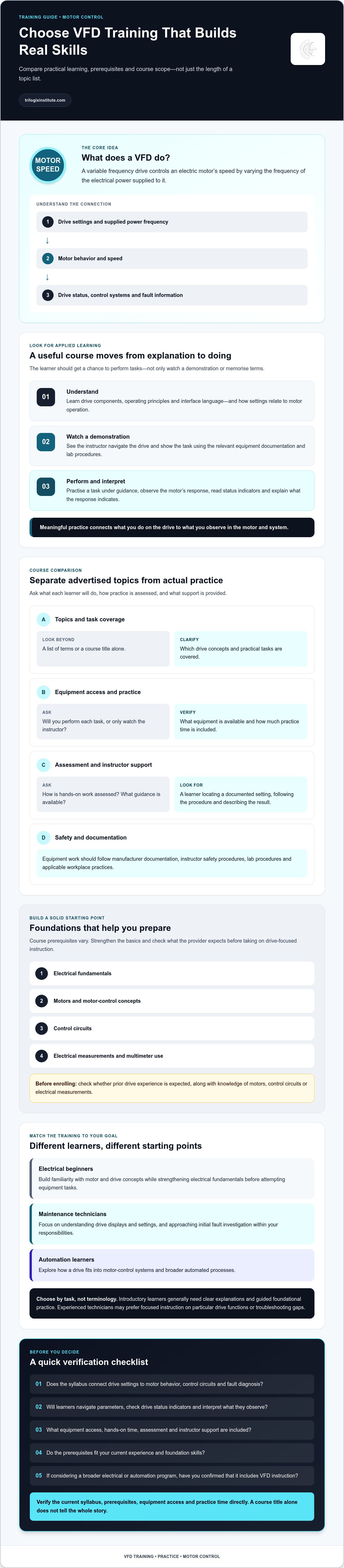
- Look for training that lets learners perform tasks, not just watch demonstrations, such as navigating parameters and checking drive status indicators.
- Use a comparison table to distinguish advertised topics from practical activities, assessment, and instructor support.
- Build electrical fundamentals and motor-control knowledge before progressing to supervised variable frequency drive (VFD) training.
- Define your learning goal and verify current course details. Relevant electrical or automation programs may provide foundations, but confirm whether they include VFD instruction.
What Is Variable Frequency Drive Training, and Who Needs It?
A variable frequency drive (VFD) controls an electric motor’s speed by varying the frequency of the electrical power supplied to it. Variable frequency drive (VFD) training teaches learners how drives work with motors and control systems, and how to operate and investigate them safely. Drives are used in industrial applications where motor speed needs to be controlled, so technicians may encounter them during maintenance, motor-control, and automation tasks. For a broader overview of drive principles and applications, see Variable-frequency drive.
What skills does VFD training develop?
Useful training moves beyond memorising terms. It introduces drive components, operating principles, and interface language, then connects those concepts to observable motor behavior. This helps learners relate drive settings to motor operation and interpret the information shown on a drive display.
Parameter configuration should be taught as a documented process, not guesswork. Practise locating settings and checking them against the relevant drive and motor documentation. Training may also introduce basic fault investigation: observe drive status or fault indications, gather relevant information, and consider the motor-control system before drawing conclusions. Equipment work should follow the instructor’s safety procedures and applicable workplace practices.
Who should consider learning about variable frequency drives?
VFD knowledge can support different learning paths. The right starting point depends on your experience and the course prerequisites.
- Electrical beginners can build familiarity with motor and drive concepts while strengthening electrical fundamentals before attempting equipment tasks.
- Maintenance technicians may want to understand drive displays and settings, and learn how to approach initial fault investigation within their responsibilities.
- Automation learners can explore how a drive fits into motor-control systems and broader automated processes.
Introductory learners generally need explanations and guided practice with foundational concepts. Experienced technicians may benefit more from focused instruction on specific drive functions or troubleshooting gaps. Check whether a course expects knowledge of motors, control circuits, electrical measurements, or prior drive experience. Entry requirements vary.
Choose training for the tasks you need to understand, not just the terminology you hope to recognise. Matching your current skills to the course prerequisites and practical scope gives you a sounder basis for deciding what to learn next.
What Should Hands-On VFD Training Teach You to Do?
A course can explain drive functions without giving learners the chance to use them. Strong variable frequency drive (VFD) training moves through three stages: the instructor explains a concept, demonstrates a task, then guides learners as they perform it on training equipment. That progression shows whether students can apply the information, not just recognise technical terms.
Practical tasks might include finding parameters in a drive interface, entering values specified by the instructor, and checking relevant motor information before a supervised start. Learners should also practise reading status indicators and relating the display to the motor’s response. Practice is meaningful when learners interpret how a drive responds, then explain what that response indicates about the task or system. A fault exercise is useful only when it follows the equipment documentation and established lab procedures.
Which VFD lab exercises demonstrate practical learning?
Ask what each learner will do, rather than whether a course simply “includes lab work.” Look for supervised setup and parameter-entry tasks, observation of motor response under instructor-approved conditions, and guided interpretation of drive status or fault information. The Rutgers VFD training course is one example of a course description that includes theory, operation, applications, and troubleshooting. Use it as a reference for topic scope, not as proof that another provider offers the same practice.
Find out whether you will perform each task yourself or only watch an instructor. Ask how practice is assessed. For example, must the learner locate a documented setting, follow the prescribed procedure, and describe the result?
How should safety and equipment documentation be taught?
Safe practice starts with the equipment manufacturer’s documentation and the lab’s own procedures. Instructors should explain the checks and permissions required before a task, demonstrate the approved process, and supervise learner activity. Ask how the course covers isolation requirements and what learners may or may not handle directly.
Training should never encourage bypassing safeguards or improvising live electrical work. If a course includes fault scenarios, confirm that they use controlled training conditions and follow relevant manuals and supervised procedures. Clear boundaries are part of practical competence.
Trilogix Institute lists electrical and automation learning pathways, but its available course information doesn’t confirm dedicated VFD instruction or specific drive lab equipment. Review the available course information and verify directly whether a current syllabus includes VFD topics, equipment access, learner practice, and supervision.
How to Compare VFD Training Courses Before You Enrol
A course title can sound practical without showing what learners actually do. Compare variable frequency drive (VFD) training by checking the syllabus, instructor access, time spent on equipment, assessment method, and prerequisites. The goal is to see whether course activities match the skills you want to develop, not to judge by promotional language alone.
What should you ask about course content?
Ask for examples of tasks learners perform. Find out which activities are demonstrations and which each participant completes, what drive types or motor-control situations are covered, and how much troubleshooting instruction is included. Ask whether exercises use current manufacturer documentation, so learners practise checking procedures and settings against relevant equipment guidance.
A course may mention “programming” or “troubleshooting” without explaining the depth of practice. Request an outline of the task and how learning is assessed. For broader technical context, explore NEMA standards for VFDs, then ask a provider which references, if any, inform its syllabus. Treat this as a comparison point, not proof of a course’s quality or suitability for every workplace.
How can you judge instructor support and course fit?
Practical learning depends on useful feedback. Check whether an instructor is available while learners carry out equipment tasks, how questions are handled, and whether assessment includes a chance to demonstrate understanding. Match entry requirements to your experience with electrical fundamentals and motor control. A beginner may need more foundational explanation; an experienced technician may prefer focused upskilling.
Consider how you learn best. If you value guided practice, verify that the schedule includes instructor-led work with equipment rather than relying mainly on lectures or observation. Don’t assume a certificate title establishes hands-on competence, accreditation, industry recognition, or employment outcomes. Ask what the credential represents and which assessed tasks support it.
Use a simple comparison table: create two columns, “Advertised topic” and “Demonstrable learner activity.” Add a row for each topic and ask the provider to describe the corresponding task and assessment.
- Parameter configuration: Is it listed in the syllabus, and will you practise locating or entering settings?
- Motor control: Does the course explain the drive-motor relationship, and will you observe an approved exercise?
- Troubleshooting: Is it named as a topic, and will you interpret documented status or fault information?
Specific answers make courses easier to compare. If a provider can’t clarify practice time, prerequisites, or assessment, treat those as open questions before enrolling.
Which Prerequisite Skills Help You Succeed in VFD Training?
Drive instruction is easier to follow when you can connect electrical fundamentals to motor-control behavior. You don’t need to be a specialist, but you should know what the course expects before enrolling. A practical readiness sequence is to strengthen basic electrical knowledge, understand motor-control principles, review course terminology, then move into supervised drive practice.
Which electrical and motor-control fundamentals matter?
Begin with basic electrical quantities and safe equipment-handling principles. Familiarity with motors, control circuits, and electrical measurements can help you follow explanations of drive operation and make sense of what a drive indicates during an exercise.
Motor-control knowledge provides context. A drive is part of a system, so understanding how a motor responds to a control input helps you judge whether observed behavior matches the task. That foundation also supports more structured troubleshooting: note what the drive displays, consider the control context, and follow the instructor’s procedure rather than guessing at a cause.
For related foundational learning, see this motor control certification guide. To explore the wider relationship between drives, control systems, and automated processes, read the industrial automation specialization guide. These resources can help you identify areas to strengthen. Confirm actual entry requirements with the provider.
How can beginners prepare for practical drive instruction?
Before enrolling, ask the provider:
- What electrical or motor-control knowledge is expected at entry?
- Will the course explain drive terminology before practical tasks?
- Does it assume previous experience with motors, control circuits, or VFDs?
- What materials or manufacturer documentation should learners review beforehand?
Reviewing assigned materials and relevant manufacturer documentation can help you arrive prepared to follow instructions and ask focused questions. General guidance isn’t a substitute for course-specific information. Prerequisites vary, so ask the provider to confirm the current requirements, including expectations for prior experience and supervised equipment practice.
Trilogix Institute’s confirmed offerings include Foundation Electrical Engineering and Industrial Automation Specialization. The available information doesn’t confirm whether either currently includes VFD instruction or lab practice. Explore the electrical engineering course information, then verify the current syllabus and prerequisites directly before choosing a learning path.
How to Choose Your Next Step in VFD Training
Choose a course based on the tasks you want to perform, the skills you already have, and the evidence the provider can give about practical learning. Before enrolling in variable frequency drive (VFD) training, work through this checklist:
- Define your goal: Decide whether you need electrical foundations, an introduction to drives, or focused development for maintenance or automation work.
- Confirm prerequisites: Check what electrical and motor-control knowledge the course assumes.
- Inspect practical learning: Ask which activities learners complete themselves, what equipment they use, and how much supervised practice is included.
- Verify outcomes: Find out how learning is assessed and what any credential represents. Don’t infer hands-on competence or employment outcomes from a course title alone.
Could Trilogix Institute training fit your electrical learning goals?
Trilogix Institute lists Foundation Electrical Engineering and Industrial Automation Specialization as relevant learning pathways. These may help build electrical or broader automation knowledge, but the available information doesn’t establish that either includes VFD instruction or access to drive equipment. Confirm the current curriculum before treating either as VFD training. For related study context, review this motor control course guide.
What should you confirm before contacting a training provider?
Prepare specific questions and compare the answers with your goal. Verify current course availability and ask whether the syllabus covers VFDs, which equipment learners can access, what practical tasks they perform, and how instructors supervise the work. Also confirm prerequisites, assessment method, credential details, and delivery format directly. Course details can change, so rely on current provider information rather than assumptions based on a course label or older description.
Trilogix Institute’s confirmed offerings can be starting points for an enquiry, not a substitute for checking VFD coverage. Ask whether the current syllabus includes relevant drive topics and supervised equipment practice. A clear answer will help you decide whether the course is a suitable foundation or whether you need a more focused option.
Set your goal, prepare your questions, then ask Trilogix Institute about its current technical training options and verify course details before making your decision.
Choose Training That Builds Practical Understanding
The right variable frequency drive (VFD) training should connect drive settings to motor behavior and troubleshooting, with clear opportunities to practise under supervision. Compare advertised topics with what learners actually perform, and check prerequisites, assessment, equipment access, and the current syllabus before enrolling.
If you need to strengthen your foundation first, Trilogix Institute offers instructor-led vocational training using real-world equipment, including confirmed electrical engineering and industrial automation offerings. These may be relevant learning pathways, but verify current VFD coverage and equipment access directly. Ask which practical tasks and learning outcomes are included.
Ready to clarify your options? Review Trilogix Institute’s current course information, then ask about VFD coverage, practical training, and the prerequisites that fit your experience and goals.
Frequently Asked Questions
What is variable frequency drive training?
Variable frequency drive (VFD) training teaches learners how a drive controls an electric motor’s speed by adjusting the frequency of its electrical supply. Course content may cover drive components, operating principles, parameter settings, motor behavior, and basic troubleshooting. Practical instruction can help learners connect what they see on a drive interface with what the motor is doing. Topics and hands-on activities vary by provider, so check the current syllabus.
Who should take VFD training?
VFD training may suit electrical beginners, maintenance technicians, and learners developing industrial automation skills. Beginners can use introductory instruction to build familiarity with drives, while experienced technicians may seek focused learning related to operation or troubleshooting. The right course depends on your goals and current knowledge. Check the prerequisites, since providers may expect learners to understand electrical fundamentals, motors, control circuits, or measurements before starting practical drive activities.
Is hands-on VFD training better than theory-only instruction?
Hands-on training can add practical value by letting learners apply concepts to equipment, but theory remains essential for understanding how and why a drive behaves as it does. A balanced course explains concepts, demonstrates procedures, and gives learners supervised opportunities to practise. Look for specific activities and assessment details rather than relying on the label “hands-on.” Confirm what you’ll do yourself, what you’ll observe, and how the instructor guides equipment use.
What should a VFD course include?
A useful VFD course should explain drive components and operating principles, then relate those concepts to motor control. Depending on its level and scope, it may include navigating the interface, checking motor information, entering parameters according to equipment documentation, performing supervised start checks, and interpreting status or fault indications. Ask how these topics are taught and assessed. Practical work should follow manufacturer documentation, lab procedures, and instructor supervision.
Do I need motor-control experience before learning about VFDs?
Not always. Entry requirements depend on the course, and introductory options may suit learners who are new to drives. However, familiarity with electrical fundamentals, motors, and control circuits can make drive operation easier to understand. If you’re starting from the beginning, ask what knowledge the provider expects and whether foundational instruction is included. Don’t assume every course is designed for beginners.
Does completing VFD training guarantee a job?
No. Completing a VFD course doesn’t guarantee employment or a particular career outcome. Training can help you develop technical knowledge, but employers consider a range of factors, including relevant experience, broader skills, and the requirements of a specific role. Before enrolling, verify what the course teaches, how learning is assessed, and what its certificate or credential represents. Be cautious of claims that promise a job solely because you completed training.
How do I choose a VFD training provider?
Compare providers by syllabus detail, learner-performed equipment tasks, supervised practice, instructor support, assessment, prerequisites, and delivery format. Ask which drive activities are demonstrations and which you’ll complete yourself. Check whether exercises use relevant manufacturer documentation and what practical outcomes are assessed. Verify current course details directly, including equipment access and credential information. A clear explanation of what learners actually do is more useful than a broad course title alone.
Does Trilogix Institute offer a dedicated VFD training course?
The available information doesn’t confirm that Trilogix Institute offers a dedicated VFD training course or specific VFD lab equipment. Its confirmed vocational training includes electrical engineering and industrial automation, delivered through instructor-led learning using real-world equipment. These subjects may provide relevant foundations, but they don’t confirm VFD instruction. Contact the institute to verify whether a current course covers drives, what equipment learners can access, and how much supervised practice is included.


