
The strongest industrial maintenance technician skills go beyond fixing a broken machine. Technicians combine mechanical and electrical knowledge with troubleshooting, equipment diagnosis, and safe repair practices to keep machinery operating. Their focus can vary by role, from maintaining a range of equipment across a facility to specialising in a particular system.
It’s easy to think of maintenance as a single job, but the work changes with the equipment and workplace. Technicians may inspect, adjust, and repair machinery in manufacturing, utilities, oil and gas, food and beverage, or facilities management, where understanding the cause of a fault matters as much as completing the repair.
This guide explains what industrial maintenance technicians do, where they work, and which practical and problem-solving abilities help them diagnose failures. It also compares maintenance roles, outlines the repair process, and shows how focused training in electrical systems and industrial motor control can build relevant foundations.
Key Takeaways
- Maintenance work spans industries that rely on operating equipment, from manufacturing and utilities to food and beverage.
- Technicians build capability through relevant technical learning and hands-on experience, with job requirements varying by role.
- Effective troubleshooting combines mechanical and electrical knowledge with careful use of diagrams, performance logs, and diagnostic tools.
- A sound repair process identifies the fault, prioritises urgent issues, and tests the equipment after corrective work.
- Specialisations range from broad facility maintenance to focused work on motors, control systems, or equipment condition monitoring.
Where do maintenance techs work?
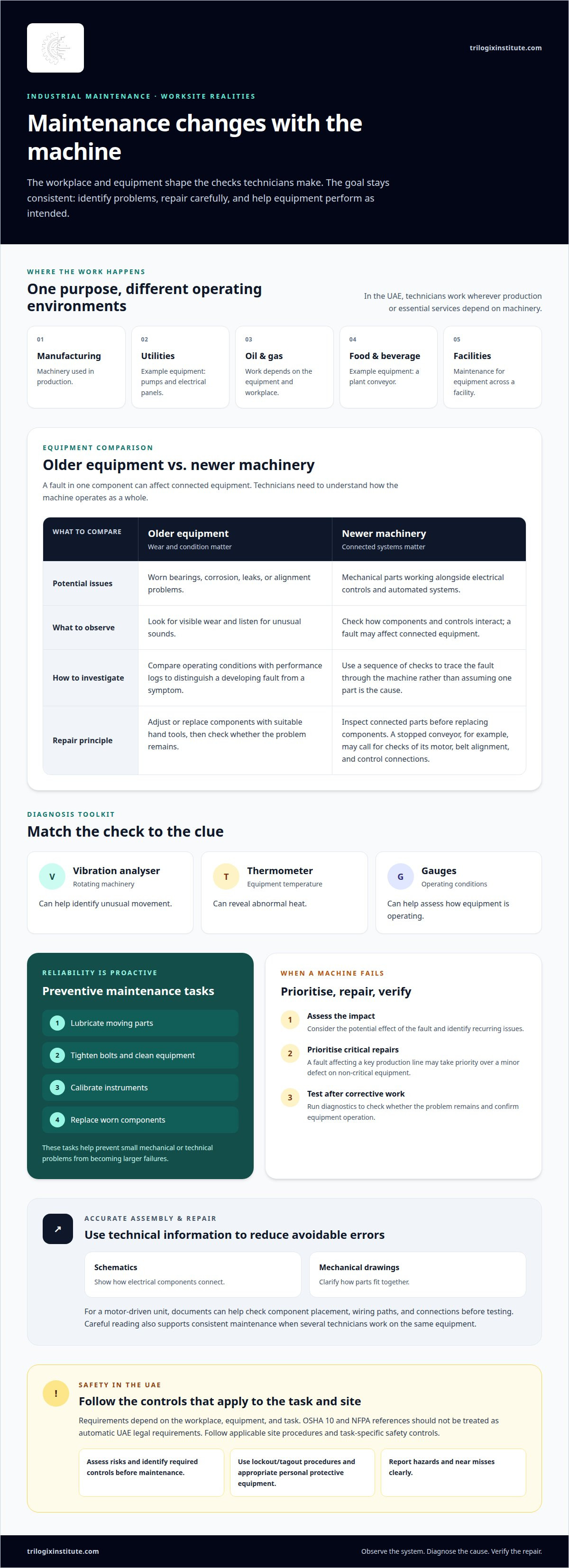
Industrial maintenance technicians work wherever production or essential services depend on machinery. In the UAE, that can include manufacturing, utilities, oil and gas, food and beverage, and facilities management. A technician in a food plant may maintain a conveyor, while one in a utility facility may inspect pumps or electrical panels. The equipment changes, but the purpose is consistent: identify problems, carry out repair work, and help keep equipment performing as intended.
Each workplace brings different troubleshooting demands. Older equipment may have worn bearings, corrosion, leaks, or alignment problems. Newer machinery may combine mechanical parts with electrical controls and automated systems. Since a fault in one component can affect connected equipment, technicians need to understand how the machine operates as a whole. They inspect for visible wear, listen for unusual sounds, and compare operating conditions with performance logs. These checks help distinguish a developing fault from a symptom caused elsewhere in the system.
Diagnosis depends on suitable tools and a clear sequence of checks. A vibration analyser can help identify unusual movement in rotating machinery, a thermometer can reveal abnormal heat, and gauges can help assess operating conditions. Technicians may use hand tools to adjust or replace components, then run diagnostics to see whether the problem remains. For example, if a conveyor stops unexpectedly, they may need to inspect its motor, belt alignment, and control connections rather than replace parts immediately.
Reliability depends on more than responding to breakdowns. Scheduled preventive maintenance can include lubricating moving parts, tightening bolts, cleaning equipment, calibrating instruments, and replacing worn components. These tasks help prevent small mechanical or technical problems from becoming larger failures. When a machine fails, technicians assess the potential impact, prioritise critical repairs, and report recurring issues. In a production facility, a fault affecting a key line may take priority over a minor defect on non-critical equipment.
Assembly and repair also require accurate interpretation of technical information. Schematics show how electrical components connect, while mechanical drawings clarify how parts fit together. When assembling a motor-driven unit, a technician can use these documents to check component placement, wiring paths, and connections before testing. Careful reading reduces avoidable installation errors and supports consistent maintenance when several technicians work on the same equipment.
In the UAE, safety requirements depend on the workplace, equipment, and task. OSHA 10 and NFPA references should not be treated as automatic UAE legal requirements; technicians should follow applicable site procedures and task-specific safety controls. Before maintenance, a risk assessment helps identify hazards and required controls. Lockout/tagout procedures, appropriate personal protective equipment, and clear reporting of hazards or near misses support safer work around machinery and electrical systems.
What Is a Maintenance Technician?
A maintenance technician inspects, maintains, and repairs equipment so workplaces can operate efficiently. In manufacturing, this might mean servicing a motor, checking a pneumatic system, or replacing a worn bearing. The role combines practical work with careful diagnosis: technicians interpret instructions, identify faults, and record their work. Responsibilities depend on the equipment, worksite, and level of responsibility.
In the UAE, qualifications and certificates depend on the employer, job duties, and equipment involved. There is no single route into maintenance technician work; relevant technical education and hands-on ability help candidates prepare for different roles. Employers may also set site-specific safety training requirements, so a credential should match the tasks it is intended to support.
Training can begin with technical coursework or a certificate focused on mechanical and electrical maintenance. Programs may cover blueprint reading, hand tools, safety, troubleshooting, welding, bearings and seals, power transmission, hydraulics, and pneumatics. Each subject supports practical work. For example, reading a schematic helps a trainee trace a connection before testing a circuit or replacing a component.
Workplace learning builds familiarity with specific machines and procedures. New technicians may work alongside experienced staff, learning how a facility documents work orders, isolates equipment, and returns machinery to service. New industrial maintenance technicians or mechanics should expect at least one year of on-the-job training. This helps them apply classroom knowledge under real production pressure while learning site routines.
Other education routes take different amounts of time. Industrial machinery mechanic certificates can take several months to a year to complete, while an associate degree for industrial maintenance training takes two years. Apprenticeships or internships may last one to several years, and millwright apprenticeships typically take three or four years. These pathways vary in their balance of instruction and supervised practice, so the best fit depends on a person’s starting knowledge and career goals.
Learning continues as machines and controls change. Technicians can develop their capabilities through workshops, further technical study, and supervised practice with unfamiliar systems. Someone moving from basic motor maintenance to automated equipment, for instance, needs to understand how electrical components interact with controls. Clear communication matters too: technicians share findings with colleagues and engineers to help teams address recurring problems and plan repairs.
For a practical career plan, connect each learning step to a task: interpret a drawing, test a component, or document a repair. This makes progress visible and helps trainees work more confidently and efficiently as their responsibilities grow.
Core troubleshooting and problem-solving skills
Strong troubleshooting combines mechanical and electrical knowledge with structured reasoning. Technicians use these abilities to locate faults, prevent repeat problems, and support reliable maintenance schedules.
Mechanical and Electrical Troubleshooting
Mechanical and electrical troubleshooting means checking connected systems methodically to find why equipment behaves abnormally. A technician may examine a pump’s moving parts, then trace its electrical supply and control signals. This helps avoid replacing a sound component while overlooking the actual fault. Understanding hydraulics and pneumatics is also useful when pressure or movement changes unexpectedly.
Useful skills include interpreting technical diagrams, recognising unusual sounds or vibration, and using suitable diagnostic tools. A motor that fails to start, for example, may have a mechanical obstruction or an electrical issue. Technicians narrow down the possibilities by comparing observed symptoms with the schematic and equipment history. This disciplined approach matters when complex machinery combines several systems.
Root-Cause Analysis
Root-cause analysis looks beyond a visible symptom to identify the underlying condition. If a conveyor repeatedly stops, the technician can compare fault records, operating conditions, and performance logs. A pattern may point to a recurring component problem rather than an isolated breakdown. Finding the cause helps teams choose repairs that address the source, not just the latest interruption.
Evidence guides the investigation. Technicians interpret schematics, inspect affected components, and record what changes after each check. They can then explain their reasoning to colleagues and engineers, using specific observations rather than guesses. This supports better decisions about repair priorities and helps the team avoid repeating ineffective fixes.
Preventive Maintenance and Problem Solving
Preventive maintenance skills include inspecting equipment, cleaning and calibrating it, lubricating moving parts, tightening bolts, and replacing worn components. These tasks help prevent minor defects from developing into larger mechanical or technical problems. A technician who notices looseness during an inspection can address it before it contributes to further wear.
Problem solving also means weighing equipment condition against operational impact. Technicians assess the potential consequences of a malfunction and prioritise critical repairs. They test completed work to confirm that the fault has been addressed. Clear records of findings and actions give the next technician useful context, especially when equipment runs on repeated production schedules.
Communication and Teamwork
Communication and teamwork matter because maintenance decisions often involve operators, technicians, supervisors, and engineers. Technicians need to describe symptoms accurately, share inspection findings, and report recurring issues. For example, an operator’s account of when a machine stalls can help focus diagnostic checks.
Good collaboration keeps problem solving evidence-led. A technician can explain which checks were completed, what the results showed, and which issue needs attention first. This shared understanding helps colleagues coordinate repairs and maintenance schedules. It also gives engineers clearer feedback about persistent equipment problems and possible improvements.
Diagnosing and repairing machine failures
A disciplined repair process connects fault diagnosis, practical planning, and post-repair testing. Each stage helps technicians address the failure and restore machinery for operation.
Critical Thinking in Repair Decisions
Critical thinking means weighing evidence before choosing a repair, rather than treating the first visible symptom as the cause. A conveyor that stops, for example, may have a damaged component or a fault elsewhere in its connected system. Technicians compare equipment behaviour with diagrams, inspection findings, and performance logs to narrow down the possibilities.
This judgement matters because replacing the wrong part can leave the original failure unresolved. A technician considers the malfunction’s potential impact, which components are affected, and whether the evidence points to a recurring issue. If a motor repeatedly overheats, checking operating conditions and related components can reveal more than replacing the motor alone. The goal is to base the repair decision on observations.
Proficiency grows through consistent reasoning and accurate records. Documenting symptoms, test results, and actions gives colleagues useful context if the same machinery fails again. Clear evidence also helps technicians explain why a repair takes priority, especially when production depends on several connected assets. This makes critical thinking central to sound maintenance decisions.
Repair Planning
Repair planning defines the work, parts, tools, and sequence needed to address a diagnosed failure. For a hydraulic press, a technician might identify the affected assembly, consult its schematic, and prepare the required replacement components before starting repairs. Good planning helps the team focus on the confirmed fault and coordinate work with operational needs.
Prioritisation matters when several problems compete for attention. Technicians assess each malfunction’s potential impact, then address critical issues first to help reduce equipment downtime. A fault affecting an essential production process may take precedence over a defect on non-critical machinery. The plan should also account for inspection findings and related components that could contribute to the same failure.
Accurate work records support the plan. A maintenance management system can capture work orders, parts used, labour, and findings. These records help technicians track recurring failures and give engineers information for planning improvements. Repair planning works best when the assigned work, equipment history, and findings remain connected throughout the job.
Testing Repairs
Testing repairs means checking equipment after corrective work to confirm the original problem has been addressed. A technician may run a repaired conveyor and observe whether it operates consistently, or check a motor after replacing a component. Testing provides evidence of the repair’s success rather than relying only on completion of the physical work.
Checks should relate directly to the failure. If a machine stopped during operation, the technician observes it under suitable operating conditions and watches for the same symptom. If a control issue caused the interruption, the technician checks the relevant response after repair. Any remaining abnormal behaviour calls for further diagnosis, not an assumption that the equipment is ready.
Finally, technicians document the test result and any remaining observations. This record informs operators and colleagues about the repair outcome and supports future maintenance decisions. A complete repair process links diagnosis, planned corrective work, and testing. This sequence helps teams restore machinery with a clear account of what failed and how the repair performed.
Maintenance technician roles and specialisations
Industrial maintenance work ranges from broad facility coverage to focused responsibility for a specific machine or system. The role’s scope shapes its daily tasks, tools, and technical depth.
Industrial maintenance technicians typically combine mechanical and electrical troubleshooting to keep production equipment operating. A maintenance mechanic often focuses on installing, maintaining, and repairing mechanical machinery, while an electrician focuses on electrical systems. These areas can overlap in industrial settings, so technicians need to recognise system interactions and work within their assigned responsibilities.
A general maintenance technician handles varied equipment across a facility. One shift might involve routine maintenance on a conveyor, followed by checks on a motor or hydraulic press. A specialist, by contrast, focuses on a particular equipment type or system. That deeper familiarity can help with complex diagnosis, component settings, and repairs specific to the machinery.
Specialisations reflect the equipment a workplace relies on. Technicians may service CNC machines, electrical panels, programmable logic controllers, motors, or hydraulic presses. A condition monitoring technician has a distinct focus: installing sensors, collecting equipment data, and conducting vibration analysis. These checks help identify changes in equipment health, giving maintenance teams information to plan inspections and follow-up work.
Modern roles also involve maintenance software. A computerised maintenance management system, or CMMS, can organise work orders, track assets, and manage parts inventory. Technicians use it to record work performed, parts used, labour hours, and inspection findings. Accurate entries help colleagues understand equipment history and support ongoing planning for routine maintenance.
The technician’s role differs from an engineering role, too. Technicians generally carry out hands-on inspections, preventive maintenance, and repairs. Maintenance engineers design maintenance systems, analyse reliability data, and develop improvement strategies. When technicians notice recurring failures, they can report the pattern, giving engineers and planners practical evidence to review.
Career development can build on this experience. Technicians may progress into senior or lead roles, supervise teams, or move toward maintenance planning, controls, automation, or facilities management. The right direction depends on whether a person prefers hands-on repair, equipment monitoring, software-based planning, or coordinating wider maintenance work.
For readers developing technical foundations, explore relevant technical course options that connect electrical systems, motor control, and automation with industrial equipment.
Trilogix Institute
Trilogix Institute helps learners build practical foundations relevant to industrial maintenance work. For those strengthening electrical knowledge or learning how industrial motors operate, technical training can connect theory with equipment-focused understanding. Options include TTI Dubai Foundation Electrical Engineering and TITP Beginner Essential Industrial Motor Control, which address complementary foundations for working with electrical systems and motors.
These courses can be a useful next step when you’re preparing for hands-on technical work or developing knowledge alongside workplace experience. They support learning, while role-specific experience continues on the job. Contact Trilogix Institute to discuss your training goals.
Build Your Next Technical Step
Turn interest into capability by choosing a clear learning goal. Decide whether you want to strengthen electrical foundations, understand industrial motor control, or develop another technical area relevant to your intended role. The industrial maintenance technician skills you build will grow through focused learning and continued workplace practice.
Trilogix Institute offers TTI Dubai Foundation Electrical Engineering, TTI Dubai Professional Culinary Arts, and TTI Dubai Advanced AutoCad 2D & 3D. These programs serve different learning interests, so focus on the pathway that matches your direction and practical development goals.
If you’re ready to explore your options, contact Trilogix Institute to discuss your next step. A focused start can help you approach technical learning with purpose and keep building confidence through practice.
Frequently Asked Questions
Can I grow in this field?
Yes, experience can lead to broader technical responsibility or team leadership. A technician who becomes proficient with a specific system may take on more complex assignments, mentor colleagues, or move toward planning and supervision. Someone who enjoys analysing recurring faults, for example, might develop toward reliability planning, while a technician interested in controls could build experience with automation. Progress depends on the equipment, capabilities, and responsibilities developed at work.
How can I get experience without formal training?
Look for supervised, entry-level exposure to equipment, such as assisting with inspections, organising maintenance records, or observing repair work where workplace rules permit. Ask a supervisor to explain the purpose of each check and how findings are recorded. A simple learning log can capture the equipment, symptom, checks observed, and outcome. This builds useful familiarity, but hands-on tasks should only be performed with appropriate instruction and authorisation.
Is this job physically demanding?
It can be. Industrial maintenance may involve lifting tools, climbing ladders, working in tight spaces, or operating in noisy environments. Physical demands vary with the site and equipment: inspecting a control panel differs from reaching a component in a confined machine area. Stamina, manual dexterity, and awareness of surroundings matter. Workplace procedures determine how tasks are prepared and which protective equipment is used.
What kind of equipment will I work on?
The equipment depends on the facility and the technician’s assignment. A manufacturing role might involve production machinery, while a facilities position may focus on building equipment and utilities. Industrial jobs can include motors, conveyors, hydraulic presses, CNC machines, electrical panels, and programmable logic controllers. Before starting a task, technicians use equipment records and diagrams to understand the machine, its connected systems, and relevant maintenance history.
What are the essential skills for an industrial maintenance technician?
Essential capabilities include careful observation, manual dexterity, attention to detail, time management, safety awareness, and clear communication. The most important industrial maintenance technician skills can vary by assignment: a technician dealing with a recurring stoppage needs to compare symptoms and records, while one completing a scheduled inspection must notice small changes. Accurate reporting helps colleagues understand the condition and plan follow-up work without relying on memory.
What technical skills do industrial maintenance technicians need in mechanical, electrical, and hydraulics systems?
Technicians need to understand how mechanical parts, electrical connections, and fluid-power systems operate and interact. For example, a hydraulic actuator’s slow movement may call for checks of its mechanical load and hydraulic behaviour, while a motor fault requires attention to its electrical supply and connected machinery. Reading schematics helps locate components and understand their relationships. The depth of knowledge required depends on the equipment and tasks assigned at the facility.
What software, diagnostic tools, and equipment should industrial maintenance technicians know?
Useful tools depend on the job, but technicians may use maintenance management software for work orders, asset histories, and parts records. Diagnostic equipment can include vibration analysers, thermometers, and gauges, each suited to different observations. A vibration reading can help assess rotating equipment, while a thermometer highlights heat changes. Knowing what a tool measures and recording results accurately makes its information more useful for maintenance decisions.
How can someone develop industrial maintenance technician skills through training and apprenticeships?
Combine technical learning with supervised practice. Coursework can introduce subjects such as electrical systems, motor control, schematics, and maintenance safety. Workplace training then connects those ideas to actual equipment and procedures. Apprenticeships provide a structured way to learn alongside experienced workers, while an instructor-led technical course can strengthen a specific foundation. Choose learning that fits the equipment and responsibilities you want to understand, then continue building through practical experience.


