

A culinary qualification is most useful when its training, duration and award align with the work you want to pursue. When choosing a professional culinary diploma in the UAE, look beyond the title: understand what the programme teaches and which practical skills you can develop.
Before committing to a course, it helps to know what you’ll learn, how the training is delivered, which qualification you’ll earn and what career support is available. Programme details differ, so compare them directly to make an informed decision.
This guide covers the key elements of culinary training in the UAE, including programme content, study duration, qualifications and career support. It also explains how Trilogix Institute’s Professional Culinary Arts offering can fit into your plans, helping you consider a practical next step based on your goals.
Key Takeaways
- Compare programme length with your goals: Culinary Operations takes one academic year, while the Advanced Diploma in Culinary Management takes two academic years.
- Look beyond cooking techniques to understand how elevated gastronomy and kitchen management feature in culinary training.
- Understand the qualification level and credit hours attached to each programme before deciding which pathway fits your plans.
- Assess career support separately from job placement guarantees, and consider what practical guidance could help you prepare for work.
- Connect course learning outcomes with the skills and culinary roles you want to pursue next.
Course duration and delivery formats
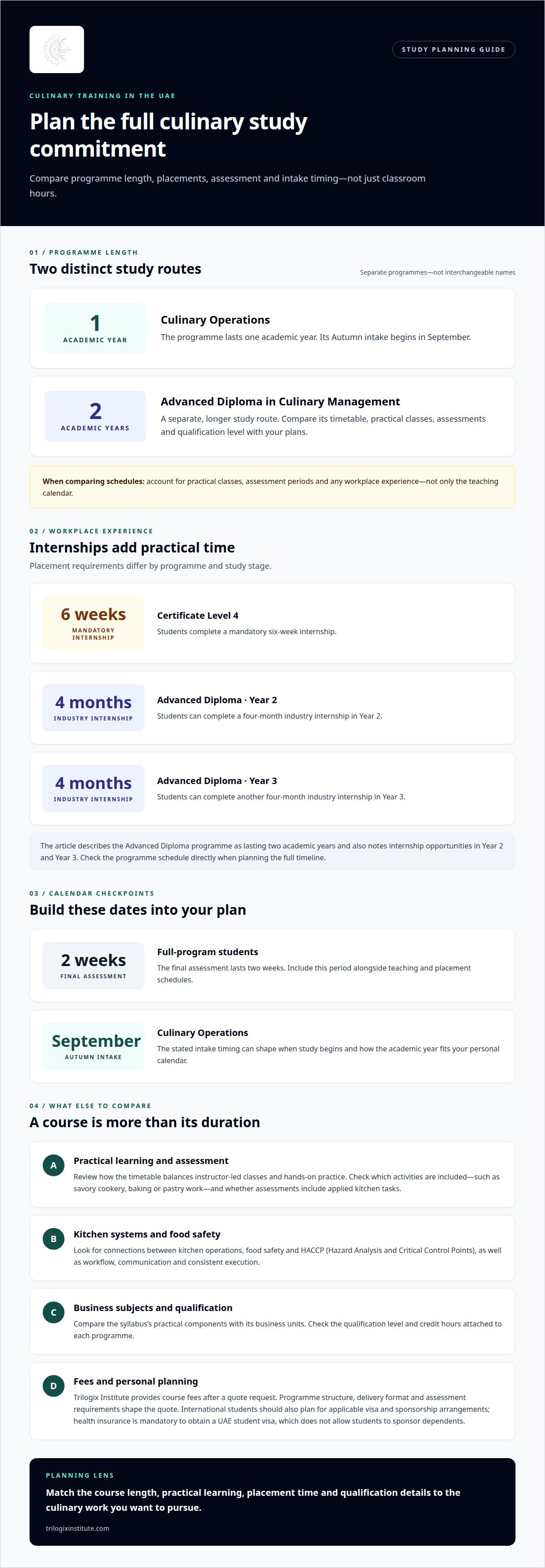
Course length depends on the qualification and its practical requirements. The Culinary Operations programme lasts one academic year, while the Advanced Diploma in Culinary Management lasts two academic years. These are separate study routes, not interchangeable names for the same course. Before choosing, compare the timetable, practical classes, assessments and qualification level with your plans. A professional culinary diploma in the UAE may involve scheduled instruction and applied kitchen learning, so consider the full study commitment, not just classroom hours.
Some programmes also include workplace experience. Certificate Level 4 students complete a mandatory six-week internship. Advanced Diploma students can complete a four-month industry internship in Year 2 and another four-month internship in Year 3. These placements extend the practical timeline and provide experience beyond scheduled classes. When comparing course dates, account for internships and assessment periods, not only the teaching calendar.
Final assessment is another part of the schedule. Full-program students complete a final assessment lasting 2 weeks. Include that period alongside the teaching schedule when planning work, travel or other commitments. The Culinary Operations programme has an Autumn intake in September. Intake timing can therefore shape when a learner begins and how the academic year fits their personal calendar.
Delivery matters because culinary arts training involves practical preparation, baking, pastry work and kitchen techniques. Review how the timetable balances instructor-led classes and hands-on practice, and whether the course combines culinary training with business subjects. Unit titles and subject mix vary by programme. Compare the practical components with the business units listed in the syllabus instead of assuming every diploma teaches the same skills. A clear schedule shows when instruction, practice and assessment take place.
Tuition varies with programme structure, delivery format and assessment requirements. Trilogix Institute provides course fees after a quote request, with these factors shaping the quote. Don’t treat another programme’s tuition as a standard UAE rate: course duration and components differ. Review how the quoted fee relates to the full study period and any required assessment or placement.
International students can study in the UAE subject to applicable visa and sponsorship arrangements. Health insurance is mandatory to obtain a UAE student visa, and a UAE student visa does not allow the student to sponsor dependents. Include visa planning and insurance in your overall timeline, alongside the course intake and scheduled classes.
Elevated gastronomy and kitchen management
Advanced culinary training brings refined food preparation together with the systems that keep a professional kitchen organized. Compare how a programme covers food safety, practical instruction and coordination in hospitality service. Look for clear connections between course content and the tasks students may encounter in a working kitchen.
Kitchen Operations and Food Safety
Look for course content that connects kitchen operations with food safety and HACCP, short for Hazard Analysis and Critical Control Points. A useful syllabus explains how these topics apply to daily work rather than listing them as disconnected terms. For example, students should be able to identify where safe handling fits into preparation, cooking and service. Check whether kitchen management also covers workflow, communication and consistent execution.
HACCP gives students a framework for considering food safety risks and controls. The syllabus should explain how this framework is taught and assessed, without suggesting that a course replaces workplace procedures. Kitchen management can also connect planning and coordination with hospitality tasks, such as preparing dishes in sequence and keeping service organized. This helps learners understand how safety and workflow shape reliable kitchen operations.
Hands-On Teaching Kitchens
Practical teaching kitchens help students develop technique through supervised preparation, cooking and presentation. Check which activities the course includes, such as savory cookery, baking or pastry work, and how practical sessions connect with classroom instruction. Consider what learners practise, how instructors give feedback and whether assessments include applied kitchen tasks.
Consider whether the learning environment supports the course’s stated practical outcomes. For example, students studying hot-kitchen techniques need opportunities to practise cooking and presentation, while pastry instruction calls for relevant practical activities. A course description should explain how hands-on sessions fit into its curriculum. The facility itself matters less than the connection between available learning activities, instruction and the skills being assessed.
Elevated gastronomy involves more than producing an attractive plate. Assess a programme by looking at how it connects ingredient preparation, cooking methods, presentation and kitchen coordination. A practical exercise might ask learners to plan several components, prepare them in sequence and present a finished dish. Specific tasks depend on the curriculum, so look for examples of practical learning rather than assuming every course develops the same techniques.
Teaching quality also depends on how practice is structured. Review whether classes move from demonstrated techniques to supervised application, and whether feedback addresses consistency, timing and presentation. These details help show how students develop skills for hospitality settings. Compare them with course units and assessment methods: a general claim about hands-on learning doesn’t explain what learners will practise.
Use a culinary course outline to connect practical instruction with the programme’s stated learning focus.
Diploma qualification and awarding bodies
Compare culinary qualifications by level, credit hours, award title and assessment requirements. The Culinary Operations programme is Level 3 on the NQF and carries 68 credit hours. The Advanced Diploma in Culinary Management is Level 5 on the NQF and carries 132 credit hours. These details distinguish different study pathways and help learners judge which qualification aligns with their goals.
The Certificate Level 4 programme is a separate route. According to the Ministry of Education, this certificate programme is accredited until 28 September 2027. Accreditation and qualification level describe different aspects of a course: one concerns recognition, while the other identifies its position within a framework. Read the exact award title and status together instead of treating “certificate,” “diploma” and “advanced diploma” as equivalent terms.
How do culinary diploma programmes across the UAE compare? Compare each programme’s qualification level, credits, practical components and awarding body. Location alone doesn’t establish equivalence. The NQF levels and credit hours stated here apply to the named programmes, not every culinary qualification available nationally.
What professional culinary diploma programmes are available in the UAE? Options include Culinary Operations, the Certificate Level 4 programme and the Advanced Diploma in Culinary Management. Their award levels and structures differ, so the right pathway depends on the skills and progression you seek. For example, a learner focused on management may consider the Level 5 route, while another may prefer a certificate-level qualification.
Assess City & Guilds culinary qualifications by their exact award name and awarding body. Don’t assume that a course awards a City & Guilds qualification simply because it teaches culinary skills or uses the word “diploma.” Award documentation should identify the qualification and issuer. This distinction matters when comparing credentials, planning further study or describing your experience to employers.
Completion requirements matter, too. Credit hours show the volume assigned to a programme, but not every assessment or practical task. Compare the course structure with the qualification title, then consider whether its units develop the skills you need. Practical and management content can support different career directions, but the formal award remains the clearest guide to what completion represents.
For a sound comparison, organize the details in a short checklist:
- Award: identify the exact qualification and awarding body.
- Level: distinguish Level 3, Level 4 and Level 5 routes.
- Credits: note whether the programme carries 68 or 132 credit hours.
- Recognition: identify the stated accreditation and its end date.
This approach separates measurable qualification details from assumptions about advanced skills or industry experience. It also helps you compare programmes across the UAE without treating different award titles as interchangeable.
Career support and graduate placement
Career support and job placement are different. Support can help graduates present their skills and prepare for recruitment; placement means an employer opportunity is arranged. A culinary qualification demonstrates completed study, but doesn’t guarantee a graduate will secure a role. Keep this distinction in mind when assessing a programme’s commitments and how it connects training with career preparation.
Start by identifying the support available during and after study. Useful areas to review include CV preparation, interview practice, career guidance and employer introductions. Each serves a different purpose. CV feedback, for example, can help a graduate explain practical kitchen experience, while an employer introduction may create an opportunity to discuss an opening. Neither is a guaranteed job offer.
Industry experience can strengthen an application when it gives graduates examples of their responsibilities. A student might describe preparing ingredients, following kitchen routines or contributing to service as evidence of applied skills. The value lies in explaining what the experience involved and how it relates to a role, not simply listing a placement on a CV. Employers can then connect the qualification with demonstrated practice.
International students should consider how their career plans fit their circumstances in the UAE. Study permission and employment arrangements are separate, so enrolling in a culinary course should not be treated as permission to work. You can start career planning during study: identify roles of interest, connect course learning to those roles, and prepare examples that demonstrate relevant techniques, teamwork and reliability.
Before choosing a programme, look for clear descriptions of career guidance and graduate placement. Find out what the support covers, when it is available, and whether it involves preparation, employer introductions or a formal placement arrangement. A concise comparison can help:
- Career guidance: clarify whether advice supports job goals and application planning.
- Application preparation: identify whether CV or interview practice is part of the support.
- Employer contact: distinguish introductions from an arranged job placement.
- Graduate outcomes: separate documented outcomes from general promotional language.
Confidence grows through preparation and specific evidence. A graduate who can explain how they handled ingredients, followed instructions and contributed to a kitchen team gives an employer concrete examples to assess. Match those examples to the role and describe the qualification accurately. This makes career support more useful while keeping expectations about placement grounded in what the programme provides.
Culinary diploma learning outcomes
A culinary diploma should turn learning into skills graduates can demonstrate in a kitchen. Assess its value by connecting each stated outcome with a course unit, practical task or assessment example. “Understand cooking” is broad; “prepare and present a dish using a specified technique” is more observable. Clear outcomes show learners what the course aims to develop and how progress is assessed.
Look for outcomes covering food preparation, cooking methods and presentation. For example, a learner may be expected to prepare ingredients, follow a recipe sequence and present a finished plate. These tasks bring technique and organization together. Baking and pastry outcomes may involve different processes, so the course outline should identify its practical learning areas rather than treating all culinary work as the same.
Operations are another important part of culinary learning. Restaurant kitchens depend on coordinated preparation, communication and consistent execution. A programme can help students understand how individual tasks connect to a service workflow, such as preparing components before assembling a dish. Look for outcomes that describe both the practical task and its operational context.
Assessment evidence gives outcomes meaning. Practical demonstrations, written work and applied assignments can assess different capabilities. A cooking task, for instance, can show technique, while a planning assignment can test how a learner organizes ingredients and steps. Assessment approaches vary by programme. Read the course outline to see how each outcome connects with the evidence used to evaluate it.
Use this simple review to judge whether outcomes are specific and relevant:
- Action: identify what graduates should be able to prepare, perform or explain.
- Context: note whether the task relates to cooking, baking, pastry or kitchen operations.
- Evidence: identify the practical task or assessment that demonstrates the skill.
- Application: connect the outcome with a role or responsibility you are pursuing.
This approach also helps distinguish a qualification from a promise of employment. Learning outcomes describe intended capabilities, not guaranteed restaurant roles or career progression. Graduates still need to demonstrate their skills at work and explain how their education relates to a position. A well-defined outcome gives them a concrete example to discuss, such as organizing preparation or completing a practical cooking task.
The useful question isn’t simply whether a programme teaches culinary arts. It’s whether its stated outcomes align with the work you want to do and whether assessments give you opportunities to demonstrate them. Compare the course description with your goals, then discuss your culinary training goals.
Trilogix Institute: TTI Dubai Professional Culinary Arts
Trilogix Institute offers TTI Dubai Professional Culinary Arts for learners seeking vocational culinary training. It’s a practical next step if you’re comparing course content, study expectations and how culinary education aligns with your goals. Consider the programme alongside the learning outcomes and qualification details discussed above, then decide whether its focus suits your intended direction.
Before choosing, clarify what you want from your training, such as developing practical culinary skills or building a foundation for further professional growth. A focused conversation can help you understand how the offering relates to those aims. Contact Trilogix Institute to discuss your culinary training goals.
Turn your culinary goals into a clear next step
Choosing a professional culinary diploma in the UAE means considering the work you want to prepare for. Before moving forward, identify the skills you want to strengthen and the responsibilities you hope to take on. A clear direction helps you assess whether a programme’s learning focus matches your ambitions.
Consider the working environment that interests you, the techniques you want to develop and how you’ll demonstrate your abilities. These priorities help focus course discussions and give you purpose as you approach training. Your professional path may evolve, but thoughtful preparation provides a stronger basis for choosing what to learn next.
Trilogix Institute offers vocational training through TTI Dubai Professional Culinary Arts, alongside programmes in electrical engineering and AutoCAD. If you’re ready to discuss how culinary training could fit your goals, contact Trilogix Institute to learn more.
Set your direction, build your skills and take the next step with confidence.
Frequently Asked Questions
What You’ll Learn In This Program?
You’ll develop practical culinary skills and learn how individual tasks support professional kitchen work. Depending on the course, learning may cover cooking techniques, ingredient preparation, baking, pastry, presentation or kitchen operations. Compare the programme’s stated outcomes with the duties you hope to perform. If you’re interested in pastry work, for example, look for relevant practical learning rather than assuming every culinary course gives equal attention to each specialty.
Do I need to have prior education?
Entry requirements depend on the culinary course and qualification. Distinguish formal education requirements from previous kitchen experience, as they are not necessarily the same. Before applying, identify the required documents, academic background and any stated experience expectations. Don’t assume every programme requires prior culinary study or that practical experience replaces formal entry criteria; each course sets its own requirements.
How can a professional culinary diploma program help me become a chef in Dubai?
A culinary programme can help you build skills and explain your training to potential employers, but a qualification alone doesn’t secure a chef role. Practical learning can give you examples to discuss, such as preparing ingredients, following a recipe sequence or coordinating tasks. Use those examples to show what you can do and relate them to the responsibilities of the roles you pursue. Career progression also depends on workplace performance and experience.
Which UAE culinary schools offer accredited professional diplomas?
Trilogix Institute offers TTI Dubai Professional Culinary Arts, while accreditation applies to specific qualifications rather than every course title. The Certificate programme described in UAE qualification information is accredited by the Ministry of Education until 28 September 2027. That status shouldn’t be treated as blanket accreditation for every diploma or provider. Compare the exact award name, awarding body and accreditation details relevant to the qualification you’re considering.
What are the admission requirements for culinary diploma courses in the UAE?
Admission requirements vary by course and institution. Common criteria to review include required education documents, language expectations, application materials and relevant experience. These are details to clarify in the specific course’s admissions information, not universal UAE rules. Organize your records before applying, then match each requirement to the requested documents. This helps distinguish formal entry conditions from preferences that may strengthen an application.
How long do professional culinary diploma programs in the UAE take?
Duration varies by qualification: Culinary Operations lasts one academic year, while the Advanced Diploma in Culinary Management lasts two academic years. Full-program students complete a final assessment lasting 2 weeks. Treat these as distinct programme structures, and include assessment dates when planning work or travel. An internship can extend the time commitment beyond taught classes, so consider the full schedule rather than only the main study period.
What is the tuition fee for culinary diplomas in the UAE, including extra costs?
Tuition depends on the programme, and Trilogix Institute provides course fees after a quote request. The overall cost may depend on course structure, duration, delivery format and included assessment or placement requirements. Consider those factors together rather than using the fee for another qualification as a guide. For personal budgeting, distinguish tuition from other study-related expenses and clarify what the course fee covers before making a financial plan.
Do UAE culinary diplomas include internships or practical kitchen training?
Some programmes include both practical training and internships, but their structure differs. Certificate Level 4 students complete a mandatory six-week internship. Advanced Diploma students can complete a four-month industry internship in Year 2 and another four-month internship in Year 3. Practical kitchen instruction is a separate part of learning, so compare the syllabus and placement structure to understand where supervised practice ends and workplace experience begins.


